Can a society truly call itself a democracy when a fraction of one percent holds more wealth than the bottom ninety percent combined, and when the policy preferences of the average citizen have virtually no impact on what the government actually does?
1. Overview
Requiem for the American Dream is not a book that will leave you feeling warm and fuzzy about the future. It’s a cold, systematic takedown of how the United States, the richest, most powerful country in human history, has engineered a system where wealth and power concentrate upward while the majority of the population is left behind.
Based on four years of interviews with Noam Chomsky, the book distills his decades of political analysis into ten clear principles that explain exactly how this happened.
This isn’t a dense academic treatise. It’s an accessible, conversationally structured work that lays out the mechanics of what Chomsky calls the “vicious cycle”: concentration of wealth yields concentration of power, which in turn yields legislation that further concentrates wealth.
Requiem for the American Dream draws on historical documents, from the secret debates of the Constitutional Convention to the Powell Memorandum, from Adam Smith to the Trilateral Commission, to show that this isn’t a bug in the system; it’s a feature that was built in from the very beginning.
What you’ll get from Requiem for the American Dream:
- A clear understanding of the ten principles that drive wealth and power concentration
- Historical context showing this has been a deliberate project for centuries
- Concrete examples of how policy has been manipulated against public will
- An unflinching look at why the American Dream is no longer achievable for most people
What you won’t get:
- A step-by-step guide to fixing everything (Chomsky is clear that change comes from organizing, not from reading a book)
- Sugarcoating or false hope
Reader Recommendation: Who Should Read Requiem for the American Dream
Read Requiem for the American Dream if:
- You’ve ever felt like your vote doesn’t matter and wondered why
- You want to understand how inequality actually happens, not just that it exists
- You’re looking for a clear, evidence-based explanation of corporate power in America
- You appreciate historical analysis that connects the Founding Fathers to modern politics
Skip Requiem for the American Dream if:
- You’re looking for detailed policy prescriptions or a blueprint for revolution
- You prefer books that offer easy solutions to complex problems
- You’re not ready to have your assumptions about American democracy challenged
Table of Contents
2. Introduction
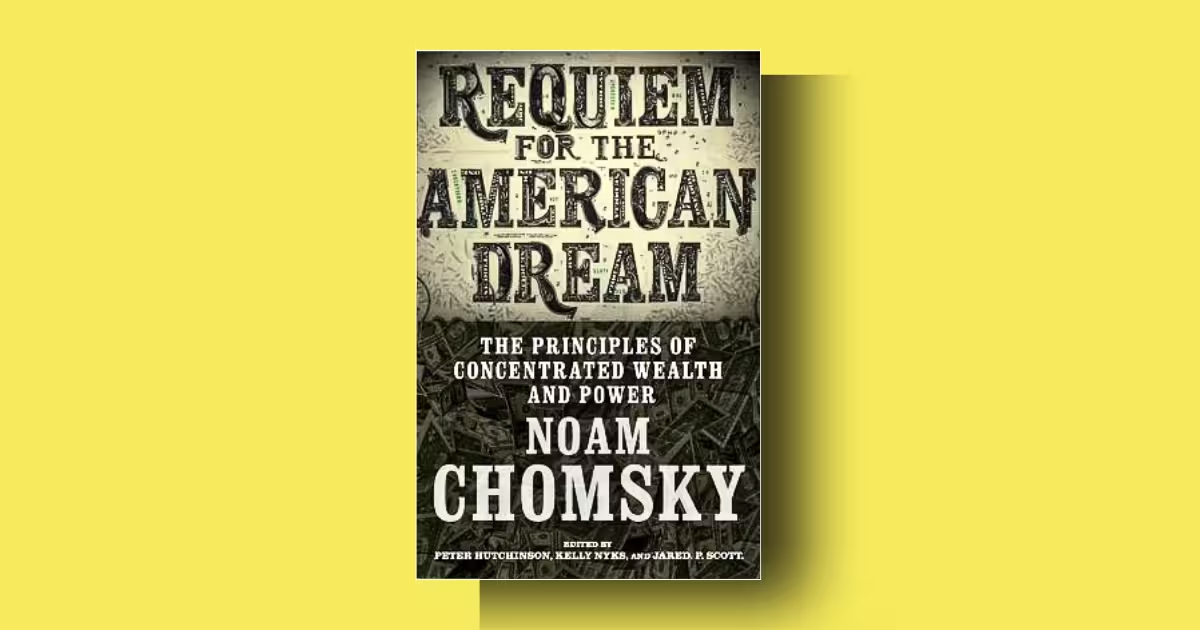
Title: Requiem for the American Dream: The 10 Principles of Concentration of Wealth & Power
Author: Noam Chomsky
Publication Details: First published on March 28, 2017, by Seven Stories Press. The book runs approximately 192 pages and is based on four years of interviews. It became a New York Times bestseller.
Context of Requiem for the American Dream
Requiem for the American Dream is Chomsky’s first major book devoted entirely to the subject of income inequality. Unlike many of his other works, which are essay collections or compilations of lectures, this book is a unified, structured presentation of his thinking on how wealth and power concentrate in America.
About the Author: Noam Chomsky is an Institute Professor Emeritus in the Department of Linguistics and Philosophy at MIT. Born in Philadelphia on December 7, 1928, he received his PhD from the University of Pennsylvania in 1955. His work in linguistics revolutionized the field, he’s sometimes called “the father of modern linguistics”, and he is one of the most cited living authors in the world.
But for decades, Chomsky has also been one of America’s most prominent social critics and political activists. His political writings have made important contributions for decades, and his book 9-11 became an international bestseller.
Purpose of Requiem for the American Dream
The central thesis of Requiem for the American Dream is that the American Dream, the idea that anyone can work hard and achieve prosperity, is no longer a reality for most Americans.
More importantly, Chomsky argues that this isn’t an accident. It’s the result of a deliberate, decades-long project by the wealthy and powerful to redesign society in their favor.
The book’s purpose is to “skewer the fundamental tenets of neoliberalism” and reveal the ten principles that drive this concentration of wealth and power.
3. Background
To understand why Chomsky wrote this book, you need to understand the context of the last forty years of American economic history.
The Golden Age: In the 1950s and 1960s, the United States experienced its greatest period of economic growth. This was “pretty egalitarian growth”; the lowest fifth of the population was improving about as much as the upper fifth.
As Chomsky notes, “it was possible for a black worker to get a decent job in an auto plant, buy a home, get a car, have his children go to school, and so on”. This was a period when Henry Ford’s principle still made sense: raise wages so your workers can buy your products.
The Shift: Beginning in the 1970s, everything changed. Chomsky describes a “concentrated, coordinated business offensive” that began in that decade to beat back the egalitarian efforts that had been building through the New Deal and the civil rights movements.
The Powell Memorandum of 1971, written by future Supreme Court Justice Lewis F. Powell, called on American business to use its economic power to fight back against what it saw as attacks on the free enterprise system. The Trilateral Commission’s 1975 report, The Crisis of Democracy, warned of an “excess of democracy” and called for more “moderation in democracy”.
The Result: Over thirty years of policy changes, tax cuts for the rich, deregulation, financialization, offshoring, have produced unprecedented inequality.
As Chomsky puts it, “Inequality is really unprecedented. If you look at total inequality today, it’s like the worst periods of American history. But if you refine it more closely, the inequality comes from the extreme wealth in a tiny sector of the population, a fraction of 1 percent”.
4. Requiem for the American Dream Summary: The Ten Principles
The book is organized around ten principles that Chomsky identifies as the mechanisms by which wealth and power concentrate in America. Here’s what each one means.
Principle #1: Reduce Democracy
Chomsky goes back to the founding of the country to show that the American political system was designed, from the start, to limit democracy. James Madison, the main framer of the Constitution, argued that the system should be designed so that power rests in the hands of the wealthy, “the more responsible set of men”.
In the debates of the Constitutional Convention, Madison said the major concern of society had to be to “protect the minority of the opulent against the majority”.
As Chomsky explains, Madison observed that if everyone in England had a vote, “the majority of the poor would get together and they would organize to take away the property of the rich”. Therefore, the constitutional system had to be set up to prevent this “tyranny of the majority.”
The Senate, which was not elected by the people but picked by legislatures, was designed to be the body that would protect property.
Chomsky contrasts this with Aristotle, who observed the same problem in ancient Athens but proposed the opposite solution: reduce inequality rather than reduce democracy. “One is: reduce inequality, and you won’t have this problem. The other is: reduce democracy”. America chose the latter.
Key Quote: “Landholders ought to have a share in the government, to support these invaluable interests, and to balance and check the other. They ought to be so constituted as to protect the minority of the opulent against the majority”, James Madison, as recorded in the Secret Proceedings and Debates of the Convention.
Principle #2: Shape Ideology
In the 1970s, business launched a major offensive to shape public ideology. The Powell Memorandum, sent to the U.S. Chamber of Commerce, warned that business was losing “control” over society and that something had to be done. Powell argued that the most persecuted class in America was the capitalist class, and that business needed to use its economic power to fight back.
The Trilateral Commission, representing liberal internationalists from Europe, Japan, and North America, was equally concerned. They warned of an “excess of democracy” and worried that previously passive parts of the population- women, young people, working people- were beginning to organize.
They called for better “indoctrination of the young” and more “moderation in democracy”.
Chomsky points to concrete examples of how this ideology-shaping works:
- College tuitions have skyrocketed since the 1970s, trapping students in debt.
- K-12 education has been reduced to “teaching to the test,” which Chomsky calls “methods of indoctrination and control”.
- Charter schools are “a very thinly disguised effort to destroy the public school system”.
Key Quote: “In 1991, at the bottom of the recession, a survey of workers at large firms by International Survey Research Corporation indicated that 25 percent feared being laid off. In 1996…the same survey organization found that 46 percent were fearful of a job layoff”, Alan Greenspan, testifying to Congress about the benefits of worker insecurity.
Principle #3: Redesign the Economy
The economy was redesigned in two crucial ways: financialization and offshoring.
Financialization: Financial institutions, banks, investment firms, insurance companies went from being a small part of the economy to, by 2007, accounting for 40% of corporate profits. The Bretton Woods system, which regulated currencies and capital, was dismantled in the 1970s. This led to an explosion of speculative capital and risky financial instruments.
Offshoring: Production was shifted to places with cheaper labor, no health and safety standards, and no environmental protections: Northern Mexico, China, and Vietnam. As Chomsky notes, “The major American corporations are getting most of their profit from abroad”.
The Attitude Change: Corporate leadership changed too. In the 1950s and 1960s, the head of a major corporation was likely to be an engineer who cared about the long-term future of the firm.
Today, managers come out of business schools and focus on short-term profits. As the Wall Street Journal reported, the average holding period of a stock on the New York Stock Exchange went from 26 months in 1990 to less than nine months.
Key Quote: “Investors’, corporate boards’ and managers’ focus on short-term gain has become so detrimental to the economy that unless they voluntarily change their behavior, regulators should step in”, Aspen Institute statement signed by Warren Buffett, John Bogle, and Louis Gerstner.
Principle #4: Shift the Burden
The burden of sustaining society has been shifted from the wealthy onto everyone else.
Taxes: Taxes on the wealthy have been dramatically reduced. Corporate taxes are much lower. Taxes on dividends are much lower. As Chomsky notes, “The tax system has been redesigned so that the taxes that are paid by the very wealthy are reduced and, correspondingly, the tax burden on the rest of the population’s increased”.
The Plutonomy: Citigroup, one of the biggest banks, published a study identifying a new category in the world, the “plutonomy”, those who have substantial wealth.
Citigroup advised investors to focus on this small group because they’re the main drivers of the economy. “The rest you can forget about”.
The Precariat: In contrast, the rest of the population is part of the “precariat”, the precarious proletariat living insecure, precarious lives.
Key Quote: “The world is dividing into two blocs, the plutonomies, where economic growth is powered by and largely consumed by the wealthy few, and the rest”, Citigroup’s Plutonomy report.
Principle #5: Attack Solidarity
The book argues that society is being systematically stripped of the principle of solidarity, the idea that we care about and support each other.
Social Security: Chomsky notes that Social Security is “based on a principle of solidarity. Solidarity: caring for others. Social Security means, ‘I pay payroll taxes so that the widow across town can get something to live on'”. The very rich have no use for this, so there’s a concerted attempt to destroy it.
Public Education: Public schools are also based on solidarity. “I no longer have children in school. They’re grown up, but the principle of solidarity says, ‘I happily pay taxes so that the kid across the street can go to school'”. This is being attacked through defunding, charter schools, and rising tuition costs.
Health Care: The U.S. has the only health care system in the advanced world that is based overwhelmingly on virtually unregulated private health care. This is extremely inefficient and very costly.
As Chomsky notes, “If we had a health care system like other countries, we would have no deficit, we’d probably have a surplus”.
Key Quote: “How selfish soever man may be supposed, there are evidently some principles in his nature, which interest him in the fortune of others, and render their happiness necessary to him”, Adam Smith, The Theory of Moral Sentiments, 1759.
Principle #6: Run the Regulators
Regulatory agencies are supposed to protect the public from corporate malfeasance. Instead, they’ve been captured by the industries they’re supposed to regulate.
Regulatory Capture: Chomsky explains that “the business being regulated is in fact running the regulators”. The banks and bank lobbyists are actually writing the laws of financial regulation.
Glass-Steagall: The Glass-Steagall Act, passed during the Depression, separated commercial banks from investment banks. In 1999, this was repealed with the cooperation of both Democrats and Republicans. As Chomsky notes, this meant that “the risky operations of investment banks ended up being guaranteed by the government”.
The Revolving Door: Legislators and regulators move in and out of the industries they’re supposed to oversee. Robert Rubin, who helped deregulate the financial industry, went on to become a director of Citigroup, helped them take over a big insurance company, made a lot of money, and then came back as Obama’s chief adviser while the government bailed out Citigroup.
Too Big to Jail: Not only are the banks “too big to fail,” they are also “too big to jail”. Criminal investigations are only undertaken where the criminal is harming other businesses, “but where they’re just robbing people, that’s done with impunity”.
Key Quote: “We assess that at least twenty companies in the 1993 Fortune 100 would not have survived at all as independent companies, if they had not been saved by their respective governments”, Winfried Ruigrok and Rob van Tulder, The Logic of International Restructuring.
Principle #7: Engineer Elections
The democratic system has been shredded by the ability to buy elections.
Corporate Personhood: The Fourteenth Amendment, intended to protect freed slaves, was almost immediately used to protect corporations.
Chomsky calls this a “perversion of the elementary morality”. “Undocumented aliens who are living here and building your buildings, cleaning your lawns, and so on, they’re not persons, but General Electric is a person, an immortal, super powerful person”.
Citizens United: The 2010 Supreme Court decision ruled that the right of free speech of corporations, mainly to spend as much money as they want, can’t be curtailed. Chomsky calls this “a tremendous attack on the residue of democracy”.
The Investment Theory of Politics: Political scientist Thomas Ferguson argues that business and investors, not voters, have tremendous influence in the political system. “If you’re funding a candidate, it buys access”. Corporate lawyers go to the staff of the legislator and “basically write the laws”.
Key Quote: “Big Money’s most significant impact on politics is certainly not to deliver elections to the highest bidders. Instead it is to cement parties, candidates, and campaigns into the narrow range of issues that are acceptable to big donors”, Thomas Ferguson, Paul Jorgensen, and Jie Chen.
Principle #8: Keep the Rabble in Line
Organized labor is the one force that has traditionally stood in the way of corporate tyranny, which is why unions have been attacked so relentlessly.
Anti-Union Sentiment: The U.S. has never ratified the core principle of the International Labor Organization, the right of free association, hence the right to form unions. Less than 7% of private sector workers have unions, “not because workers don’t want unions, polls show that, overwhelmingly, they want to unionize, but they can’t”.
Violent Labor History: The U.S. has a long and violent labor history. Chomsky cites the 1937 beating of union organizers by Ford Motor Company employees. “It was the worst licking I’ve ever taken,” one organizer said.
The Business Offensive: In 1978, the head of the United Auto Workers, Doug Fraser, lamented that “business is waging a one-sided class war against the working class”. This offensive increased during the Reagan years and continued through George W. Bush.
Key Quote: “I have concluded that participation in these meetings is no longer useful to me or to the 1.5 million workers I represent as president of the UAW. I believe leaders of the business community, with few exceptions, have chosen to wage a one-sided class war today in this country”, Douglas Fraser’s resignation letter from the Labor-Management Group, 1978.
Principle #9: Manufacture Consent
The public relations industry exists to control what people think and believe.
The PR Industry: The PR industry developed in Britain and the United States because it became clear that it was no longer easy to control the population by force. Edward Bernays, the guru of the PR industry, wrote a book called Propaganda in which he explained the purpose: the country has to be governed by the “intelligent minority”.
The method is “engineering of consent”.
Fabricating Consumers: The goal is to trap people into consumerism. As Chomsky notes, “The ideal is what you actually see today where, let’s say, teenage girls if they have a free Saturday afternoon will go walking in the shopping mall, not to the library or somewhere else”.
Selling Candidates: The same PR techniques are used to run elections. After the 2008 election, Obama won an award from the advertising industry for the best marketing campaign.
Executives were euphoric: “We’ve been selling candidates, marketing candidates like toothpaste ever since Reagan, and this is the greatest achievement we have”.
Key Quote: “The conscious and intelligent manipulation of the organized habits and opinions of the masses is an important element in democratic society. Those who manipulate this unseen mechanism of society constitute an invisible government which is the true ruling power of our country”, Edward Bernays, Propaganda, 1928.
Principle #10: Marginalize the Population
The majority of the population has virtually no influence on policy.
The Evidence: Political scientists Martin Gilens and Benjamin Page studied about 1,700 policy decisions and compared them with public attitudes and business interests. They found that “policy is uncorrelated with public attitudes, and closely correlated with corporate interests”.
About 70% of the population has no influence on policy.
The Status Quo Bias: When popular majorities favor the status quo, they’re likely to get their way. But “when a majority, even a very large majority, of the public favors change, it is not likely to get what it wants”.
Even when 80% of the public favors a policy change, they get it only about 43% of the time.
Unfocused Anger: Because people know they have no influence, there’s tremendous antagonism toward all institutions. This takes the form of “unfocused anger, hatred, attacks on one another and on vulnerable targets”. Chomsky points to Donald Trump as an example of someone who exploits this anger.
Key Quote: “The deadlocks and the impotence of Congress are definitely the mirror of the demonstrated incapacity of the captains of industry and finance to conduct the affairs of the country prosperously as an incident to the process of feathering their own nests”, John Dewey, 1931-1932.
5. Requiem for the American Dream Analysis
Reading Requiem for the American Dream is like having a cold glass of water thrown in your face. It’s uncomfortable, but you need it.
What makes this book effective is its structure.
By organizing the argument around ten principles, Chomsky gives the reader a clear framework for understanding what can otherwise feel like an overwhelming and chaotic system.
Each principle builds on the last, showing how the pieces fit together: reduce democracy, shape ideology, redesign the economy, shift the burden, attack solidarity, run the regulators, engineer elections, keep the rabble in line, manufacture consent, marginalize the population.
The book draws on an impressive range of sources, from Aristotle to Adam Smith, from the secret debates of the Constitutional Convention to the Powell Memorandum, from the Trilateral Commission to Citigroup’s Plutonomy report. Chomsky is showing us that this isn’t a conspiracy theory; it’s a documented historical project.
What I found most compelling: The historical continuity.
The realization that the same debates Madison had at the Constitutional Convention, about how to protect the wealthy from the poor, are still playing out today. The recognition that Aristotle and Madison identified the same problem but chose opposite solutions.
The knowledge that the principles Chomsky outlines aren’t new; they’ve been refined and perfected over centuries.
What I found most disturbing: The evidence that the majority of Americans have virtually no influence on policy. That when 80% of the public wants something, they get it less than half the time. The realization that democracy, in any meaningful sense, has been hollowed out.
6. Strengths and Weaknesses
Strengths
Accessibility: This is one of Chomsky’s most accessible books. It’s not an academic treatise; it’s a conversation. The structure around ten principles makes complex ideas easy to grasp.
Evidence-Based: Every claim is backed by citations to primary sources, historical documents, Supreme Court decisions, corporate reports, academic studies. This isn’t opinion; it’s documented fact.
Historical Depth: By tracing these principles back to Aristotle and the Founding Fathers, Chomsky shows that this isn’t a recent aberration. It’s a feature of the system, not a bug.
Clarity of Argument: The book does what it sets out to do: explain the mechanisms of wealth and power concentration clearly and concisely.
Weaknesses
Lack of Solutions: Many readers have noted that the book offers little in the way of actionable solutions. Chomsky’s response would be that change comes from organizing, not from reading books, but some readers will find this unsatisfying.
Pessimistic Tone: The book can feel overwhelming. It’s a relentless catalog of how the system is rigged. There’s no escaping the conclusion that the situation is dire.
Limited Scope: At 192 pages, the book covers a lot of ground but doesn’t go deep into any particular area. Readers looking for detailed policy analysis may want to supplement this with other works.
7. Comparison with Similar Works
Requiem for the American Dream sits alongside several other important works on inequality and corporate power:
Thomas Piketty’s Capital in the Twenty-First Century: Piketty’s book is a massive, data-driven analysis of wealth inequality. Chomsky’s book is more accessible and focuses specifically on the mechanisms of power concentration in America.
Robert Reich’s Saving Capitalism: Reich, like Chomsky, argues that the system is rigged. Reich offers more specific policy proposals; Chomsky is more focused on diagnosis than prescription.
Naomi Klein’s The Shock Doctrine: Klein shows how crises are exploited to push through unpopular policies. Chomsky’s book is broader, looking at the day-to-day mechanisms of control rather than just crisis moments.
Jane Mayer’s Dark Money: Mayer documents the network of wealthy conservatives who have funded the right-wing movement. Chomsky’s book is more theoretical, focusing on principles rather than personalities.
What sets Chomsky’s book apart is its historical depth and its focus on the principles of concentration. It’s less about who did what and more about how the system works.
8. Conclusion
Final Recommendation
Requiem for the American Dream is essential reading for anyone who wants to understand why inequality is so extreme in America and how the system was designed to produce this outcome. It’s particularly valuable for:
- Students of politics, economics, or sociology
- Activists looking for a clear framework to understand the forces they’re fighting
- Anyone who feels like the system is rigged and wants to understand how
This isn’t a book that will tell you what to do. But it will tell you what’s been done to you. And as Chomsky notes, that’s a necessary first step.
The Bigger Picture
Chomsky ends Requiem for the American Dream by pointing to something even more urgent than inequality: the survival of the species. “We are heading, eyes open, toward a world in which our grandchildren may not even be able to survive”. The U.S., under the pressure of business interests, is in the lead of accelerating environmental destruction.
But Chomsky also offers a note of hope. “The reason things change is because lots of people are working all the time. They’re working in their communities, in their workplace, or wherever they happen to be, and they’re building up the basis for popular movements, which are going to make changes”.
The freedoms we have were won by “hard, painful, courageous popular struggle”. And they can be won again.
As Howard Zinn, Chomsky’s close friend, put it: “what matters is the countless small deeds of unknown people, who lay the basis for the significant events that enter history”. That’s the message of this book, and perhaps the only real answer it offers.
9. Further Reading
Books:
- Capital in the Twenty-First Century by Thomas Piketty
- Saving Capitalism by Robert Reich
- The Shock Doctrine by Naomi Klein
- Dark Money by Jane Mayer
- Winner-Take-All Politics by Jacob S. Hacker and Paul Pierson
- The Divide by Matt Taibbi
- This Changes Everything by Naomi Klein
Films:
- Requiem for the American Dream (the documentary film that preceded this book)
- Inequality for All (2013) – featuring Robert Reich
- The Corporation (2003)
- Manufacturing Consent (1992) – about Noam Chomsky and the media