
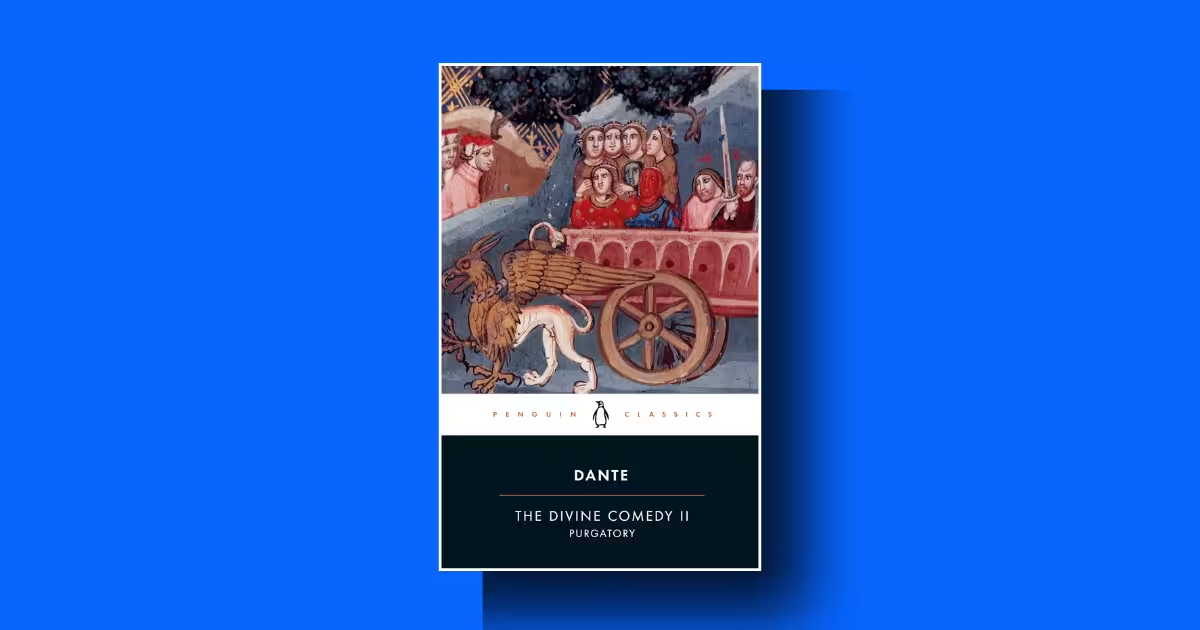

Ever wondered why everyone quotes Inferno but nobody finishes Purgatorio? The forgotten middle child of Dante’s trilogy might actually be the one that changes how you see yourself.
Purgatorio is the most human, psychologically acute, and spiritually hopeful book of Dante’s Divine Comedy. It’s where sinners want to be purified, where punishment becomes therapy, and where the poet finally grows up. If Inferno is about what’s wrong with the world, Purgatorio is about what’s possible for you.
Purgatorio is best for:
- Readers who found Inferno fascinating but morally exhausting
- Anyone interested in psychology, moral growth, or spiritual transformation
- Poetry lovers who want to understand why Dante is considered a literary titan
- Christians (and non-Christians) curious about how medieval theology actually works
- Students of Western literature who want the full picture, not just the horror show
Not for:
- Readers who only want gore and spectacle (stick with Inferno)
- Anyone allergic to allegory, theology, or medieval politics
- People who found Inferno already too dense—Purgatorio is more complex, not less
- Impatient readers—this is a slow burn, literally and figuratively
Table of Contents
1. Introduction
Title: The Divine Comedy of Dante Alighieri, Volume 2: Purgatorio
Author: Dante Alighieri (c. 1265–1321)
Original Publication: c. 1321 (public domain)
Notable Translations Featured: Dorothy L. Sayers (1954), John Ciardi (1957), Mark Musa (1971/84), Allen Mandelbaum (1981), Robert & Jean Hollander (2000)
The Edition: Divine Comedy Omnibus 2: Purgatorio (Septcentenary Edition, 2021)
This isn’t just another reprint. The omnibus presents five complete translations side-by-side—Sayers, Ciardi, Musa, Mandelbaum, and Hollander—along with excerpts from Cary, Longfellow, Langdon, and Wright.
For anyone who’s ever struggled with a single translation and wondered, “Is this really what Dante meant?”, this edition is a revelation.
2. Background
Dante wrote the Comedy in exile. In 1302, he was banished from Florence on trumped-up political charges, never to return. He was in his late thirties, separated from his wife and children, his career destroyed, his reputation in tatters. The Comedy is, among many other things, an act of imaginative revenge—but also an act of imaginative self-reconstruction.
The poem is structured as a journey through three realms: Hell (Inferno), Purgatory (Purgatorio), and Heaven (Paradiso). The date is Easter weekend, 1300—a Jubilee year, when pilgrims flocked to Rome for spiritual renewal. Dante the pilgrim is guided first by Virgil (representing human reason and classical wisdom) and later by Beatrice (representing divine revelation and grace).
What makes Purgatorio unique is its setting. Hell is eternal; Purgatory is temporary. Hell is about punishment without hope; Purgatory is about purification with hope.
The souls here want to suffer—because suffering is what cleanses them. As Dorothy L. Sayers puts it in her introduction, the souls in Purgatory “are forever beyond the reach of sin”. Their suffering is not retributive but therapeutic.
3. Purgatorio Summary
Canto 1–2: Arrival and the Ship of Souls
Dante and Virgil emerge from Hell’s depths onto the shore of an island-mountain at the Antipodes. The atmosphere shifts immediately: “For better waters now the little bark of my poetic powers hoists its sails”. Four stars—representing the Cardinal Virtues—shine in the southern sky.
An old man with a long white beard appears: Cato of Utica, the guardian of the mountain. He’s a pagan—a suicide, no less—yet he guards the entrance to Purgatory. Why? Because he represents natural virtue, the moral goodness achievable by human reason alone. As Sayers explains, this shows that “Grace does not oust or destroy Nature, but redeems and perfects it”.
Virgil explains their mission: Dante is alive, guided by a lady from Heaven (Beatrice), and Cato permits their passage—but only after Virgil washes Dante’s face with dew and girds him with a humble reed. The reed symbolizes humility, “the safeguard against Pride, which is the head and source of all the Capital Sins”.
Then comes the Ship of Souls—angels ferrying the newly dead from the Tiber’s mouth to Purgatory. Among them is Casella, a musician friend of Dante’s. Dante tries to embrace him but his arms close on empty air—a poignant reminder that these are shades, not bodies. Casella sings one of Dante’s own poems, and the souls are entranced—until Cato rebukes them for wasting time.
Canto 3–6: The Late-Repentant and the Shadow
The poets begin climbing. Dante notices something strange: he casts a shadow, but Virgil doesn’t . Why? Because Virgil is dead—he has no body to block light. Virgil explains that shades can still feel pain and heat, but they cast no shadow—a mystery of divine will “which wills not that Its ways be shown to us”.
They encounter the Excommunicate—souls who repented at the last moment but were cut off from the Church. Manfred, the Ghibelline king, is among them. Despite being excommunicated and his body dumped outside the kingdom, he’s saved—because “the Goodness Infinite hath arms so wide, that It receiveth all who turn to It” .
Manfred explains the rule of Ante-Purgatory: those who delayed repentance must wait thirty times as long as they delayed —though prayers from the living can shorten this.
Canto 7–9: The Valley of the Princes and Peter’s Gate
Night falls. The poets rest in a beautiful valley where the Negligent Rulers—kings and princes who neglected their spiritual duties—sing the Salve Regina. Two angels descend to guard against the serpent. Dante recognizes Nino Visconti, a friend, who asks for prayers.
That night, Dante dreams of being snatched by an eagle—a vision of St. Lucy actually carrying him up the mountain. He wakes at the Gate of Purgatory, guarded by an angel with a naked sword.
The gate has three steps:
- White marble—Confession
- Dark, cracked stone—Contrition
- Red porphyry—Satisfaction
The angel traces seven P’s on Dante’s forehead—peccata, sins—and unlocks the gate with two keys: gold (divine authority) and silver (human skill in absolution). The gate groans open like Tarpeia’s rock when Caesar broke in , and Dante hears the Te Deum.
Canto 10–12: The Proud and Humility’s Lesson
The First Cornice: the Proud. The inner wall is carved with scenes of humility—the Annunciation, David dancing before the Ark, Emperor Trajan stopping to hear a widow’s plea. These are the “Whip” of Pride—examples to meditate on.
The proud souls themselves crawl under crushing stones, bent double like corbels. One of them, Omberto Aldobrandesco, acknowledges his pride destroyed his family . Another, the painter Oderisi, speaks of the vanity of earthly fame: “A breath of wind—no more—is earthly fame”. He points to Provenzan Salvani, who, despite a life of arrogance, was saved by one act of self-humiliation—begging in Siena’s marketplace to ransom a friend.
Dante’s first P is erased by the Angel of Humility.
Canto 13–15: The Envious and the Lesson of Generosity
The Second Cornice: the Envious. Their eyelids are sewn shut with iron wire. They wear coarse haircloth and lean on each other like blind beggars.
Sapia of Siena confesses her envy: she rejoiced when her own countrymen were defeated at Colle. She was saved only because a holy hermit prayed for her.
Virgil delivers his First Discourse on Love: love is the root of all virtue and all vice. The “evil love” that harms others takes three forms—Pride, Envy, Wrath.
Canto 16–18: The Wrathful and Free Will
The Third Cornice: the Wrathful, walking through thick, choking smoke. They sing the Agnus Dei.
Marco Lombardo discusses Free Will. The stars influence us but don’t determine us—we have reason and will to choose. The world’s corruption comes from bad leadership, not fate: the Pope and Emperor have confused their roles, “the sword’s blent now with the crook”.
Canto 19–21: The Slothful and Dante’s Dream
Dante dreams of the Siren—a hideous woman who becomes beautiful when he looks at her, then reveals a stinking belly when Virgil rips her open . This is the sin of Sloth: the fantasy of false pleasures that rot the soul.
The Fourth Cornice: the Slothful, running ceaselessly. The Angel of Zeal erases the fourth P.
Statius appears—the poet who spent 500 years on the Cornice of Avarice. He explains that the mountain shakes when a soul is purified. Statius reveals he was secretly Christian, converted by reading Virgil’s Fourth Eclogue—which he interpreted as a prophecy of Christ. He wishes he’d lived when Virgil did —and then learns that Virgil is standing right next to him. He tries to embrace Virgil’s knees, forgetting they are both shades.
Canto 22–24: The Gluttonous and the Sweet New Style
The Fifth Cornice: the Gluttonous, starving amid fruit and water they cannot touch. Forese Donati, Dante’s old friend, is here—so emaciated he’s unrecognizable. He explains that his wife Nella’s prayers sped his purification. He denounces Florentine women for their immodesty.
Bonagiunta of Lucca asks Dante if he wrote “Ladies who have intelligence of Love.” Dante replies: “I am one who when Love breathes within give ear, and as he prompts take mode and pitch from him”. This is the essence of the dolce stil nuovo—the “sweet new style” of poetry that follows Love’s dictation.
Canto 25–27: The Lustful and the Wall of Fire
Statius’s Discourse on the Soul is one of the most remarkable passages in the poem. He explains how the soul is formed: first vegetative (like a plant), then sensitive (like an animal), then—when the brain is fully formed—God breathes in the rational soul, creating “one single soul complete, alive, and sensitive, and self-aware”. At death, this soul survives, forming an aery body from the surrounding air—which is why shades can speak, feel pain, and appear solid.
The Sixth Cornice: the Lustful, walking through flames. They sing the Summae Deus clementiae and cry examples of chastity.
Dante must pass through the fire himself. He’s terrified—until Virgil says: “’Twixt Beatrice and thee there is this wall” . The name breaks his resistance. He steps through.
Canto 28–33: The Earthly Paradise and Beatrice
Dante enters the Earthly Paradise—the Garden of Eden, restored. A lady, Matilda, gathers flowers on the far bank of Lethe. She explains the two rivers: Lethe (forgetfulness of sin) and Eunoë (remembrance of good).
Then comes the Heavenly Pageant:
- Seven golden candlesticks
- Twenty-four elders (the Old Testament)
- Four living creatures (the Evangelists)
- A chariot drawn by a Griffin (Christ, with his two natures, divine and human)
- Three ladies dancing (Faith, Hope, Charity)
- Four ladies (the Cardinal Virtues)
And then—Beatrice. Dante turns to Virgil for comfort—but Virgil is gone.
Beatrice rebukes Dante for his sins. He confesses, weeps, and faints. Matilda plunges him into Lethe. He drinks, and his memory of sin is washed away.
Beatrice prophecies a future deliverer—a “Five-hundred-ten-and-five” who will slay the giant and the harlot (the corrupt papacy and French monarchy) . Then Dante drinks from Eunoë , and the poem ends with these words:
“Pure and prepared to leap up to the stars.”
4. Purgatorio Analysis
4.1 Purgatorio Characters
Dante the Pilgrim undergoes the most profound transformation in literature—and I mean that literally. He starts as a man lost in a dark wood, full of self-pity and moral confusion. By the end of Purgatorio, he’s been reborn. He stops looking for Virgil and starts looking for Beatrice. That’s the whole point. The most moving moment? When he weeps at Virgil’s disappearance—not because he’s lost a guide, but because he’s lost a father.
Virgil is the heart of the poem. He’s not just Reason—he’s a person. He’s kind, patient, occasionally sharp, and heartbreakingly aware of his own limitations. When he says, “I’ve brought thee here by wit and by address; make pleasure now thy guide” , he’s not abdicating—he’s acknowledging that his job is done. He’s led Dante as far as human reason can go. The rest requires grace.
Beatrice is terrifying. She’s not the sweet, remote beloved of the Vita Nuova. She’s a judge. She speaks with “regal aspect and unbending” tone. She calls Dante out—not cruelly, but with the stern love that knows the stakes. She’s the truth that hurts before it heals.
Statius is a wonderful addition—a poet who owes everything to Virgil, yet surpassed him in one crucial way: he had faith. His joy at meeting Virgil, and his embarrassment when he tries to embrace a shade, is both comic and deeply touching.
Sordello embodies the tragedy of Italy. He’s proud, solitary, and instantly transformed by the mere mention of Mantua. Dante uses him to launch one of his fiercest political rants—but the man himself is a portrait of wounded nobility.
4.2 Purgatorio Themes and Symbolism
Purgatory as Therapy. The most radical idea in Purgatorio is that punishment isn’t punishment—it’s treatment. The proud want to be crushed; the envious want to be blind; the gluttonous want to starve. As Sayers explains, “Purgatory is not a system of Divine bookkeeping—so many years for so much sin—but a process of spiritual improvement which is completed precisely when it is complete”.
Love as the Root of Everything. Virgil’s Discourse on Love (Canto 17–18) is the theological engine of the whole poem. Love is neutral—it’s what we do with it that matters. Love can be perverted (Pride, Envy, Wrath), defective (Sloth), or excessive (Avarice, Gluttony, Lust). The seven terraces map exactly onto these distortions. This isn’t arbitrary—it’s a coherent moral psychology.
Free Will vs. Determinism. Marco Lombardo’s discussion (Canto 16) is astonishingly modern. The stars influence us—but they don’t force us. We have reason and we have will. If the world is corrupt, it’s because we choose to be corrupt. This isn’t medieval fatalism; it’s a robust defense of human responsibility.
The Body and the Soul. Statius’s discourse on the “aery body” (Canto 25) is one of the most beautiful passages in the poem. The soul survives death and makes a new body from air—which is why shades can feel pain, speak, and even embrace. It’s a brilliant way to solve the problem of how disembodied souls can suffer physical punishment.
The Earthly Paradise. The final cantos are a triumph of symbolic art. The Griffin (Christ), the chariot (the Church), the harlot (corrupt papacy), the giant (French monarchy)—it’s all here. And at the center of it all, Beatrice: not just a woman, but the Image of the Sacrament itself. She is what she represents.
5. Purgatorio Evaluation
Purgatorio is the most underrated masterpiece in Western literature. There, I said it.
Everyone reads Inferno. It’s got the cool imagery, the memorable punishments, the shock value. But Purgatorio is where Dante grows up. It’s where he stops pointing fingers and starts looking inward. It’s where he learns that the worst sin isn’t murder or betrayal—it’s pride, the refusal to admit you’re wrong.
The structure is astonishing. Each terrace has its own prayer, its own “Whip” (examples of virtue), its own “Bridle” (examples of vice), its own angel, its own beatitude. The whole mountain is a machine for reordering love—and Dante made it up from scratch.
Strengths
- Psychological depth. Dante the pilgrim is more complex and conflicted here than anywhere else.
- Architectural brilliance. The seven terraces are a masterpiece of moral classification.
- Emotional range. From the comedy of the gluttonous starving to the terror of Beatrice’s rebuke to the tenderness of Virgil’s farewell.
- Theological sophistication. Free will, love, grace, the nature of the soul—Dante handles it all with a clarity that rivals Aquinas.
- Poetry. The terza rima is breathtaking. Try reading the dream of the Siren aloud and tell me it doesn’t sing.
Weaknesses
- The allegory can be exhausting. Not everyone wants to decipher what the Griffin means.
- The politics are dated. Dante’s obsessions with the Emperor and the Pope can feel like ancient history.
- It’s slow. The climb is literally a climb. Some cantos are more about theology than action.
- You need a guide. Without notes, you’re lost. This edition’s multiple translations help, but you still need the commentary.
Impact
This book changed how I think about failure. The souls in Purgatory aren’t failures—they’re works in progress. They screwed up, they’re paying the price, but they’re moving. There’s hope. That’s something I needed to hear.
Comparison with Similar Works
Milton’s Paradise Lost: More cosmic, less personal. Dante feels like a person; Milton feels like a prophet.
Bunyan’s Pilgrim’s Progress: More allegorical, less poetic. Bunyan is a preacher; Dante is a poet.
Augustine’s Confessions: More introspective, less structured. Augustine is a memoirist; Dante is a architect.
6. Personal Insight: Why Purgatorio Speaks Today
We live in an age of performative outrage—we’re all experts at pointing fingers at everyone else’s sins. Social media thrives on it. News cycles feed on it.
Purgatorio offers a radical alternative: look at yourself first.
Dante doesn’t spend his time in Purgatory judging others—he spends it being judged. He confesses. He weeps. He accepts that he was wrong.
That’s hard. That’s uncomfortable. That’s also the only way forward.
Five Lessons from Purgatorio for Modern Life
1. Your sins are not your identity. The souls in Purgatory are their sins—but they’re also more than their sins. They’re becoming something else.
2. Suffering can be meaningful. Not all pain is punishment. Some pain is purification.
3. You need help. Dante can’t climb the mountain alone. Neither can you.
4. The past is not permanent. Lethe washes away the memory of sin. You can start over.
5. Love is the measure of everything. Not success, not fame, not money. Love—rightly ordered—is the whole point.
7. Purgatorio Quotess
“O glory of the Latins! thou,” he said, “In whom our tongue showed powers beyond compare!”
“A breath of wind—no more—is earthly fame, And now this way it blows and that way now, And as it changes quarter, changes name.”
“I am one who when Love breathes within give ear, and as he prompts take mode and pitch from him.”
“The temporal fire and the eterne Thou hast beheld, my son, and reached a place Where, of myself, no further I discern.”
“Free, upright, whole, thy will henceforth lays down Guidance that it were error to neglect, Whence o’er thyself I mitre thee and crown.
“Pure and prepared to leap up to the stars.”
8. Conclusion
Purgatorio is not an easy read. It demands patience, attention, and a willingness to engage with theology and medieval politics. But it rewards that effort with something rare: a vision of hope.
Hell is forever. Heaven is forever. But Purgatory is temporary—and that makes all the difference. The suffering has a purpose. The climb has an end. The purification works.
If you’ve only read Inferno, you’ve only read half the story—and the wrong half. Purgatorio is where Dante becomes Dante: the poet who didn’t just describe sin, but showed how to escape it.
Recommendation: Read this book if you’re ready to be challenged—not by monsters or demons, but by the uncomfortable truth that the biggest obstacle to your own growth is you. Read it with a good translation (the Sayers and Ciardi in this edition are excellent). Read it slowly. And when you finish, drink some water—you’ll feel like you’ve climbed the mountain yourself.