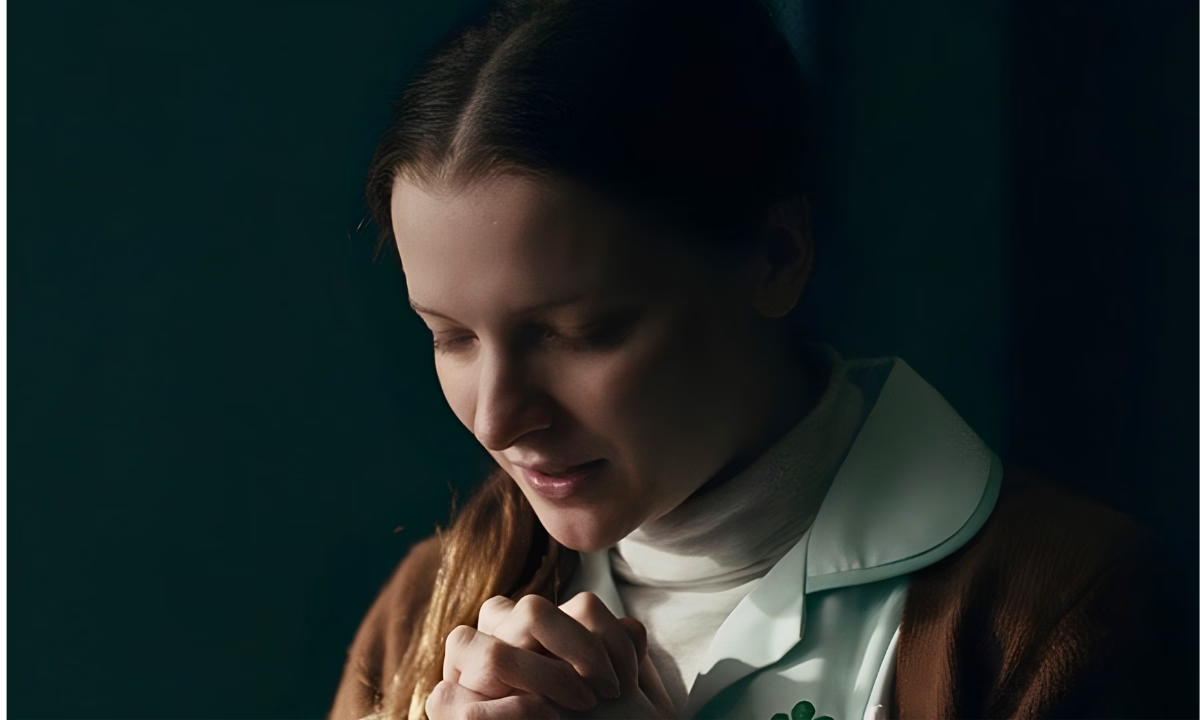
Saint Maud (2019) is worth your 84 minutes if you want horror that crawls under your skin instead of jolting you out of your seat, and it is a poor pick if you need comfort or tidy answers. Rose Glass wrote and directed this British psychological horror as her feature debut, and it follows a newly devout palliative care nurse who decides she must save her dying patient’s soul.
It premiered at the Toronto International Film Festival on 8 September 2019, reached UK cinemas on 9 October 2020, and then led the 2020 British Independent Film Awards with a record 17 nominations.
I watched it, and I came away uneasy, impressed and a little annoyed at how well it works. Below you get a spoiler-free verdict, a full spoiler plot, the ending explained, the performances, the themes, and a blunt list of who should skip it.
Table of Contents
At a glance
Verdict: my rating is 4.5 out of 5. It is tense, tightly made and bleak, with one of the most discussed final shots in recent British horror.
What it is: a psychological horror from Film4, the BFI and Escape Plan Productions, starring Morfydd Clark as Maud and Jennifer Ehle as her patient Amanda.
Length and rating: 84 minutes, rated R in the US and 15 in the UK.
Reception: on Rotten Tomatoes, 92% of 193 critics’ reviews were positive, and Metacritic gave it 83 out of 100 (figures as captured by Wikipedia; scores shift over time).
The ending, in one line (spoiler): Maud kills Amanda, then sets herself on fire on a beach, and for a split second the film shows you the angel wings she sees and the agony everyone else sees.
Best for: slow-burn horror fans and anyone who liked Repulsion, Carrie or Taxi Driver.
Skip it if: you want jump scares, a clear villain or a comforting finish. It contains self-harm, sexual assault and suicide by self-immolation.
Is Saint Maud a 2019 or a 2020 film, and who made it?
It is both, depending on what you count: Saint Maud is a 2019 film by its festival premiere and a 2020 film by its UK cinema release. When I searched, I found pages calling it 2019, 2020 and even 2021, so here is the clean timeline. A24 and StudioCanal had planned a spring 2020 release, but the pandemic got in the way. The film was first set for 10 April in the US and 1 May in the UK, and A24 pulled it from the schedule more than once as cinemas stayed shut. That delay is why so many listings disagree.
The film grew out of Rose Glass’s time at the National Film and Television School, according to a featurette summarised by NAB Amplify. Interiors were shot mostly in a school in Islington, with a mid-December stint in Scarborough, which is where the film is set. After the Toronto premiere, the film won a Special Commendation at the London Film Festival, where jury president Wash Westmoreland called it a powerful new voice in British cinema.
Two sources, two box office totals. I cannot confirm which is more complete, so treat the figure as roughly $1.4 million to $1.6 million. Where to stream it depends on your country and changes often, so check a service such as JustWatch rather than trusting any static list, including mine.
Morever, Saint Maud is one the 10 best religious horror films.
Saint Maud summary
Saint Maud follows a nurse named Katie who renames herself Maud, loses her job after striking her patient, and ends the film by killing that patient and setting herself alight on a beach. Everything below spoils the whole film, including the ending.
If you have not seen it, jump to the verdict in the conclusion. Because this is a film and not a series, I have split the plot into four acts instead of seasons.
Act one: Katie becomes Maud
The film opens with Katie failing to save a patient, despite attempting CPR. A review in the Fort Worth Weekly describes the first image of Maud as a woman crouched on a hospital floor, blank-faced and covered in someone else’s blood. Some time later she is calling herself Maud, she has become a devout Roman Catholic, and she works as a private palliative care nurse in an English seaside town.
Her new patient is Amanda, a hedonistic former dancer and choreographer from the United States with stage four lymphoma. Amanda is bitter about her fate and admits she fears the oblivion of death.
Maud decides God has given her one job: save the atheist’s soul. The two pray together and appear to be overcome with ecstasy. Back in her bare flat, Maud hears God, and the voice comes through a cockroach and speaks Welsh.
Act two: the birthday party
Amanda’s partner Carol visits and the two have sex.
Maud thinks the flesh is endangering Amanda’s soul and asks Carol to stop coming. Carol accuses her of homophobia; Maud denies it. At Amanda’s birthday party, Amanda tells the guests what Maud did. They laugh, call her “Saint Maud”, and wrap a covering around her head.
Amanda mocks her mission and calls her a jealous prude. Maud hits Amanda and is dismissed.
Act three: God goes quiet
Maud, convinced God has abandoned her, goes to a pub looking for company and is mostly turned away. She goes home with a man. During sex she has flashbacks to the patient she could not save, and she stops. He seems kind for a moment, then rapes her.
Maud resists and then appears to dissociate. As she leaves, he taunts her by mentioning her wilder past. Later she runs into Amanda’s replacement nurse, sees that the two get along, and storms off. Alone, she begs for a sign. God answers and tells her to prepare for an act that will prove her faith.
She builds a device to punish her own foot, and one reviewer notes her habit of driving thumbtacks through her shoe insoles.
Act four: the beach
That night Maud dresses in a homemade robe and rosary beads and lets herself into Amanda’s house once the other nurse leaves. Amanda is weak in bed and apologises for mocking her. Maud reminds her of the moment they shared with God. Amanda says she faked it and that God is not real.
Maud sees Amanda turn demonic, hurl her across the room and jeer at her need to prove herself, and in a frenzy Maud stabs her to death with scissors. At dawn Maud walks onto a beach, douses herself with a flammable substance in front of horrified onlookers, and speaks her last words in Welsh, “glory to God”.
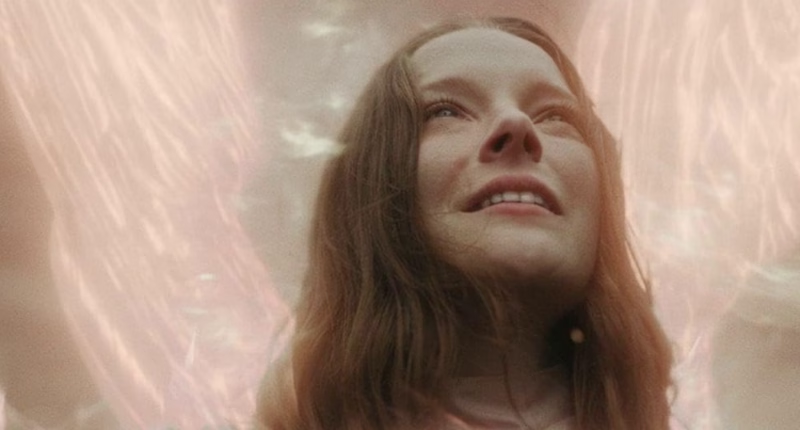
Angel wings appear, the crowd kneels, and then the film smash-cuts for a split second to Maud burning alive and screaming.
Why does Saint Maud work so well as horror?
It works because Rose Glass locks you inside Maud’s point of view and lets the picture and the sound come apart as Maud’s mind does. Glass has said the team made the visual language looser and more exaggerated as Maud’s mental state unravels, while sound designer Paul Davies kept the soundtrack ominous from the first scene.
Time Out praised that sound design for creeping through your head the way the beetle haunts Maud’s damp flat, and I agree. You hear the dread before you see a reason for it.
Ben Fordesman’s photography does the other half of the job. One reviewer called the look gothic-tinged, with the world painted in thick shadow, and the film won Best Cinematography at the British Independent Film Awards. The seaside town is drained of colour on purpose; one critic noted the dull grey hue mirrors how Maud sees everyone around her. Adam Janota Bzowski’s first feature score fills the gaps with synths and drones.
Surprisingly, the film is also funny. Danny Boyle, quoted by Looper, called it “mordantly funny at times”, and that dark humour is what keeps Maud human. Without it, the film would be a long sermon about suffering. At 84 minutes it never overstays.
Still, it is not flawless. One reviewer felt the second act flounders, and another argued that it is not as strong as the films it is compared with. I think both have a point: the middle repeats Maud’s isolation a beat too often before the plot tightens again.
What does the ending of Saint Maud mean?
The ending is built to be read two ways at once: as a woman’s psychotic break and as a believer’s brush with something real.
Glass has said that early on she did not ask herself whether the voice was truly God or only in Maud’s head, and that viewers will read the film according to what they believe. One recap notes that whether you see a troubled woman or a nurse caught in spiritual warfare, Glass is happy for you to choose.
Other write-ups lean harder one way. Looper reads the finale as a measure of how far delusion can go, and Refinery29 frames the whole film as Maud’s perception, asking whether the ending is only narrative framing.
Here is my reading, and it is only mine. The wings and the kneeling crowd are what Maud believes she is getting. The split-second smash cut to the real scene is what everyone else sees. The film gives you both images and refuses to say which one wins. In other words, the cruelty is not that Maud is mad or holy. It is that nobody in the story was close enough to tell her apart from herself.
One detail is easy to over-read. The Welsh is partly luck: Glass has said Maud was not written as Welsh, that is simply who Clark is, and the scene where God speaks in Welsh was written during the edit. It adds to the strangeness, but I would not treat it as a hidden clue.
How good are Morfydd Clark and Jennifer Ehle in Saint Maud?
Both are excellent, and the film depends on the gap between them. Morfydd Clark carries almost every scene in her first lead role.
Time Out said she deserved awards for remarkable physical acting, and the awards did arrive: she won British/Irish Actress of the Year at the London Film Critics’ Circle Awards and Best Actress at the British Academy Cymru Awards, and was nominated for Best Actress at the BIFAs. What impressed me is how little she overplays Maud’s meekness.
The Irish News called it a bravura central performance, but the quiet moments are what land: her painful awkwardness around Amanda’s artist friends and the grim determination with which she drinks a beer in the pub. Clark has since gone on to play Galadriel in The Rings of Power.
Jennifer Ehle has the harder job in some ways, because Amanda has to be funny, cruel, frightened and sympathetic without tipping into cliché. JoBlo called her the film’s only grounded character, and Buzz magazine said she adds vinegar to the mix. She was nominated for Best Supporting Actress at the BIFAs and by the London Film Critics’ Circle (both per Wikipedia).
The chemistry is the point. The Independent Cinema Office described a palpable chemistry between the leads, and it is a strange kind: pity, mockery and need swapping places in a single exchange.
The birthday party is the standout scene for me, because Ehle’s cruelty and Clark’s humiliation arrive together. In the supporting cast, Lily Frazer’s Carol is played with vivacity, and Lily Knight’s brief scene as Maud’s former colleague Joy reopens old wounds in a short scene.
What is Saint Maud really about?
It is about loneliness more than it is about religion, and Rose Glass says so herself. In one interview she called the film more about the psychological loneliness and mental health side than about faith itself.
Roger Ebert’s site reached the same place, calling it a study of Maud’s existential loneliness and the dangers of being cut off from humanity.
Faith or illness?
Glass has pointed out that a couple of thousand years ago, someone who heard God might have been revered, whereas now the reaction is very different. The film sits on that fault line. Clark, for her part, was reluctant to put a diagnosis on Maud because she did not feel she knew enough to do so. I respect that. The film never hands you a label, so you cannot use one to feel safe.
Pain as proof
Maud’s private rule, according to the Fort Worth Weekly, is not to waste her pain. That one idea explains the shoe tacks, the foot device and the beach. Maud treats suffering as a currency she can spend to buy God’s attention.
The device she builds echoes mortification of the flesh in Catholic tradition, but the film treats it as something closer to self-punishment than devotion.
Care work and who gets help
Glass has said that without Maud’s point of view, the story could be a bleak, small, social-realist film about a traumatised nurse with mental health issues who is not getting the help she needs. That is the quiet outrage under the horror. Maud looks after the dying all day and nobody looks after her. In contrast with many horror films, Glass does not treat her female characters as bait or meat.
Body versus spirit
Maud and Amanda are built as opposites. One critic lists the contrasts as good and evil, belief and atheism, celibacy and liberation. Yet the film complicates it: the man who assaults Maud knows about her wilder past, so her purity is a rebuilt identity, not a starting point. Katie did not disappear. She was renamed.
How does Saint Maud compare with Repulsion, Taxi Driver and Rose Glass’s later film?
It sits closest to Repulsion and Taxi Driver, two films Rose Glass has named herself, but its focus on faith and care work gives it a different engine. Glass has cited Repulsion and Rosemary’s Baby for visual language, tone and style, and Taxi Driver as another reference even though it is not a horror film.
She has also named Bergman’s Persona and Through a Glass Darkly. The table below sets out what each shares with Saint Maud and where Saint Maud goes its own way. The “differs” column is my own reading.
| Film | What it shares | Where Saint Maud differs |
|---|---|---|
| Repulsion (1965) | Glass says she held it in her head for tone and visual style | The unravelling is driven by devotion and a relationship with God, not by fear alone |
| Taxi Driver (1976) | Glass sees Maud and Travis Bickle as neurotic antiheroes whose inner story clashes with how society sees them | Maud’s story ends in self-destruction and a hallucinated public reverence |
| Carrie (1976) | A lonely lead and destructive religious fanaticism, and a Danny Boyle comparison | Maud chose her faith as an adult convert; she collects the parts of religion she likes |
| Persona (1966) | A major influence, with a similar friction between two women | A carer and patient with a body and a death clock between them |
| First Reformed (2017) | Cited alongside Taxi Driver and Carrie by Roger Ebert’s site | Believers in that film reach extremes through reasoned belief; Maud hears a voice in a cockroach |
As for its A24 siblings, Fangoria placed it in the company’s run of The Witch, Hereditary, Midsommar and The Lighthouse. I would say it is quieter and smaller than most of them, and more intimate than Hereditary, though that is taste, not fact.
Glass’s next film
Glass’s second feature, Love Lies Bleeding, is a romantic thriller co-written with Weronika Tofilska and starring Kristen Stewart and Katy O’Brian. It premiered at Sundance on 20 January 2024 and opened in the US on 8 March and the UK on 3 May. Stewart came to the project as a fan of Saint Maud.
O’Brian said the original script had several Saint Maud moments, including body horror, that were consolidated. If you finish Saint Maud wanting more from Glass, start there, but expect a louder film.
Who is Saint Maud for, and what did critics think?
Saint Maud is for patient horror fans and cinephiles, and critics were overwhelmingly positive. If you like slow-burn character studies in the vein of Repulsion, Persona or First Reformed, you are the target audience. If you mostly watch horror for jump scares, you will probably find it grim.
The film is rated R in the US for disturbing and violent content, sexual content and language and 15 in the UK. I would add my own content notes: it shows self-harm, a sexual assault, a killing, and a suicide by fire. It is not a casual date-night film.
What the critics and audiences said
On Rotten Tomatoes, 92% of 193 critics’ reviews were positive with an average of 8 out of 10, and Metacritic scored it 83 out of 100 from 35 critics.
Individual reviews were just as strong. Time Out gave it five stars and called it the best British horror film since Under the Skin. The Irish News gave it 9 out of 10. Critic Mark Kermode named it his favourite film of 2020, and in July 2025 The Hollywood Reporter ranked it 15th on its list of the 25 best horror movies of the 21st century. Director Mike Flanagan called it a tour de force performance from Clark and said he was a Glass fan for life.
Not everyone agreed. As noted earlier, one critic found the second act flounders and another found it less brilliant than its inspirations.
Awards and honours
| Awarding body | Result |
|---|---|
| British Independent Film Awards 2020 | A record 17 nominations, beating the 15 Lady Macbeth received in 2017; won Best Cinematography (Ben Fordesman) and the Douglas Hickox Award for best debut director (Glass) |
| 74th BAFTA Film Awards | Nominated for Outstanding British Film and for Outstanding Debut by a British Writer, Director or Producer |
| London Film Critics’ Circle (41st) | Won British/Irish Film of the Year, British/Irish Actress of the Year (Clark) and Breakthrough British/Irish Filmmaker of the Year (Glass) |
| British Academy Cymru Awards (30th) | Morfydd Clark won Best Actress |
| Fangoria Chainsaw Awards (24th) | Won Best First Feature |
| BFI London Film Festival 2019 | Special Commendation in the Official Competition |
I did not find a verified Oscar nomination for the film, so I make no claim about one.
What can Saint Maud teach us about loneliness today?
It teaches that loneliness can look like discipline, piety or good manners, which is exactly why other people miss it. Maud is polite, punctual and devoted to her work. Nobody around her sees the emptiness until it is far too late, and that is the part of the film I carried out with me.
The numbers behind that feeling are not small. The Campaign to End Loneliness, working with Office for National Statistics data, reports that between April and May 2020 5.0% of people in Great Britain, about 2.6 million adults, said they felt lonely often or always, and this rose to 7.2%, about 3.7 million adults, between October 2020 and February 2021.
In June 2023, a later ONS survey, as reported by the South West London paper, found 6% felt lonely often or always, and 25% felt lonely at least some of the time. I use British figures because this is a British film, and I would not assume the pattern stops at any border.
The ONS also said in 2020 that ongoing health concerns seemed more strongly linked with chronic loneliness, which matters in a story where one woman is dying and the other is carrying something she cannot name.
Three things stay with me.
Care workers need care too. Glass described Maud as a traumatised nurse who is not getting the help she needs. I could not verify nurse burnout statistics from the sources I gathered, so I will not quote any. What I can say is that the film makes the case better than a statistic would. Someone who spends all day with the dying has nobody to talk to at night.
How we react to a strange belief matters. Glass has contrasted the way a person hearing God might once have been revered but is now met with a very different reaction. The film does not ask you to decide whether Maud is holy or ill. It asks whether you would notice a colleague changing, and whether you would ask about it kindly instead of laughing, as the party guests do.
One source of meaning is a thin rope. Maud puts all her weight on a single relationship, and when it seems to go quiet she spirals. That is my reading, not a clinical claim. It applies to a faith, a job, a partner or a phone screen alike.
If you want a practical takeaway, message one person this week who lives alone or works nights, and ask them a direct, kind question. Stay on the line if the answer worries you, and encourage them to speak to a doctor or a local support service.
The same goes for you if the film stirred something. I am not a clinician, and even Clark said she did not want to diagnose Maud. The film is fiction, and it is not an argument that faith causes harm; Glass says it is not really about religion per se.
Which Saint Maud lines are worth remembering?
Four short lines stand out to me. Because this is a film, there are no episode or season numbers, so I give the scene context instead, and I keep every quote brief and tied to its source. Reviewers transcribe some lines slightly differently, so treat the wording as the version in each source, not a checked subtitle track.
“Never waste your pain.” Maud’s closest thing to a motto. It frames every act of self-punishment that follows.
“You must be the loneliest girl I’ve ever seen.” A sharp early exchange between patient and nurse. It names the film’s real subject within minutes.
“It takes nothing special to mop up after the dying.” Maud’s line, where she sets cleaning up after death against the grander work of saving a soul.
“Saved me for something greater.” Maud’s prayer to God. The whole tragedy is in the ambition of that sentence.
What are the pros and cons of Saint Maud?
The strengths are craft and commitment; the weaknesses are pace, bleakness and a refusal to give answers.
| Pros | Cons |
|---|---|
| A controlled, physically remarkable lead performance from Morfydd Clark | Slow and bleak, with almost no relief from Maud’s point of view (my view) |
| Sound design and a synth-and-drone score that build dread before anything happens | One critic felt the second act flounders |
| Gothic photography that won Best Cinematography at the BIFAs | Ambiguity may frustrate viewers who want a clear answer about God or madness |
| A tight 84-minute runtime | Contains self-harm, sexual assault and a suicide by fire (my content notes) |
| Dark humour that Danny Boyle noticed | Some critics rate it below the films that inspired it |
| Rewards a second watch and a long conversation afterwards | A 67% audience score on one listing, below the critics’ score |
Should you watch Saint Maud? My verdict
Yes, if you can take a bleak film that trusts your intelligence, and no if you need comfort or a clear answer. Saint Maud is a small, controlled shocker that turns a lonely nurse’s faith into something frightening and sad at once.
Morfydd Clark and Jennifer Ehle are superb, Rose Glass directs with a confidence that is rare in a first feature, and the final shot stays with you long after the screen goes dark. It has flaws in the middle, and it will not suit everyone.
I give it 4.5 out of 5.
Who gets the most from it? Slow-burn horror fans, anyone who likes character studies in the vein of Repulsion, Persona or Taxi Driver, and viewers who enjoy arguing about endings.
Who should skip it? Anyone who wants jump scares, a clear villain, or a night of easy viewing, and anyone for whom depictions of self-harm or sexual assault are a problem.
Watch it with the sound turned up and the lights low, and expect to talk about it afterwards.
Saint Maud
Director: Rose Glass
Date Created: 2026-11-05 07:28
4.5
Pros
- Clark's performance; sound design and score; gothic cinematography; tight 84 minutes; dark humour
Cons
- Slow and bleak; second act can drag; ambiguity may frustrate; disturbing content