
Do you ever wonder why some family secrets cut deeper than others, leaving scars that never fully heal? As someone who’s delved into countless thrillers, I can tell you that Gillian Flynn’s Sharp Objects uncovers those wounds in a way that’s both mesmerizing and profoundly unsettling, making it a must-read for anyone grappling with the shadows of their own past.
Sharp Objects masterfully unveils how buried family traumas and small-town facades can erupt into unimaginable violence, forcing a troubled journalist to confront her demons while solving grisly murders.
Sharp Objects is perfect for fans of psychological thrillers who crave deep dives into mental health struggles, dysfunctional families, and twisty plots that linger long after the last page—think readers of Gone Girl or Big Little Lies who appreciate unflinching portrayals of human darkness.
However, it’s not ideal for those sensitive to graphic depictions of self-harm, child abuse, or substance misuse, as the raw intensity might prove overwhelming and trigger emotional distress.
Table of Contents
1. Introduction
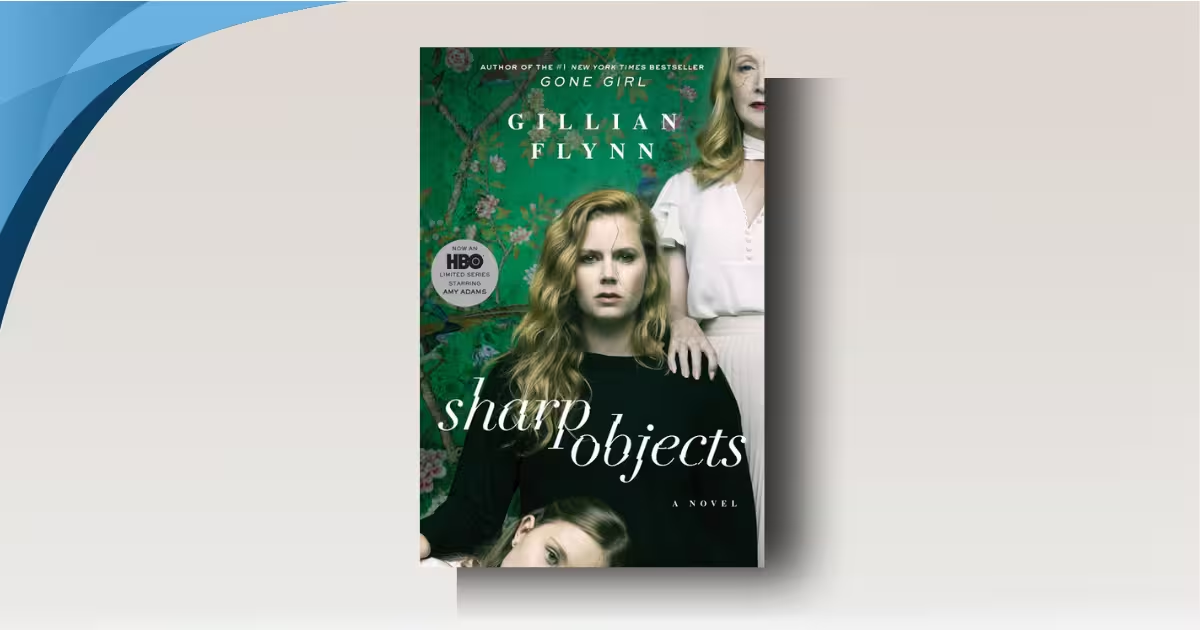
Sharp Objects is the gripping debut novel by Gillian Flynn, an American author renowned for her razor-sharp psychological thrillers. First published on September 26, 2006, by Shaye Areheart Books, an imprint of Crown Publishing Group (a division of Random House), the book spans about 254 pages in its original hardcover edition.
It was later reissued in paperback by Broadway Books in 2013. Flynn, born in 1971 in Kansas City, Missouri, drew from her background as a former journalist for Entertainment Weekly to craft this story, writing it during nights and weekends over several years.
The novel quickly garnered acclaim, winning the 2007 Ian Fleming Steel Dagger for best thriller and being shortlisted for several awards, including the Mystery Writers of America Edgar for Best First Novel.
Its success paved the way for Flynn’s later bestsellers like Dark Places (2009) and Gone Girl (2012), solidifying her as a master of dark, character-driven narratives.
2. Background
Although Sharp Objects is a work of fiction with no direct historical ties, it draws on the cultural and social fabric of small-town America, particularly in the Midwest.
Set in the fictional Wind Gap, Missouri—a stagnant, hog-butchering community in the state’s boot heel—the story echoes the economic decline and isolation often seen in rural areas post-1960s, when many such towns were built hastily during suburban expansions but left to languish.
Flynn’s own upbringing in Kansas City adds authenticity to the portrayal of Missouri’s underbelly, where old money mingles with poverty, and societal pressures amplify personal dysfunctions.
The novel subtly nods to broader American issues like the opioid crisis precursors and mental health stigma in conservative communities, though it predates widespread discussions of these topics.
Having said that, its themes of generational trauma and hidden abuses resonate with real-world events, such as the rise in reported Munchausen syndrome by proxy cases in the 2000s, highlighting how family secrets fester in tight-knit, overlooked places.
3. Sharp Objects summary
Part 1
Sharp Objects follows Camille Preaker, a 30-year-old journalist working for the Daily Post, Chicago’s fourth-largest newspaper. Recently released from a psychiatric hospital after a stint for self-harm—where she carved words into her skin as a coping mechanism—Camille is assigned by her editor, Frank Curry, to cover a potential serial killer story in her hometown of Wind Gap, Missouri.
The town, a decaying port on the Mississippi with a population of about 2,000, is reeling from the murder of nine-year-old Ann Nash, found strangled in a creek with all her teeth removed, and the recent disappearance of 10-year-old Natalie Keene. Reluctant to return due to her traumatic past, Camille agrees, hoping it might “flush some stuff out” as Curry suggests.
Upon arriving, Camille stays at her family’s Victorian mansion with her estranged mother, Adora Crellin, a wealthy, controlling socialite who inherited the town’s dominant hog-slaughtering business; her passive stepfather, Alan; and her 13-year-old half-sister, Amma, a beautiful but manipulative girl who alternates between doll-like innocence at home and wild partying with her friends.
Camille’s history is fraught: At 13, after her younger sister Marian died of a mysterious illness, Camille began cutting words like “wicked,” “vanish,” and “fix” into her body, covering nearly every inch except her face and hands. She also endured sexual abuse by older boys in the woods, fueling her self-destructive tendencies, alcoholism, and avoidance of intimacy.
As Camille investigates, she reconnects with old acquaintances, including her high school friend Jackie O’Neill, now a gossiping alcoholic, and Chief Vickery, the local police head who’s resistant to outside help.
She teams up with Detective Richard Willis, a handsome Kansas City outsider, and their professional rapport turns romantic, though Camille keeps her scars hidden by wearing long sleeves in the sweltering heat.
Natalie Keene’s body is soon found, propped in an alley with her teeth also pulled, confirming a serial killer. The murders share similarities: both girls were “biters” who targeted authority figures, and the killer seems to have a personal motive tied to punishment or collection.
Camille interviews the victims’ families. Ann’s father, Bob Nash, is a grieving factory worker suspicious of outsiders; Natalie’s brother, John Keene, is an emo teen ostracized by the town, while his girlfriend Meredith Wheeler defends him. Rumors swirl about John or even a Mexican trucker, but Camille senses deeper rot in Wind Gap’s facade of Southern politeness.
Meanwhile, her interactions with Adora are tense—Adora criticizes Camille constantly, favoring Amma, who Camille observes bullying her friends Jodes, Kelsey, and Kylie in secret roller-skating escapades laced with drugs and cruelty.
Flashbacks reveal Camille’s childhood: Adora’s coldness, Marian’s prolonged “illness” with fevers and vomiting, and Camille’s alienation. In the present, Adora hosts Calhoun Day, a bizarre town festival reenacting a Confederate child’s martyrdom, where Amma stars as the victim.
Chaos ensues when drunk teens fight, and Amma gets hurt, amplifying Adora’s smothering “care.” (Note: Calhoun Day is expanded in the adaptation but core to the book’s social commentary.)
Camille’s mental health deteriorates: She drinks heavily, has vivid hallucinations of Marian, and nearly relapses into cutting. Sleeping with John Keene in a moment of vulnerability, she lets him see her scars, leading to a raw connection.
Richard grows frustrated with her secrecy but shares evidence pointing to a female killer—someone who strangled the girls without sexual assault and pulled teeth postmortem, possibly as trophies.
Suspicions turn to Adora when Jackie hints at her “tendencies.” Camille recalls Marian’s symptoms matching poisoning. Testing a blue bottle of “medicine” Adora gives her, Richard confirms rat poison.
Adora has Munchausen syndrome by proxy—she poisoned Marian for attention and is doing the same to Amma, explaining her “sickly” spells. To gather proof, Camille lets Adora “nurse” her, falling ill. Richard raids the house, finding pliers with blood (matching the girls) and arrests Adora for Marian’s murder and attempts on Camille and Amma.
Part 2
With Adora jailed, Camille takes Amma to Chicago, hoping to give her a fresh start. Amma thrives initially, but Camille notices odd behaviors: Amma’s obsession with her dollhouse—a replica of Adora’s mansion—and her controlling nature with new friends.
When a girl named Mae goes missing and is found strangled with teeth removed, Camille confronts Amma.
The shocking reveal: Amma is the killer. Jealous of Ann and Natalie stealing Adora’s attention (Ann bit Adora during a “nursing” visit; Natalie during a town event), Amma lured them to the woods with her friends’ help. They held the girls down while Amma strangled them, then pulled their teeth for her dollhouse’s “ivory” floor—a perverse mimicry of Adora’s hog empire and need for perfection.
Amma killed Mae alone, out of envy over Camille’s affection. In jail, Amma’s friends confess, sealing her fate. Amma whispers to Camille, “Don’t tell mama,” echoing the cycle of secrets.
The epilogue finds Camille shattered, realizing her family’s poison runs deep. She relapses briefly but finds solace with Curry and his wife Eileen, who become surrogate parents. Reflecting on her scars, Camille sees them as a map of survival, but questions if healing is possible.
The ending is ambiguous: Camille wonders if she’s “fixed,” hinting at ongoing trauma, while Amma’s imprisonment offers cold justice. Flynn leaves readers haunted, emphasizing how abuse perpetuates across generations in stifling environments.
4. Sharp Objects analysis
4.1. Sharp Objects Characters
Camille Preaker emerges as a deeply complex protagonist, her development a slow unraveling of suppressed pain. Starting as a detached reporter, her return to Wind Gap forces confrontation with her self-harm—words like “punish” and “wicked” etched on her skin symbolizing internalized guilt from Marian’s death and Adora’s neglect.
Her motivations stem from survival; journalism offers escape, but romance with Richard exposes vulnerabilities, leading to growth in vulnerability. However, her bond with Amma blinds her to the killer’s identity, highlighting denial’s role in trauma.
Adora Crellin is a chilling antagonist, her Munchausen syndrome by proxy driving the family’s destruction. Superficially elegant, her control masks deep insecurity from her own abusive mother, manifesting in poisoning her daughters for “love” and attention. Her relationship with Camille is toxic rejection, while with Amma it’s smothering favoritism, fostering Amma’s psychopathy.
Amma Crellin, the ultimate twist villain, evolves from seemingly spoiled teen to sociopathic murderer. Her dual personality—innocent doll at home, vicious leader outside—mirrors Wind Gap’s facade. Motivated by jealousy and Adora’s influence, she kills to “collect” teeth, symbolizing stolen innocence. Her bond with Camille is manipulative, ending in betrayal.
Supporting characters like Richard provide contrast; his outsider perspective uncovers truths, but his affair with Camille underscores her self-sabotage. Curry acts as a moral anchor, urging Camille’s healing. Overall, Flynn’s characters are richly motivated by intergenerational abuse, their relationships a web of codependency and deception.
4.2. Sharp Objects Themes and Symbolism
Flynn masterfully weaves themes of abuse and victimization, showing how trauma cycles through families.
Adora’s poisoning and Amma’s murders illustrate inherited violence, with Camille’s cutting a personal rebellion yet continuation of self-destruction. Mental illness permeates: Depression, alcoholism, and Munchausen are portrayed raw, emphasizing stigma in small towns where help is scarce.
Symbolism abounds—the title’s “sharp objects” represent Camille’s blades, but extend to emotional cuts from family and society. Pulled teeth symbolize lost voices and power; Amma’s dollhouse floor of them mocks domestic perfection, a miniature of Adora’s controlling world.
Pigs at the slaughterhouse mirror human brutality, underscoring Wind Gap’s moral decay. These elements integrate seamlessly, amplifying themes of facade versus reality, where secrets fester like wounds.
5. Evaluation
As a debut, Sharp Objects rivals seasoned works in its unflinching gaze, much like The Guardian praised its “icy, eye-opening” journey. The New York Times lauded its “mesmerizing Southern thriller” that “cuts slow but deep,” capturing the languid horror.
The New Yorker highlighted Amy Adams’ unraveling in the adaptation, but the book’s raw prose hits harder.
1. Strengths/pleasant/positive experiences with the book
Flynn’s vivid descriptions immerse you in Wind Gap’s stifling heat and hypocrisy, making the setting a character itself. Compelling characters like Camille evoke empathy, her scars a poignant metaphor for unspoken pain.
The twists, especially Amma’s reveal, deliver gut-punch satisfaction, and the exploration of female rage feels empowering yet tragic.
2. Weaknesses/negative experiences with the book
Pacing drags in the middle, with repetitive introspection bordering on tedium. Graphic content—self-harm, abuse—can feel exploitative, potentially alienating readers. Some themes, like small-town racism, are underdeveloped.
3. Impact
Emotionally, it left me unsettled, pondering my own family dynamics. Intellectually, it sparked reflections on mental health invisibility, resonating deeply in a post-#MeToo era.
4. Comparison with similar Works
Like Flynn’s Gone Girl, it subverts expectations with unreliable narrators, but focuses more on trauma than marriage. Echoes Big Little Lies in affluent dysfunction, or The Girl on the Train in alcoholic protagonists uncovering secrets. Yet, its Southern Gothic vibe sets it apart, akin to Flannery O’Connor with modern twists.
5. Adaptation
Comparisons between book & TV adaptation – Box-office information: The 2018 HBO miniseries, starring Amy Adams as Camille, Patricia Clarkson as Adora, and Eliza Scanlen as Amma, stays faithful but makes tweaks: Setting shifts to St. Louis for logistics, Amma’s aged up to 19 (actress’s age), added flashbacks and Calhoun Day amplify atmosphere, and the ending uses mid-credits for the reveal versus epilogue.
The show expands subplots like Camille’s rehab roommate Alice, heightening visual trauma through Vallée’s fragmented editing. As a miniseries, no traditional box office, but viewership peaked at 2.6 million for the finale (up 40% from prior), averaging 7 million gross, rivaling Big Little Lies.
Premiere drew 1.5 million, growing via streaming.
6. Personal insight with contemporary educational relevance
Diving into Sharp Objects, I couldn’t help but connect its raw depiction of generational trauma and mental health struggles to today’s conversations around family dynamics in small-town America.
In an era where rural mental health crises are rampant—CDC data shows suicide rates in rural areas are 45% higher than urban ones, with limited access to care (only 20% of non-metro counties have psychiatrists, per a 2023 report)—Flynn’s story feels eerily prescient.
Adora’s Munchausen by proxy mirrors real cases like Dee Dee Blanchard (chronicled in Hulu’s The Act), highlighting how isolation amplifies abuse; a 2022 study in JAMA Pediatrics noted a spike in such cases during COVID lockdowns, underscoring the need for community vigilance.
Educationally, the book teaches empathy for invisible wounds, like self-harm affecting 17% of teens (NIMH stats), often rooted in family secrets.
Its impact? Sparking discussions on toxic femininity and rural decay, influencing adaptations that reached millions, boosting awareness—HBO’s series alone averaged 7 million viewers, prompting articles on trauma (e.g., Vox’s piece on generational abuse).
For students or readers, it’s a lens on resilience: Camille’s survival reminds us healing starts with confronting pain, a lesson vital amid rising youth anxiety.
Ultimately, Sharp Objects isn’t just entertainment—it’s a call to break cycles, relevant as ever in our divided society. (248 words)
7. Sharp Objects quotes
- “The face you give the world tells the world how to treat you.” – This captures Camille’s facade, hiding scars that symbolize her inner turmoil.
- “A child weaned on poison considers harm a comfort.” – Adora’s line foreshadows her abuse and Amma’s twisted normalcy.
- “Sometimes I think illness sits inside every woman, waiting for the right moment to bloom.” – Reflects the novel’s theme of suppressed female rage and mental fragility.
- “I was friends with them for a while… We had fun, running around in the woods. We were wild.” – Amma’s chilling confession in the epilogue, revealing her complicity in the murders.
- Passage: “When I was still in grammar school, maybe twelve, I wandered into a neighbor boy’s hunting shed… Ribbons of moist, pinkish meat dangled from strings, waiting to be dried into jerky.” – Symbolizes Camille’s early exposure to violence, paralleling the girls’ fates.
8. Conclusion
Overall, Sharp Objects left me breathless with its masterful blend of suspense and psychological depth, a debut that punches above its weight in exposing human frailty.
I recommend it to thriller enthusiasts and those interested in mental health narratives, but approach with caution if triggers apply—fans of dark domestic dramas like Big Little Lies or The Silent Patient will devour it.
In fact, its significance lies in demystifying trauma’s grip, reminding us that healing demands unearthing the sharpest truths, making it timelessly worth the read.