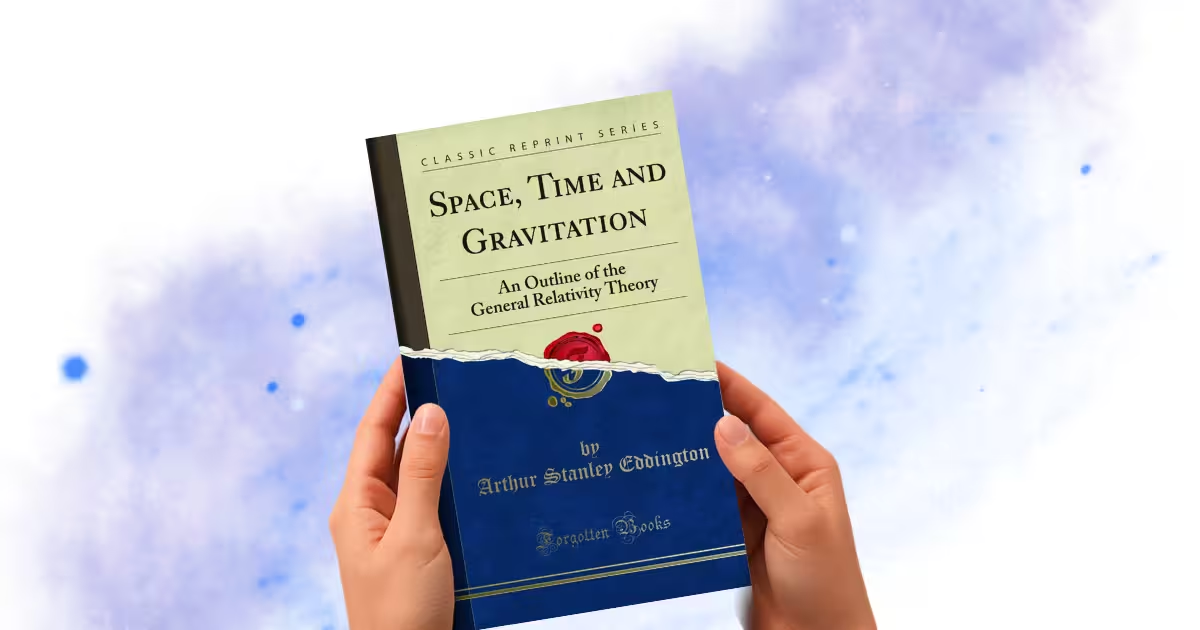

Ever wondered why a falling apple and a ray of starlight obey the same cosmic rules? Arthur Eddington’s Space Time and Gravitation doesn’t just answer that—it hands you the keys to Einstein’s universe, written by the man who proved it.
Table of Contents
Overview
In 1919, a British astronomer named Arthur Eddington led an expedition to the island of Príncipe, off the coast of West Africa, to photograph a solar eclipse.
The goal was simple yet profound: to see if the Sun’s gravity would bend the light from distant stars, exactly as Albert Einstein’s new theory predicted. The results were a sensation.
Einstein became a global celebrity overnight, and Eddington, the man who made the observation possible, became the chief interpreter of relativity for the English-speaking world.
Hot on the heels of that historic moment, in 1920, Eddington published Space, Time and Gravitation: An Outline of the General Relativity Theory.
This wasn’t just another scientific textbook. It was a first-hand account, written by one of the few people outside Germany who truly understood Einstein’s radical ideas. The book is a masterclass in scientific communication, aiming to explain the complex geometry of a four-dimensional universe “without introducing anything very technical in the way of mathematics, physics, or philosophy”.
It’s the kind of book that makes you feel like you’re sitting in on a series of lectures by a brilliant, witty, and deeply thoughtful professor who is just as excited about these ideas as you are.
Reader recommendation
Space Time and Gravitation is best for:
Curious Minds: Anyone who has ever looked up at the night sky and wondered about the nature of space and time.
Science Enthusiasts: Readers who want to go beyond popular documentaries and grasp the conceptual core of general relativity.
History Buffs: Those interested in the pivotal moment when physics shifted from a Newtonian worldview to an Einsteinian one.
Writers and Philosophers: Anyone seeking to understand how a scientific revolution reshapes our fundamental understanding of reality.
Space Time and Gravitation is not recommended for:
The Math-Averse: While Eddington avoids complex equations, this is still a book about physics. It demands focus and a willingness to engage with abstract concepts like non-Euclidean geometry and four-dimensional space-time.
Casual Readers: This isn’t a light, breezy read. It requires active engagement and a genuine interest in the subject matter.
Those Seeking a Modern Update: The book is a historical document. While its explanations are timeless, it doesn’t cover the century of scientific progress that has followed.
Background: The Man Who Explained Einstein
Arthur Stanley Eddington (1882–1944) was more than just a popularizer of science; he was a titan of astrophysics. He held the prestigious Plumian Professorship of Astronomy and Experimental Philosophy at Cambridge University. His work on the internal structure of stars was foundational, and the “Eddington limit” – the maximum luminosity a star can achieve – is named in his honor.
But his most significant contribution to the public understanding of science was his role as an early champion of Einstein’s general theory of relativity. During World War I, when communication between British and German scientists was severed, Eddington, a Quaker and a pacifist, was one of the few in the UK who had access to Einstein’s papers. He recognized their genius immediately.
His 1919 eclipse expedition, which confirmed the bending of starlight, was the dramatic proof that catapulted Einstein and his theory onto the world stage. Space Time and Gravitation was his victory lap, his attempt to share with the world the profound shift in understanding that he had helped to validate.
Space Time and Gravitation Summary
Eddington’s book is structured as a logical, step-by-step exploration. He doesn’t just present the conclusions of relativity; he guides you through the reasoning that led to them, starting from familiar ground and gently pulling you into the strange new world of Einstein.
Chapter 1: The FitzGerald Contraction
Eddington opens not with a dry definition, but with a simple, powerful analogy. He asks you to imagine a swimmer in a river, racing against and across the current.
This analogy perfectly illustrates the famous Michelson-Morley experiment of 1887, which attempted to detect the Earth’s motion through the hypothetical “aether.” The result was a dead heat: the speed of light appeared to be the same in all directions, regardless of the Earth’s motion.
To explain this, Eddington introduces the FitzGerald contraction, a hypothesis that objects physically shorten in the direction of their motion through the aether. He makes this strange idea tangible:
“Suppose that by development in the powers of aviation, a man flies past us at the rate of 161,000 miles a second… If we could catch an instantaneous glimpse as he passed, we should see a figure about three feet high, but with the breadth and girth of a normal human being.”
The effect is completely reciprocal. To the aviator, it is we who appear flattened. Eddington emphasizes this reciprocity is not an illusion; it’s a fundamental consequence of the relativity of motion.
Chapter 2: Relativity
This chapter is the philosophical heart of the book. Eddington argues that every observation has two parties: the observer and the observed. What we see depends on our own circumstances. He introduces the core idea that length and duration are not inherent properties of objects but are relations between the object and the observer.
“Thus length and duration are not things inherent in the external world; they are relations of things in the external world to some specified observer.”
He uses the analogy of a sheet of paper. An aviator flying past at high speed would measure the sheet as an oblong, while a stationary observer would see it as a square. Who is right? Both are, for their own frame of reference. This leads to the central insight: space and time are not separate, absolute entities but are part of a single four-dimensional order, which Eddington calls “space-time.”
Chapter 3: The World of Four Dimensions
This is where the book gets truly mind-bending. Eddington introduces the concept of the “interval,” a single, invariant quantity that combines distance in space and duration in time. This is the true, objective measure of separation between two “events” (a point in space at a point in time).
The crucial formula is:
s² = (x₂ – x₁)² + (y₂ – y₁)² + (z₂ – z₁)² – (t₂ – t₁)²
That minus sign before the time term is the secret. It’s what makes space-time different from ordinary space. It means that the geometry of the universe is not Euclidean but “semi-Euclidean” or “hyperbolic.” Eddington uses the analogy of a rectangular hyperbola to show how different observers can slice this four-dimensional “block” into different spaces and times, much like different observers can slice a loaf of bread at different angles.
He also uses a clever device, “imaginary time” (multiplying time by the square root of -1), to make the geometry look Euclidean. This is a mathematical trick that makes the four-dimensional world completely isotropic, with no special direction.
Chapter 4: Fields of Force
Eddington tackles the nature of force by starting with a familiar experience: the feeling of weight in an accelerating elevator. This “artificial” field of force feels exactly like gravity. He argues that this is no coincidence.
“A gravitational field of force is precisely equivalent to an artificial field of force, so that in any small region it is impossible by any conceivable experiment to distinguish between them.”
This is the Principle of Equivalence, the cornerstone of Einstein’s theory. It leads to a radical conclusion: gravity is not a “force” in the traditional sense. It is the geometry of space-time itself. An object in free fall isn’t being pulled; it’s simply following the natural, straightest possible path (a “geodesic”) through a curved four-dimensional landscape. When you stand on the ground, you are not experiencing a force of gravity; you are being prevented from following your natural path.
The sensation of weight is the result of the Earth’s surface pushing you off your geodesic.
Chapter 5: Kinds of Space
This chapter is the most technical, introducing the mathematical machinery that describes curved space. Eddington explains how the geometry of a space is determined by a set of ten numbers, the “potentials” (g’s), which vary from point to point. He likens this to the coordinates on a map. The Earth’s surface is curved, and a flat map distorts it. Similarly, space-time is curved by the presence of mass and energy.
He introduces the crucial concept of “curvature” as a way to distinguish different kinds of space-time. The law of gravitation, in Einstein’s theory, is simply a statement about what kinds of curvature are possible in empty space. Eddington notes that a four-dimensional space with “no curvature” is not the same as a “flat” space, a fact that even he found perplexing.
Chapter 6: The New Law of Gravitation and the Old Law: Einstein vs. Newton
This chapter contrasts Einstein’s new law of gravitation with Newton’s. Eddington presents the now-famous solution to Einstein’s field equations for the gravitational field around a single, spherical mass (like the Sun). This solution, known as the Schwarzschild solution, is the basis for all the tests of general relativity.
He shows that this new law predicts the same results as Newton’s law in most cases (for slow-moving objects like planets) but differs in three critical ways:
The Bending of Light: Einstein’s theory predicts that light will be bent by gravity twice as much as Newton’s theory does. Eddington explains this using the analogy of a ray of light passing through a refracting medium.
The Advance of Mercury’s Perihelion: Einstein’s theory predicts that the elliptical orbit of a planet like Mercury will slowly rotate (precess). The predicted amount of 43 arcseconds per century perfectly matched a long-standing, unexplained anomaly in Mercury’s orbit.
The Gravitational Redshift: Light emitted from a strong gravitational field (like the surface of the Sun) should be shifted towards the red end of the spectrum.
Chapter 7: Weighing Light
This is the most dramatic chapter of the book, where Eddington tells the story of his own historic expedition. He describes the preparations, the journey to the remote island of Principe, and the nail-biting moments of the eclipse itself.
On May 29, 1919, a total solar eclipse provided the perfect opportunity to test the bending of light. Eddington’s team and a second team in Sobral, Brazil, photographed the stars near the Sun. The results were clear: the stars appeared displaced from their normal positions by exactly the amount Einstein’s theory predicted.
Eddington describes the moment with characteristic understatement:
“The results from this plate gave a definite displacement, in good accordance with Einstein’s theory and disagreeing with the Newtonian prediction.”
He also acknowledges the initial confusion when the Sobral plates seemed to show the Newtonian half-deflection. The problem was traced to distortion of the mirror by the Sun’s heat. When the good plates were measured, they confirmed Einstein’s full deflection of 1.75 arcseconds.
The chapter includes a fascinating diagram showing the measured deflections of the stars plotted against their distance from the Sun. The points line up beautifully with Einstein’s predicted curve.
Chapter 8: Other Tests of the Theory
While light is the “hare,” the planets are the “tortoise.” Eddington describes the other two classic tests of general relativity. The first is the advance of the perihelion of Mercury, which he presents as a triumph of the theory.
The second is the gravitational redshift of spectral lines, which, at the time of writing, had not been definitively confirmed. Eddington notes that the observations were inconclusive and that the predicted shift was a “highly probable prediction” that he anticipated would ultimately be confirmed.
He candidly discusses the uncertainties involved, showing his intellectual honesty.
Chapter 9: Momentum and Energy
Eddington explains how Einstein’s theory unifies inertia and gravitation. He argues that the “natural track” of a particle is not due to an active force but is simply the path of maximum interval-length in curved space-time. This leads to a redefinition of momentum and mass.
He shows that mass must increase with velocity:
M = m / √(1 – u²)
Where M is the observed mass, m is the “rest mass,” and u is the velocity (in units where the speed of light is 1). This was a prediction that had been confirmed by experiments on fast-moving electrons (beta particles), and it was a huge success for the theory. This led to the famous equivalence of mass and energy, a concept that would later be encapsulated in Einstein’s E=mc².
Chapter 10: Towards Infinity
Eddington tackles a major philosophical objection to relativity: absolute rotation. How can we detect rotation (like the Earth’s spin) if all motion is relative? He acknowledges the problem and explores possible solutions. He discusses the idea of a “natural frame” defined by the geodesic structure of space-time.
He also introduces the notion that the universe itself might have a global curvature, which would provide a frame of reference for rotation without appealing to absolute space.
He discusses the “spherical” and “cylindrical” models of the universe proposed by de Sitter and Einstein, and the intriguing idea that the redshift of light from distant nebulae might be due to this cosmic curvature rather than a simple Doppler effect.
Chapter 11: Electricity and Gravitation
Eddington explores the emerging theory of Hermann Weyl, which sought to unify gravity and electromagnetism in a single geometric framework.
This is a much more speculative chapter, reflecting the cutting-edge physics of the time. Weyl’s theory suggested that in addition to the ten potentials describing the gravitational field, there were four more potentials describing the electromagnetic field.
The geometry becomes even more abstract: in Weyl’s world, the length of a vector is not integrable; it can change depending on the path it takes, and this non-integrability of length is what we perceive as the electromagnetic field.
Chapter 12: On the Nature of Things
This final chapter is Eddington’s philosophical manifesto. He argues that physics, at its deepest level, is not about “things” but about “relations.” He uses the analogy of a game of chess.
The rules of the game (the laws of physics) can be understood without knowing anything about the physical nature of the chess pieces (the ultimate substance of reality).
“We have a world of point-events with their primary interval-relations. Out of these an unlimited number of more complicated relations and qualities can be built up mathematically, describing various features of the state of the world… Mind filters out matter from the meaningless jumble of qualities.”
He concludes with a profound statement that captures the essence of the book’s philosophical thrust:
“We have found a strange footprint on the shores of the unknown. We have devised profound theories, one after another, to account for its origin. At last, we have succeeded in reconstructing the creature that made the footprint. And Lo! it is our own.”
Space Time and Gravitation Analysis
Reading Space Time and Gravitation is a uniquely immersive experience. It’s not just a book about physics; it’s a book about thinking about physics. Eddington doesn’t just present the facts; he invites you to participate in the intellectual journey that led to them.
What makes it so effective?
The Power of Analogy: Eddington is a master of metaphor. From the swimmer in the river to the aviator in his spaceship, from the flatfish in its ocean to the hurdles in a field, his analogies make abstract concepts tangible. He doesn’t just explain relativity; he helps you feel it.
Acknowledging the Difficulty: He doesn’t pretend the ideas are easy. He admits to his own moments of perplexity, which makes him a relatable guide. He describes the “period of much perplexity, when he had not realized that a four-dimensional space with ‘no curvature’ is not the same as a ‘flat’ space”. This honesty is disarming and builds trust.
The Conversational Prologue: The book opens with a brilliant dialogue between a Physicist, a Mathematician, and a Relativist. This immediately sets the stage, clarifying the philosophical and definitional issues that underpin the entire theory. It’s an elegant way to address potential objections before they arise.
Historical Context: The book is embedded in its time. The excitement of the 1919 eclipse is palpable. This gives the reader a sense of being present at a pivotal moment in scientific history.
Philosophical Depth: Eddington doesn’t shy away from the profound implications of relativity. He grapples with the nature of reality, the role of the observer, and the relationship between mind and matter. This elevates the book from a mere textbook to a work of genuine philosophical reflection.
As the reviewer in The Athenaeum put it, it’s “a masterly book. The arrangement, the vigour and ease of the reasoning, the felicity of illustration, the clear, flexible prose and (we must mention it) the wit, make this book one of the most adequate and engaging attempts at the non-technical exposition of a scientific theory that it has ever been our good fortune to encounter”.
Strengths and Weaknesses
Strengths:
Clarity: Eddington’s ability to explain complex ideas without sacrificing accuracy is unparalleled.
Wit and Charm: The book is engaging and often humorous, making a notoriously difficult subject enjoyable.
Historical Importance: It’s a primary source, written by a key figure at a crucial moment in the history of science.
Philosophical Insight: The book encourages deep thought about the nature of reality, the scientific method, and the limits of human knowledge.
Weaknesses:
Datedness: The book was written in 1920. It doesn’t include later developments in cosmology, quantum mechanics, or the ongoing search for a unified theory.
Conceptual Difficulty: Despite Eddington’s best efforts, the subject matter is inherently challenging. Some readers may find the later chapters on Weyl’s theory and the philosophical conclusions heavy going.
Lack of Modern Visuals: The book relies on diagrams and the reader’s imagination. It lacks the stunning computer-generated imagery and animations that can now help visualize concepts like curved space-time.
Comparison with Similar Works
For a modern reader, Space Time and Gravitation sits alongside other classic works of popular science. Compared to Stephen Hawking’s A Brief History of Time, Eddington’s book is more focused and rigorous, less concerned with showmanship.
Compared to Brian Greene’s The Elegant Universe, it is more philosophical and less focused on particle physics. Compared to Einstein’s own Relativity: The Special and the General Theory, Eddington’s book is more expansive, providing greater context and commentary.
Conclusion
Space Time and Gravitation is more than just a historical curiosity. It is a masterpiece of scientific exposition that has stood the test of time. Eddington’s ability to distill the essence of Einstein’s revolutionary ideas into clear, accessible prose is a gift to any curious mind.
If you are willing to put in the mental effort, this book will not only teach you about relativity but will also fundamentally change the way you think about the universe and your place in it. It’s a book that rewards re-reading, revealing new layers of insight with each pass.
Eddington concludes with a haunting image: the footprint on the shore of the unknown, which we ultimately recognize as our own. This book is a guide to understanding that footprint – not just the shape of it, but the process by which we came to recognize it.
It is a testament to the power of the human mind to unravel the deepest mysteries of the cosmos, and a reminder that, in the end, we are part of the mystery we seek to understand.