
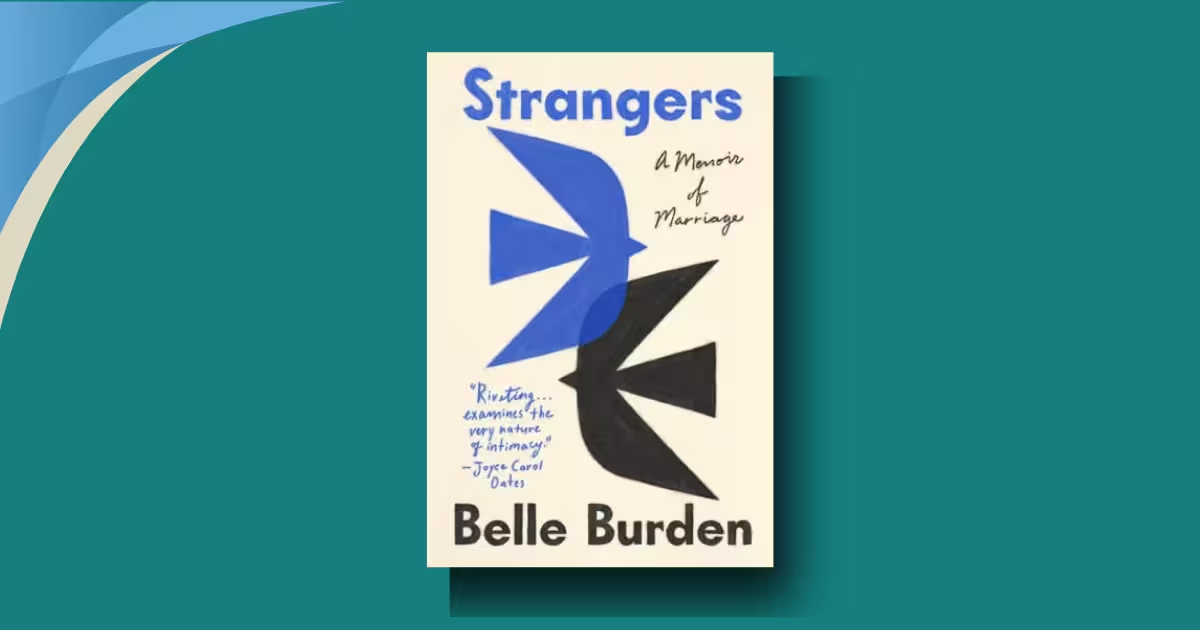
Have you ever noticed that the harder you try to force a change, the more the old version of you fights to stay? Strangers: A Memoir of Marriage is a searing, forensic examination of how a twenty-year “perfect” partnership can evaporate overnight, leaving a woman to rebuild her identity from the wreckage of a sudden abandonment.
Strangers is best for readers who have survived a sudden breakup, “gray divorce,” or infidelity and are craving validation that they aren’t crazy; also for fans of high-stakes emotional memoirs like Wild Game or The Palace Papers due to the “wealthy family drama” element. Not for those looking for a “how-to” divorce manual or readers who find stories of extreme financial privilege (private planes, multiple homes) hard to empathize with, even in tragedy.
Table of Contents
1. Introduction
Strangers: A Memoir of Marriage is written by Belle Burden, a pro bono immigration attorney and former corporate lawyer based in New York City. Published by The Dial Press, this memoir expands on her viral New York Times “Modern Love” essay, “Was I Married to a Stranger?”.
Strangers sits firmly in the genre of “divorce memoir,” but it feels less like a recounting of a breakup and more like a psychological thriller where the villain is the husband’s sudden, inexplicable personality transplant.
Burden comes from a lineage of significant American wealth and social prominence—her mother’s stepfather was Bill Paley, founder of CBS, and her own father was a Vanderbilt descendant—which adds a layer of “gilded cage” fascination to the story.
Burden’s central thesis is that we can share a bed, a life, and children with someone for decades and yet, fundamentally, not know them at all.
She argues that the “story” of a marriage is often a fiction we tell ourselves to feel safe, and when that story is shattered, the only way to survive is to stop being “Belle the Good” and start being difficult, loud, and real.
2. Strangers Summary
The Setting: The Calm Before the Collapse
The story begins in March 2020, as the world shuts down for the COVID-19 pandemic. Belle and her husband, James, retreat from their Tribeca apartment to their second home on Martha’s Vineyard with their two daughters, Evie (15) and Carrie (12).
To the outside world, and largely to Belle herself, they are the picture of stability. They have been married for twenty years. James is a successful hedge fund executive; Belle is a devoted mother and community volunteer.
They settle into a “cozy” quarantine routine. James cuts wood for fires and makes Belle whiskey sours at sunset. He seems protective, the “knight” Belle always believed him to be. But the cracks are invisible and deep. On March 21, just days into their isolation, after a family dinner where James acts strangely—eating gnocchi directly from the bowl—Belle receives a voicemail from a stranger.
The Explosion: March 2020
The voicemail is from a young man who says, “I’m sorry to tell you this, but your husband is having an affair with my wife”. When Belle confronts James, he admits to an affair with a younger woman, a banker he met through work.
He claims it “meant nothing” and promises it is over. But the chaos escalates immediately: the other woman attempts suicide that same night, and James spends the evening comforting her over the phone while Belle falls apart in their bathroom.
The next morning, at 6 a.m., James walks into their bedroom fully dressed in heavy boots and a parka.
His eyes, usually warm, are “narrowed and icy”. He delivers a line that haunts the rest of the book: “I’ve decided I want a divorce. I’m leaving”. He walks out, leaving Belle and his daughters alone on the island as the pandemic rages. He tells her she can keep the house and the kids; he just wants out. “I don’t want any of it,” he says.
The Anatomy of a Marriage
Burden spends the middle section of the book dissecting their history, trying to understand how the “steady” man she married became this cold stranger. They met at the elite law firm Davis Polk in 1998. James was a “bad boy” turned responsible lawyer—he had a tattoo, a mug shot from a teenage prank, and a history of heartbreaks, but he seemed safe and ambitious.
Belle, whose own father died suddenly when she was in law school, was drawn to James’s certainty. He told her, “Nothing bad will ever come of this”.
They built a life of immense privilege but emotional distance. James worked obsessively, rising to become a partner at a hedge fund. He managed all their finances, and Belle, traumatized by her father’s chaotic financial legacy, happily ceded control.
She focused on the children and their domestic life, creating a “perfect” world of summer clubs and private schools. In hindsight, she realizes she ignored signs of his detachment—his refusal to do “bath, bed, or homework”, his solitary hobbies, and his growing obsession with money and status.
The Aftermath: Survival Mode
After James leaves, Belle enters a state of shock. She loses the ability to eat or sleep. She walks eight miles a day around the island just to exhaust herself. The community on Martha’s Vineyard, a tight-knit enclave of wealthy summer residents, becomes a minefield.
Friends turn away from her, unsure of what to say to a discarded wife. One woman even suggests James is the victim, praising him at a dinner party while Belle sits there frozen.
James’s behavior becomes increasingly erratic and cruel. He refuses to tell the children the truth about the affair (though they find out anyway). He searches the basement for their prenuptial agreement while visiting for ninety minutes to break the divorce news to the kids. He tells Belle she is “playing the victim” when she cries.
The Financial Betrayal
The divorce proceedings reveal a second, devastating betrayal. During the discovery process, Belle learns the true extent of their wealth.
James has accumulated a fortune in his own name, while the family homes—which Belle paid for with her inheritance—are technically joint property. He attempts to enforce their twenty-year-old prenup to force the sale of the houses, threatening to leave Belle and the children without their home base.
This is the turning point for Belle. Realizing that the man she loved is now an adversary willing to “crush” her, she decides to fight back. She hires a tough lawyer and files a counterclaim, even though she knows she will likely lose. It is an act of reclaiming her voice.
The Resolution
Ultimately, James settles just an hour before their trial is set to begin. He gives up his claim to the houses but keeps his accumulated millions. Belle changes her name back to Burden, shedding her identity as his wife.
She writes an essay for the New York Times “Modern Love” column, outing the experience of being left for a stranger. The publication of the essay is a triumph, a public declaration that she survived.
The memoir ends with a powerful image of nature. Throughout the book, Belle watches a pair of ospreys nesting on her property. The male osprey, usually a devoted provider, is a foil to James. In the final pages, Belle, now divorced and standing on her own land, watches the ospreys return. She waves to them and says, “Welcome home”.
3. Critical analysis
Evaluation of Content:
Burden’s argument—that the “good wife” archetype is a trap—is supported by her visceral, day-by-day account of her unraveling. She doesn’t just tell us she was compliant; she shows us: making James a turkey sandwich after he tells the kids he’s divorcing her, or keeping quiet when friends praise him.
The evidence of the “system” working against her is stark, particularly in the legal battles where her unpaid labor as a mother is valued at zero compared to his hedge fund earnings.
However, the book operates in a rarefied stratosphere of privilege that can sometimes undercut the universality of her pain.
When she describes worrying about losing her second home or being ostracized at a private tennis club, it can be hard to feel the same level of urgency one might feel for a woman facing poverty.
Yet, Burden acknowledges this, admitting she is “more privileged than ninety-nine percent of the world”. The book succeeds because she convinces us that emotional abandonment hurts the same, regardless of the zip code.
Contribution to the Field:
Strangers adds a necessary chapter to the “Runaway Husband” literature. Unlike Eat, Pray, Love, which is about choosing to leave, this is about the trauma of being left without warning.
It validates the experience of “Sudden Arrhythmia Death Syndrome” of a marriage, giving language to the disorientation of gaslighting.
4. Strengths and Weaknesses
Strengths:
- Forensic Detail: Burden has a lawyer’s eye for evidence. She catalogs the small indignities—the black garbage bags James uses to throw away his life, the empty medicine cabinet—which makes the emotional violence tangible.
- The Osprey Metaphor: The recurring motif of the osprey nest is beautiful and effective. It mirrors the cycle of the seasons and the family’s disintegration without being heavy-handed.
- Raw Honesty: She admits to embarrassing thoughts, like wondering if her husband’s affair partner is prettier, or hoping he will hate his new rental. She doesn’t paint herself as a saint, just a human.
Weaknesses:
- The “Bubble”: The relentless focus on the optics of her social circle—who is waving to whom at the club, who is invited to dinner—can feel claustrophobic and, at times, trivial. It highlights the insulation of her world in a way that might alienate general readers.
- Unresolved “Why”: The reader, like Belle, never gets a satisfying answer as to why James flipped. While true to life, from a narrative perspective, it leaves a slight void. We are left only with speculation that he was a “child who was still scared”.
5. Comparison with Similar Works
- Compared to Wild Game by Adrienne Brodeur: Both memoirs deal with complex family secrets and high-society settings (Cape Cod vs. Martha’s Vineyard). Burden’s writing is cooler and more analytical, whereas Brodeur’s is more atmospheric.
- Compared to Untamed by Glennon Doyle: While Doyle advocates for blowing up your own life to find happiness, Burden explores what happens when your life is blown up for you. Strangers is the shadow side of the “live your truth” movement, showing the carnage left behind when one partner decides to abruptly “find themselves.”
6. Conclusion
Strangers is a haunting, elegant scream of a book. It is a testament to the fact that you can follow all the rules—be the good student, the supportive wife, the devoted mother—and still lose everything.
Recommendation:
Strangers is essential reading for anyone navigating the disorientation of a sudden breakup. It is also a fascinating anthropological study for those interested in the social mores of the American upper class. However, if you are currently in a happy marriage and prone to anxiety, proceed with caution—this book will make you look at your partner and wonder, “Who are you, really?”
Check of “Runaway Husband” Context:
According to psychology experts like Vikki Stark (author of Runaway Husbands), the “Wife Abandonment Syndrome” Burden describes is a distinct phenomenon.
Statistics suggest that in marriages ending due to a husband’s infidelity or sudden departure, the “rewrite of history”—where the leaver claims they were unhappy for years—is a standard coping mechanism, exactly as James does in the book.







