
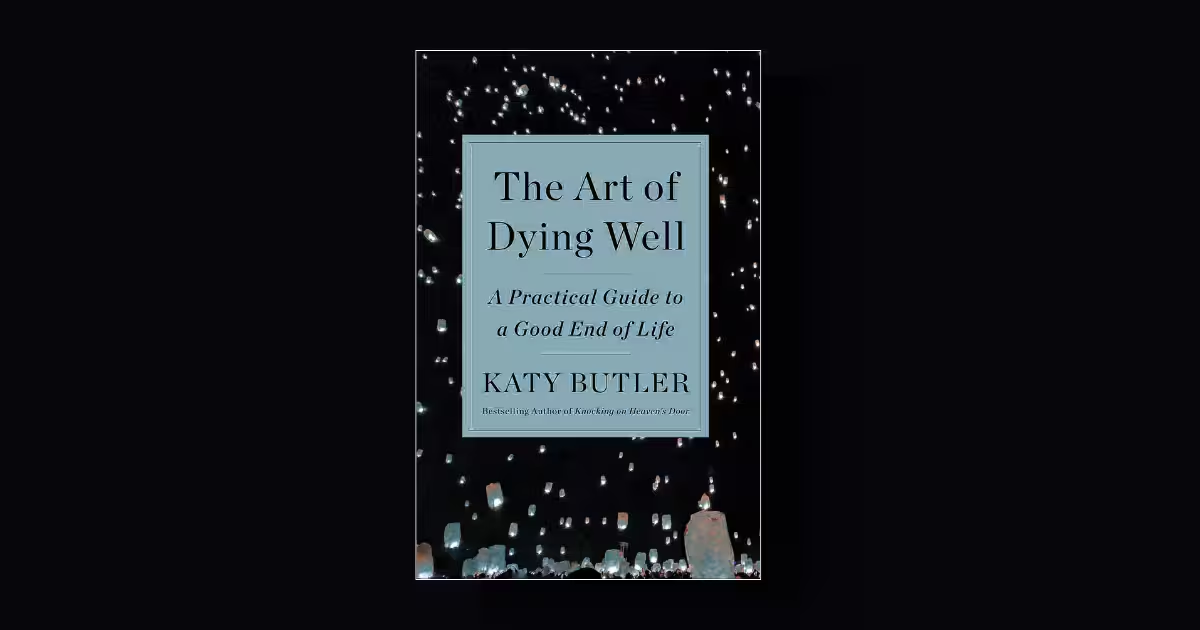
Ever wonder why we spend so much time planning for birth, weddings, and careers, yet leave the end of our lives to chance? Katy Butler’s The Art of Dying Well tackles this profound cultural blind spot head-on. Published by Scribner in February 2019, this book is a practical, compassionate, and deeply informative roadmap for navigating the final stages of life.
Overview
The Art of Dying Well is not a morbid book about death, but a vibrant, practical guide about living well, even as our bodies and minds begin to fail. Katy Butler, a New York Times bestselling author and award-winning journalist, argues that we have lost touch with the “art of dying” that our ancestors once practiced.
The book provides a step-by-step framework for navigating the predictable health stages of later life, from robust old age to the final breath. Butler empowers readers to reclaim their agency, make informed medical decisions, and shape a meaningful end-of-life experience that aligns with their values.
Reader Recommendation: Who Will Actually Love The Art of Dying Well
This book is essential reading for anyone over fifty, anyone caring for aging parents, and anyone diagnosed with a serious or terminal illness.
You will love this book if: you appreciate clear, actionable advice grounded in real-life stories; you want to understand the complex medical system to avoid unnecessary suffering; and you’re ready to have honest conversations about mortality with your family and doctors.
However, this book might not be for you if you are deeply uncomfortable thinking about death and decline, or if you prefer to avoid practical planning and leave medical decisions entirely to your doctors.
Some readers might find the detailed descriptions of medical procedures and the realities of dying confronting. But for those willing to engage, the payoff is immense: the chance to live and die on your own terms.
Table of Contents
Introduction
Book Title: The Art of Dying Well: A Practical Guide to a Good End of Life
Author: Katy Butler
Publication Details: Scribner, an imprint of Simon & Schuster, first published in February 2019. The audiobook, narrated by the author, has a runtime of approximately 10 hours and 28 minutes.
Context and Background of The Art of Dying Well
The Art of Dying Well is a nonfiction guide that sits at the intersection of healthcare, memoir, and practical philosophy. Katy Butler is a seasoned journalist and essayist whose work has appeared in The New York Times Magazine, The New Yorker, and The Wall Street Journal.
She is a finalist for a National Magazine Award and her previous book, Knocking on Heaven’s Door: The Path to a Better Way of Death, was a New York Times Notable Book and a Books for a Better Life Award winner. Butler’s deep personal experience caring for her aging parents, combined with her rigorous journalistic research, gives her a unique and authoritative voice on this subject.
Purpose and Central Thesis
The central argument of The Art of Dying Well is that while modern medicine excels at saving lives and fixing acute problems, it has largely forgotten how to help people die well. Butler contends that we have lost touch with the communal, spiritual, and practical wisdom that guided our ancestors through the deathbed.
The book’s primary purpose is to provide a modern “Ars Moriendi” – a guide to reclaiming the power to shape how we live and die, even in an era of high-tech medicine.
As Butler writes in the introduction, the book is a “step-by-step guide to remaining as healthy and happy as possible…through the predictable health stages of later life”.
Background
Butler’s work is grounded in a stark reality. She points out that while more than three-quarters of Americans hope to die at home, fewer than a third actually do.
Nearly a third of people spend time in an intensive care unit in their final month, and 17 percent of Americans die in an ICU. This is a direct result of a medical system that is “poorly structured to meet the needs of aging people,” a system that pours its money, energy, and time into “saving lives, curing the curable, and fixing the fixable”. This “fast medicine” conveyor belt, as Butler describes it, does a poor job of addressing the needs of those with incurable conditions.
As she puts it, “The modern custom of reducing dying to a medical procedure, and stripping it of dignity and humanity, is intensifying”.
Butler draws a powerful contrast with the past, referencing the 15th-century Catholic monk who wrote the Ars Moriendi (The Art of Dying), a medieval death manual that taught people how to navigate the physical and spiritual trials of the deathbed. Unlike today, where death is often hidden away in hospitals, our ancestors saw dying as a domestic and communal event, “as sacred and as familiar as a baptism or a wedding”.
This historical context underscores the book’s thesis: we have lost a crucial human skill and must consciously work to regain it.
The Art of Dying Well Summary
Katy Butler organizes the journey from healthy aging to death into seven distinct stages, and she devotes a chapter to each one. This structure makes the book incredibly practical, allowing readers to jump to the section most relevant to their current situation. Here is a breakdown of what I learned from each stage.
Chapter 1: Resilience
This chapter is for people in their fifties, sixties, and early seventies who are still generally healthy and active. The primary message here is one of empowerment. You still have the physical capacity to reverse substantial health problems. Butler urges readers to build their reserves—physically, socially, and spiritually.
The major threats to future well-being are identified as physical weakness, isolation, heart disease, lung disease, diabetes, and dementia.
The book provides clear, actionable advice. It emphasizes the importance of vigorous, pleasurable exercise, like walking briskly for at least half an hour daily. Butler cites a study showing that people over sixty-five who walk regularly can increase the size of their hippocampus, the brain’s memory center.
The chapter also highlights that lifestyle habits—smoking, a sedentary life, poor diet, and excessive alcohol—are responsible for 70 percent of the degenerative diseases that make later life difficult. Changing these habits after fifty-five can cut health risks by as much as sevenfold, a better payoff than almost all drugs.
Butler introduces the concept of “interdependence,” arguing that in later life, it’s vital to cultivate reciprocal relationships, get to know neighbors, and build a “tribe” of friends. She also tackles the practical and spiritual task of preparing for the future. This includes filling out advance directives and durable powers of attorney for healthcare. The chapter concludes with a powerful section on “Caring for the Soul,” encouraging readers to contemplate death as part of their spiritual practice.
Key Quote from the Book: In this chapter, Butler quotes Bertrand Russell, who wrote that an individual human existence “should be like a river: small at first, narrowly contained within its banks, and rushing passionately past rocks and over waterfalls. Gradually the river grows wider, the banks recede, the waters flow more quietly, and in the end, without any visible break, they become merged in the sea, and painlessly lose their individual being”.
Chapter 2: Slowing Down
This stage is characterized by a feeling that you are not who you used to be. You might be seeing several specialists, taking multiple medications, and finding your physical and cognitive reserves are thinner. The key message here is that “less is more.” Butler argues that for aging bodies, the rapid deployment of tests, drugs, and surgeries can expose them to unnecessary risk. This is where the philosophy of “Slow Medicine” comes into play.
A significant portion of this chapter is dedicated to the dangers of polypharmacy, the use of multiple medications. Butler tells the story of “Marj,” a ninety-two-year-old woman who was taking twenty-two different pills prescribed by six different doctors, creating a “disaster waiting to happen”. The solution is a medication review with a primary care doctor or geriatrician, who can help wean patients off drugs that are causing more harm than good. Butler specifically warns against anticholinergic drugs, which are found in many common over-the-counter remedies for sleep and allergies, as they “substantially increase the likelihood of developing dementia”.
Butler also advises against unnecessary health screenings.
She cites the American Academy of Family Physicians, which recommends against PSA tests for men over seventy-five without a family history of fast-moving prostate cancer. Similarly, colonoscopies are not recommended for people over seventy-five without a family history of colon cancer.
The chapter encourages readers to make peace with loss and to simplify their lives by decluttering and focusing on what truly brings them joy and meaning.
Chapter 3: Adaptation
This chapter addresses the moment when you realize you are not going to get better.
This is the “new normal.” You may have given up driving, use a cane or walker, and need help with chores. Butler tells the poignant story of Bronni Galin, an eighty-two-year-old psychotherapist who had to stop driving due to macular degeneration.
Her life was drastically reconfigured, but she adapted by moving in with a friend and joining “Marin Villages,” a mutual aid network for older people.
A key insight from this chapter is the importance of interdependence. “Human beings are herd animals,” Butler writes. “We give and receive help throughout our lives”. The chapter emphasizes the need to abandon shame and accept help graciously. Butler encourages readers to find allies in occupational and physical therapy, whose goal is “not to have you running marathons. It’s to keep you doing things that give your life joy”. She provides a detailed guide to “disaster-proofing” daily life by reducing fall risks: installing grab bars, removing throw rugs, and improving lighting.
The chapter also addresses the difficult decision of moving to a new home or retirement community.
Butler provides a list of questions to ask when considering such a move, including: “Can you walk to interesting places?” and “What is the policy regarding minor falls?”. Finally, she discusses the importance of being an example to others.
Drawing on the work of psychologist Valery Hazanov, she notes that people who cope best with aging and pain are those who have long been passionate about something outside themselves—a hobby, a cause, or a creative pursuit.
Chapter 4: Awareness of Mortality
This is the chapter for when a doctor says you have a “serious” or terminal illness. The central lesson here is the “art of honest hope”, the ability to accept death while continuing to live fully. Butler uses the story of Amy Berman, a nurse who was diagnosed with stage-four breast cancer.
When a top oncologist presented her with a grueling treatment plan without asking what mattered to her, she walked away. She instead chose a gentler approach that allowed her to maintain her quality of life, eventually outliving many who opted for more aggressive treatments.
Butler provides crucial guidance on how to talk to your doctor. She suggests opening with, “I want a realistic picture, so I can plan”. She also encourages readers to ask for a “sketch” of the trajectory of their illness.
The book outlines four common trajectories: the Niagara Falls trajectory (high functioning followed by a rapid decline), the Looping Decline (repeated crises with partial recovery), the Stair Step Down (sudden drops in functioning), and The Dwindles (a slow, gradual wearing out). Understanding which trajectory you are on can help you make more informed decisions.
This chapter is also a powerful introduction to palliative care. Butler explains that palliative care focuses on relieving suffering and improving function, not on curing disease. She points out that people who get palliative care often live longer and with less suffering than those who continue with harsh, last-ditch treatments.
She encourages readers to ask their doctors, “What is it like to die of my disease, and how can medicine ease my symptoms?”.
Chapter 5: House of Cards
This stage describes a state of health as precarious as a structure built of playing cards. It is for people who are frail, perhaps with dementia, who spend ten hours or more a day sleeping, and who might have been to the emergency room in the past year and come back worse. The chapter’s core message is that protection from inappropriate medical care is now at least as important as access to it.
Butler tells the heartbreaking story of her own father, Rick Hoefer, an eighty-three-year-old man with multiple health conditions who underwent a minimally invasive heart procedure.
The procedure was a technical success, but it was catastrophic for Rick. He never walked again and died nine months later. The procedure was “the feather that knocked him over.”
The chapter emphasizes the dangers of hospitalization for the frail. A hospital stay can lead to muscle wasting, hospital delirium, and a permanent decline in function. Butler urges readers to avoid the emergency room for minor issues and to explore alternatives like physician house call programs, which are being revived across the country.
She also provides an in-depth guide to upgrading advance directives to a POLST or MOLST, a doctor’s order that is more likely to be honored in a crisis.
The chapter offers a deeply compassionate and practical guide to coping with dementia. It provides a sample letter to a medical advocate, outlining a vision of “comfort care” that includes refusing feeding tubes, antibiotics, and hospital transport, while prioritizing pain management and a natural death. Butler concludes with a simple but profound piece of advice for those in the “House of Cards”: “Enjoy the day”.
Chapter 6: Preparing for a Good Death
This chapter is for when you are within six months to a year of dying.
The key message is to make good use of the time you have left. Butler tells the story of Mary Jane Denzer, an eighty-two-year-old woman with pancreatic cancer who chose to enroll in hospice after a brutal round of chemotherapy. Against all expectations, she lived for another year, full of purpose, joy, and connection.
A significant portion of this chapter is dedicated to demystifying hospice. Butler debunks common myths, such as the idea that hospice is a building, that it’s only for the last few days of life, or that it’s a “death warrant”.
She explains that hospice is a package of services that provides medical, emotional, and spiritual support to terminally ill people and their families. She emphasizes that people who get hospice care early often continue to work, see friends, and do what matters to them.
The chapter also guides readers through the “five emotional tasks of dying,” popularized by hospice doctor Ira Byock: “Please forgive me. I forgive you. Thank you. I love you. Goodbye”. Butler shares powerful stories of reconciliation and forgiveness that occurred at the end of life, showing how a good death can heal old wounds.
She also offers practical advice on settling one’s affairs, including writing legacy letters and making funeral plans.
Chapter 7: Active Dying
The final chapter describes the last few weeks or days of life. Butler provides a frank and comforting description of what dying looks like, including the physical signs such as a lack of appetite, withdrawal, and “rallying”, a sudden burst of joy and energy before death.
The Art of Dying Well emphasizes that dying is a natural process, akin to giving birth, and that it can be a “good enough” death, even if it’s not perfect.
Butler provides practical guidance on preparing for a home death, including creating a “death kit” with necessary supplies and making an alternative plan to calling 911. She also discusses how to humanize a hospital death, offering suggestions like asking for a private room, removing unnecessary medical equipment, and creating a sacred space with photos and music.
The chapter includes beautiful examples of improvised rites of passage, such as a ceremony where a dying girl untied knots that represented her guilts.
It also features a moving story of a family washing and anointing their mother’s body after death, a practice that brought them peace.
The Art of Dying Well Analysis
The Art of Dying Well is a profoundly important and necessary book. It is a groundbreaking work that fills a critical void in our cultural conversation about aging and death. Butler’s approach is not just informative; it is deeply humanizing.
She takes a topic that our society often shrouds in fear and silence and makes it approachable, practical, and even empowering. The book’s structure, moving through seven distinct health stages, is a masterstroke of organization, allowing readers to find the guidance they need without getting lost in a sea of information.
Butler effectively supports her arguments with a powerful combination of personal narrative, rigorous reporting, and compelling statistics. For instance, the statistic that “lifestyle habits are responsible for 70 percent of the degenerative diseases that make later life difficult” provides a concrete, motivating reason to adopt healthier habits.
Her use of real-life stories—Doug von Koss, Bronni Galin, Amy Berman, and the Manfreddi family—makes the abstract concepts of medical ethics and end-of-life planning tangible and emotionally resonant. These aren’t just case studies; they are people with whom we can identify.
Strengths and Weaknesses
Strengths
1. Practicality and Actionability. The book is a manual, not just a philosophical treatise. Each chapter ends with a “Ways to Prepare” list that provides concrete steps the reader can take immediately. Butler does not just describe the problem; she offers a solution. She provides clear instructions on how to get a medication review, how to talk to a doctor about a terminal diagnosis, and how to fill out a POLST form.
2. Compassionate and Human Tone. Butler writes with a deep sense of empathy and understanding. She never judges the people in her stories, whether they are the patients making difficult decisions or the families struggling with grief. This compassion extends to the reader, making the book feel like a conversation with a wise and trusted friend. The book is “comforting…thoughtful”.
3. Evidence-Based and Authoritative. Butler is an award-winning journalist, and it shows. Her arguments are grounded in research, statistics, and the opinions of leading medical experts.
She references studies, such as the one on the benefits of walking for brain health, and she is not afraid to call out the flaws in the healthcare system, such as the financial incentives that promote overtreatment.
Weaknesses
1. AUSA-Centric Focus. As one reviewer noted, the book is “USA-centric as to care options”. The details about Medicare, Medicaid, and the American healthcare system are not directly applicable to readers in other countries.
While the core philosophy and many of the practical suggestions (like having conversations with family) are universal, the specific medical and financial guidance may need to be adapted.
2. Emotional Weight. The subject matter is inherently difficult, and Butler does not shy away from the painful realities of aging and dying. Some readers, particularly those who have recently lost a loved one or are facing a serious diagnosis, may find the book emotionally overwhelming. As one reviewer noted, “I cried a lot reading this book”. This is a sign of the book’s power, but it’s also a potential challenge for some readers.
3. Can Be Repetitive. At times, the book’s extensive detail can feel slightly repetitive, especially for readers who are already familiar with some of the concepts, like the importance of advance directives. However, this repetition reinforces the key messages and ensures that the guidance is clear and memorable.
Comparison with Similar Works
The Art of Dying Well is a worthy successor to other landmark books on the subject of death and dying, but it carves out its own unique niche.
It shares the same mission as Atul Gawande’s Being Mortal (2014), which also explores how medicine can better serve the needs of the aging and dying. However, while Gawande focuses more on the systemic and philosophical issues within medicine, Butler provides a more granular, step-by-step guide for the individual.
The book also echoes the work of Elisabeth Kübler-Ross, the pioneering psychiatrist who wrote On Death and Dying (1969) and introduced the five stages of grief. Yet, Butler’s work is more practical and less theoretical. She focuses on what you can do, not just what you might feel.
For readers interested in the spiritual dimensions of dying, Butler’s work can be paired with Joan Halifax’s Being with Dying (2008), which offers a Zen Buddhist perspective. However, Butler’s approach is secular and accessible to people of all faiths or none.
In essence, The Art of Dying Well is the missing practical manual that complements the more philosophical works in this field. It is, as one review put it, “the best guidebook I know of for navigating the later stages of life”.
Conclusion
The Art of Dying Well is a vital, life-affirming, and deeply practical guide that everyone should read—whether you are in your twenties or your eighties. It is an essential tool for anyone who wants to live a meaningful life, right up to the very end. Katy Butler has done an extraordinary service by demystifying the end of life and providing a clear path to reclaiming our agency.
Who will benefit most from reading this book? Anyone who is aging, anyone who cares for an aging loved one, and anyone who wants to ensure they are not at the mercy of a fragmented medical system. It is suitable for general audiences, though its emotional depth and subject matter may be challenging for some.
As one reviewer summarized, it’s “full of useful information” and an “opportunity to reflect on your relationship with and perspective on death”.
Ultimately, this book is a gift. It gives us the language, the tools, and the courage to face our mortality, not with fear, but with intention and peace.







