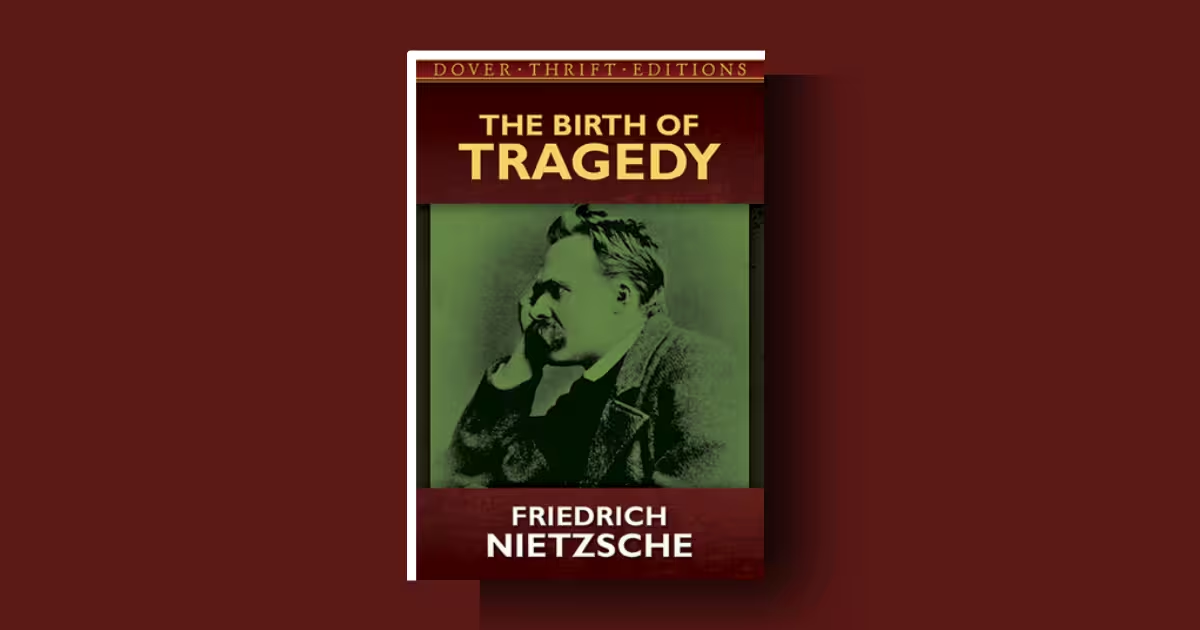
Do you know what it feels like to wrestle with a book that seems determined to make you hate it? That was my experience with Friedrich Nietzsche’s The Birth of Tragedy. Here was a young professor, just 28 years old, recently appointed to a prestigious chair in classical philology at the University of Basel, who decided to torch his entire academic career with a single, fiery manifesto.
And somehow, against all odds, that reckless act of intellectual self-immolation became one of the most influential philosophy books ever written.
I went in expecting dense German philosophy. What I got was something closer to a fever dream—a book that Nietzsche himself later called “badly written, clumsy, embarrassing, furious and frenzied in its imagery”. The man literally apologized for his own book in a later preface.
Yet the same book that nearly ended his career before it began went on to shape twentieth-century thought more profoundly than almost any other philosophical work, rivaling only Freud and Marx in its cultural impact.
So here’s the question that kept me turning pages: How can something so flawed be so important?
Table of Contents
Overview
Published in 1872 as The Birth of Tragedy from the Spirit of Music (and reissued in 1886 as The Birth of Tragedy, Or: Hellenism and Pessimism), Nietzsche’s first book is simultaneously a study of ancient Greek tragedy, a manifesto for the regeneration of German culture through Wagnerian opera, and an extended argument about why rationalism has ruined everything.
Nietzsche’s central claim is that Greek tragedy emerged from the fusion of two opposing artistic forces: the Apollonian (associated with form, order, reason, and the beautiful illusion of individual identity) and the Dionysian (associated with chaos, emotion, intoxication, and the dissolution of the self into a primal unity).
The greatest art, he argues, arises when these two forces achieve a delicate balance, when the wild, formless energy of Dionysus is given beautiful shape by Apollo.
The book traces the birth of this fusion in Attic tragedy (Aeschylus and Sophocles), its death at the hands of the rationalist Socrates and the playwright Euripides, and its potential rebirth in the music of Richard Wagner. It’s a work of breathtaking ambition that ranges from ancient Greek religion to contemporary German politics, from the metaphysics of music to the psychology of dreams.
And it’s an absolute mess. Which is precisely why I loved it.
Reader recommendation
The Birth of Tragedy is best for:
- Readers who want to understand where Nietzsche’s later ideas came from
- Anyone interested in the philosophy of art and aesthetics
- People who enjoy intellectual provocations that challenge conventional thinking
- Students of Greek tragedy who want a radically different interpretation
- Music lovers curious about the philosophical significance of Wagner
The Birth of Tragedy is not for:
- Readers seeking a systematic, clearly argued philosophical treatise
- Anyone who needs their philosophy neat and tidy
- People who prefer their authors to be humble and measured
- Those looking for a scholarly, objective analysis of Greek drama
Background
To understand The Birth of Tragedy, you need to understand the man who wrote it. Friedrich Nietzsche was a prodigy—appointed to a professorship at Basel at just 24, he was the youngest professor of classical philology in Europe. He was also deeply influenced by two figures who would shape the rest of his intellectual life: the philosopher Arthur Schopenhauer and the composer Richard Wagner.
Nietzsche wrote most of the book while recovering from illness contracted during his brief service as a medical orderly in the Franco-Prussian War of 1870-71. He was convalescing in the Alps, the thunder of distant battles still echoing across Europe, when he began formulating his thoughts on the Greeks. The book was born out of a deeply personal, almost obsessive question: Why did the Greeks—the most beautiful, accomplished people in history—need tragedy?
This wasn’t an academic exercise.
Nietzsche genuinely believed that German culture was in crisis, that the recent military victory over France had created an opportunity for cultural rebirth, and that Wagner’s music might be the key. The Birth of Tragedy was his contribution to that rebirth—a call to arms disguised as classical scholarship.
The academic establishment was not impressed. Ulrich von Wilamowitz-Möllendorff, a rising star in classical philology, published a devastating critique accusing Nietzsche of inaccuracy, distortion, and lack of objectivity. Nietzsche’s career as a professional classicist was effectively over.
He would resign his professorship in 1879, at age 34, and spend the rest of his life as a wandering, mostly ignored philosopher.
The Birth of Tragedy Summary
The Apollonian and Dionysian: Nietzsche’s Central Duality
Nietzsche opens by defining two opposing artistic impulses that he sees as fundamental to Greek culture. The Apollonian takes its name from Apollo, the god of light, dreams, and prophecy. It represents form, order, individual identity, and the beautiful appearance that makes life bearable. Apollo is the god of sculpture and architecture, arts that create visible, stable forms.
The Dionysian takes its name from Dionysus, the god of wine and intoxication. It represents formless flux, ecstatic loss of self, and the terrifying insight into the underlying unity of all existence. Dionysus is the god of music, an art that has no physical form and speaks directly to our deepest emotions.
Nietzsche describes these forces through the analogy of dream and intoxication. In dreams, we experience the Apollonian world of beautiful images and individual forms. In intoxication, we experience the Dionysian dissolution of boundaries and union with something greater than ourselves.
Here’s how Nietzsche himself puts it in the text:
“We will have achieved much for the discipline of aesthetics when we have arrived not only at the logical insight but also at the immediate certainty of the view that the continuing development of art is tied to the duality of the Apollonian and the Dionysian.”
The Birth of Tragedy from Music
For Nietzsche, Greek tragedy represents the highest achievement of both impulses working together. The Dionysian element comes from music, the choral odes that were the original core of tragedy. The Apollonian element comes from the dramatic action and dialogue, which give beautiful form to the terrifying insights of the Dionysian state.
The tragic chorus, Nietzsche argues, is not a representation of the audience or a political institution. It is the embodiment of the Dionysian state—a group of transformed beings who have lost their individual identities and become one with the primal forces of nature. From this chorus, the vision of the tragic hero emerges, an Apollonian dream-image that makes the Dionysian truth bearable.
Nietzsche’s argument about the chorus is worth quoting directly:
“Following this insight, we must understand Greek tragedy as the Dionysian chorus which again and again discharges itself in an Apollonian world of images.”
The Death of Tragedy: Enter Socrates
The villain of Nietzsche’s story is Socrates—or rather, the rationalist spirit that Socrates represents. According to Nietzsche, Socrates introduced a new way of thinking that valued reason above instinct, knowledge above art, and optimism above tragic insight.
Socrates believed that virtue was knowledge, that reason could solve all problems, and that the world could be understood and improved through logic. This optimistic rationalism was completely incompatible with the tragic worldview, which recognized the fundamental suffering and irrationality of existence.
The playwright Euripides became the instrument of this rationalist revolution in art. Working in alliance with Socrates, Euripides stripped tragedy of its Dionysian elements and rebuilt it on purely Apollonian—that is, rational—principles. He brought the ordinary spectator onto the stage, replaced myth with psychology, and replaced music with rhetoric.
Nietzsche describes the consequences:
“To excise that original and all-powerful Dionysian element from tragedy and to rebuild tragedy purely on the basis of an un-Dionysian art, morality, and world-view—that is the Euripidean tendency.”
The Alexandrian Age and the Modern World
With the death of tragedy, Greek culture entered what Nietzsche calls the Alexandrian age—a period of dry scholarship, imitation, and the endless cataloguing of past achievements. This is the culture of the “theoretical man,” the scholar who believes that knowledge can solve all problems and that life can be perfected through science.
Nietzsche sees striking parallels between the Alexandrian age and his own time. The nineteenth century, with its obsession with history, its rationalism, and its faith in science, was repeating the mistakes of the Alexandrian Greeks. German culture was dying from an overdose of knowledge.
But Nietzsche also sees hope. The music of Beethoven and Wagner represents a resurgence of the Dionysian spirit, a return to the primal forces that created tragedy. If German culture could embrace this musical revival, it might experience its own rebirth of tragedy, a new art form that could heal the wounds of rationalism and restore meaning to existence.
Nietzsche’s hopes for this rebirth are expressed with characteristic passion:
“Yes, my friends, believe with me in the Dionysian life and in the rebirth of tragedy. The age of the Socratic man is over: garland yourselves with ivy, take the thyrsus in your hands, and show no surprise when the tiger and the panther lie down fawning at your feet.”
The Birth of Tragedy Analysis
The Power of the Duality
The Apollonian-Dionysian distinction has proven remarkably durable. It has been used to analyze everything from psychology to politics to literature. Sigmund Freud’s distinction between the conscious and unconscious, the tension between Eros and Thanatos, echoes Nietzsche’s duality.
Thomas Mann’s Death in Venice and D. H. Lawrence’s Women in Love explore the conflict between Apollonian restraint and Dionysian passion.
Why has this particular opposition proven so useful? I think it’s because Nietzsche identified something fundamental about human experience, the tension between our desire for order and our attraction to chaos, between the individual self we construct and the larger forces that threaten to dissolve it. We all feel this tension. Nietzsche just gave it a name.
The Critique of Rationalism
Nietzsche’s attack on Socrates and rationalism feels remarkably contemporary. We live in an age that worships data, that believes every problem has a technical solution, that trusts algorithms more than intuition. Nietzsche would recognize this world. He would see it as the culmination of the Socratic project, a culture drowning in its own knowledge, unable to create meaning or value.
The warning he offers is worth taking seriously. Reason is a tool, not a god. When we treat it as the only path to truth, we cut ourselves off from other ways of knowing—from art, from intuition, from the messy, irrational, vital forces that make life worth living.
The Book as Performance
Perhaps the most remarkable thing about The Birth of Tragedy is the way it enacts its own argument. This is not a calm, scholarly treatise. It’s a passionate, sometimes hysterical performance—a book that tries to do what it describes, to embody the Dionysian spirit even as it analyzes it.
Nietzsche himself later recognized this. In the 1886 preface, he wrote that the book “should have sung, this ‘new soul’—rather than spoken!” He regretted not having written it as poetry. But in a way, the book’s excesses are its strength. You can’t write about the Dionysian in a dry, academic style. You have to let some of the madness in.
The Birth of Tragedy Quotes
1. “Knowledge kills action; action requires the veils of illusion.”
This is perhaps the single most quoted line from the book. Nietzsche uses the example of Hamlet to argue that once you’ve seen the horrific truth of existence, you lose the motivation to act. It’s a devastating critique of the idea that knowledge is always a good thing.
2. The Wisdom of Silenus
“The best of all things is something entirely outside your grasp: not to be born, not to be, to be nothing. But the second best thing for you is to die soon.”
This is the famous legend where King Midas captures Silenus and forces him to reveal the worst thing about human existence. Nietzsche uses it to show that the Greeks created their beautiful art not because life was easy, but because it was unbearable.
3. “Christianity was from the beginning, essentially and fundamentally, life’s nausea and disgust with life.”
This line shows up everywhere. Nietzsche argues that Christianity is a “will to decline” that slanders this world in favor of an imaginary “better” one. It’s one of the clearest early statements of his lifelong hostility to Christian morality.
4. “It is only as an aesthetic phenomenon that existence and the world are eternally justified.”
This is the philosophical heart of the book. Nietzsche insists that art, not morality or religion, is what makes life worth living. It’s his answer to the question of how to endure a meaningless world.
5. “Without myth, however, every culture loses its healthy creative natural power.”
Nietzsche argues that myth is the foundation of cultural vitality. Without it, culture becomes rootless and dead. This passage has been hugely influential on thinkers like Joseph Campbell.
6. “Man is no longer an artist, he has become a work of art.”
In the Dionysian state, the individual dissolves and becomes part of something greater. This line captures Nietzsche’s vision of art as a metaphysical activity that transforms human existence.
7. “Wherever the Dionysian prevailed, the Apollonian was checked and destroyed.”
This passage describes the eternal struggle between the two artistic impulses. The two forces are locked in a perpetual conflict that neither can fully win.
8. “Greek tragedy perished by suicide.”
Nietzsche argues that tragedy didn’t fade away naturally—it destroyed itself. Socrates and Euripides killed it from within.
9. “Language can never adequately render the cosmic symbolism of music.”
For Nietzsche, music is the deepest art form because it speaks directly to the will. Language can only scratch the surface.
10. The Metaphysical Comfort of Tragedy
“The metaphysical comfort—with which, I am suggesting even now, every true tragedy leaves us—that life is at the bottom of things, despite all the changes of appearances, indestructibly powerful and pleasurable.”
This is Nietzsche’s definition of what makes tragedy great—not despair, but the consolation that life itself is eternal.
Strengths and Weaknesses
What Works
The central insight is genuinely original. Before Nietzsche, most commentators saw Greek culture as serene and harmonious. Nietzsche showed that this serenity was a hard-won victory, not a natural state—that the Greeks had to struggle with darkness to achieve their brilliance.
The writing is electric. Even when it’s frustrating, The Birth of Tragedy is never boring. Nietzsche’s prose crackles with energy, with exclamation points and rhetorical questions and images that leap off the page.
The ambition is breathtaking. This is a book that tries to explain everything—art, religion, psychology, politics, the fate of Western civilization. Even when it fails, it fails magnificently.
What Doesn’t
The argument is often sloppy. Nietzsche makes sweeping claims without adequate evidence. He attributes motives to historical figures based on little more than intuition. He assumes what he needs to prove.
The Wagner worship is embarrassing. Nietzsche’s belief that Wagner would save German culture now seems naive, even comical. Wagner was a brilliant composer but a deeply problematic human being, and his music hardly produced the cultural renaissance Nietzsche hoped for.
The book is poorly organized. It reads like a series of brilliant intuitions strung together rather than a coherent argument. Ideas appear and disappear. The structure is confusing.
Nietzsche himself acknowledged many of these flaws. In his 1886 preface, he called it “an impossible book” and listed its faults with devastating honesty. But he also defended its essential insight—the importance of the Dionysian in art and life.
Comparison with Similar Works
The Birth of Tragedy belongs to a tradition of works that use classical Greek culture to criticize modernity. Johann Joachim Winckelmann’s Reflections on the Imitation of Greek Works (1755) also presented Greece as a model for artistic excellence, but Winckelmann emphasized the serene, harmonious aspects of Greek art rather than the dark, Dionysian elements Nietzsche uncovered. Schiller’s On Naive and Sentimental Poetry (1795) made a similar distinction between spontaneous ancient creativity and self-conscious modern sensibility.
More recently, The Birth of Tragedy has influenced works like Thomas Mann’s Doctor Faustus (1947), which explores the link between artistic innovation and political barbarism, and Antonin Artaud’s The Theatre and Its Double (1938), which called for a return to the ritual, non-verbal elements of theatre.
Conclusion
The Birth of Tragedy is not a perfect book. It’s not even a particularly good book, if you judge it by the standards of academic philosophy. It’s messy, overblown, and full of assertions that don’t stand up to scrutiny. Nietzsche himself knew this. He spent much of his later career trying to live down the reputation this book gave him.
But here’s the thing: The Birth of Tragedy is also a work of genuine genius. It identified a duality at the heart of human experience that has proven remarkably fruitful. It offered a critique of rationalism that feels more relevant than ever. And it did all this with a passion and urgency that makes most academic philosophy feel like dry bones.
More than 150 years after its publication, scholars are still debating its meaning and significance. It has been interpreted as a work of aesthetics, of cultural criticism, of psychology, of politics.
It has been claimed by radicals and conservatives, by artists and philosophers. This interpretive richness is itself a kind of proof that Nietzsche was onto something.
If you’re looking for a neat, systematic philosophical argument, this isn’t the book for you. But if you want to read a young genius working through ideas that would change the world, if you want to watch someone wrestle with the biggest questions while risking everything they have, then The Birth of Tragedy is essential reading.
Just don’t expect it to make complete sense. That’s not the point.