Do you know why a 1971 genocide that claimed up to 3 million lives remains almost entirely forgotten in American memory, while the men who enabled it are still celebrated as foreign policy geniuses?
That question haunted me throughout every page of Gary J. Bass’s The Blood Telegram: Nixon, Kissinger, and a Forgotten Genocide . And honestly? It’s still haunting me.
Overview
The Core Tragedy: In 1971, the Pakistani military launched a brutal crackdown on East Pakistan (now Bangladesh) to crush a popular movement for autonomy. This resulted in one of the worst humanitarian catastrophes of the 20th century.
The U.S., led by President Nixon and his National Security Advisor Henry Kissinger, provided crucial support to the Pakistani dictatorship, despite having detailed, first-hand knowledge of the genocide.
The Human Cost:
Deaths: Estimates of the death toll vary widely. The Bangladesh government puts the figure at 3 million. Independent researchers often estimate between 300,000 and 500,000. Even conservative U.S. government estimates during the crisis were staggering: midway through the bloodshed, the CIA and State Department estimated 200,000 people had already lost their lives. At least a quarter of a million Bengalis died.
Refugees: The crackdown forced a massive exodus of 10 million Bengali refugees into India. At the peak, 50,000 refugees were arriving in India daily. 90% of these refugees were from the Hindu minority, who were disproportionately targeted.
Sexual Violence: An estimated 200,000 to 400,000 women and girls were subjected to rape and sexual violence by the Pakistani army and its allies.
The U.S. Complicity:
Aid to Pakistan: The U.S. provided military aid to Pakistan, with weapons used in the crackdown. Even after Congress imposed an arms embargo, Nixon and Kissinger illegally funneled weapons to Pakistan through countries like Iran and Jordan.
The “Blood Telegram”: U.S. Consul General Archer Blood and 20 of his staff sent a formal dissent cable to Washington, accusing their own government of “moral bankruptcy” in the face of what they called “genocide”. The dissent was ignored.
The “China Card”: Kissinger and Nixon were secretly using Pakistan’s dictator, Yahya Khan, as a channel to open relations with China. They refused to pressure him or condemn the atrocities for fear of jeopardizing this historic diplomatic goal.
The Result: The crisis culminated in the India-Pakistan War of 1971, which ended with the surrender of Pakistani forces in Dacca and the creation of the independent nation of Bangladesh. The book is a damning account of how Cold War realpolitik and personal prejudice triumphed over basic human decency and American values.
Who should read this book: If you care about US foreign policy, human rights, Cold War history, or understanding how democratic leaders can enable mass atrocities while claiming moral authority, this book is essential reading. You’ll come away angry, informed, and asking hard questions about what “realism” actually means.
Who should skip it: If you’re looking for a neutral, “both sides have a point” history, this isn’t that book. Bass makes his moral judgment clear from the first page. Also, if graphic descriptions of violence and refugee suffering are too much for you, be warned, the book doesn’t flinch.
Table of Contents
1. Introduction
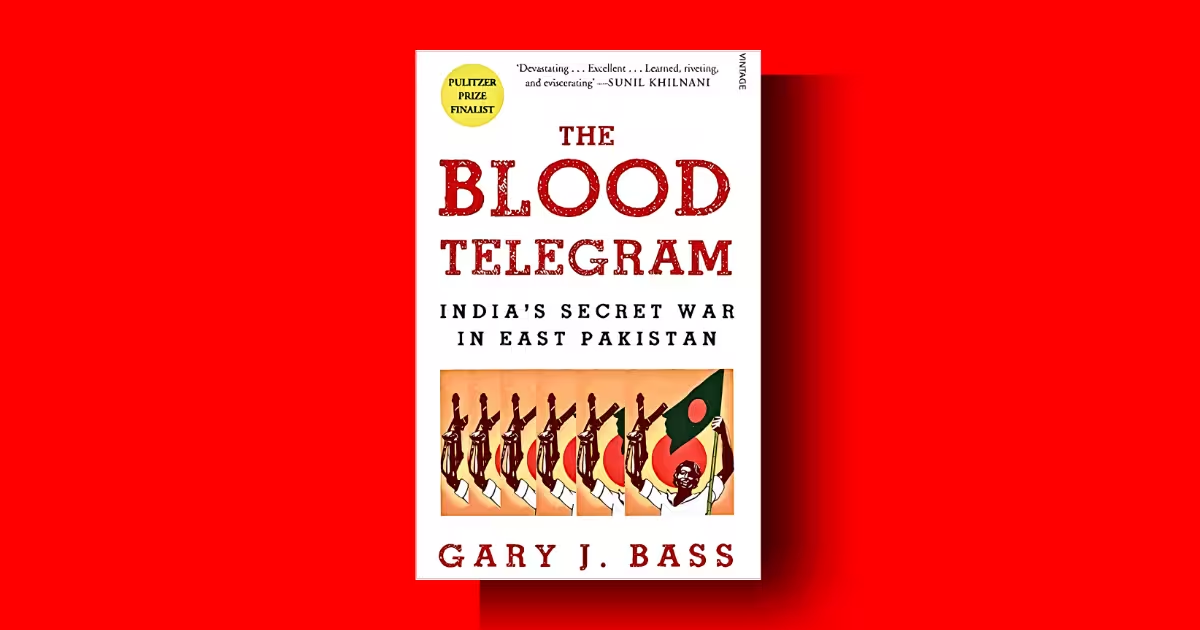
The Blood Telegram: Nixon, Kissinger, and a Forgotten Genocide by Gary J. Bass
- Publisher: Alfred A. Knopf (2013)
- Pages: xxiv + 499
- ISBN: 978-0-307-70020-9
- Awards: Winner of the 2014 Lionel Gelber Prize for Foreign Affairs; Finalist for the Pulitzer Prize; New York Times Notable Book; Washington Post Notable Book; Economist Best Book of the Year
Context of The Blood Telegram
The book chronicles one of the most shameful chapters in American foreign policy, a chapter most Americans have never heard of.
Bass, a professor of politics and international affairs at Princeton University, previously wrote Freedom’s Battle: The Origins of Humanitarian Intervention and Stay the Hand of Vengeance: The Politics of War Crimes Tribunals.
His expertise in humanitarian intervention and international law makes him uniquely qualified to dissect how the United States actively supported a genocide while claiming moral leadership of the “free world.”
Purpose of The Blood Telegram
The book’s central argument is devastatingly simple: Richard Nixon and Henry Kissinger knowingly supported Pakistan’s military dictatorship as it carried out mass atrocities against its own Bengali population, not despite knowing what was happening, but while receiving detailed, firsthand reports of the slaughter.
And they did this primarily because Pakistan’s dictator, Yahya Khan, was useful as a secret channel to China.
2. Background
To understand the tragedy, you need to understand the context.
Pakistan in 1970 was a geographical absurdity, two wings separated by a thousand miles of Indian territory. East Pakistan (now Bangladesh) had a larger population than West Pakistan but was treated as a colony by the Punjabi-dominated military elite in the west.
In November 1970, a catastrophic cyclone hit East Pakistan, killing at least 230,000 people. The central government’s response was, in the words of U.S. Consul General Archer Blood, “almost as if they just didn’t care”.
Then came the December 1970 elections, Pakistan’s first free and fair democratic vote. The Awami League, led by Sheikh Mujibur Rahman, won an overwhelming majority in East Pakistan. But rather than transfer power, Yahya Khan postponed the National Assembly and, on March 25, 1971, launched Operation Searchlight, a military crackdown aimed at crushing Bengali nationalism.
What followed was systematic slaughter. The Pakistani army targeted Bengali civilians, particularly Hindus, with a brutality that shocked even hardened diplomats.
3. The Blood Telegram Summary
The Man Who Refused to Stay Silent
The Blood Telegram opens with Archer Blood, the U.S. consul general in Dacca. On the night of March 25, 1971, Blood watched from his roof as tracer bullets lit up the sky and machine guns rattled through the city. He knew the people in the darkness below, many were friends.
Blood and his staff began sending detailed cables to Washington documenting the atrocities: professors dragged from their homes and shot, students mowed down in their dormitories, Hindu neighborhoods systematically burned.
The response from Washington? “A deafening silence”.
The Telegram That Changed Everything
On April 6, 1971, Blood and twenty of his colleagues sent what became known as the “Blood Telegram”, a formal dissent cable accusing their own government of “moral bankruptcy” in the face of what they bluntly called “genocide”.
The cable read, in part:
“Our government has failed to denounce the suppression of democracy. Our government has failed to denounce atrocities. Our government has failed to take forceful measures to protect its citizens… Our government has evidenced what many will consider moral bankruptcy”(p. 77).
This was unprecedented. Never before had American diplomats so publicly repudiated their own government’s policy. And for their courage, Blood was effectively fired, recalled from his post and professionally exiled.
Nixon and Kissinger: The Real Story
Bass’s use of White House tapes is what makes this book truly devastating. We hear Nixon and Kissinger in their own words, without the polish of memoirs.
When informed of the massacres, Nixon compared the situation to Hitler’s persecution of Jews, and then did nothing(p. 86-87). When told that Hindus were being specifically targeted for extermination, neither man expressed concern(p. 154). Instead, they worried about embarrassing Yahya.
Kissinger sneered at people who “bleed” for “the dying Bengalis”. Nixon called Indians “slippery, treacherous people” and “goddamn Indians”(p. 177, 209). He referred to Indira Gandhi as “the old bitch”(p. 252).
The personal racism is staggering. But what’s worse is the policy that flowed from it.
The China Connection
Here’s the cold calculation: Yahya Khan was secretly carrying messages between Washington and Beijing. Nixon and Kissinger needed him to open relations with China. So they couldn’t afford to pressure him, no matter how many Bengalis died.
As Kissinger himself admitted, they needed Yahya “for six months”(p. 148). Those six months coincided with the worst of the killing.
In Nixon’s own handwritten note from April 1971: “To all hands. Don’t squeeze Yahya at this time”.
India’s Impossible Choice
The book also provides a balanced treatment of India’s role. Indira Gandhi’s government faced an impossible situation: ten million refugees fleeing into India, most of them Hindus targeted for extermination.
India’s response was not purely humanitarian. Bass shows that Gandhi and her advisers were also motivated by strategic calculation, the chance to permanently weaken Pakistan(p. 92-94). India secretly armed and trained Bengali insurgents, the Mukti Bahini(p. 95-99). Indian troops crossed into East Pakistan.
But here’s the crucial point: India kept its borders open to refugees, even though it couldn’t afford to shelter them(p. 190-192). As Edward Kennedy said at the time, India “could have cordoned off its land and refused entry. But, to its everlasting credit, India chose the way of compassion”(p. 190).
The Illegal Arms Pipeline
One of the book’s most damning revelations: Nixon and Kissinger knowingly broke U.S. law to continue arming Pakistan.
Even after Congress imposed an arms embargo, Kissinger told Nixon they could secretly funnel weapons through Jordan and Iran. When Nixon asked if it was legal, Kissinger admitted it wasn’t. Nixon’s response? “We’ve done worse”(p. 298).
The operation was conducted with the full knowledge that U.S. weapons were being used to slaughter civilians. The State Department and Pentagon lawyers warned them it was illegal. They did it anyway(p. 294-296).
The War and Its Aftermath
Pakistan’s attack on India on December 3, 1971, triggered full-scale war. India crushed Pakistan’s forces in the east and secured the surrender of Pakistani troops in Dacca on December 16(p. 319-320). Bangladesh was born.
But the human cost was staggering. At least 200,000, and possibly up to 3 million, Bengalis died. Ten million became refugees.
And what did Nixon and Kissinger do? They sent the USS Enterprise carrier group into the Bay of Bengal to intimidate India(p. 311-312). They secretly encouraged China to mass troops on India’s border(p. 291-293). They broke U.S. law to funnel weapons to Pakistan, all to prevent India from winning too decisively(p. 293-302).
Islam as a Unifying Idea for Pakistan
The book describes how the concept of a shared Muslim identity was the primary ideological foundation for Pakistan’s existence as a single nation, a concept that ultimately failed.
According to a senior Indian diplomat, Pakistan was described by critics as a “geographical monstrosity” united only by Islam, the English language, and Pakistan International Airlines.
Indian officials and strategists, such as P. N. Haksar, argued that the war “clearly establishes the total inadmissibility of trying to found a nation on a religious basis”.
Indira Gandhi herself argued that Pakistan’s obsession with “Indophobia was clothed in the metaphysics of holy wars and the defence of Islam”.
Anti-Hindu Prejudice as a Driver of Atrocities
The military campaign was not framed in terms of “Islamist militancy” but was driven by a violent anti-Hindu ideology that was central to the Pakistani military’s worldview.
The book provides extensive documentation of the systematic targeting of the Hindu minority in East Pakistan, which Archer Blood and other U.S. diplomats repeatedly labeled as “genocide”.
The reasoning behind this was explicitly religious and ethnic: the Pakistan army viewed Hindus as a fifth column and sought to “purify” East Pakistan by driving them out. One U.S. official noted that the army’s rationale was that “by eliminating Hindus, Pakistan purifies itself, rids itself of anti-state, anti-Pakistan, anti-Islam elements”.
Pakistani forces would target Hindus by checking for circumcision and forcing them to recite Muslim prayers.
4. The Blood Telegram Analysis
What Bass Gets Right
This book is a masterpiece of archival research. Bass spent years in American and Indian archives, listened to hundreds of hours of White House tapes, and interviewed key participants. The result is a level of detail that makes the moral failures impossible to ignore.
The use of the Nixon tapes is particularly effective. We don’t have to guess what Nixon and Kissinger thought, we hear them say it. When Kissinger sneers at people who “bleed” for Bengalis, we know exactly what he meant.
The book also does something rare: it treats Indian decision-making with seriousness. Bass doesn’t pretend India’s motives were purely humanitarian, he shows the strategic calculations clearly. But he also shows that India’s democratic politics forced Gandhi to respond to public outrage in ways that Nixon and Kissinger never had to(p. 194-197).
What Bass Gets Wrong (or Could Have Done Better)
The book is not neutral, and it doesn’t pretend to be. Bass makes his moral judgment explicit: Nixon and Kissinger were complicit in genocide. If you’re looking for “both sides” analysis, you won’t find it here.
Some critics have argued that Bass is too harsh on Nixon and Kissinger while giving insufficient attention to the atrocities committed by Bengali nationalists against Bihari Muslims. The book does acknowledge these reprisal killings, but they receive less attention than the Pakistani army’s crimes.
The book also doesn’t fully explore why the American public didn’t pressure Nixon more. Vietnam fatigue is mentioned, but the deeper question of why Americans didn’t care about brown people dying far away is left somewhat unexplored.
5. Strengths and Weaknesses
Strengths
Unmatched Archival Work: Bass’s research is extraordinary. The White House tapes alone make this book indispensable.
Moral Clarity: The book doesn’t equivocate. When leaders enable genocide, they deserve condemnation.
Balanced Treatment of India: Bass shows India’s mixed motives without dismissing the genuine humanitarian impulse.
Readable Narrative: Despite the grim subject, the book is compulsively readable.
Weaknesses
Not Neutral: If you want a “balanced” account, this isn’t it. Bass makes his judgment clear.
Limited Attention to Bengali Atrocities: The reprisal killings against Biharis are acknowledged but not explored in depth.
Limited Exploration of American Public Opinion: Why didn’t Americans care more? The question is raised but not fully answered.
6. Comparison with Similar Works
The Blood Telegram stands alongside Samantha Power’s A Problem from Hell as a searing indictment of American inaction in the face of genocide. But Bass goes further: this wasn’t inaction, it was active support.
Christopher Hitchens’s The Trial of Henry Kissinger makes similar arguments but lacks Bass’s scholarly depth. The Nixon tapes alone give Bass’s work an authority Hitchens couldn’t match.
For the military and political history of the war, War and Secession by Richard Sisson and Leo Rose remains essential. But Bass’s focus on U.S. decision-making makes his book unique.
For Pakistani perspectives, The Betrayal of East Pakistan by A. A. K. Niazi offers a Pakistani general’s account. For Indian perspectives, Surrender at Dacca by Jacob-Farj-Rafael Jacob is invaluable.
7. Conclusion
Reading this book made me angry. Not the kind of abstract anger at historical injustice, the kind of anger that comes from realizing that people who are still alive, still celebrated, made choices that cost hundreds of thousands of lives.
Kissinger is still alive as I write this. He still gives speeches. He’s still consulted by presidents. And he’s never apologized for Bangladesh, or for Cambodia, or for Chile, or for any of the other places where his “realism” meant turning a blind eye to slaughter.
Nixon is dead, but his legacy lives on. The opening to China was a genuine achievement. But it came at a cost: the lives of Bengalis who were sacrificed so that Nixon could have his moment with Mao.
Recommendation
Who should read this book: Anyone who cares about American foreign policy, human rights, or Cold War history. Anyone who wonders how democracies can enable atrocities. Anyone who wants to understand why South Asia is the way it is today.
Who should skip it: If you’re looking for a neutral account, this isn’t it. If graphic descriptions of violence bother you, be warned, the book doesn’t flinch.
Final Thought
Archer Blood died in 2004, his career ruined by his courageous stand. Nixon and Kissinger went on to be celebrated as foreign policy geniuses. Kissinger is still a revered figure in many circles.
That tells you everything you need to know about who we choose to remember, and who we choose to forget.
Related Films: The Killing Fields (1984), Bangladesh: A New Nation (documentary)