

Last updated on October 24th, 2026 at 12:35 pm
Is The Color Purple worth reading today? Yes, and maybe more than ever. Alice Walker’s 1982 novel opens with one of the most disturbing first pages in American fiction, then spends the next forty years of its heroine’s life showing how a girl who was told to stay silent ends up running her own business, loving whom she wants, and talking back to God.
I finished my reread of The Color Purple convinced that most people remember the wrong book.
They remember the beatings. What Walker actually wrote is a novel about who you send your letters to, and how changing that address can save your life.
Table of Contents
At a glance
The Color Purple (Harcourt Brace Jovanovich, 1982) is an epistolary novel by Alice Walker about Celie, a poor Black girl in rural Georgia, told mostly through her letters to God and to her sister Nettie.
It won the 1983 Pulitzer Prize for Fiction and the National Book Award, and Walker became the first Black woman to win the Pulitzer for fiction.
The story covers roughly four decades: incest, a forced marriage, a love affair with the blues singer Shug Avery, the discovery of decades of hidden letters, and a final family reunion.
Its deepest subject is not violence but voice: Celie moves from writing “Dear God” because no one else will listen to writing “Dear Everything” because she finally sees the sacred all around her.
It is one of the most challenged books in the United States, ranking No. 17 on the ALA’s most challenged list for both the 1990s and 2000s.
Rating: 4.5/5. Read it if you can handle graphic abuse in the opening chapters. The payoff is one of the most earned happy endings in modern literature.
Introduction
The Color Purple is Alice Walker’s third novel, first published in 1982 by Harcourt Brace Jovanovich. The edition I read is the Open Road Integrated Media ebook from 2011, which includes Walker’s 1992 preface and a short illustrated biography.
According to that edition’s biography, the novel has sold fifteen million copies, a figure I could only find in the publisher’s own material, so treat it as the publisher’s claim.
Walker was born in 1944 in Eatonton, Georgia, the daughter of sharecroppers. She studied at Spelman College, where Howard Zinn taught her, then finished at Sarah Lawrence.
Before The Color Purple, she had worked as an editor at Ms. magazine and written the 1975 essay “In Search of Zora Neale Hurston,” which helped bring Hurston back into the American canon (per the edition’s biography and the Georgia Encyclopedia).
You can feel Hurston all through The Color Purple, in the dialect, in the Southern Black women who refuse to be broken, and in the faith that ordinary speech is good enough for literature.
Featured Snippet Sections
Quick Verdict
A harrowing, funny, and finally joyous novel about a woman who writes her way from silence to selfhood. Recommended for anyone who loves character-driven literary fiction and can sit with hard material.
Should You Read It?
| Pros | Cons |
|---|---|
| Celie’s voice is one of the most original narrators in American fiction | The opening pages describe child rape in explicit, plain language |
| A redemption arc for an abuser that feels earned, not sentimental | Nettie’s African letters slow the pace in the middle third |
| Sofia and Shug Avery are unforgettable secondary characters | The ending ties up nearly every thread, which some readers find too neat |
| Short (around 250 pages), readable in a weekend | The portrayal of the African Olinka can feel more like a lesson than a world |
| Rich spiritual ideas about God, nature, and beauty | Dialect may take a few pages to get used to |
What Is It About?
The Color Purple follows Celie, a Black girl in rural Georgia in the early twentieth century, who is raped by the man she believes is her father and then handed in marriage to a cruel widower.
Through her letters to God and her sister Nettie, and through her friendships with the defiant Sofia and the glamorous singer Shug Avery, Celie slowly finds her voice, her body, her faith, and her family.
Rating
4.5 / 5 stars
Reader Recommendation
If you loved Their Eyes Were Watching God or Beloved, you will likely find this one easier to read than Morrison and just as moving. Readers who want plot twists will find a few, including a revelation about Celie’s parentage that lands like a thunderclap.
If you are looking for a gentle book, or if sexual abuse is a hard trigger for you, wait until you are ready: Walker writes the first ten pages without any cushioning, and that choice is deliberate.
Background
The novel spans roughly from the 1900s to the 1940s, ending around the time of the Second World War (a telegram reports that Nettie’s ship was sunk by German mines near Gibraltar).
It is set in a Jim Crow South where a Black woman could be jailed for saying no to a white mayor’s wife, and where a successful Black shopkeeper could be lynched for being too successful. Both of those things happen in this book.
Walker’s own preface, written ten years after publication, says she considers the novel a theological work. She describes it as a book about moving “from the religious back to the spiritual.”
That framing matters. Many early readers fought about how the book portrayed Black men. Walker herself thought it was a book about God.
The Color Purple Plot Summary
Part One: Dear God
The Color Purple opens with a warning from the man Celie calls Pa: she had better not tell anybody but God, because it would kill her mother. So Celie, fourteen years old, writes to God.
Her first letters describe how Pa begins raping her while her mother is sick. She gets pregnant twice. Pa takes the first baby, a girl, and Celie believes he killed it in the woods. He takes the second, a boy, and Celie suspects he sold the child to a couple in Monticello. Her mother dies cursing her. Pa soon marries a girl about Celie’s age from round Gray and starts eyeing Celie’s younger sister, Nettie. Celie does everything she can to put herself in his way so he leaves Nettie alone.
A widower known only as Mr. _____ (later revealed as Albert) comes calling for Nettie. His wife was killed by her lover, he has several children, and gossip links him to a scandalous blues singer named Shug Avery. Pa refuses to give him Nettie. Instead, he offers Celie, describing her as ugly but a hard worker, and adds that “God done fixed her,” meaning she can no longer have children. He throws in a cow. Mr. _____ takes the deal.
Celie’s marriage is a second captivity. On her wedding day, Mr. _____’s oldest boy, Harpo, hits her in the head with a rock. Mr. _____ beats her the way you might beat a mule. Celie copes by going dead inside. When he beats her, she tells herself she is wood, a tree. Her one private comfort is a photograph of Shug Avery, the first picture of a real person she has ever seen, which she stares at all night.
Nettie runs away from Pa and shelters with Celie. When Mr. _____ makes advances on her and she refuses him, he throws her out. Celie tells her to go find a well-dressed woman she once saw in town, a minister’s wife with a little girl who had Celie’s eyes. Mr. _____ swears Nettie will never hear from her sister again. Celie waits for letters. None come.
Part Two: Sofia, Harpo, and the Question of Beating
Harpo grows up and marries Sofia, a big, strong, cheerful woman who is already pregnant with his child. Sofia does not take orders. Harpo, coached by his father, asks how to make her mind. Mr. _____ tells him, in effect, that wives are like children and need a good beating. Then Harpo asks Celie. Celie, who envies Sofia’s freedom, says it too: beat her.
Harpo tries. He comes back with a swollen face and a story about a mule. Sofia learns that Celie gave the advice and confronts her. Celie admits the truth: she said it because she was jealous. Sofia can fight, and Celie cannot. Sofia answers with one of the novel’s most important speeches about growing up in a house full of men who threatened her: she had to fight her father, her brothers, her cousins, her uncles. She never thought she would have to fight in her own house.
The two women make up and start a quilt together.
Harpo, for his part, starts eating constantly, trying to grow big enough to overpower his wife. It doesn’t work. Sofia eventually leaves him and takes the children to her sister’s house. Harpo turns his home into a juke joint.
Part Three: Shug Avery Comes Home
Shug Avery falls sick, and nobody in town will take her in. Mr. _____ brings her home to his house, where Celie nurses her. Shug is cruel at first, mocking Celie for being ugly. But Celie bathes her, combs her hair, feeds her, and slowly Shug softens.
The quilting scene where Celie sits between Shug and Mr. _____, the three of them united against Albert’s brother Tobias, is the first time Celie says she feels “just right.”
When Shug recovers, she sings at Harpo’s juke joint. She performs a song she calls “Miss Celie’s Song,” because Celie helped scratch it out of her head while she was sick. Nobody has ever named anything after Celie before.
Shug learns that Mr. _____ beats Celie when she is away, and she decides to stay longer to put a stop to it. She also asks Celie about sex. Celie admits she has never enjoyed it, not once. Shug tells her she is still a virgin, in every way that counts, and hands her a mirror so she can look at her own body. Celie realizes, with surprise, that it is hers.
Part Four: Sofia and the Mayor
Sofia shows up at the juke joint with a prizefighter boyfriend and gets into a fight with Harpo’s new girlfriend, a light-skinned girl everyone calls Squeak. Not long after, Sofia goes to town with her children and the prizefighter. The mayor’s wife, Miss Millie, admires how clean the children are and asks Sofia to be her maid. Sofia says, “Hell no.” The mayor slaps her.
Sofia knocks him down.
The police beat her nearly to death. When Celie visits her in jail, Sofia’s skull is cracked, her ribs are cracked, and one eye is swollen like an eggplant. She is sentenced to twelve years.
The family schemes to get her moved. Squeak turns out to be the niece of the white warden, Bubber Hodges, through her mother. They bathe her, dress her up, and send her to plead.
The warden rapes her. But the plan half works: Sofia is transferred out of the laundry to serve as Miss Millie’s maid instead, which is a different kind of prison. After the rape, Squeak insists everyone call her by her real name, Mary Agnes, and starts singing her own songs.
Part Five: The Hidden Letters
Shug leaves and returns some time later with a new husband, Grady. One night, while the men are out, Shug and Celie sleep together. Celie describes it as feeling like heaven. Shug becomes the first person ever to tell Celie she is loved.
Then Shug notices something. Mr. _____ sometimes pockets letters with strange foreign stamps. She steals one: it is from Nettie, postmarked from Africa. Shug and Celie search Mr. _____’s trunk and find dozens of letters, years of them, all hidden.
Celie’s rage is so complete that she stands behind Mr. _____ with his open razor. Shug laughs loudly and covers for her, saying she only needed the razor for a hangnail.
From here, The Color Purplel shifts. Celie reads Nettie’s letters in order, and we read them with her.
Part Six: Nettie’s Letters From Africa
After leaving, Nettie went to the minister’s wife Celie told her about. Her name is Corrine, her husband is the Reverend Samuel, and their two adopted children are Olivia and Adam. Nettie realizes they are Celie’s children, the ones Pa took. Samuel and Corrine are missionaries with the American and African Missionary Society, and they bring Nettie along as a helper.
They travel through New York and England to West Africa, to a village of the Olinka people.
The Olinka worship the roofleaf, a plant they use to thatch their huts. They do not educate girls, which Olivia immediately compares to white people back home who don’t want Black children to learn. Olivia befriends a village girl named Tashi, whose mother, Catherine, slowly comes to trust Nettie.
Corrine grows suspicious that Nettie is secretly Samuel’s lover and the children’s real mother, since the children look so much like her. She sickens with fever and turns cold to Nettie. Nettie finally convinces her with a quilt Corrine made from old dresses: one square is the cloth Corrine bought the day Celie spoke to her in a store in town.
Corrine traces the pattern, remembers, weeps, and admits she pushed the memory away out of fear of losing Olivia. She dies soon after, at peace.
Samuel then tells Nettie the story that changes everything. Celie and Nettie’s real father was a successful Black farmer and store owner. White competitors lynched him. Their mother lost her mind with grief, and a stranger named Alphonso married her for her property. Alphonso is the man Celie calls Pa. He is not her father, so her children are not also her siblings.
Things go badly for the Olinka.
An English rubber company builds a road straight through the village, destroys the roofleaf, and replaces the huts with corrugated tin. Samuel and Nettie travel to England to plead for the Olinka and are turned away by the missionary society. On that trip, Samuel and Nettie fall in love and marry.
Part Seven: Celie Talks Back
The news about Pa pushes Celie from rage into clarity. She and Shug visit Alphonso, who now lives with a very young wife named Daisy. He confirms the story with no shame at all.
Celie stops writing to God and begins writing to Nettie. She tells Shug that God never listened to her. What follows is the novel’s great theological conversation. Shug says she gave up the old white man God from the Bible. God, she says, is not a he or a she, but an “it,” something you feel inside you and in everything.
God wants to be admired, she argues, which is why it would be offended if you walked past the color purple in a field without noticing it. People, trees, flowers, all of it is trying to be loved. To find that God, Shug says, you have to get “man off your eyeball.”
At a family dinner, Shug announces that Celie is coming with her to Memphis. Mr. _____ mocks her. Celie finally tells him off, with years of anger. She curses him: until he does right by her, everything he touches will crumble.
He laughs and lists everything she lacks: black, poor, ugly, a woman. She answers him with the line that became the book’s heart: she is poor, black, maybe ugly, “But I’m here.” Squeak (Mary Agnes) leaves with them too, to pursue singing.
Part Eight: Folkspants, Unlimited
In Memphis, Celie starts sewing pants, first for Shug, then for friends, then for paying customers. Shug gives her a room for a workshop. The business grows into Folkspants, Unlimited. For the first time Celie has love, money, friends, and time.
Back home, Mr. _____ falls apart. Harpo nurses him.
He cannot sleep; he feels Celie’s curse working on him. Sofia later tells Celie that he only began to recover after Harpo made him send Celie the rest of Nettie’s letters. Meanness kills, Sofia says. Sofia is released and goes back to Harpo, whose relationship with her becomes more equal. Later Celie hires her to clerk in the sisters’ store, where she waits on Black customers who never had anyone serve them before.
She also has to deal with Miss Millie’s daughter, Eleanor Jane, who keeps trying to win the affection of the woman who raised her.
Alphonso dies in his sleep. His young widow Daisy phones Celie with the truth: the house, the land, and the store never belonged to Alphonso.
They belonged to Celie and Nettie’s real mother, and now they belong to the sisters. Celie moves home to the property and opens a pants shop in the store.
Part Nine: Losing Shug, Finding Albert
Then Shug breaks Celie’s heart. She falls for Germaine, a nineteen-year-old flute player in her band, and asks Celie to give her six months. Celie lets her go. “Who am I to tell her who to love?” she writes.
In the same season, a telegram arrives from the U.S. Department of Defense: Nettie’s ship back from Africa was sunk by German mines off Gibraltar, and everyone on it is presumed drowned. All of Celie’s letters to Nettie come back unopened.
Celie does not believe her sister is dead.
The man who helps her through this is, of all people, Mr. _____. She now calls him Albert. He has changed. He cooks, cleans, and asks real questions about why people suffer and why they are black or male or female. He sits with Celie on the porch while she sews, and he sews too. He tells Celie that as a boy he tried to sew alongside his mother and everybody laughed at him, though he liked it. He asks her to marry him again, this time as a real marriage.
She says no; she does not want men, though she wants him as a friend. Albert says that for the first time in his life he feels like “a natural man.”
Celie refuses to grieve. No matter what the telegram says, she writes, she still gets letters from Nettie, and the novel keeps giving them to us. Tashi, now grown, underwent facial scarification and the initiation ritual to show solidarity with her people under colonial pressure.
She is ashamed and frightened that Adam will reject her. Adam, to prove his love, has the same scars cut into his own face. He and Tashi marry, and the family prepares to come home.
The Ending Explained
Shug returns from Germaine and settles back in with Celie, though the love affair has become a lifelong friendship. Albert, Shug, and Celie sit on the porch together in peace.
On the Fourth of July, a car pulls up.
Nettie climbs out, alive, with Samuel, Olivia, Adam, and Adam’s wife Tashi. Whatever the telegram said, they survived. Celie and Nettie fall into each other’s arms on the porch and sit on the ground holding each other. Celie hugs her children for the first time since they were babies.
Celie’s final letter is addressed to “Dear God. Dear stars, dear trees, dear sky, dear peoples. Dear Everything. Dear God.” She thanks God for bringing her family home. The whole extended household gathers for a picnic: Celie, Nettie, Shug, Albert, Samuel, Harpo, Sofia, Jack, Odessa, and the young people home from Africa.
The children think the elders are old and out of touch, but Celie writes that none of them feel old. She thinks this is the youngest they have ever felt.
So what does the ending mean? Celie’s first letter is written to a God who, as she imagines him, is a distant white man in the sky. Her last letter is written to everything, because she now believes the sacred is everywhere: in Nettie’s face, in the trees, in Albert’s changed heart, in the color purple in a field.
The family reunion is not a coincidence or a deus ex machina so much as The Color Purple‘s thesis made physical. A girl who was told to tell nobody now tells everybody, and everybody, finally, answers.
Analysis and Critique
Characters
Celie is the most remarkable narrator Walker ever created because she starts with almost nothing: no education past early childhood, no belief in her own beauty, no sense that her body belongs to her.
Walker never lets her become wise too fast. For half The Color Purple Celie survives by numbness. Her famous turn is not a sudden epiphany but a series of small permissions: Shug looking at her, Sofia forgiving her, Nettie’s letters proving she was loved all along.
What I find most moving on a reread is that her growth happens through work. Her pants are not a metaphor; they are a business, and money is what lets her leave.
Mr. _____ / Albert is the book’s most controversial character, and the most interesting one. Walker withholds his first name for most of the novel, the way Celie withholds her trust. His violence is learned: we see his own father, Old Mr. _____, controlling his love life and shaming Shug.
When Albert finally sits on the porch sewing beside Celie, it is not forgiveness exactly. It is two damaged people agreeing to be honest. Critics who read the book as anti-male usually skip this arc, which is the opposite of a caricature.
Shug Avery is part blues queen, part prophet, part selfish lover. Walker refuses to make her a saint. She mocks Celie at first, leaves Celie for a nineteen-year-old, and treats her own children as an afterthought. Yet she is the one who teaches Celie that pleasure is holy and that God is not a man.
That combination of flaw and grace is why she feels real.
Sofia is the novel’s conscience about race.
Her single “Hell no” costs her more than a decade of her life. Through her, Walker shows that a Black woman’s resistance in the Jim Crow South was punished by the state with a brutality that dwarfed anything Harpo could inflict.
Her later scenes with Eleanor Jane, the white girl who wants to be loved by the woman her family enslaved in all but name, are some of the sharpest in the book.
Nettie is Celie’s opposite: educated, articulate, outward-looking. Her letters let Walker widen the frame from one Georgia farm to global colonialism. The cost is that Nettie’s voice is more polished and less alive than Celie’s, which is part of why her sections feel slower.
Harpo, Mary Agnes (Squeak), Samuel, Corrine, Tashi, and Adam each carry a smaller version of the main theme. Harpo learns that he does not need to dominate the woman he loves. Mary Agnes reclaims her name after rape. Adam scars his own face to stand beside Tashi. In a book about men who hurt women, Walker lets several men learn to stand with them.
Themes and Symbolism
Voice and silence. The novel is built on a gag order. Pa tells Celie to tell no one but God, so she writes to God. When Shug and Nettie arrive in her life, the addressee changes. The epistolary form is the theme: every letter is an act of defiance against the instruction to keep quiet.
God and the sacred. Shug’s speech about the color purple is the philosophical center of the book. Walker’s preface calls this the reason she wrote it.
Celie moves from a God who looks like the men who hurt her, a God she imagines as old, tall, and white, to a God who is in every living thing and who wants to be noticed. The color purple is the symbol: something ordinary and spectacular at once, easy to walk past, a little miracle that asks only to be seen.
Quilting and sewing. Celie and Sofia make peace over a quilt pattern called Sister’s Choice. Shug donates an old yellow dress for scraps. Albert eventually sews beside Celie. Needlework in this novel is how broken people stitch something whole out of pieces, and it is also, through Folkspants, how Celie earns her independence.
Pants. Walker gives pants a quiet political charge. In a world where men wear the pants, Celie makes pants for everyone, including Albert. Gender, The Color Purple suggests, is something you can tailor.
Names. Mr. _____ has no name until Celie stops being afraid of him. Squeak becomes Mary Agnes. Pa becomes Alphonso. In each case, naming someone correctly is a way of taking power back.
Colonialism and the Olinka. Nettie’s letters draw a line from the Georgia farm to the West African village: the Olinka refuse to educate girls, just as white Southerners refuse to educate Black children.
The English rubber company that bulldozes the roofleaf is the same force that lynched Celie’s father. Walker is not sentimental about Africa either; she is critical of Olinka patriarchy and of the facial scarring and initiation rites inflicted on girls, an issue she later wrote about at length.
Love between women. Celie and Shug’s relationship is tender, sexual, and openly central. It is one of the main reasons The Color Purple is challenged in schools. It is also, in plain terms, the first time anyone in Celie’s life treats her body with care.
Evaluation
The Color Purple is a shattering, generous, and stubbornly hopeful novel, a book that walks you into the worst room in the house and refuses to let you leave until the windows are open.
Strengths
Celie’s voice is the triumph. Walker writes in Black Southern vernacular without apology, and by page twenty you stop translating.
The Color Purple is also funny, which people forget. Sofia’s commentary on her employers, Henrietta refusing every yam dish the family invents, and Albert grumbling about Shug are all genuinely funny. The redemption of Albert is handled with a patience few novelists would risk.
Weaknesses
Nettie’s African letters are the weak link. They are informative and morally clear, but they read more like missionary reports than fiction, and the Olinka never feel as alive as anyone in Georgia.
The ending is extraordinarily tidy: the lost family returns, the abuser reforms, the lover comes back, the property is restored. I believe Walker earns it, but I understand readers who feel the final chapters are a little too generous to everyone.
Impact and Controversy
When the book came out, Mel Watkins in the New York Times Book Review called it “striking and consummately well-written” (Wikipedia summary of reception).
It won the Pulitzer and the National Book Award in 1983. Then came the backlash. Critics accused Walker of portraying Black men as violent brutes, a debate that intensified with Spielberg’s film, when the NAACP accused it of “stereotypical portrayals of black males” (1985 film page).
The censorship fights started even earlier. In 1984, a parent in Oakland, California, challenged its use in a classroom; the district kept the book (National Geographic).
Walker later wrote that she watched sales rise as the bans spread: “If they wanted it, let them fight to keep it” (quoted by National Geographic). Oprah Winfrey has described reading the first page as a survivor of childhood sexual abuse and thinking she was not alone (same source).
On a personal level, what stayed with me most was not the abuse but Albert on the porch with a needle. I have rarely read a novel so convinced that people can change late, and so honest that the change does not erase what they did.
Comparison With Similar Works
Zora Neale Hurston, Their Eyes Were Watching God (1937). Walker’s direct ancestor. Both follow a Black Southern woman finding herself through love and speech. Hurston’s Janie is more lyrical; Walker’s Celie is rawer and funnier.
Toni Morrison, Beloved (1987). Both books force readers to face violence against Black women. Morrison writes as a mythmaker and is harder to read; Walker writes as a letter-writer and is easier to love.
Maya Angelou, I Know Why the Caged Bird Sings (1969). A memoir rather than a novel, but it shares Celie’s arc from sexual abuse and silence to voice.
Samuel Richardson, Pamela (1740). The classic epistolary novel about a young woman resisting a powerful man. Walker turns that form upside down by making the letter-writer poor, Black, and almost unlettered.
Gloria Naylor, The Women of Brewster Place (1982). Published the same year, it shares the focus on a community of Black women surviving men and poverty.
Adaptations
The 1985 film. Steven Spielberg directed the first adaptation, with Whoopi Goldberg as Celie, Danny Glover as Albert, Oprah Winfrey as Sofia, and Margaret Avery as Shug (film page).
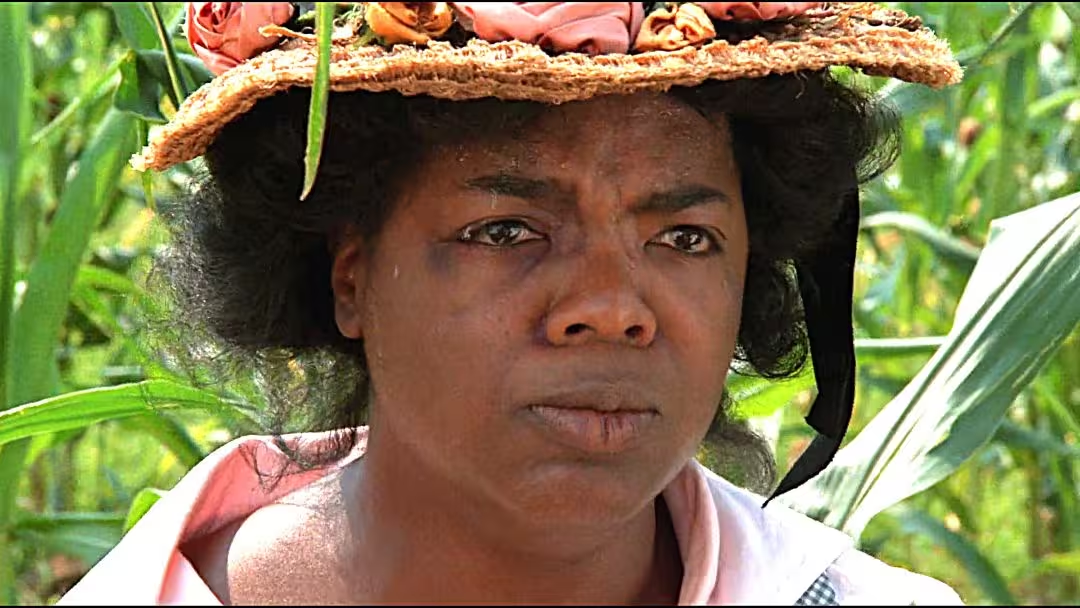
It had a $15 million budget and grossed $98.4 million. It earned 11 Academy Award nominations and won none, tying The Turning Point for the most nominations without a win (same source).
Spielberg admitted he reduced Celie and Shug’s sexual relationship to a kiss. Janet Maslin noted that the film took a sunnier view than the novel, and Michele Wallace complained that it buried Walker’s feminist message in Disney-like sentiment (same source).
Having read The Color Purple, I agree: the film is moving, but it turns Celie’s spiritual awakening into a story mostly about family reunion, and Shug’s theology is cut almost entirely.
The Broadway musical. A stage musical opened on Broadway on December 1, 2005. John Doyle’s stripped-down revival opened in 2015, and Cynthia Erivo won a Tony for her performance as Celie (The Stage; TheaterMania).
The 2023 musical film. Blitz Bazawule directed the movie version of the musical, released December 25, 2023, with Fantasia Barrino as Celie, Taraji P. Henson as Shug, Colman Domingo as Albert, and Danielle Brooks as Sofia.

It opened with $18.2 million on Christmas Day, the second-best Christmas Day opening ever for a domestic film, and grossed about $67.5 million worldwide against a reported $90 to $100 million budget (same source). Brooks was nominated for Best Supporting Actress, becoming the second actor nominated for playing Sofia after Winfrey. Whoopi Goldberg makes a cameo as a midwife.
The musical keeps more of Celie and Shug’s love than Spielberg did, but its song-and-dance energy smooths over the novel’s quieter spiritual material.
Personal Reflection: A Book About Silence That People Keep Trying to Silence
The angle that matters most to me today is the one The Color Purple announces in its first line: you better not tell nobody. Celie’s entire story is about what happens when a girl is ordered not to speak about abuse. That makes it strange, and a little bitter, that this book has spent four decades being pulled off shelves.
The numbers are not abstract.
The Color Purple ranked No. 17 on the American Library Association’s list of most challenged books for both 1990 to 1999 and 2000 to 2009, and No. 50 for 2010 to 2019. In 2022, a parent group in Indian River County, Florida, targeted it as part of a list of 156 books (National Geographic).
PEN America counted 6,870 school book bans in the 2024 to 2025 school year, with Florida, Texas, and Tennessee accounting for most of them (Michigan Public, reporting PEN America’s data).
The problem Celie writes about has not gone anywhere. According to the CDC, more than 1 in 3 women in the U.S. have experienced contact sexual violence, physical violence, or stalking by an intimate partner (CDC).
Five lessons I took from reading it this time:
Silence is usually an instruction, not a choice. Celie is not quiet by nature. She is ordered to be. When you hear “why didn’t she say something,” remember who told her not to.
Your first listener might not be a person. Celie’s letters to God kept her mind alive until real people showed up. Writing it down is not nothing.
One witness changes everything. Shug does not rescue Celie. She simply sees her and says so. Sometimes being the person who notices is enough to start a chain.
Economic independence is part of healing. Celie leaves when she has a place to go and a way to earn. Emotional recovery and a paycheck are not separate projects.
Removing a book does not remove the experience. The children who most need The Color Purple are the ones who already know what its first page describes. Taking it away does not protect them. It just repeats Pa’s order.
Quotable Lines From The Color Purple
All quotations are from the 2011 Open Road edition, used briefly for review.
- “You better not never tell nobody but God.” (the opening warning)
- “I think it pisses God off if you walk by the color purple in a field somewhere and don’t notice it.” (Shug to Celie)
- “Everything want to be loved.” (Shug)
- “All my life I had to fight.” (Sofia to Celie)
- “Until you do right by me, everything you touch will crumble.” (Celie’s curse on Albert)
- “I’m pore, I’m black, I may be ugly and can’t cook … But I’m here.” (Celie)
- “You have to git man off your eyeball, before you can see anything a’tall.” (Shug)
- “Who am I to tell her who to love?” (Celie, on Shug and Germaine)
- “Every stitch I sew will be a kiss.” (Celie, writing to Nettie about the pants)
- “I’m satisfied this the first time I ever lived on Earth as a natural man.” (Albert)
- “Dear Everything.” (Celie’s final letter)
- “I think this the youngest us ever felt.” (the last line before Walker’s afterword)
Conclusion
The Color Purple is short, brutal in its opening, and more joyous at its close than almost any serious novel I know. Its reputation as a book about abuse is accurate but incomplete. It is really a book about how a person learns that she is allowed to exist, to speak, to love, to earn, and to look at a purple flower and feel God looking back.
I recommend it for fans of Southern literature, Black women’s fiction, epistolary novels, and literary fiction with a spiritual undercurrent.
It is especially worth reading for anyone who has ever been told to keep quiet. If you only know the films, read the book: the theology, the sex, and the sharpness that both adaptations soften are all here.
Forty-four years after publication, it still matters because the order Celie received on page one is still being given.
The Color Purple

Is The Color Purple worth reading today? Yes, and maybe more than ever. Alice Walker's 1982 novel opens with one of the most disturbing first pages in American fiction, then spends the next forty years of its heroine's life showing how a girl who was told to stay silent ends up running her own business, loving whom she wants, and talking back to God.
URL: https://www.sopranu.com/color-purple-alice-walker-debate/
Author: Alice Walker
4.5
Pros
- Array
Cons
- Array







