
Last updated on November 6th, 2026 at 11:37 am
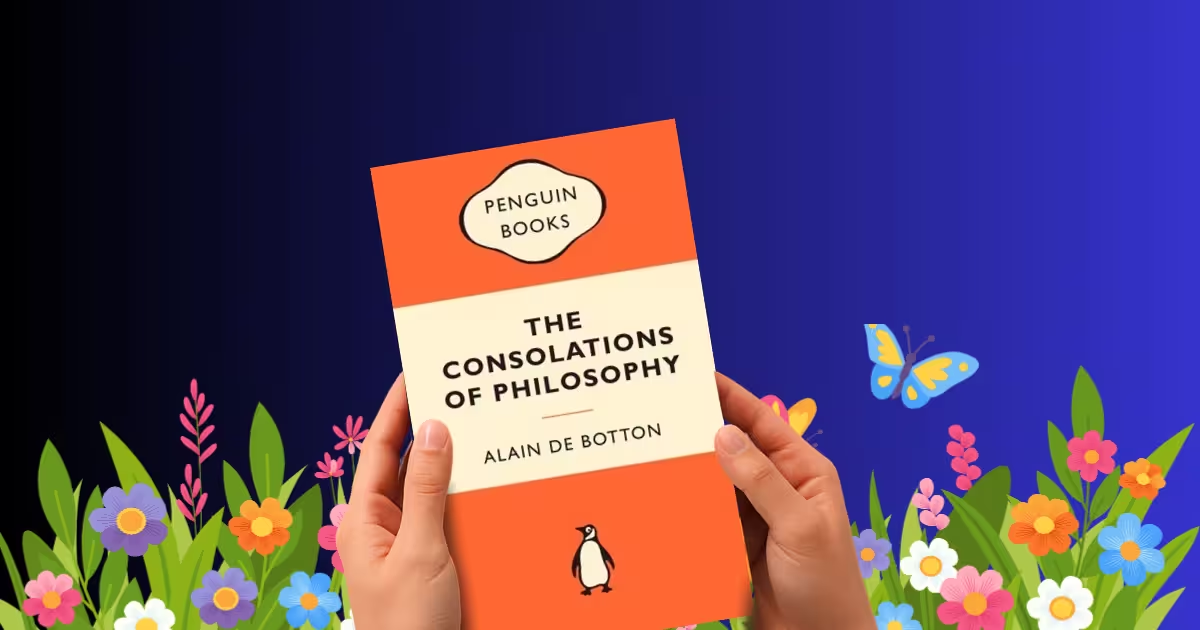
Why does a 2,400-year-old trial transcript still explain the exact feeling in your stomach before a performance review? I picked up The Consolations of Philosophy expecting a tidy history lesson on six dead men. Instead I got talked down from a real financial worry, a real breakup, and one deeply awkward dinner party, all inside 265 pages.
That is the honest case I want to make to you here, without the marketing gloss and without pretending the book is flawless, because it isn’t.
Overview
The Consolations of Philosophy (2000) is Alain de Botton’s non-fiction bestseller pairing six historical philosophers, Socrates, Epicurus, Seneca, Montaigne, Schopenhauer, and Nietzsche, with six everyday miseries: unpopularity, poverty, frustration, inadequacy, heartbreak, and difficulty.
It holds a 4.01 out of 5 rating from 34,967 Goodreads readers across 3,484 written reviews, and it spawned a six-part Channel 4 series, Philosophy: A Guide to Happiness, broadcast between March 26 and May 7, 2000.
The writing is warm, funny, and full of real illustrations, letters, and paintings, but the philosophy is deliberately simplified, and a couple of chapters (Seneca and Nietzsche, mainly) lean closer to inspirational quote-collecting than argument.
If you want a first, human doorway into six major thinkers, this book earns its reputation. If you want rigorous philosophical argument, treat it as a starting point, not a destination.
Reader suggestion
The Consolations of Philosophy is a strong fit for:
- Readers who feel intimidated by philosophy and want an entry point that reads like a good long-form magazine essay.
- Anyone currently sitting with money worries, romantic rejection, professional criticism, or a general sense of being difficult or inadequate, who wants company rather than a lecture.
- Fans of de Botton’s other essayistic work, or of Sophie’s World by Jostein Gaarder, who want the same accessibility applied to real historical thinkers instead of a novel’s frame story.
It’s probably not for:
- Philosophy students or academics who already know Socrates, Epicurus, Seneca, Montaigne, Schopenhauer, and Nietzsche in the original and want close textual argument rather than biography plus quotation.
- Readers currently in an acute mental health crisis, since this is a reflective, philosophical book rather than a clinical or peer-support resource.
- Anyone who dislikes a personal, essayistic voice mixed into non-fiction; de Botton writes himself into the book constantly, and that choice does not suit every reader.
Table of Contents
Introduction
The Consolations of Philosophy is a 2000 non-fiction book by the Swiss-British writer Alain de Botton, first published in Britain by Hamish Hamilton and in the United States by Pantheon Books, with a Vintage International paperback following in April 2001.
De Botton was born in Zurich on December 20, 1969, the son of the financier Gilbert de Botton, who had run Rothschild Asset Management before founding Global Asset Management and selling it to UBS in 1999, the year before this book appeared.
Alain de Botton studied at Cambridge, published his debut, Essays in Love, at twenty-three, and by the time The Consolations of Philosophy came out he already had four earlier books behind him.
Notably, he later became a Fellow of the Royal Society of Literature (2011) and, in a small twist that suits this particular book, received the Melbourne Writers Festival’s “Fellowship of Schopenhauer” award in 2015, named for one of the very philosophers he profiles here.
Context
The Consolations of Philosophy sits at the intersection of biography, popular philosophy, and self-help; Goodreads itself files it under Philosophy, Nonfiction, and Self Help in roughly that order of prominence. Each of its six chapters pairs one historical philosopher with one common form of suffering, and each chapter mixes short biography, direct quotation, reproductions of paintings and photographs, and de Botton’s own commentary and personal anecdotes.
The title deliberately echoes Boethius’s sixth-century Consolation of Philosophy, written in a prison cell while its author awaited execution; de Botton’s version is plural, aimed at a general modern reader rather than a single condemned man.
Purpose
The Consolations of Philosophy‘s central argument is stated plainly in its introduction: philosophy, properly used, is not an abstract university subject but a practical tool for reducing specific, nameable forms of suffering.
De Botton frames each philosopher as a kind of specialist consultant, brought in for one particular ailment, in the same way you would see a cardiologist for your heart and a dentist for your teeth.
The book’s implicit promise is that six philosophers, taken together, can function as a general practitioner for a difficult life.
Background
De Botton wrote The Consolations of Philosophy after four earlier books, three literary and personal (Essays in Love, The Romantic Movement, Kiss and Tell) and one that first showed his signature method, How Proust Can Change Your Life (1997), which used Marcel Proust’s life and novels as a source of practical guidance.
The Consolations of Philosophy extended that method to six philosophers instead of one novelist, and the choice paid off commercially: the book was tied to a six-part Channel 4 television series he wrote and presented, Philosophy: A Guide to Happiness, which aired weekly from March 26 to May 7, 2000, with each episode mirroring one of the book’s six chapters.
The pairing of book and series is itself a small case study in how philosophy got repackaged for a mainstream audience at the turn of the millennium, alongside Jostein Gaarder’s Sophie’s World, which had done something similar for the history of philosophy through fiction a few years earlier.
It is worth knowing, too, that de Botton was not simply parachuting into these six thinkers.
Two of them, Montaigne and Seneca, had already shaped his earlier work; the essayistic, personal, digressive style of How Proust Can Change Your Life owes an obvious debt to Montaigne’s own Essays, which de Botton discusses at length in this book’s fourth chapter.
That continuity matters for judging the book’s authority: this is not a journalist parachuting into six unfamiliar names for a single commission, but a writer returning to thinkers who had already shaped his own approach to non-fiction.
The Consolations of Philosophy Summary
1. Socrates: Consolation for Unpopularity
De Botton opens in a New York gallery in front of Jacques-Louis David’s 1787 painting The Death of Socrates, and from there tells the story of the philosopher’s trial and execution in Athens in 399 BC.
Three Athenians accused Socrates of corrupting the young and failing to worship the city’s gods; a jury of 500 citizens convicted him by a narrow margin and later voted, by a wider one, for his death.
Socrates’ own dry reaction to the first vote, “I didn’t think the margin would be so narrow,” sets the tone for the whole chapter: composure under mass disapproval, without either meek retreat or empty defiance.
The philosophical payload here is the Socratic method itself, which de Botton lays out almost as a recipe: take a statement people treat as obvious common sense, look for a single case where it fails, and use that failure to refine the statement until it can survive rational attack.
Applied to courage, this method shows that simply not retreating in battle cannot be the whole definition, since real courage sometimes requires retreat and cowardice can hide behind blind advance.
Applied to virtue and money, it shows that wealth alone guarantees nothing about a person’s character. The point de Botton draws out for readers is not “ignore what people think of you,” but something more precise: the size of the crowd against you says nothing about whether you are right, only the quality of their reasoning does.
As Socrates told the court, “I am convinced that I never wronged anyone intentionally,” a defense that failed to save his life but, on de Botton’s reading, did not need the jury’s agreement to remain true.
2. Epicurus: Consolation for Not Having Enough Money
The second chapter opens, memorably, with a mock “acquisition list”, a fantasy of a Georgian townhouse, a private jet, a Tuscan villa, that de Botton then systematically dismantles using the actual philosophy of Epicurus (341 BC to 270 BC), a thinker whose name has been unfairly reduced in everyday English to mean gluttony and luxury.
In reality, Epicurus lived on bread, vegetables, and a little cheese, and founded a philosophical commune, “the Garden,” outside Athens with a circle of friends, both men and women, who pooled resources specifically so they would not have to work for people they disliked.
Epicurus’s actual argument, as de Botton presents it, sorts human desires into three tiers: natural and necessary (friendship, freedom, and a roof over one’s head), natural but unnecessary (a large house, servants, banquets), and neither natural nor necessary (fame, power).
His famous line, “Nothing satisfies the man who is not satisfied with a little,” is less an ascetic put-down than a diagnosis: past a fairly modest income, more money buys almost no additional happiness, because happiness was never primarily a financial problem in the first place.
De Botton also walks through Epicurus’s practical thought experiment for testing any expensive desire (imagine getting it, imagine not getting it, and ask honestly which outcome you would actually mind), a method that reads today almost exactly like a piece of modern financial-therapy advice, decades before that phrase existed.
3. Seneca: Consolation for Frustration
Chapter three turns to Seneca (4 BC to AD 65), tutor and later victim of the emperor Nero, who was ultimately ordered to take his own life on suspicion of conspiracy despite little real evidence against him.
De Botton treats Seneca’s Stoicism as, in effect, a dictionary of frustration: anger, shock, a sense of injustice, and anxiety are each traced back to a single root cause, a mismatch between what we expect from the world and what the world actually delivers.
“There is nothing which Fortune does not dare” is Seneca’s blunt summary of that unpredictability, and his solution is not passive resignation but active mental preparation, a daily praemeditatio, or rehearsal of everything that could plausibly go wrong, so that when disaster does arrive it meets a mind that already expected some version of it.
The chapter’s most quietly devastating passage concerns Seneca’s letter to a grieving mother, Marcia, who had spent three years unable to accept her son’s early death; Seneca’s blunt, almost cruel-sounding comfort is that death that early is common, not exceptional, and that treating it as a freak injustice only compounds the pain.
Whether that counts as comfort or coldness is, notably, exactly where the book’s harshest critics dig in, a point I return to in the analysis section below.
The chapter closes on Seneca’s own death by suicide under Nero’s order, an episode de Botton uses to ask a pointed question: “What need is there to weep over parts of life?”, a line originally addressed to Marcia that reads very differently once you know it will apply, a few years later, to Seneca’s own end.
4. Montaigne: Consolation for Inadequacy
The fourth chapter, the longest in The Consolations of Philosophy, is arguably its warmest, and covers three separate strands: sexual inadequacy, cultural inadequacy, and intellectual inadequacy, all addressed through the sixteenth-century French essayist Michel de Montaigne.
De Botton draws on genuinely startling material here: Montaigne’s own frank writing about impotence, farting, and toilet habits, material that scandalized some readers in the sixteenth century and still catches modern readers off guard.
Montaigne’s blunt observation that “Kings and philosophers shit: and so do ladies” is not vulgarity for its own sake; it is a direct assault on the idea that dignity requires denying the body, a move de Botton connects to Montaigne’s larger project of writing himself “whole, and wholly naked” onto the page, decades before autobiography as a genre really existed.
The cultural-inadequacy section follows Montaigne’s own seventeen-month, 3,000-mile horseback journey through Switzerland, Germany, and Italy in 1580, during which he noted, sometimes with visible delight, how confidently the French dismissed German stoves and the Germans dismissed French fireplaces, each side certain their own habit was simply “normal.”
This section connects directly to Montaigne’s reading about the recently discovered peoples of the Americas and the horrifying colonial violence justified by Europeans’ certainty that unfamiliar customs meant subhuman status, a genuinely dark historical detour that de Botton does not soften.
His conclusion, borrowed from Terence, is a line Montaigne himself had painted on his library ceiling: “I am a man, nothing human is foreign to me.”
The intellectual-inadequacy section, meanwhile, is the book’s funniest stretch, featuring an entire mock exam paper built from Montaigne’s actual anecdotes (a jealous villager, a man’s boast about “cat pie,” a friend who once lost an erection and psychologically never recovered), used to argue that lived wisdom, not classical learning, is what actually deserves the name of intelligence.
De Botton’s summary line for the whole chapter, “We are richer than we think, each one of us,” captures Montaigne’s real thesis: an ordinary life, examined honestly, contains as much material for wisdom as any classical education.
5. Schopenhauer: Consolation for a Broken Heart
Chapter five is built around Arthur Schopenhauer (1788 to 1860), presented first through an unusually detailed year-by-year biographical timeline (a device the book uses nowhere else), tracking his father’s likely suicide, his cold relationship with his mother, his repeated romantic failures, and his eventual devotion to a series of poodles.
Schopenhauer’s flat verdict that “Human existence must be a kind of error” could easily read as pure misery, and yet de Botton turns this pessimism into a genuine comfort for heartbreak specifically because Schopenhauer never expected happiness in the first place, so its absence never struck him as a personal failing.
The chapter’s structural trick is a present-day short story, “A Contemporary Love Story,” interleaved with Schopenhauer’s theory of the “will-to-life,” his claim that romantic attraction is not really about the two people involved at all but an unconscious calculation aimed at producing balanced offspring, which is why, in his account, love so often overrides our own stated preferences and even our own self-interest.
It is a strange, faintly clinical theory of attraction, and de Botton knows it; he presents it with a certain wry distance rather than full endorsement.
The chapter’s real payoff, though, is not the biology but the closing argument about art: reading a novel like Goethe’s The Sorrows of Young Werther about someone else’s heartbreak, de Botton argues, following Schopenhauer directly, helps us “turn pain into knowledge,” converting an isolating private wound into something recognizably human and shared, which is precisely why literature about heartbreak so reliably outsells advice about how to avoid it.
6. Nietzsche: Consolation for Difficulties
The final chapter follows Friedrich Nietzsche (1844 to 1900) from an early, devoted period as a Schopenhauer disciple through a decisive break in Sorrento in 1876, after which Nietzsche rejected his mentor’s core claim that a wise life minimizes pain, and argued instead that difficulty itself is the necessary price of anything genuinely fulfilling.
Nietzsche’s own formulation, borrowed initially from Aristotle via Schopenhauer and then overturned, is quoted directly: “The prudent man strives for freedom from pain, not pleasure,” presented as the very position Nietzsche would spend the rest of his career arguing against.
De Botton leans heavily on mountain imagery here, tracking Nietzsche’s actual summers in the Swiss village of Sils-Maria and a real hike up the 3,451-metre Piz Corvatsch, to argue for a philosophy of “gardening” one’s own painful emotions (anger, envy, anxiety) into something productive rather than simply weeding them out.
The most striking biographical material in the whole book sits in this chapter: Nietzsche’s near-total professional and romantic failure during his sane lifetime (his books sold in the low hundreds; a marriage proposal to Lou Andreas-Salomé was rejected; he eventually broke down in a Turin street embracing a horse and spent his final eleven years in the care of his mother and sister).
Nietzsche’s own closing verdict, “Not everything which makes us feel better is good for us,” and the book’s very last line, that treating a state of distress as something to simply abolish is “almost as stupid as the will to abolish bad weather,” land with genuine force after that biography, precisely because Nietzsche himself never got to enjoy the fulfilment he theorized about.
The Consolations of Philosophy Analysis
The honest answer, and the one this book’s own reception history keeps circling back to, is: partly. De Botton is scrupulously accurate about biography and reliably faithful when he quotes his six subjects directly; nothing in this review’s chapter-by-chapter summary above required inventing an idea that isn’t genuinely in Socrates, Epicurus, Seneca, Montaigne, Schopenhauer, or Nietzsche’s own writing.
Where The Consolations of Philosophy gets shakier is in argument. Each philosopher is assigned exactly one problem and largely stripped of the parts of their thought that resist that assignment; Nietzsche, for instance, gets reduced almost entirely to a philosophy of productive suffering, with barely a mention of the will to power, eternal recurrence, or his broader critique of morality that dominates serious scholarship on him.
That trade-off is precisely what split the book’s critics on publication, in March and April 2000.
Many reviews praised it as congenial and refreshing and suggested de Botton “may well achieve the impossible” by making philosophy genuinely popular, and John Banville, reviewing it for the Irish Times, offered the line that ended up on every subsequent paperback cover, that “philosophy is the new rock and roll” with de Botton cast as its Colonel Tom Parker.
Set against that, the philosopher Jonathan Lear, reviewing it for the New York Times in 2000, argued that academic philosophy’s real virtue is a shared discipline of trying to get things right, and that on that measure, “this isn’t philosophy.”
Edward Skidelsky, writing in the New Statesman the same week Banville’s review ran, was even sharper, dismissing the whole project in three words as “comforting, but meaningless.” Somewhere in between sits The Sunday Times‘s Humphrey Carpenter, who called it “a commentary rather than a work of original thought” while still finding it entertaining enough to recommend.
Reader reception, at scale, splits along almost the same fault line.
Across 34,967 Goodreads ratings, the book sits at 4.01 out of 5, with 73 percent of readers giving it four or five stars, but a recurring theme in the 3,484 written reviews is exactly this same tension: is this a philosophy book wearing self-help clothing, or a self-help book borrowing philosophy’s prestige?
One widely-liked Goodreads review from 2014 puts the dilemma almost exactly the way Lear does, admitting the reader could not decide, even after finishing, whether the book was “a work on philosophy masquerading as a self-help book” or the reverse.
That the same tension shows up independently in a professional philosopher’s New York Times review and in ordinary readers’ Goodreads comments, years apart, is itself a fairly strong signal that the criticism is tracking something real in the text, not just professional territorialism.
Does The Consolations of Philosophy fulfil its own stated purpose, though?
Judged against its actual promise, practical comfort for six named forms of suffering rather than a scholarly monograph, it mostly succeeds. The Epicurus and Montaigne chapters in particular hold up as genuinely useful thinking tools you can apply the same afternoon you read them.
The Seneca and Nietzsche chapters are shakier as arguments (Seneca’s advice to imagine the worst outcome and Nietzsche’s advice to embrace difficulty can, read uncharitably, both collapse into “just feel differently about your problem”), but even there, the biography surrounding the ideas does real work: knowing Seneca wrote about accepting sudden reversal while actually facing execution, or that Nietzsche wrote about productive suffering while dying in genuine poverty and loneliness, gives the ideas a weight that the bare arguments alone would not carry.
Strengths and Weaknesses
Strengths:
Genuinely useful biography. De Botton is at his best as a storyteller of these six lives, and the specific, dated, verifiable detail (Socrates’ actual jury margin, Epicurus’s actual commune arrangements, Seneca’s actual exile to Corsica, Nietzsche’s actual sales figures) does more persuasive work than abstract argument alone could.
Real illustrations and primary material. The Consolations of Philosophy reproduces paintings, engravings, photographs, and de Botton’s own snapshots throughout, alongside real quoted letters and diary entries; this is not a text-only summary of six thinkers but a genuinely illustrated, researched object.
Emotional honesty about the author’s own life. De Botton includes his own money anxieties, a real account of erectile difficulty read directly against Montaigne’s own writing on the same subject, and a real failed train-to-restaurant romance structured around Schopenhauer, and none of it reads as performative; it gives the abstract philosophy somewhere concrete to land.
Genuine accessibility without obvious dumbing-down. Even the book’s harshest critics concede the prose itself is clear, funny, and well-made; nobody has seriously accused de Botton of writing badly, only of oversimplifying his subjects’ full range of thought.
Weaknesses:
Selective philosophy. Each thinker is narrowed to fit one problem, which means genuine tensions and contradictions in, say, Nietzsche’s full body of work simply do not appear here, a real gap for any reader who goes on to read Nietzsche directly and wonders where the rest of him went.
Uneven chapters. The Montaigne and Epicurus chapters are consistently the ones readers and critics single out as the strongest; Seneca’s and Nietzsche’s arguments, by contrast, can feel closer to reframed positive thinking than rigorous philosophical argument, a criticism the Mail on Sunday’s 2000 review pressed hardest.
Advice that can read as thin once stated plainly. Stripped of its historical costume, some of the core counsel (“don’t judge yourself by how many people dislike you,” “expect that things can go wrong,” “money buys less happiness than friendship does”) is genuinely old and genuinely simple; the book’s real achievement is dressing familiar wisdom in unfamiliar, persuasive company, not inventing new wisdom outright.
Light on female and non-Western philosophy. All six subjects are men, all six are European, and the book makes no claim otherwise; readers looking for a broader philosophical range will need other books entirely.
Comparison With Similar Works
The Consolations of Philosophy invites an obvious comparison to its own namesake, Boethius’s sixth-century Consolation of Philosophy, written in a Roman prison cell awaiting execution.
Where Boethius received comfort from a single personified figure of Philosophy herself, de Botton distributes that role across six historical men and a general modern audience rather than one condemned prisoner, a structural difference some reviewers feel actually weakens the emotional stakes of the borrowed title.
Among more recent popular-philosophy books, Sarah Bakewell’s How to Live: A Life of Montaigne in One Question and Twenty Attempts at an Answer covers exactly the same essayist as de Botton’s fourth chapter, at far greater depth and with considerably more scholarly rigor, making it the natural next stop for any reader who found Montaigne the highlight here.
Readers drawn specifically to the Seneca chapter’s Stoicism have two obvious next steps: William B. Irvine’s A Guide to the Good Life: The Ancient Art of Stoic Joy, and the more contemporary, business-facing Stoicism of Ryan Holiday’s The Obstacle Is the Way, both of which apply the same ancient material with a narrower, more explicitly self-help framing than de Botton allows himself.
Jules Evans’s Philosophy for Life and Other Dangerous Situations runs on almost the same premise as this book (named philosophers applied to named modern problems) but leans further into cognitive behavioral therapy and personal case studies.
And for readers who want de Botton’s own accessible method applied to a single writer instead of six philosophers, his earlier How Proust Can Change Your Life is the direct blueprint this book scaled up.
Readers who enjoy this warts-and-all approach to serious thinkers, incidentally, will find a similarly candid treatment of Bertrand Russell’s own intellectual reversals, or of E.M. Cioran’s bleaker version of consolation, in Sopranu’s philosophy book review archive, which applies much the same strengths-and-weaknesses format to adjacent figures.
Conclusion
The Consolations of Philosophy earns its long shelf life honestly: it is well-researched, genuinely funny in places, and reliably faithful to what its six subjects actually wrote, even while it narrows each of them down to a single, usable idea.
Read it as your first door into Socrates, Epicurus, Seneca, Montaigne, Schopenhauer, and Nietzsche, not your last, and it does exactly what it promises.
General readers, especially anyone currently short on money, recently rejected, or quietly convinced they are somehow inadequate, will likely find real, specific comfort here rather than vague reassurance.
Specialists and serious students of any one of these six philosophers should treat it as a well-written biography with excerpts attached, not a substitute for the primary texts themselves, several of which (Montaigne’s Essays, Seneca’s Letters, Nietzsche’s Beyond Good and Evil) are genuinely more rewarding once this book has done its job of making you curious enough to open them.







