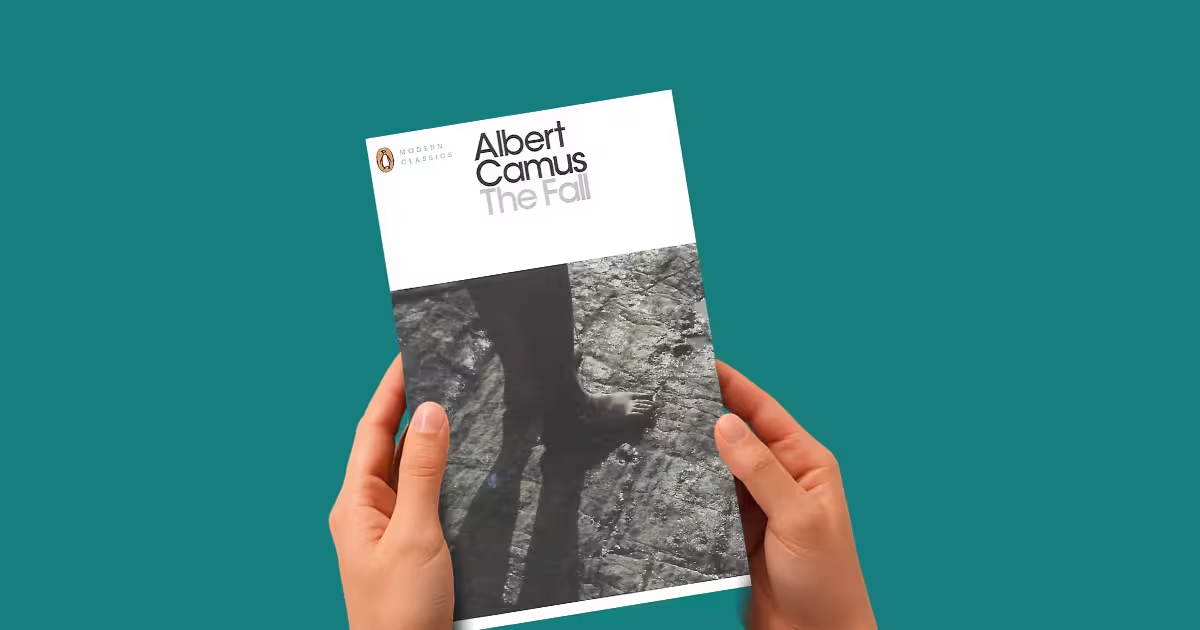
Did you ever catch yourself helping someone and then immediately feel proud of your own generosity, not because you actually cared, but because of how good it made you look? Albert Camus’s The Fall forces that exact question down your throat, and it’s deeply uncomfortable. Written in 1956, the same year it was published in France as La Chute, this 147-page novel isn’t just a story. It’s an interrogation.
And by the time you finish, you realize you’ve been on trial the entire time.
Overview
The Fall by Albert Camus is a haunting philosophical novel about guilt, hypocrisy, and self-deception. Through the confession of a disgraced lawyer, Camus challenges readers to confront the gap between the moral image they project and the reality of their actions. It’s a short but deeply unsettling book that offers psychological insight rather than entertainment.
I would suggest The Fall to readers who enjoy philosophical fiction, existentialist literature, character-driven monologues, and books that make you question your own morality. Fans of Dostoevsky, Sartre, or Kafka will find familiar territory here.
But I suggest to skip The Fall by those seeking fast-paced plots, action, or uplifting narratives. If you prefer clear resolutions or sympathetic protagonists, this novel will frustrate you.
Table of Contents
1. Introduction
The Fall (La Chute) is Albert Camus’s final novel published during his lifetime. It came out in 1956 through Librairie Gallimard in France, followed by an English translation by Justin O’Brien published by Alfred A. Knopf, Inc. in the United States later that same year.
Camus, born in Algeria in 1913, had already established himself as a major literary figure with The Stranger (1942), The Plague (1947), and the philosophical essay The Myth of Sisyphus (1942). In 1957, just a year after The Fall appeared, Camus received the Nobel Prize in Literature. The Nobel committee specifically praised his work for illuminating “the problems of the human conscience in our times”.
Tragically, Camus died in a car accident on January 4, 1960, at just 46 years old. The Fall stands as his last completed work of fiction—a haunting farewell from a writer who spent his career wrestling with questions of meaning, justice, and human responsibility.
2. Background
To understand The Fall, you have to know something about the intellectual climate of postwar Europe. Camus wrote this novel during a period of intense personal and philosophical turmoil.
First, his relationship with Jean-Paul Sartre—once a close friend and fellow existentialist—had completely collapsed. By the early 1950s, the two had become public intellectual rivals. Camus rejected Sartre’s brand of atheistic existentialism, which held that humans must create their own values in a meaningless universe. In The Fall, Camus delivers a devastating critique of that framework. Through Clamence, he suggests that without God or any objective moral standard, human beings don’t become liberated—they become judges of one another, and that judgment is far more oppressive than any divine tribunal.
Second, the shadow of World War II and the Holocaust looms large over the novel. Clamence lives in Amsterdam’s former Jewish Quarter, and he openly acknowledges that 75,000 Jews were deported or assassinated there.
He calls it “real vacuum-cleaning” and admits that living on the site of “one of the greatest crimes in history” has shaped his worldview. This historical backdrop gives Clamence’s moral crisis a collective dimension—his personal guilt mirrors a broader civilizational failure.
Third, Camus was reportedly going through personal struggles while writing The Fall. Some critics have noted that the novel reflects his own anxieties about success, fame, and the gap between public image and private reality.
The novel’s protagonist, Jean-Baptiste Clamence, is a successful Parisian lawyer who becomes disgusted with his own hypocrisy. It’s not hard to see parallels with Camus himself, who by 1956 was an international celebrity grappling with the weight of his own reputation.
3. The Fall Summary
The Fall is structured as a five-day monologue. The narrator, Jean-Baptiste Clamence, speaks to an unnamed listener—a fellow Frenchman he meets in a seedy Amsterdam bar called Mexico City.
Day One: The Encounter
The novel opens in the bar. Clamence approaches the listener, a Parisian lawyer, and offers to help him order gin from the Dutch-speaking bartender. This simple act of kindness is the first of many. Clamence presents himself as charming, helpful, and worldly. He points out an empty rectangle on the wall where a painting used to hang—a painting that was, he says, a “real masterpiece”.
Clamence reveals that he was once a lawyer in Paris, a specialist in “noble cases”—widows and orphans, the wrongly accused. He describes his former life with immense pride: he was generous, courteous, and popular. He helped blind people cross streets, gave alms, and defended the poor for free. He lived “above” others, both literally and metaphorically. He preferred heights—balconies, mountains, upper decks—because they allowed him to dominate and be seen.
But then he drops a bombshell: he is now a “judge-penitent.” The listener, naturally curious, asks what that means. Clamence promises to explain, but first, he walks the listener through Amsterdam’s concentric canals, which he compares to Dante’s circles of hell. The city, with its fog, rain, and moral decay, mirrors Clamence’s internal state.
Day Two: The Confession Begins
Clamence starts revealing the cracks in his perfect life. He recounts the evening that changed everything. Walking along the Pont Royal in Paris, he passed a young woman in black leaning over the railing, staring at the river. He walked on. Moments later, he heard the sound of a body hitting the water. Then a cry—repeated several times—before silence.
He didn’t turn around. He didn’t jump in. He stood frozen, told himself it was “too late, too far,” and walked away. He never reported it. The next day, he didn’t even read the newspapers.
This is the core of Clamence’s guilt. But as he tells the story, we realize the guilt isn’t just about one woman’s death. It’s about the entire structure of his life. His “generosity” was really self-congratulation. His “humility” was a performance. His “virtue” was a way of feeling superior.
He also recalls a strange, disembodied laugh he heard behind him on the Pont des Arts. He turned around—no one was there. The laugh seemed to come from the water. It followed him for weeks, a constant reminder that someone, somewhere, knew the truth about him.
Day Three: The Mask Cracks
Clamence continues his confession, describing how he tried to destroy his own reputation in order to escape judgment. He made provocative speeches, insulted humanitarian values, and even publicly praised God in atheist circles just to shock people. But none of it worked. People still admired him. The laughter persisted.
He turned to women, but not for love. He admits he never truly loved anyone. He collected women like trophies, using charm and manipulation to possess them. He once seduced a woman, humiliated her, and then abandoned her—all to prove he could. He calls this “the desire to be loved and to receive what in my opinion was due me”.
Despairing of love, he turned to debauchery—alcohol and prostitutes. He describes this as a substitute for immortality, a way to escape the fear of death. But his body gave out. His liver failed. The exhaustion only made his guilt more acute.
Day Four: The Pope of the Prison Camp
Clamence reveals his wartime experience. During World War II, he was interned in a camp near Tripoli. There, a fellow prisoner—a devout Catholic—proposed that they elect a “pope” from among themselves. Clamence, as a joke, volunteered. To his surprise, the others agreed.
As “pope,” Clamence administered the camp’s water rations. He began favoring some prisoners over others. Then, in a moment of desperate pragmatism, he drank the water of a dying comrade, convincing himself that the others needed him more. He closed the circle of his own moral corruption.
Day Five: The Stolen Painting and the Judge-Penitent
The final day. Clamence reveals that the painting missing from the bar is “The Just Judges,” a panel from the Van Eyck altarpiece stolen from Ghent Cathedral in 1934. It has never been recovered. Clamence now possesses it.
Why doesn’t he return it? He gives several excuses: it belongs to the bartender, no one can tell the difference between the original and the copy, and—most tellingly—by possessing it, he “dominates”. Justice, he says, is now “definitively separated from innocence—the latter on the cross and the former in the cupboard”.
This is the essence of Clamence’s philosophy. He confesses his sins publicly, not to achieve redemption, but to gain the right to judge others. By accusing himself, he accuses everyone. By admitting his guilt, he forces others to admit theirs. He becomes a “judge-penitent”—a man who condemns himself in order to condemn the world.
The novel ends ambiguously. Clamence tells the listener that he hopes the listener will someday confess his own sins. He imagines the listener asking: “O young woman, throw yourself into the water again so that I may a second time have the chance of saving both of us!” But it’s too late. It’s always too late.
The last line? “Fortunately!”
4. The Fall Analysis
4.1. Characters
Jean-Baptiste Clamence (The Narrator)
Clamence is the only speaking character in the novel. Every word comes from him. He is a former Parisian lawyer, successful, charming, and deeply narcissistic. He describes his past self as a man who lived “on the heights,” helping others not out of genuine compassion but because it made him feel superior.
His fall begins on the Pont Royal, when he fails to save a drowning woman. But his fall was always inevitable—the bridge merely exposed what was already there. Clamence is a master of self-deception. He genuinely believed he was virtuous until the moment he couldn’t. After that, he became hyper-aware of his own hypocrisy.
As a “judge-penitent,” Clamence confesses his sins to strangers, but only to trap them. He forces them to recognize their own guilt, thereby shifting the burden of judgment away from himself. He is manipulative, brilliant, and utterly unredeemed. Jean-Paul Sartre called The Fall “perhaps the most beautiful and the least understood” of Camus’s works.
The Unnamed Listener
We never learn the listener’s name. He is a French lawyer, recently arrived in Amsterdam, and Clamence uses him as a sounding board. The listener occasionally asks questions, but we only hear Clamence’s responses. This technique makes you, the reader, the listener. Clamence isn’t just talking to an anonymous stranger—he’s talking to you.
The Woman in Black
The young woman who drowns herself in the Seine is barely a character. She has no name, no dialogue, no backstory. Yet she is the catalyst for everything. Her death exposes Clamence’s cowardice and sets his entire confession in motion.
The Ape (The Bartender)
The Dutch bartender at Mexico City is described as ape-like, silent, and distrustful. Clamence claims to admire him because “they at least don’t have any ulterior motives”. The bartender is a foil to Clamence—simple, unpretentious, and uninterested in the games of human judgment.
The Prison Camp Comrades
Clamence’s fellow prisoners are mostly nameless. The most significant is Du Guesclin, the devout Catholic who proposes electing a pope. He represents faith and idealism—qualities Clamence admires but cannot sustain.
4.2. The Fall Themes and Symbolism
Guilt and Universal Judgment
The central theme of The Fall is that all human beings are guilty. Clamence argues that we are all responsible for our choices, and we all make bad ones. The problem isn’t guilt itself—it’s our inability to accept it.
We judge others to avoid being judged ourselves. We insist on our own innocence, even when the evidence says otherwise. Clamence’s solution is to confess his guilt publicly—but even that is a manipulation. He isn’t seeking forgiveness; he’s seeking power.
The Absence of Objective Morality
Without God—or any universally accepted moral standard—human beings become judges of one another. This, Camus suggests, is hell. Clamence describes Amsterdam’s canals as concentric circles of hell, and he places himself at the center. He is both the condemned and the judge. The stolen painting, “The Just Judges,” symbolizes this collapse: justice and innocence are now separate, and no one knows the difference anymore.
Hypocrisy and Self-Deception
Clamence’s entire life was a lie. His generosity was self-serving. His humility was pride in disguise. He admits this openly, but even his confession is hypocritical—he uses it to gain leverage over others. The novel suggests that self-awareness doesn’t necessarily lead to redemption. Sometimes it just makes you more skilled at manipulation.
Freedom and Slavery
Clamence claims that freedom is “too heavy to bear”. He prefers slavery—submitting to a master, a law, a system—because it relieves him of the burden of choice. This is a direct critique of Sartrean existentialism, which holds that humans are “condemned to be free”. Camus suggests that most people, when faced with radical freedom, will choose to give it up.
The Little-Ease
Clamence describes a medieval torture device called the “little-ease”—a cell so small that the prisoner cannot stand or lie down. He uses it as a metaphor for his own existence: trapped, contorted, unable to escape. This is the human condition, as Camus sees it. We are all in the little-ease, and we can’t get out.
The Doves
Throughout the novel, Clamence mentions doves circling above Amsterdam. They want to come down, but there is “never a head on which to light.” The doves symbolize grace, forgiveness, and innocence—things that are always present but never quite reach us.
5. The Fall Evaluation
My Overall Impression
The Fall is a masterpiece—but a deeply unsettling one. It’s not a book that makes you feel good. It’s a book that makes you feel seen, and not in a flattering way.
The New York Times called it “an irresistibly brilliant examination of modern conscience”. I’d agree, but with a caveat: it’s also an indictment. Camus isn’t just examining conscience—he’s putting it on trial. And by the end, you realize you’ve been the defendant all along.
Strengths
The Voice. Clamence is one of the most compelling narrators in 20th-century literature. He’s charming, witty, and utterly unreliable. You want to trust him, but you know you shouldn’t. The monologue format is perfectly suited to his character—it allows him to control the narrative while slowly revealing his true nature.
The Philosophical Depth. Camus packs more ideas into 147 pages than most novelists manage in 500. Every sentence carries weight. The themes of guilt, judgment, freedom, and hypocrisy are explored with surgical precision.
The Atmosphere. Amsterdam is rendered as a foggy, watery, moral wasteland. The setting is inseparable from the story. The concentric canals, the rain, the red-light district—all of it reinforces Clamence’s internal descent.
The Ending. The novel’s conclusion is ambiguous and haunting. Clamence imagines the listener asking to save the drowning woman “a second time.” Then he laughs and says it’s too late. “Fortunately!” That final word is devastating. It suggests that Clamence is relieved—not that he failed to save her, but that he’ll never have to try again.
Weaknesses
The Pacing. The Fall is a monologue, and monologues can feel static. There’s no action, no plot in the traditional sense. If you’re not invested in Clamence’s voice, the novel can feel like a long, meandering lecture.
The Misogyny. Clamence’s treatment of women is appalling. He admits to manipulating, humiliating, and discarding them. Some readers may find this difficult to stomach—and not in a productive way. It’s worth noting that Camus is critiquing this behavior, not endorsing it, but the line can feel blurry.
The Intellectual Density. This is not a casual read. You need to be familiar with existentialism, Christian theology, and postwar European history to fully appreciate it. Without that context, some passages can feel obscure.
Impact and Controversy
The Fall has been read as an autobiographical novel. Many critics see Clamence as a stand-in for Camus himself—a man grappling with his own success, hypocrisy, and moral failures. Others read it as a satirical attack on Sartre and atheistic existentialism. Still others interpret it as a meditation on the Holocaust and collective guilt.
The novel’s ambiguity is both its strength and its weakness. It refuses to offer easy answers. Clamence is never redeemed. He never achieves peace. He simply learns to live with his guilt—and to weaponize it.
Comparison with Similar Works
The Fall is often compared to Dostoevsky’s Notes from Underground. Both novels feature unreliable narrators who confess their sins in a monologue format. Both are deeply critical of human nature and society. But where Dostoevsky’s Underground Man is bitter and resentful, Clamence is charming and seductive. He draws you in before he reveals his true nature.
It also echoes Sartre’s Nausea, another existentialist novel about a protagonist confronting the meaninglessness of existence. But where Sartre’s Roquentin finds liberation in absurdity, Clamence finds only guilt and manipulation.
6. Personal Insight with Contemporary Educational Relevance
Five Lessons from The Fall That Still Matter Today
1. Your “Good Deeds” Might Be About You, Not Others.
Clamence helped blind people cross the street—not because he cared about them, but because it made him feel virtuous. This is uncomfortable to admit, but how many of us do the same? We post about our charity work on social media. We volunteer to feel good about ourselves. The lesson isn’t to stop helping—it’s to be honest about our motives.
2. We Are All Hypocrites.
Clamence’s entire life was a performance. He was generous, kind, and successful—on the surface. Beneath it, he was selfish, manipulative, and cowardly. The novel forces us to ask: how much of our own lives is performance? How much of our “virtue” is just a mask?
3. Judgment Is a Reflex, Not a Right.
Clamence argues that people judge others to avoid being judged themselves. This is as true today as it was in 1956. We live in an age of public shaming, cancel culture, and instant moral verdicts. But The Fall reminds us that judgment is easy—and rarely justified.
4. Freedom Is Terrifying.
Clamence says freedom is “too heavy to bear.” He prefers slavery—submitting to a master, a law, a system—because it relieves him of choice. In an era of endless options and overwhelming personal responsibility, this resonates deeply. We often choose comfort over freedom, and we don’t even realize we’re doing it.
5. You Can’t Escape Your Conscience.
Clamence hears the drowning woman’s cry for the rest of his life. No amount of alcohol, sex, or self-justification silences it. The novel suggests that guilt is inescapable. You can run, but you can’t hide. The only way out is through—but Clamence is too afraid to take that path.
7. The Fall Quotes
Here are some of the most striking passages from the novel:
On human nature:
“Men are never convinced of your reasons, of your sincerity, of the seriousness of your sufferings, except by your death.”
On guilt and judgment:
“We have no need of God to create guilt or to punish. Our fellow men are enough, with our help.”
On the Last Judgment:
“Don’t wait for the Last Judgment. It takes place every day.”
On honesty:
“Don’t lies eventually lead to the truth? And don’t all my stories, true or false, tend toward the same conclusion?”
On freedom:
“Ah, mon cher, for anyone who is alone, without God and without a master, the weight of days is dreadful.”
On love:
“I loved women—which amounts to saying that I never loved any of them.”
On the painting:
“Justice being definitively separated from innocence—the latter on the cross and the former in the cupboard.”
On the little-ease:
“I had to submit and admit my guilt. I had to live in the little-ease.”
8. Conclusion
The Fall is not a comfortable book. It’s not meant to be. Camus forces you to look at yourself in a mirror that doesn’t flatter. He asks questions you’d rather not answer: Are you really as good as you think? Would you save a stranger if it cost you something? Can you live with the person you actually are?
The novel offers no redemption, no comfort, no easy way out. Clamence remains trapped in his own guilt, using confession as a weapon rather than a path to healing. And yet, there’s something oddly liberating about the book’s honesty. Once you stop pretending, you can at least start seeing clearly.
I’d recommend The Fall to anyone interested in existentialist philosophy, character-driven fiction, or books that challenge your assumptions about yourself. It’s short enough to read in a weekend but dense enough to think about for years.
Just don’t expect to feel good afterward. That’s not the point.