Last updated on October 22nd, 2026 at 08:25 am
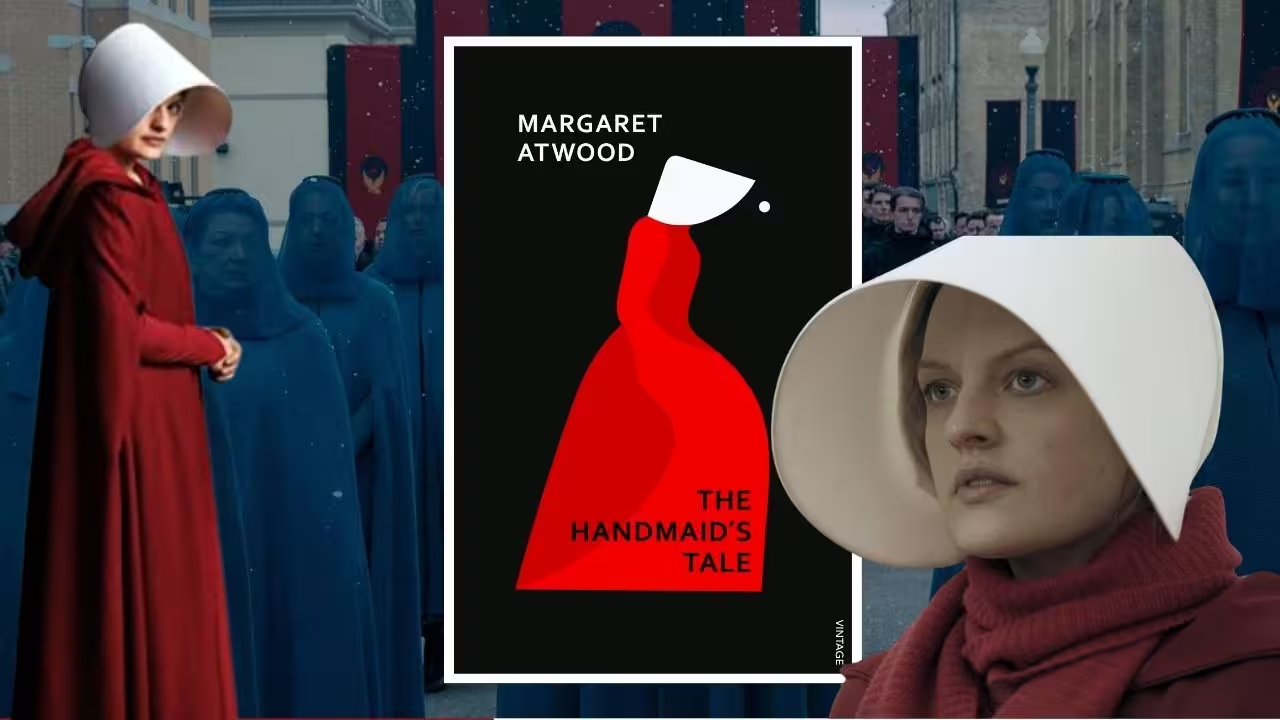
Offred climbs into a black van at the end of The Handmaid’s Tale, and Margaret Atwood refuses to say whether it carries her to prison or to freedom. Then the book keeps going. A short, strange epilogue set in the year 2195 shows a room of academics laughing at puns while they pick over her voice, and that epilogue is the real answer to the question “what happened to her?”
Neither the 1990 film nor the Hulu series managed to put it on screen, so if you only know Gilead from television, you have missed the part of the book that changes how the whole story reads. I read the novel in full for this review, and what follows covers every major spoiler, the ending, and why I think the last twelve pages are the cleverest thing Atwood ever wrote.
Table of Contents
Snapshot
What happens: Offred, a Handmaid forced to bear a child for a Commander and his Wife, survives by small acts of rebellion. She has an affair with the household chauffeur, Nick, and may be pregnant by him. When a van arrives, Nick tells her it is “Mayday” and to trust him. She steps inside. We never see where it goes.
The ending, explained: Her story is a set of cassette tapes found two centuries later. Because the tapes exist, she almost certainly got out of the house alive, but the professors who study them cannot say what became of her.
The big idea: Gilead fell. The oppressor state is temporary, and the people who study it afterwards are not as wise as they believe.
My verdict: 4.5 out of 5. Read it if you want a novel that is frightening and funny in the same paragraph.
What is the book, and who wrote it?
The Handmaid’s Tale is a dystopian novel by Canadian author Margaret Atwood, published by McClelland and Stewart on April 17, 1985. It won the 1985 Governor General’s Award and the first Arthur C. Clarke Award in 1987, and it was shortlisted for the 1986 Booker Prize (The Booker Prizes).
According to The Canadian Encyclopedia, it has sold more than eight million copies in English and been translated into more than 40 languages. My copy was a 307-page PDF edition that includes the “Historical Notes” and a short author biography at the back.
Quick verdict
A cold, funny, furious novel about a woman who is reduced to a body and keeps talking anyway. Recommended for anyone who thinks they already know the story from television.
Should you read it?
| Reasons to read it | Reasons to hesitate |
|---|---|
| Offred’s voice is wry, sad and sharp, and it carries the whole book | The first third moves slowly, with long stretches of remembered detail |
| The epilogue changes the meaning of everything before it | Some readers find the Historical Notes smug and flat after the emotional ending |
| Short chapters, and a story you can finish in a few sittings | Scenes of sexual coercion and public execution are disturbing |
| Almost every cruelty in it has a real-world precedent | Offred’s passivity frustrates readers who want a fighter |
What is it about?
In a near-future America overthrown by a religious regime called Gilead, fertile women are assigned to powerful men as Handmaids. Offred is one of them. The book follows a few months of her life in one household, her memories of the world before, and her slow decision to risk something.
Rating
4.5 / 5
Why did Atwood write it? A short background
Atwood has said repeatedly that she invented almost nothing. In an interview reported by the Associated Press, she said everything in the book has either happened or could happen. In her own words in the New York Times, she knew from growing up in the Second World War that established orders can vanish overnight. The Handmaid’s Tale‘s Gilead sits in Cambridge, Massachusetts, a city that began as a Puritan seminary town, and she pulled on that history deliberately.
The Handmaid’s Tale itself points to two real-world models. In the epilogue, Professor Pieixoto mentions that Romania banned birth control in the eighties and tied wages to fertility, and he lists his own paper, “Iran and Gilead: Two Late-Twentieth-Century Monotheocracies.”
Romania’s Decree 770, which outlawed abortion and contraception, is commonly cited as one of her research sources, though sources give the date as either 1966 or 1967. She also named the dystopias she grew up on: Orwell’s 1984, Huxley’s Brave New World, Bradbury’s Fahrenheit 451 and Zamyatin’s We.
The Handmaid’s Tale plot summary
The Red Center and the Commander’s house (Parts I to III)
The book opens in a former school gymnasium. Women sleep on army cots in rows, watched by Aunts carrying electric cattle prods. They are being trained to become Handmaids, and they lip-read each other across the dark to trade names. The last names on the list are Alma, Janine, Dolores, Moira and June. We are never told which one is our narrator.
Then we jump to her new life. She is called Offred, which only means “of Fred,” the first name of the Commander who owns her. Her room has no glass over the picture, no chandelier, and a window that only opens partway, because Gilead is not afraid she will run. It is afraid of “those other escapes, the ones you can open in yourself.” She wears red, with white wings around her face so she cannot see or be seen.
Her household has four other people. The Commander is a gray-haired official. His Wife, Serena Joy, was once a television gospel singer and now knits and gardens in bitter silence. Two Marthas, Rita and Cora, run the kitchen. And Nick, the chauffeur, who winks at Offred and leans on the car.
Each day she walks to the shops with another Handmaid, Ofglen. They pass the Wall outside the old university, where executed men hang with sacks over their heads. They also pass a pregnant Handmaid named Ofwarren, whom Offred recognizes as Janine from the Red Center.
Offred’s body is a government resource. Once a month a doctor checks her. Once a month, on the fertile day, she takes part in the Ceremony, in which she lies between Serena Joy’s legs while the Commander reads from the Bible and has sex with her. Atwood writes it flatly and it is the coldest scene in the book. Offred insists it is not rape, because she agreed to this life. As she puts it, she had choices, and none of them were good.
The past comes back
As the days pass, Offred recalls how Gilead was built. First came the attack on Congress and the suspension of the Constitution. Then came the day the women lost their jobs. One morning Offred went to work in a library and was told, by guards, to go home.
Bank accounts had been converted to men. Luke, her husband, told her he would take care of her, and she saw something shift between them.
They tried to escape across the Canadian border with their little daughter, using false papers, and they were caught. Offred never saw Luke again and never learned for certain whether he was killed. Her daughter was taken and given to another family. Her mother, a hard-edged feminist, drifts through her memories, and Offred spots her once in an old film among protesters.
She also remembers Moira, her best friend from college, who ended up at the Red Center beside her. Moira was the one who fought back. She smashed her way out of the Center by threatening an Aunt with part of a toilet and then walked out wearing the Aunt’s clothes.
Back in the present, The Handmaid’s Tale turns on a strange invitation. The Commander asks Offred to meet him alone in his study at night, which is forbidden. He wants to play Scrabble. Handmaids may not read or write, so the letter tiles feel to her like a drug. He gives her hand lotion and old women’s magazines. He asks her to kiss him as if she meant it.
She does not know what he wants, but she knows that her power over him is real, and she keeps going back.
Serena Joy, Nick and Ofglen
Serena Joy has been silent about the Commander’s infertility for years. Gilead insists the fault is always the woman’s. Yet she is desperate for a child, and she makes Offred an offer. She suggests that Offred sleep with Nick, so a baby might be passed off as the Commander’s. In return she promises a photograph of Offred’s daughter. A few days later Serena Joy hands it over, and Offred looks at the child’s face and sees that she has already stopped being hers.
Offred goes to Nick’s room over the garage, and what begins as a favor turns into something else. She begins to return on her own and tells him things she tells no one. For a time she forgets about escape.
Her friendship with Ofglen goes the other way. Ofglen is a secret member of the resistance known as Mayday, and she asks Offred to bring back information from the Commander’s study. Offred hesitates.
A Birth Day interrupts the routine. When Ofwarren goes into labor, every Handmaid in the district is summoned to her Commander’s house, where the Wives gather around the birthing stool and the Handmaids chant and sweat in sympathy. Offred watches Janine deliver a baby that the household treats as a triumph, and she feels envy and dread in equal parts. Later the child is judged an “Unbaby,” one of the deformed newborns Gilead calls shredders, and Janine’s mind begins to slip. Offred understands that the same verdict could one day fall on her. Moira’s story reaches her in a different place.
One night, in a plot the Commander arranges, Offred is taken to a hidden hotel nightclub called Jezebel’s. Commanders drink there, and women in discarded costumes from the old world work the floors. Offred borrows eyeshadow and a feathered outfit.
Then, in a washroom, she spots Moira in a bunny costume. Moira tells her what happened after her escape. She was caught, shown a film about the Colonies, which are toxic clean-up camps where women die slowly, and given a choice between the Colonies and Jezebel’s. She chose Jezebel’s.
She sounds tired, and Offred finds this more frightening than anything else. Offred never sees her again.
The Salvaging, the van and the ending
Soon afterwards Gilead strikes. In a women-only Salvaging, three women are hanged, and the other Handmaids are made to touch the rope. Immediately after, a man is dragged out for a ritual called a Particicution. He is accused of rape, and the Handmaids are given permission to tear him apart. Ofglen reaches him first and kicks him in the head. She says later that he was one of theirs, and that she killed him to spare him the pain. Offred does not know whether to believe her.
Within days a new woman walks beside Offred on her shopping trip. She calls herself Ofglen, but she is not the same one. Offred tries the password “Mayday” and the stranger replies that she does not know what Offred means. Then she tells Offred that the real Ofglen hanged herself before the van could take her. Offred feels relief first, then shame.
That night Offred sits in her room, convinced she has used up her time. She has broken rules with the Commander and gone to Jezebel’s, and she expects the punishment to arrive. She thinks of setting the house on fire, of hanging herself in the closet where her predecessor did, of going to Nick, of trying her luck in the street.
Then the black van arrives. Two men in uniform come up the stairs. Nick comes in first. He says, “It’s Mayday. Go with them,” and calls her by her real name, which the book never prints. She does not know whether to trust him, because Nick belongs to the Eyes, the secret police. Serena Joy stands in the hallway and says, “Bitch.”
The Commander asks whether the men have a warrant, and they say they do not need one. Offred lets the men take her by the elbows. The last words of her narrative read “into the darkness within; or else the light.”
The ending, explained: the Historical Notes
The next page is a transcript from a conference held on June 25, 2195, at the University of Denay in Nunavit, a future Arctic Canada. The keynote speaker, Professor Pieixoto of Cambridge, explains that Offred’s story was found as thirty cassette tapes in an army footlocker buried near the ruins of Bangor, Maine.
The speaking voice was hidden between songs by Elvis and Boy George. The tapes were in no order, so he and a colleague arranged them by guesswork, and they named the result “The Handmaid’s Tale,” partly as a pun on Chaucer and partly as a pun on the word “tail.”
He explains that Gilead is gone. He calls Offred an anonymous woman whose name cannot be recovered. After trawling old records, he and his colleague guess that her Commander was a man named Frederick R. Waterford, who was purged soon after, and that Nick was a Mayday agent who engineered her escape. They do not know whether she crossed the border or whether she was captured. Pieixoto ends by saying that “the past is a great darkness, and filled with echoes,” then asks, “Are there any questions?”
So the answer to what happened is both yes and no. The tapes exist, so she lived long enough to record them. But whether she stayed free is a mystery that history has lost forever.
Analysis
Who are the main characters, and what do they want?
Offred. She is the most believable narrator in the dystopian canon, because she is not noble. She is careful, observant, easily embarrassed and often selfish. She calls herself a wimp, and she is hard on herself in a way that feels honest. Her main weapon is language.
She trades puns, notices the shape of words, and corrects herself in front of us: she tells a version of events, admits she made part of it up, and then tells it again. That habit makes her trustworthy. We believe her because she shows us the places where she might be lying.
The Commander. The most unsettling man in The Handmaid’s Tale is the one who thinks he is kind. He wants conversation, Scrabble and a kiss that feels sincere. Atwood is careful about what this tells us. His private decency does not make him less guilty, and his taste for forbidden pleasures does not protect him.
The epilogue says he was purged after being accused of owning forbidden books and harboring a subversive.
Serena Joy. She helped build the world that now traps her. Once a public voice for traditional values, she is now banned from speaking at all, and her hatred of Offred is in part hatred of her own situation. I find her more interesting than any other character, because Atwood gives her real dignity while still letting her be cruel.
Nick. He is the book’s biggest unknown. We never learn if he is a rescuer, a spy or both, and the epilogue suggests both. His love for Offred is real enough to make him risk his life, but he also works for the secret police.
Moira. Moira is the friend Offred wishes she could be. Her fate is the book’s saddest. Offred wants her to blow up Jezebel’s with fifty Commanders inside it, and instead she gets a tired woman who has made a deal with her captors.
Ofglen, Janine and the Aunts. Ofglen shows what courage costs, and Janine shows what breaking costs. Aunt Lydia, with her cattle prod and her gentle voice, is the book’s best illustration of how oppression recruits its victims. The epilogue confirms that the regime controlled women through other women, and that many Aunts took the job for the small share of power it gave them.
What are the themes and symbols of The Handmaid’s Tale?
Freedom to and freedom from. Aunt Lydia tells the trainees that there is more than one kind of freedom: the freedom to do things and the freedom from being harmed. In the “days of anarchy,” she says, it was freedom to, and “now you are being given freedom from.” Atwood does not mock the idea. She lets us feel why it appeals.
The danger of Gilead is that some of its promises are real.
Complicity and ignoring. The most devastating passage in The Handmaid’s Tale is a warning about habit: “We lived, as usual, by ignoring.” Offred adds that ignoring is not the same as ignorance, because “you have to work at it.” This is the book’s real horror. Gilead does not arrive by tanks.
It arrives because ordinary people kept shopping, kept commuting and decided the news was about other women. Offred even recalls the media stories of dead women in ditches, and how those stories were always about someone else.
Storytelling as survival. Offred keeps reminding us that she is telling a story. “I would like to believe this is a story I’m telling,” she says, because then she controls the ending. In a society where Handmaids cannot read or write, narration becomes the one private room she has.
The cassette tapes are a physical version of that idea.
The body as a resource. Red is “the color of blood, which defines us.” The Handmaids’ clothing makes them visible, like a traffic signal, and invisible as people. Her ovaries are the only part of her that matters. Atwood makes the point mechanically, with a chilling lack of fuss, in the monthly doctor visit and the Ceremony.
Names and naming. Offred’s name belongs to a man. Her real name is hidden, and the epilogue confirms it is unrecoverable. In a regime that takes names, the one thing she still has is her own secret name, which she keeps like a coin in a pocket.
Context. “Context is all,” Offred says, twice, once about being asked to play Scrabble and once about the past. A kiss, a game of Scrabble, a lipstick or a flower means something different in Gilead. The epilogue pushes this to its limit, because the scholars cannot understand Offred without her context, and do not try very hard.
The Eurydice image. Pieixoto compares Offred to Eurydice, the dead wife whom Orpheus calls back from the underworld and loses when he turns to look. He says historians can call a voice forth, but cannot make it answer. It is a lovely image, and it is also an accusation, because he does not notice that he is doing exactly what Orpheus did.
Small symbols. The flowers that are still allowed in the room, the shatterproof window and the missing chandelier all carry one idea: the state has taken every means of suicide, because Handmaids are too useful to lose. The mirror in the hallway is round and convex, like the eye of a fish, and the Wall at the university is an old, cruel use of a place of learning. The phrase scratched into her closet, Nolite te bastardes carborundorum, is mock Latin, and it translates roughly as “Don’t let the bastards grind you down.” The Commander explains that schoolboys used it as a joke.
A woman before Offred wrote it in the dark, and then hanged herself there. Later, Offred hears the phrase again and cannot use it. In the last chapter, she says it conveys nothing.
Evaluation
The Handmaid’s Tale is a furious, funny, patient novel, and one that traps you in a woman’s head the way Gilead traps her in a house. The ending works because it refuses us the comfort of a rescue and then offers a different comfort, that the regime was temporary and the tapes outlived it.
Positive sides of The Handmaid’s Tale
Offred’s voice. She is sardonic, self-correcting and tender, and her humor makes the cruelty hit harder.
The restraint. Atwood almost never describes violence directly. The Wall, the sacks, the feet in red shoes do the work.
The structure. The mix of present and memory means the story of how Gilead was built arrives in fragments, the way trauma does.
The Historical Notes. They make the whole story a document, and they raise questions about who gets to tell it.
Negative sides of The Handmaid’s Tale
The first third can feel slow, with long descriptions of rooms and shopping trips.
Offred’s passivity is deliberate, but it can be exhausting.
Pieixoto’s epilogue is smug by design, yet some readers feel it deflates the ending. One reviewer on Worlds Without End said the notes took power away from the narrative, and I understand that reaction, even though I disagree with it.
The Commander’s motives are never fully explained.
Why did it matter, and what was the controversy?
The Handmaid’s Tale was a commercial and critical success, but not everyone liked it. The American critic Mary McCarthy, according to The Canadian Encyclopedia, dismissed it in the New York Times as an unimaginative polemic. I disagree with that verdict. Gilead is meant to be assembled from real parts, and the book never pretends otherwise.
The book’s sales have tracked political anxiety ever since. After the 2016 US election, the publisher reprinted 100,000 copies in three months, according to a New York Times report, and protesters at the Women’s March carried signs that referenced the novel. I read that as proof that the book has done something unusual. It is read as a warning every time the headlines make people feel unsafe.
How does it compare with similar books?
1984 by Orwell. Orwell shows a state crushing a mind. Atwood shows a state crushing a body, then shows how the mind keeps working anyway. Orwell ends in defeat, and Atwood ends in doubt, which I find more honest.
Brave New World by Huxley. Huxley’s regime pleases people into obedience, and Gilead scares them into it, but the two share a belief that bodies and reproduction are the easiest levers to pull.
Fahrenheit 451 by Bradbury. In both books, reading is the dangerous act. In Atwood’s, though, the act of telling matters as much as the act of reading.
The Testaments by Atwood. The 2019 sequel shared the Booker Prize and is told partly by Aunt Lydia. It answers some of the mystery, but I prefer the original’s silence.
How can it be compared with the film and the TV series?
The 1990 film. Directed by Volker Schlondorff from a script by Harold Pinter, with Natasha Richardson, Faye Dunaway and Robert Duvall, the film reportedly cost $13.5 million and earned about $4.96 million at the US box office. I could not find a verified international figure, so I will not guess one.
It was met with scathing reviews. The core problem is that the novel is built on ambiguity, and, as one SBS analysis put it, everything on screen becomes factual.
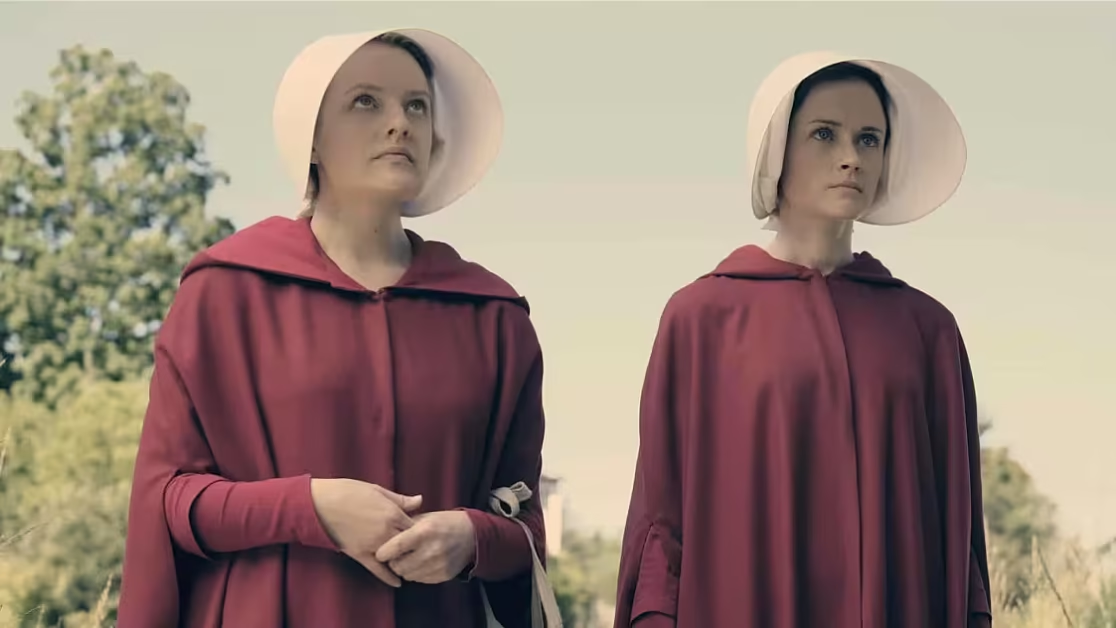
The Hulu series. The 2017 series was the first streaming show to win the Emmy for Outstanding Drama Series. Its first season adapted the whole book and then kept going, and the series ended on May 27, 2025. A follow-up series, The Testaments, was scheduled for April 2026. The show gives the narrator a name and a long war against Gilead. The book gives her neither.
Reading The Handmaid’s Tale after the show is a strange experience, because the quiet, internal Offred is far more fragile than the television hero.
The biggest gap between the two is still the epilogue. Neither screen version has adapted it, so the book’s final joke, that the history of a tragedy becomes a conference with a fishing trip, is only in the book.
What does The Handmaid’s Tale teach us today?
The angle I keep returning to is the bathtub. “Nothing changes instantaneously,” Offred says, “in a gradually heating bathtub you’d be boiled to death before you knew it.”
That slow heating is happening in Afghanistan. Girls were shut out of secondary schools in March 2022, and women were barred from universities that December. In August 2026, UNESCO said that about 2.4 million girls are now excluded from secondary education, 200,000 more than a year earlier, with a projection of nearly four million by 2030. By 2021, nearly one million girls were enrolled in secondary school. This is not a novel come true, and I would not claim it is. It is a reminder of why Atwood insisted she invented nothing.
Five lessons I took from it
- Gradual loss feels like routine, so write down what you stop being allowed to do.
- Control tends to start with money and work, so watch who controls the accounts.
- Regimes recruit insiders, so ask who benefits from enforcing the rules.
- Keep a record, because a story told afterward is better than silence.
- Do not trust the future to understand you, because Pieixoto laughs at the people he studies.
Which qoutes are worth remembering?
I have kept these short, with chapter numbers, so you can find them in context.
- “We were the people who were not in the papers.” (Chapter 10)
- “Ignoring isn’t the same as ignorance, you have to work at it.” (Chapter 10)
- “There is more than one kind of freedom.” (Chapter 5, Aunt Lydia)
- “Better never means better for everyone.” The line continues: “It always means worse, for some.” (Chapter 32, the Commander)
- “Context is all.” (Chapter 24)
- “I would like to believe this is a story I’m telling.” (Chapter 7)
- “Pen Is Envy.” (Chapter 29, a Center motto)
- “Faith is only a word, embroidered.” (Chapter 46)
- “Are there any questions?” (the Historical Notes, the book’s last line before the biography)
Conclusion
I finished The Handmaid’s Tale feeling angry on Offred’s behalf and oddly relieved on her behalf. Gilead, the book insists, was a stage in history, and its rulers did not get the last word. The epilogue is where Atwood turns the knife the other way, by showing that a later, more comfortable society can still treat the oppressed as a puzzle and a joke.
I would recommend it to readers of Orwell and Huxley, to book clubs that want an argument, and to anyone who has only watched the show. If you want a fast thriller with a clear ending, you may find it too quiet. If you want a book that rewards a second reading, it is one of the best.
Rating: 4.5 / 5
Frequently asked questions
Does Offred escape at the end of The Handmaid’s Tale?
The book does not say for certain. She is taken away in a van while Nick tells her it is “Mayday.” The epilogue then shows her story survived as audio tapes, so she was probably free long enough to record them, but the professors cannot say what became of her.
What is the narrator’s real name?
The novel never prints it. The opening lists the names Alma, Janine, Dolores, Moira and June, and readers often guess June, but the text does not confirm it.
What are the Historical Notes in The Handmaid’s Tale?
They are a fictional lecture from 2195 that treats Offred’s story as a historical document, and they reveal that Gilead eventually fell.
Is The Handmaid’s Tale based on a true story?
No, but Atwood has said every element has happened or could happen.
The Handmaid's Tale
Offred climbs into a black van at the end of The Handmaid's Tale, and Margaret Atwood refuses to say whether it carries her to prison or to freedom. Then the book keeps going. A short, strange epilogue set in the year 2195 shows a room of academics laughing at puns while they pick over her voice, and that epilogue is the real answer to the question "what happened to her?"
URL: https://www.sopranu.com/the-handmaids-tale-margaret-atwood-analysis/
Author: Margaret Atwood
4.5
Pros
- Offred's voice; restraint and dark humor; an ending that changes the story; a theme that stays current
Cons
- Slow opening third; passive narrator; epilogue divides readers