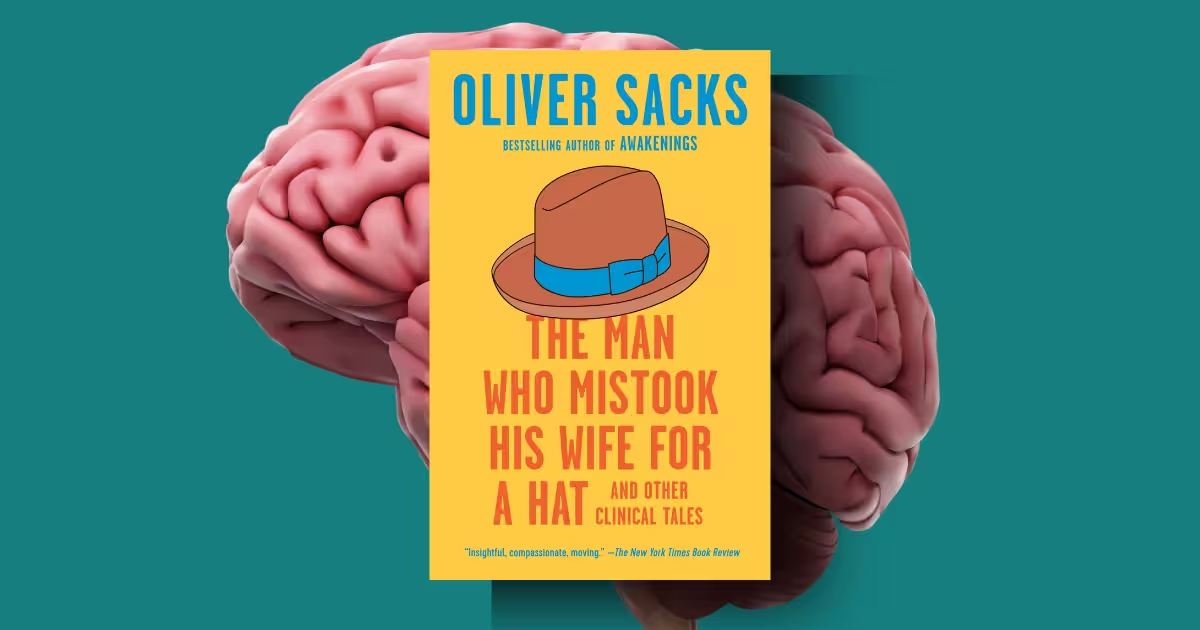

Do you ever stop and wonder what makes you, well, you? Is it your memories, your body, or something else entirely? Oliver Sacks’s The Man Who Mistook His Wife for a Hat doesn’t just ask these questions, it throws you headfirst into the lives of people who have lost the very things we take for granted, forcing both you and the author to confront the fragile, bizarre, and beautiful nature of human identity.
Overview
The Man Who Mistook His Wife for a Hat is a collection of 24 neurological case histories written by the late Oliver Sacks, a British neurologist who became one of the most beloved science writers of the 20th century.
First published in 1985, the book became an unlikely bestseller, spending months on the New York Times list.
It’s not a textbook. It’s a series of deeply human stories about patients with extraordinary conditions: a man who loses his memory and is permanently stuck in 1945, a woman who loses all sense of her own body, a group of autistic savants who communicate in prime numbers, and a Tourette’s patient whose tics vanish when he plays the drums.
Sacks’ central thesis is that neurological disorders are not just mechanical deficits. They are profound disruptions of identity, and each patient’s struggle to adapt, compensate, and survive reveals something fundamental about what it means to be human. He writes, “A disease is never a mere loss or excess: that there is always a reaction, on the part of the affected organism or individual, to restore, to replace, to compensate for and to preserve its identity”.
However, the book’s legacy is now complicated.
In 2025, journalist Rachel Aviv, granted access to Sacks’ private journals by the Oliver Sacks Foundation, revealed that Sacks himself confessed to “lies” and “falsification” in the book. Some cases were partially or wholly fabricated. This revelation has detonated the book’s reputation as non-fiction. So, is it still worth reading? Let’s find out.
Reader recommendation
This book is best for anyone with a curious mind. If you are fascinated by the mysteries of the brain, the nature of consciousness, or the fundamental question of what it means to be human, this book will be a revelation. It’s also perfect for readers who appreciate a blend of science and storytelling, where complex neurological concepts are explained through vivid, moving, and often darkly humorous personal narratives.
Sacks writes with such empathy and clarity that even readers with no background in medicine will find themselves completely absorbed.
This book is not for readers seeking a dry, textbook-style account of neurology. The case studies are the heart of the book, and Sacks’s narrative style is as much about the human drama as it is about the medical facts.
If you prefer your science purely objective and devoid of personal interpretation or philosophical musing, you might find Sacks’s style too subjective. Additionally, some readers might be put off by the dated language and the controversies surrounding the factual accuracy of the cases.
However, for those who can look past these issues, the book remains a profoundly insightful and moving work.
Table of Contents
Introduction
Book Title: The Man Who Mistook His Wife for a Hat and Other Clinical Tales
Author: Oliver Sacks (1933–2015)
Publication Date: 1985 (originally published in the UK by Duckworth, and in the US by Summit Books)
Genre: Popular Science, Neurology, Psychology, Medical Humanities
Oliver Sacks was a British neurologist who spent most of his career in New York. He was a prolific writer, a frequent contributor to The New Yorker, and the author of several other acclaimed books, including Awakenings (which was adapted into a film starring Robin Williams) and Migraine. The New York Times called him “one of the great clinical writers of the 20th century”.
He was known for his deeply empathetic, almost novelistic approach to his patients, treating them not as “cases” but as individuals with rich inner lives.
The book’s title comes from the first chapter, where Dr. P., a distinguished musician, literally mistakes his wife’s head for a hat. This bizarre incident sets the tone for the entire collection: strange, poignant, and deeply revealing.
Central Thesis of The Man Who Mistook His Wife for a Hat
The book’s central argument is that neurology, at its best, must be a “romantic science”, a discipline that combines rigorous observation with deep human empathy. Sacks argues that classical neurology, with its focus on deficits and mechanical functions, fails to capture the lived experience of patients.
He writes, “To restore the human subject at the centre—the suffering, afflicted, fighting, human subject—we must deepen a case history to a narrative or tale; only then do we have a ‘who’ as well as a ‘what'”. He was heavily influenced by the Russian neuropsychologist A.R. Luria, who pioneered this narrative approach.
Background
When The Man Who Mistook His Wife for a Hat was published in 1985, it was a phenomenon. It was a book about neurology that became a popular bestseller, appealing to both scientists and general readers. Part of its appeal was Sacks’ writing style: he made complex medical conditions accessible and deeply moving. As one reviewer noted, “These cases are like Poe”.
Another said, “It will inform and entertain anyone, especially those who find medicine an intriguing and mysterious art”.
The book was also timely. In the 1980s, there was a growing public interest in the brain and consciousness. Sacks’ book tapped into this curiosity, offering a glimpse into the strange and wonderful world of neurological disorders.
However, the book’s reputation has been severely damaged by revelations of Sacks’ “falsification.” In 2025, The New Yorker published an article by Rachel Aviv, who had access to Sacks’ private journals. Sacks had written of his “guilt” over his “lies” and “falsification” in the book.
Aviv found that some cases, like that of “Rebecca” and the prime-number-calculating twins, were either exaggerated or entirely fabricated. This has led to a crisis of trust, with critics arguing that the book should be reclassified as fiction.
The Man Who Mistook His Wife for a Hat Summary
The Man Who Mistook His Wife for a Hat is divided into four parts, each exploring a different aspect of neurological experience: Losses, Excesses, Transports, and The World of the Simple. Each part contains several case histories, and together they paint a panoramic picture of the human brain’s fragility and resilience.
Part One: Losses
This section deals with patients who have lost specific functions: memory, proprioception, visual recognition, and more.
1. The Man Who Mistook His Wife for a Hat
This is the book’s most famous case. Dr. P. was a distinguished musician and teacher who developed a severe form of visual agnosia. He could see individual features but could not recognize whole faces or objects. He would pat fire hydrants, mistaking them for children’s heads, and, most famously, tried to lift his wife’s head off her shoulders, thinking it was a hat.
When Sacks examined him, he found that Dr. P. had no trouble with abstract shapes but was utterly lost when it came to real faces and objects. He could describe a glove as “a continuous surface infolded on itself with five outpouchings” but could not identify it as a glove. Sacks writes, “He saw nothing as familiar. Visually, he was lost in a world of lifeless abstractions”.
This case is a powerful illustration of what happens when the brain loses its ability to process the “concrete” and is reduced to the “abstract.” Sacks notes that Dr. P. had lost not just visual perception but also visual memory and imagination. He no longer dreamed pictorially. Yet, his musical abilities were perfectly preserved, and Sacks prescribed a life centered entirely on music, which became his salvation.
Key line: “He faced me with his ears, I came to think, but not with his eyes. These, instead of looking, gazing, at me, ‘taking me in’, in the normal way, made sudden strange fixations—on my nose, on my right ear, down to my chin, up to my right eye—as if noting (even studying) these individual features, but not seeing my whole face, its changing expressions, ‘me’, as a whole”.
2. The Lost Mariner
Jimmie G. was a handsome, charming man in his late forties who was admitted to a nursing home. He appeared perfectly normal until you asked him about the present. He believed it was 1945, that he was nineteen years old, and that World War II had just ended. He had no memory of anything that had happened since then.
Sacks describes Jimmie’s condition as a severe case of Korsakov’s syndrome, caused by alcohol-related damage to the mammillary bodies of the brain. Jimmie could remember his childhood and his war service in vivid detail, but he could not retain new information for more than a few seconds. He would greet Sacks as if meeting him for the first time, every single time.
What struck Sacks most was Jimmie’s emotional and spiritual life. Despite his profound amnesia, Jimmie found meaning and continuity in religious worship. Sacks writes, “I watched him kneel and take the Sacrament on his tongue, and could not doubt the fullness and totality of Communion, the perfect alignment of his spirit with the spirit of the Mass”. This led Sacks to a profound conclusion: “A man does not consist of memory alone. He has feeling, will, sensibilities, moral being”.
Key line: “You have to begin to lose your memory, if only in bits and pieces, to realise that memory is what makes our lives. Life without memory is no life at all… Our memory is our coherence, our reason, our feeling, even our action. Without it, we are nothing”.
3. The Disembodied Lady
This is one of the most haunting cases in the book. Christina was a 27-year-old woman who developed a severe sensory neuritis that destroyed her proprioception—the “sixth sense” that tells you where your body is in space. She lost all sense of her own body. She could not sit up, stand, or hold anything without watching her limbs. She felt “disembodied”.
Sacks describes how Christina had to use her eyes to compensate for the loss of proprioception. She had to watch her hands to know what they were doing, and if she closed her eyes, she would collapse. She learned to walk and perform daily tasks, but she never regained the feeling of owning her own body. She told Sacks, “I feel my body is blind and deaf to itself… it has no sense of itself”.
This case is a powerful demonstration of the importance of proprioception to our sense of self. As Sacks notes, “The ego is first and foremost a body-ego”. Without proprioception, Christina was, in a sense, “pithed” like a frog.
Key line: “She continues to feel, with the continuing loss of proprioception, that her body is dead, not-real, not-hers—she cannot appropriate it to herself”.
4. The Man Who Fell Out of Bed
This is a brief, almost comic case about a patient who, after a stroke, became convinced that his own left leg was a “severed human leg” that had been placed in his bed as a joke. When he threw it out of bed, he followed it and ended up on the floor. This case illustrates a phenomenon called “hemisomatognosia”—the loss of awareness of one side of the body.
5. Hands
Madeleine J. was a 60-year-old woman who had been blind and had cerebral palsy since birth. She had never used her hands. They were, in her words, “useless godforsaken lumps of dough”. Sacks discovered that, despite having normal sensation, she had never developed the ability to recognize objects by touch. This was a form of “developmental agnosia”.
Sacks and his team devised a simple intervention: they left food slightly out of reach so that Madeleine would have to reach for it. One day, she did, and that was the beginning of her “birth as a motor individual”. She went on to become a talented sculptor, discovering an artistic gift she never knew she had.
6. Phantoms
This section contains short vignettes about phantom limbs. One patient, who had lost his finger, still felt it rigidly extended and feared it would poke his eye out. Another patient with a leg amputation had to “wake up” his phantom by slapping his stump before he could put on his prosthesis. These cases illustrate the strange persistence of the body image even after the body part is gone.
7. On the Level
Mr. MacGregor, a 93-year-old man with Parkinson’s disease, leaned to one side without being aware of it. He had lost his “spirit level”—the inner sense of balance that keeps us upright. Sacks and Mr. MacGregor collaborated to design a pair of glasses with spirit levels attached, allowing him to use his vision to correct his posture. This is a beautiful example of Sacks’ collaborative, problem-solving approach to therapy.
8. Eyes Right!
Mrs. S. had a stroke that destroyed her awareness of the left side of the world. She would only eat from the right half of her plate and only put makeup on the right half of her face. She developed a clever strategy: she would swivel her wheelchair to the right in a full circle until the missing half came into view. This case illustrates a condition called “hemi-inattention”.
9. The President’s Speech
This is a delightful chapter about a group of aphasic patients watching a speech by a former U.S. president. They could not understand the words, but they could read the tone, the body language, and the emotional subtext perfectly.
They laughed uproariously at the speech because they could see it was inauthentic. Sacks contrasts this with a patient with tonal agnosia who could understand the words but not the emotion, and who found the speech “not cogent”.
Part Two: Excesses
This section deals with patients who have too much of something, too many tics, too much energy, too much sexual desire.
10. Witty Ticcy Ray
Ray was a 24-year-old man with severe Tourette’s syndrome. He had uncontrollable tics, jerks, and compulsions, and he would involuntarily shout obscenities. He was a brilliant jazz drummer who could channel his tics into wild, creative improvisations.
Sacks tried Ray on the drug Haldol, which suppressed his tics but also dulled his personality and creativity. Ray made a difficult decision: he would take Haldol during the workweek but go off it on weekends to let his “witty ticcy” self out. This case raises profound questions about the relationship between disease and identity. Ray said, “I consist of tics—there is nothing else”, but Sacks helped him see that there was more to him than his disorder.
Key Quote: “Having Tourette’s is wild, like being drunk all the while. Being on Haldol is dull, makes one square and sober, and neither state is really free”.
11. Cupid’s Disease
Natasha K. was a 90-year-old woman who became suddenly euphoric, energetic, and sexually forward. She diagnosed herself as having “Cupid’s Disease”—neurosyphilis. She was right. She had been infected nearly 70 years earlier, and the spirochetes were now stimulating her brain.
She asked Sacks not to cure her completely, because she enjoyed feeling “frisky”. Sacks treated her with penicillin, which killed the spirochetes, but left her with a mild, harmless euphoria.
12. A Matter of Identity
William Thompson had severe Korsakov’s syndrome. He could not remember anything for more than a few seconds. To cope with this, he constantly confabulated, he invented identities and stories on the spot. He would mistake the doctor for a deli customer, a mechanic, or his old friend Tom.
Sacks notes that William had lost not just his memory but his sense of reality and his soul. He was a man in a perpetual frenzy of self-creation, but it was all surface, with no depth.
Key line: “Deprived of continuity, of a quiet, continuous, inner narrative, he is driven to a sort of narrational frenzy—hence his ceaseless tales, his confabulations, his mythomania”.
13. Yes, Father-Sister
Mrs. B. had a frontal-lobe tumor. She became facetious, indifferent, and unable to distinguish between a father, a sister, and a doctor. She said, “Father, sister, doctor—what’s the big deal?”. This is a chilling example of “equalization”, the loss of meaning and distinction that can occur with frontal-lobe damage.
14. The Possessed
This chapter describes a woman with a severe form of Tourette’s syndrome who compulsively imitated everyone she passed on the street. She was a “woman with a thousand faces” who lost her own self in the process. This case illustrates the extreme end of Tourette’s, where the personality is overwhelmed by impulsive, convulsive behavior.
Part Three: Transports
This section deals with patients who are “transported” to other times, places, or states of consciousness by neurological events.
15. Reminiscence
Mrs. O’C., an 88-year-old woman, suddenly started hearing Irish songs from her childhood after a stroke. An EEG showed she was having temporal-lobe seizures. The seizures gave her back memories she had lost, and she felt a profound sense of peace and completeness. Sacks compares this to Proust’s involuntary memories and Dostoievski’s ecstatic seizures.
Key Quote: “I know you’re there, Dr Sacks. I know I’m an old woman with a stroke in an old people’s home, but I feel I’m a child in Ireland again, I feel my mother’s arms, I see her, I hear her voice singing”.
16. Incontinent Nostalgia
This is a short piece about a post-encephalitic patient who, under the influence of L-Dopa, was flooded with forgotten memories and sexual songs from her youth. This is a classic example of a “forced reminiscence”.
17. A Passage to India
Bhagawhandi P., a young woman dying of a brain tumor, began having visions of her childhood home in India. As her tumor progressed, the visions became more frequent and more vivid. She told Sacks, “I am dying… I am going home”. She died peacefully, “having completed her passage to India”.
This is a haunting meditation on the power of memory and the possibility of a peaceful death.
18. The Dog Beneath the Skin
Stephen D., a medical student, had a drug-induced experience in which his sense of smell was extraordinarily enhanced. He could identify people and places by smell alone and felt he was living in a “world of pure perception”. This case illustrates the power of sensory disinhibition and the loss we experience in becoming “civilized”.
19. Murder
Donald, a man who killed his girlfriend under the influence of PCP, had no memory of the crime. After a head injury, the memory suddenly returned in vivid, hallucinatory detail, tormenting him. This case raises questions about the nature of memory, repression, and guilt. Sacks suggests that the frontal-lobe damage may have “de-repressed” the memory.
20. The Visions of Hildegard
This is a fascinating analysis of the visions of Hildegard of Bingen, a 12th-century mystic. Sacks argues that her visions were actually migrainous auras. He includes illustrations of her visions, which show classic migraine patterns like fortification figures and scintillating scotomas. This case shows how a neurological event can be interpreted as a spiritual revelation.
Key line: “They provide a unique example of the manner in which a physiological event, banal, hateful or meaningless to the vast majority of people, can become, in a privileged consciousness, the substrate of a supreme ecstatic inspiration”.
Part Four: The World of the Simple
This section deals with patients who are intellectually disabled but possess other remarkable gifts.
21. Rebecca
Rebecca was a 19-year-old woman with severe developmental delays. She could not read, write, or find her way around the block.
But she was a natural poet, a lover of stories, and a gifted actress. Sacks contrasts her performance in formal testing, where she failed miserably, with her performance on stage, where she was a “complete person”. This case is a powerful argument for the importance of narrative and the arts in human development.
Key line: “She is an idiot Ecclesiastes”.
22. A Walking Grove
Martin A. was a retarded man with an astonishing musical memory. He knew over 2,000 operas and the entire Grove’s Dictionary of Music by heart. But his real passion was singing in church choirs. When he sang, all his defects fell away, and he was transformed.
23. The Twins
This is one of the most famous and controversial chapters. John and Michael were autistic twins with IQs of 60. They could not add or subtract, but they could instantly tell you the day of the week for any date in 80,000 years. They could also spontaneously identify prime numbers of up to twenty digits. Sacks observed them “seeing” numbers as if they were visual objects.
However, the accuracy of this case has been questioned. As the New Scientist article notes, “Sacks claims that a pair of identical twins with severe neurological difficulties were nevertheless able to spontaneously identify six-digit primes—something never seen before or since”. There is no independent verification of this claim.
Key line: “We didn’t count, they said. ‘We saw the 111′”.
24. The Autist Artist
Jose was an autistic man with severe epilepsy and no speech. But he was a gifted artist. Sacks gave him a pen and watched him draw with remarkable accuracy and creativity. Jose’s drawings were not just copies; they were transformations, full of life and humor. This case is a testament to the power of art to transcend intellectual disability.
The Man Who Mistook His Wife for a Hat Analysis
The Man Who Mistook His Wife for a Hat is an extraordinary book. It is beautifully written, deeply empathetic, and intellectually provocative. Sacks had a rare gift for making the strange familiar and the familiar strange. He could take a patient with a bizarre neurological condition and make you see the world through their eyes.
The book’s greatest strength is its humanity. Sacks never treats his patients as objects of curiosity. He treats them as people with rich inner lives, and he shows how, even in the face of devastating neurological damage, they find ways to adapt, compensate, and maintain their identities.
As one reviewer put it, “Sacks brings us into the lives of people with amnesia, neurosyphilis, Tourette’s syndrome and much more… he explores the neurological basis of their conditions, and considers what they tell us about the nature of the human mind”.
However, the book’s reputation has been severely damaged by the revelations of Sacks’ “falsification.” The fact that some cases were partially or wholly fabricated undermines the book’s claim to be non-fiction. If we cannot trust the facts, how can we trust the conclusions?
The New Scientist article makes a compelling case for reading the book as a work of fiction or, at least, as a work of “literary non-fiction” that prioritizes emotional truth over factual accuracy. The author writes, “Its greatest achievement is something that we normally associate with fiction: putting the reader into the minds of people whose experiences and perceptions are radically different”.
I find myself agreeing with this assessment. The Man Who Mistook His Wife for a Hat is not a reliable textbook, but it is a profound work of art. It has inspired countless people to think differently about the brain, identity, and what it means to be human. Even if some of the details are false, the emotional and philosophical truths it conveys are real.
Strengths and Weaknesses
Strengths
- Empathy and Humanity: Sacks’ compassionate, non-judgmental approach to his patients is the book’s greatest strength. He treats them as individuals, not as cases.
- Narrative Power: The book is exceptionally well-written. Each case is a compelling story that draws the reader in.
- Philosophical Depth: Sacks raises profound questions about identity, memory, consciousness, and the nature of the self.
- Accessibility: Sacks makes complex neurological concepts understandable to a general audience without dumbing them down.
- Influence: The book has inspired a generation of students and researchers in psychology and neuroscience.
Weaknesses
- Factual Inaccuracy: The revelations of Sacks’ “falsification” are a serious blow to the book’s credibility as non-fiction.
- Outdated Language: The book uses language about developmental disability that is now considered offensive.
- Lack of Scientific Rigor: Most of the case studies were never published in scientific journals and lack independent verification.
- Over-Interpretation: Sacks sometimes indulges in philosophical musings that feel forced or overblown.
- Lack of Transparency: Sacks never disclosed his “falsifications” during his lifetime, which raises questions about his integrity as a writer.
Comparison with Similar Works
The Man Who Mistook His Wife for a Hat is often compared to other works of popular neuroscience and psychology. Here are a few notable comparisons:
Awakenings by Oliver Sacks: Sacks’ earlier book is also a collection of case histories, this time about post-encephalitic patients who were “awakened” by the drug L-Dopa. Awakenings is more focused and more rigorously documented, but it shares the same empathetic, narrative style.
The Brain that Changes Itself by Norman Doidge: Doidge’s book explores the concept of neuroplasticity, the brain’s ability to rewire itself. It is more scientifically rigorous than Sacks’ book but less literary.
An Anthropologist on Mars by Oliver Sacks: This is another collection of case histories, published later, which includes the famous story of the autistic artist Temple Grandin. It is similar in style and substance to The Man Who Mistook His Wife for a Hat.
The Man with a Shattered World by A.R. Luria: This is one of the key influences on Sacks. Luria’s book is a detailed case history of a man with a severe brain injury. It is more clinical than Sacks’ work but shares the same focus on the human subject.
Conclusion
The question of whether to read The Man Who Mistook His Wife for a Hat is now complicated by the revelations of Sacks’ “falsification.” If you are a strict factual purist who requires 100% verifiable accuracy, this book will frustrate you. You will constantly wonder, “Is this true?”
However, if you can approach the book as a work of literary non-fiction, a collection of stories that are based on real medical conditions but shaped by the author’s imagination and empathy, you will find it a deeply rewarding read. As the New Scientist article concludes, “if you read it knowing that [it is not entirely factual], you will nevertheless find that it expresses something true”.
I would recommend this book to anyone interested in the human mind, the nature of identity, or the power of storytelling. It is a masterpiece of empathy and imagination, even if it is not a reliable textbook. It will make you think, feel, and see the world in a new way. And that, in the end, is what the best books do.
Who Should Read This Book:
- Fans of narrative non-fiction and medical storytelling.
- Psychology and neuroscience enthusiasts.
- Anyone curious about the strange and wonderful ways the brain can fail and adapt.
- Writers and storytellers looking for inspiration.
Who Should Skip This Book:
- Strict factual purists.
- Readers looking for a systematic textbook on neurology.
- Those who are easily disturbed by graphic medical descriptions.