
Last updated on January 13th, 2026 at 05:13 am
Ever wonder why one tiny choice—one word, one label—can feel like it rewires your whole future? The Names doesn’t just tell you that names carry weight; it makes you live the consequences.
A mother names her newborn son—and that single decision fractures into three possible lives, showing how identity, love, violence, and chance reshape a family.
Best for:
- Readers who love Sliding Doors-style “what if” fiction, but with emotional realism and domestic stakes.
- Anyone interested in how trauma travels through families—and how healing sometimes does too.
- Book-club readers who want a structure that sparks debate (three timelines, one family).
Not for:
- Readers who want a simple linear plot (this one is deliberately prismatic).
- Anyone sensitive to domestic abuse themes without space for reflection (it’s central, not incidental).
Table of Contents
1. Introduction
Book: The Names: A Read with Jenna Pick
Author: Florence Knapp
Publisher/Imprint: Pamela Dorman Books (Viking/Penguin Random House)
First published: 2025, ISBN: 978-0-593-83390-2
Public-facing listings describe it as Knapp’s debut novel and note it will be translated widely.
2. Background
The Names is set against recognizable late-20th/early-21st century life in the UK/Ireland—jobs, schools, relationships, and the quiet grind of ordinary days. But it’s also anchored in the reality that leaving an abusive partner can be dangerous—something the book states outright: “The most dangerous time is before you leave.”
That line lands harder when you compare it to the real world: WHO estimates nearly 1 in 3 women globally experience physical and/or sexual violence in their lifetime.
And then there’s the novel’s other obsession: what a name “does.” Not magically—socially. We already know names can trigger bias (even on job callbacks). A classic field experiment found resumes with “white-sounding” names received about 50% more callbacks than “African-American–sounding” names.
Knapp’s genius is to braid these realities—danger and identity—into one structural dare: what if a name nudges a life onto another track?
3. The Names Summary
First, how the novel is built
The table of contents tells you what you’re in for: each “era” (1987, 1994, 2001, 2008, 2015, 2022) splits into three chapters—Bear, Julian, Gordon—the same family refracted through three possible names.
The opening problem is stark and intimate: tomorrow Cora will register the name of her son—“or perhaps… she’ll formalise who he will become.”
The one family, the fixed pieces
Across all versions:
- Cora is the mother.
- Maia is her older child (already 9 in 1987).
- Gordon is the husband/father (and the shadow over the house).
- The newborn son becomes Bear, Julian, or Gordon (the son) depending on the timeline.
1987: The storm, the registry office, and the crack in the marriage
A storm has battered everything. Cora has a newborn, Maia at her side, and a decision that feels small on paper but massive in her body. She thinks of the name Bear with an almost tender defiance—Knapp even tells us why it fits: “It’s the name a bear would choose, if a bear could choose a name.”
But inside the home, Gordon’s control is tightening. There’s a detail that captures Cora’s daily imprisonment: he complains about the milk not being arranged, and she clocks the ridiculousness of it—and still obeys.
Then the true danger arrives. Gordon turns threatening, and Knapp refuses to soften it: “Many women are killed by their partners. It’s not safe to leave him.”
Cora hears the threat as a prophecy aimed at her.
This is the pivot where the three realities split.
Timeline A — BEAR: A life that blooms… and then breaks
1. 1994–2008: A childhood that grows around love and vigilance
In the Bear-strand, the household’s emotional weather is different enough that Bear develops a personality with real softness and curiosity—yet the story never lets you forget the original fear.
Bear and Maia’s sibling bond is one of the few constants that feels truly safe: “They are inseparable now, and always.”
By 2008, Bear is old enough that the outside world starts shaping him—education, friendships, the first serious love. The book begins to show how a “tender” boy becomes an adult who still holds other people’s feelings carefully.
2. 2015: Love, distance, and a world that can turn violent overnight
Bear’s adult life becomes outward-facing: travel, work, ambition. His relationship with Lily deepens, but distance and danger are real. One of the novel’s sharpest collisions of personal life and public event happens around the Paris attacks of Nov. 13, 2015, where at least 130 people were killed.
Knapp uses that era to show how “fate” can arrive through the news—and still land like a fist in one private apartment.
3. 2020–2022: The ending of Bear’s life (yes, really)
By 2022, the Bear-timeline is already grieving. Lily wears it visibly: “Lily wears her grief like a second skin.”
Pearl—Bear and Lily’s little girl—carries grief the way kids do: in questions and blunt statements. Knapp gives her the simplest knife of a line: “Papa died.”
The novel explains how it happened. On the day of the accident, Bear is up in the loft dealing with the cold-water tank—focused, practical, ordinary. Then the body betrays him: a sting, swelling, panic. “There’s a wasp sting… it’s already swelling.” Lily has only moments to act, and the scene is written like a countdown you can’t stop.
The Bear timeline ends not with a neat lesson, but with the truth of loss: two years later, they’re still learning how to live in the space he left behind.
Bear’s ending, in plain terms: he dies suddenly from an acute allergic reaction after a wasp sting while fixing the tank; the aftermath is Lily and Pearl rebuilding a life that now has “before” and “after.”
Timeline B — JULIAN: A life shaped by absence, Ireland, and the ache of being left
4. The core difference: Cora is gone
The Julian-strand carries a different tragedy: Julian “barely remembers the night his mother died.”
Instead of being raised inside Cora’s constant calculations, Julian grows up in Ireland with his grandmother Sílbhe and her partner Cian.
That matters because Julian becomes the kind of adult who learned early that love can vanish without warning. Knapp underlines the social vulnerability too: “It is like this, when you have no one. They take what they want.”
5. 2008–2015: Work, talent, and the hunger to be chosen
Julian becomes a jeweler—craft-driven, careful. He works in a place called the Old Chocolate Factory and begins to build a life that’s stable because he makes it stable.
He meets Liberty, who becomes a key hinge in his adult life—connected to stockists, London, and the possibility of being truly seen.
He also builds a family with Orla, and their children Niamh and Aoife.
6. 2022: Lockdown, abandonment, and Julian’s emotional “trial”
By 2022, the Julian timeline is in the COVID era, and the personal crisis is relentless: Orla leaves during lockdown after “everything” becomes too much—homeschooling, stress, resentment.
Julian is left trying to win her back, but the book doesn’t romanticize it. He’s not a hero; he’s a man repeating patterns—clinging because he was trained by grief to cling.
Julian’s ending, in plain terms: it’s less “wrapped up” than Bear’s, but the emotional resolution is clear: Julian must face the fact that love doesn’t stay just because you want it to—and that the life he’s built can still be real, even if it looks different than his fantasy of reunion.
Timeline C — GORDON (the son): A life that inherits the name… and fights the inheritance
7. 1987: Violence becomes public
In this strand, Gordon (the husband) escalates to the point the police are involved. The scene is explicit: glass, force, shouting, and then handcuffs—the private horror made visible.
8. 2001–2015: The son Gordon grows up with the weight of being “named after”
When the son is named Gordon, the book explores a different kind of curse: not just abuse, but legacy—what it means to carry your father’s name when your father is the person you fear. (The “name” here becomes a symbol of inheritance, expectation, and shame.)
By 2015, Gordon (the son) is struggling with addiction and its humiliations; he’s in recovery spaces, learning the language of repair.
9. 2022: The husband Gordon’s final control tactic—and Cora’s exit
Near the end of the novel, this strand delivers one of its most chilling details: Gordon (the husband) has hidden cameras inside the house. The footage is used as leverage—control disguised as “proof.”
But this is also the timeline where Cora finally steps into a life that’s hers. After the split, she’s living alone, reclaiming normalcy: “Cora lives alone now, in a bungalow in west London.”
When she sees Gordon later, she notices something ridiculously human—tomato soup spilled on his shirt—and realizes the fear is shrinking.
Gordon (son) ending, in plain terms: the novel offers the clearest “escape + aftermath” arc here—Cora gets out, and the family begins the long, messy work of living without Gordon’s domination.
The Epilogue: what the book is really saying
The epilogue names the thesis directly: “There is a child, born amid a great storm. In one life he is Bear. In another Julian. In another Gordon.”
It’s not saying names are magic spells. It’s saying something more unsettling: identity is built from a mix of choice, story, violence, luck, and time—and any one of those can tilt a life.
Knapp even frames her own guiding question in the author’s note: the tension between how much a life is shaped by what happens to us, and how much by the stories we tell.
4. The Names analysis
4.1 The Names Characters
Cora — the survivor whose “main power” is attention
Cora is the emotional anchor across all timelines. What makes her complex is that she isn’t written as endlessly brave or endlessly broken—she’s written as alert. Even small domestic details (like the milk) become survival math.
Her best moments aren’t speeches—they’re decisions. Sometimes that decision is love (Bear). Sometimes it’s grief-avoidance (Julian). Sometimes it’s strategic submission that later becomes escape (Gordon timeline).
Gordon (the husband) — not a “monster,” a pattern of control
Knapp doesn’t excuse him. But she shows the mechanism: intimidation, humiliation, coercion. He even uses surveillance as a final form of possession.
Maia — the silent record-keeper
Maia is constant across lives: the sibling bond, the witness, the one who grows up too early. The line “inseparable now, and always” is one of the book’s few uncomplicated comforts.
Bear / Julian / Gordon (the son) — three identities, three emotional grammars
- Bear reads like empathy embodied: love-forward, outward-facing, then tragically mortal.
- Julian reads like abandonment metabolized: craft, control, a hunger to be chosen that becomes his flaw.
- Gordon (son) reads like inherited conflict: the fight to be more than the name that ties him to his father.
4.2 The Names Themes and Symbolism
1. Naming as identity and social consequence
Knapp explicitly assigns “energy” to names (Bear as a name a bear would choose).
But the deeper point is social: names invite assumptions, expectations, bias—sometimes opportunity. That’s why the name thread resonates in the real world too. (
2. Domestic abuse: the economics of fear
The book says what many survivors know: leaving isn’t just emotionally hard; it can be the most dangerous phase.
This theme is reinforced by real-world prevalence data.
3. Fate vs agency: the story you tell yourself
The author’s note frames the central tension: life shaped by events vs life shaped by narrative.
The structure makes you feel that tension—because you keep asking: Is this the name? Or is it the storm of everything else?
4. The storm (symbol)
The storm at the beginning is literal, but it functions like a thesis: you can’t control what hits your roof—but you can sometimes control what you name, what you hold, what you leave.
5. The cover image / hybrid plant (symbol)
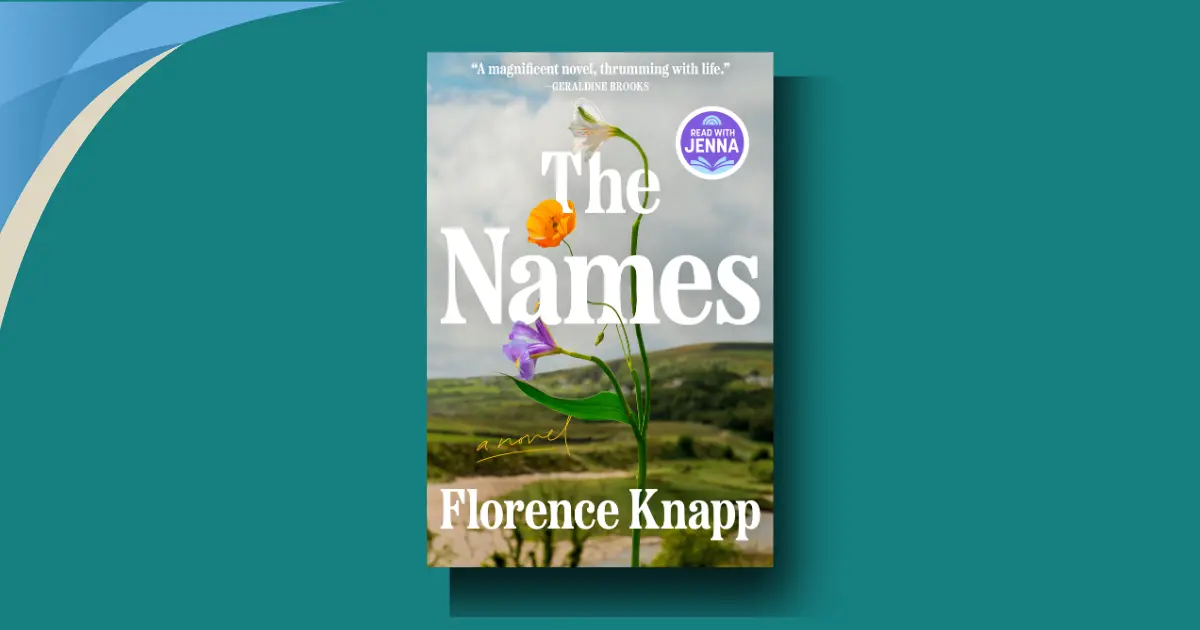
Knapp even points out the cover’s meaning: three different flowers sharing one stem—one family, three realities.
5. Evaluation
Strengths (what works beautifully)
- Structure that actually earns its gimmick. The “three lives” design isn’t just clever; it deepens the emotional stakes.
- Domestic detail as tension. The milk scene is a masterclass in showing coercion without shouting “THIS IS ABUSE.”
- Grief written without sentimentality. The Pearl lines are brutal because they’re simple.
Weaknesses (what may not work for everyone)
- Emotional whiplash. Switching between strands can feel like starting over repeatedly (by design, but still a cost).
- Uneven closure. Bear’s strand has the sharpest “ending,” while Julian’s can feel less resolved (some readers will love that realism; others won’t).
Impact
The book’s lasting effect isn’t just “names matter.” It’s the feeling that any life is a braid of choices and collisions—and that escaping harm is often a long, non-linear craft.
Comparison with similar works
- Kate Atkinson’s Life After Life (multiple lives, fate/choice loops)
- The film Sliding Doors (single choice fractures into two lives)
- Matt Haig’s The Midnight Library (alternate selves, regret, possibility)
Knapp’s difference: the engine isn’t cosmic—it’s domestic, social, embodied.
6. Personal insight with contemporary educational relevance
One reason The Names feels so teachable right now is that it turns “identity” into something you can trace. In classrooms, therapy circles, even workplace training, we talk about “systems” and “bias” as if they’re abstract.
Knapp makes them intimate: a name changes how others meet you, and violence changes what you believe you deserve.
That’s not just literary theory. In hiring research, names function like signals; the Bertrand–Mullainathan field experiment found “white-sounding” names received substantially more callbacks than “African-American–sounding” names—despite identical resumes.
That kind of evidence doesn’t mean a name determines a life, but it does show how quickly society attaches meaning to labels.
And the book’s abuse narrative matters in a very current way: WHO and UN Women both summarize global estimates at roughly 1 in 3 women experiencing physical and/or sexual violence in their lifetime.
When Knapp writes, “The most dangerous time is before you leave,” she’s echoing a risk reality many advocates emphasize: exits can escalate danger.
So the contemporary “lesson” isn’t a slogan like “choose better names.” It’s sharper: pay attention to the quiet coercions, trust the body’s alarm system, and recognize how institutions—and even everyday language—can tilt outcomes. That’s an educational takeaway with real-world use.
7. The Names Quotes
- “Tomorrow… Cora will register the name of her son… she’ll formalise who he will become.”
- “It’s the name a bear would choose, if a bear could choose a name.”
- “You could leave, Cora. You could have a different life.”
- “The most dangerous time is before you leave.”
- “They are inseparable now, and always.”
- “There’s a wasp sting… it’s already swelling.”
- “Papa died.”
- “Lily wears her grief like a second skin.”
- “It is like this, when you have no one. They take what they want.”
- “There is a child… In one life he is Bear. In another Julian. In another Gordon.”
8. Conclusion
The Names is a novel about a single decision that keeps echoing—through love, through harm, through chance, through the stubborn work of becoming yourself anyway. Its structure is bold, but its real power is emotional: it asks what we inherit, what we choose, and what we survive.
Recommendation:
- If you like literary fiction with a high-concept spine and a tender heart, this is for you.
- If you enjoy book-club conversation starters about fate vs agency, identity, and family, it’s a strong pick.
- If depictions of domestic abuse are a hard boundary, consider reading with support or skipping.
- What is The Names about? A mother names her son; the story shows three versions of that life.
- Is it sad? Yes—especially the Bear timeline’s ending.
- Is it worth reading? If you like emotionally intelligent “what if” fiction, it’s a standout.







