
Last updated on November 6th, 2026 at 11:40 am
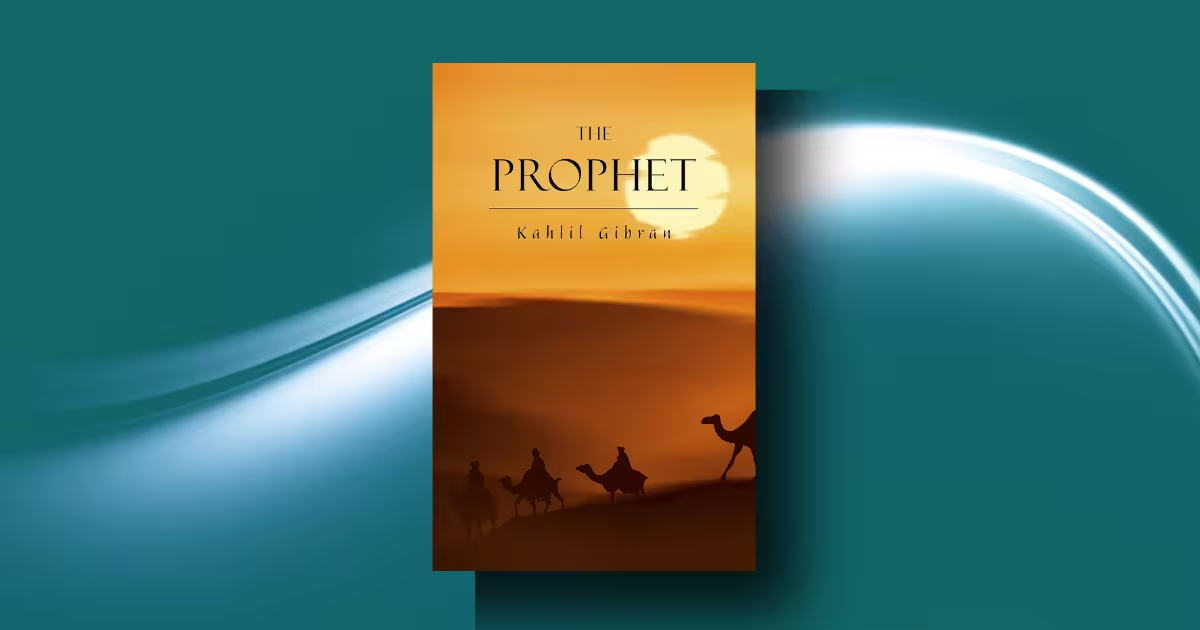
Did you ever hold a book in your hands and feel, with an almost physical certainty, that it was not merely written but breathed into existence? The Prophet felt the same way to me.
I am writing this not as a scholar perched in a distant tower of literary criticism, but as a fellow traveler who has sat with this book in the heavy, pregnant silence of a sleepless night, and in the chaotic, sun-drenched joy of a morning full of possibilities.
In a world that screams for our attention, this slender volume, first offered to the world in 1923, doesn’t raise its voice. It waits, with infinite patience, for us to be ready to listen.
And when we finally do lower our defenses and open its pages, we don’t find a set of rules for living; we find a clear, cool pool of wisdom that reflects our own deepest, most beautiful, and most frightened selves back to us.
Life’s most profound experiences—love, work, joy, sorrow, and even death—are not separate, warring entities to be feared and controlled, but inseparable notes in a single, sacred song, and your deepest self, the “god-self” within, knows how to dance to it if you will only give it silence.
The Prophet is for you if: You are standing at a precipice in your life. If you’ve just experienced a profound loss, a great love, the birth of a child, or the quiet despair of a life half-lived.
It’s for the seekers, the wanderers of the spirit, and for anyone who feels a gnawing hunger that material success cannot satisfy. This is for the young graduate just as much as it is for the retiree looking back.
It requires no religious affiliation, only an open heart.
The Prophet is not for you if: You are looking for a linear plot, a cast of characters, or a traditional narrative with conflict and resolution. It won’t satisfy if you need a prescriptive, dogmatic self-help manual with numbered action steps.
The language is poetic and metaphysical; if you demand literal, empirical truths, you will likely bounce off its lyrical surface, dismissing it as vague mysticism. It demands to be felt, not just analyzed.
Table of Contents
1. Introduction
Let us begin with the name on the cover: Kahlil Gibran. He was born in 1883 in the village of Bsharri, in what is now modern-day Lebanon, a land of ancient cedars and deep, stony valleys that would forever inhabit the imagery of his work.
He emigrated to the United States as a young boy, a stranger in a strange land, and this experience of existing between two worlds—the mystical East of his birth and the materialist West of his new life—forged the crucible of his philosophy.
He was a painter, a poet, and a philosopher, a man who seemed to carry a great reservoir of spiritual electricity.
As Claude Bragdon noted of him, his “power came from some great reservoir of spiritual life else it could not have been so universal and so potent, but the majesty and beauty of the language with which he clothed it were all his own.”
Published in 1923, The Prophet arrived in the wake of the First World War, a period of immense spiritual and existential disillusionment.
A generation had just stared into the abyss, and the old certainties had crumbled. Into that moral vacuum stepped not a politician or a general, but a poet.
The Prophet is a prose-poem fable, a form that was both ancient and startlingly new. Its setting is the fictional city of Orphalese, but its landscape is the human soul. It is a book impossible to contain in a single genre; it is fiction, philosophy, scripture, and poetry all knitted together with threads of sheer, luminous beauty.
2. The Prophet Complete Summary
Imagine reading a story that unfolds not through a sequence of dramatic events, but through the slow, radiant breaking of a dawn.
That is the experience of reading The Prophet. The book is structured as a single, fateful day in the life of Almustafa, the “chosen and the beloved, who was a dawn unto his own day.”
The Gathering at the Shore
We learn that for twelve long years, Almustafa has waited in the city of Orphalese for his ship to return and carry him back to the isle of his birth.
He is an exile, a stranger who has become intimately woven into the city’s fabric, yet his soul yearns for his homeland. On the seventh day of Ielool, the month of reaping, he climbs the city wall and looks seaward.
His heart’s gates “were flung open” as he sees his ship arriving with the mist. Yet, descending the hill, a profound sadness washes over him. Here, Gibran gifts us the first of his heartbreaking paradoxes: the joy of returning home is inseparable from the pain of departure.
Almustafa’s internal conflict is immediately established. “How shall I go in peace and without sorrow?” he asks himself. “Nay, not without a wound in the spirit shall I leave this city.”
He isn’t merely casting off a garment; he feels he is tearing “a skin that I tear with my own hands.” This is the core of all profound transition—we are forever leaving a part of ourselves behind.
Word of his ship’s arrival spreads, and the people of Orphalese stream from their fields and vineyards. They are distraught, for he has been a “noontide in our twilight,” a spiritual father, son, and friend. The elders, priests, and priestesses entreat him not to leave, their veiled love now crying aloud in the hour of separation.
But Almustafa answers nothing; he only bends his head, and those near to him see his tears falling upon his breast.
The Seeress and the Sacred Covenant
In the great square, a seeress named Almitra emerges from the sanctuary.
She was the first to believe in him when he arrived, a stranger, in their city. She is the catalyst, the one who transforms the people’s grief into a sacred opportunity. She does not bind him with pleas for him to stay.
Instead, she honors his longing for his homeland and asks for a final, lasting gift: his truth. “Now therefore disclose us to ourselves,” she pleads, “and tell us all that has been shown you of that which is between birth and death.”
This is The Prophet’s fundamental premise.
The people do not ask for news of the afterlife, or for abstract theology. They ask to understand this life. Almustafa’s answer is the gateway to the entire The Prophet: “People of Orphalese, of what can I speak save of that which is even now moving within your souls?” He is not a dispenser of external truths; he is a mirror.
This single line is the key that unlocks every sermon that follows.
The Sermons: A Cycle of Life and Breath
What follows is not a lecture, but a series of twenty-six luminous, poetic responses to the deepest questions of the human heart.
Each question is posed by a different member of the community, and Almustafa’s answers are not argumentative; they are lyrical revelations that reconcile opposites.
This is where The Prophet becomes a spiritual epic in miniature.
On Love: Almitra’s first question is the foundation of all others. Almustafa’s response is fierce and majestic.
He shatters the romantic, comfortable notion of love.
“When love beckons to you, follow him,
Though his ways are hard and steep.”
He says love does not just crown you; it will “crucify you.”
It does not just help you grow; it is for “your pruning.” He uses a visceral, agricultural metaphor: love threshes you to make you naked, sifts you to free you from husks, grinds you to whiteness, kneads you until you are pliant, and then “assigns you to his sacred fire, that you may become sacred bread for God’s sacred feast.”
The purpose of this painful transformation is startlingly beautiful: so that you may “know the secrets of your heart, and in that knowledge become a fragment of Life’s heart.”
It’s a seismic shift in perspective, moving love from a feeling of possession to a force of evolution.
On Marriage: The answer is a radical call for spiritual solitude within togetherness. The famous lines are a masterpiece of balanced imagery:
“Let there be spaces in your togetherness,
And let the winds of the heavens dance between you.”
He instructs them to fill each other’s cup but not drink from one cup, to give bread but not eat the same loaf. The most profound analogy is musical: “Even as the strings of a lute are alone though they quiver with the same music.” A love that clings and possesses suffocates; a love that stands beside, strong and independent, creates a cathedral of the spirit where “the pillars of the temple stand apart.”
This is a rejection of codependency framed in the most sacred, architectural terms.
On Children: A woman holding a babe against her bosom receives a discourse that dismantles parental ownership. It begins with the arresting line:
“Your children are not your children. They are the sons and daughters of Life’s longing for itself.”
They come through parents, but are not from them. Gibran redefines the parent’s role completely:
“You are the bows from which your children as living arrows are sent forth.”
The archer, he explains, is the infinite, and parents should let the archer’s hand bend them for gladness. The chapter is a poignant release, freeing both the parent from possession and the child from the terrible burden of fulfilling another’s dreams.
Their souls “dwell in the house of tomorrow, which you cannot visit, not even in your dreams.”
On Giving: A rich man’s question prompts a radical redefinition of generosity. Almustafa declares bluntly,
“You give but little when you give of your possessions. It is when you give of yourself that you truly give.”
He warns against the hidden motives of giving for recognition or as a badge of virtue. True givers, he says, give as “the myrtle breathes its fragrance into space,” an unconscious, life-affirming exhalation.
In a moving twist, he even counsels the receivers to shed the “weight of gratitude,” for to be overly mindful of your debt is to doubt the free-hearted generosity of the giver who has “God for father.”
On Eating and Drinking: An innkeeper’s practical question becomes a cosmic, sacrificial rite. Almustafa asks that we live on the fragrance of the air plant, but accepts that we must kill to survive. His plea is to make it “an act of worship,” where your board becomes “an altar.”
When you crush an apple, you are to say in your heart, “Your seeds shall live in my body, And the buds of your tomorrow shall blossom in my heart.”
The entire process of consumption is transformed from a carnal need into a holy communion that acknowledges a deep, self-sacrificing unity with all life. As we consume, we too shall be consumed, our souls kept “in eternal vessels.”
On Work: A ploughman’s question and the answer is a spiritual anthem for any who have toiled with their hands. Almustafa says work allows you to “keep pace with the earth and the soul of the earth.”
He addresses the ancient curse of labor and pronounces it a lie. When you work, he says, you are not just fulfilling a part of earth’s dream, you are, most intimately, “loving life.”
And then he builds a ladder of consciousness: “And all urge is blind save when there is knowledge, And all knowledge is vain save when there is work, And all work is empty save when there is love.” This is the peak: “Work is love made visible.”
A baker who works with indifference “bakes a bitter bread that feeds but half man’s hunger.” It’s a profound psychological truth turned into spiritual law—the intention we infuse into our labor literally changes the substance of what we create.
On Joy and Sorrow: This might be the most healing passage in the entire The Prophet. He tells us they are inseparable twins, “suspended like scales.” The deeper that sorrow carves into your being, the more joy you can contain.
In one of the most stunning images, he asks a question that is its own answer: “Is not the cup that holds your wine the very cup that was burned in the potter’s oven?” The vessel of our joy was forged in the fire of our pain.
He advises that when you feel joy, you must look deep into your heart and you will see that “it is only that which has given you sorrow that is giving you joy.” The boundaries dissolve. Sorrow is the hollowing out of the soul so it can hold a greater ecstasy.
On Houses, Clothes, Buying and Selling, Crime and Punishment, Laws: These chapters form a unit about the architecture of a just and free society.
He tells the mason that our houses are our “larger body” but that the lust for comfort is a “stealthy thing that enters the house a guest, and then becomes a host, and then a master,” effectively murdering the soul’s passion.
To the weaver, he reveals that clothes are both a concealment of beauty and a shield for modesty against the “eye of the unclean,” but he longs for a day when we can meet the sun and wind with more of our skin.
To the merchant, he speaks of scale of values. And then, to the judge and lawyer, he delivers a startling, radical empathy. He dares to say, “The murdered is not unaccountable for his own murder, And the robbed is not blameless in being robbed.”
A wrongdoer cannot do wrong “without the hidden will of you all.” He compares society to a woven cloth; we cannot separate the black thread from the white. This is not a denial of individual responsibility, but a profound, almost unbearably compassionate plea to see the interconnected roots of evil.
The vindictive reformer is told to look into the spirit of the offended, and a judge must know that “the cornerstone of the temple is not higher than the lowest stone in its foundation.”
On Freedom, Reason and Passion: Almustafa dismantles the shallow definition of freedom as casting off shackles, revealing it can become a new fetter.
True freedom comes when what once girdled your life no longer binds you; you rise above care and want, “naked and unbound.” A priestess’s question leads to the perfect balance of the soul’s polarities. “Your reason and your passion are the rudder and the sails of your seafaring soul.”
One without the other leads to confinement or destruction. The goal is to exalt reason to the height of passion so it may sing, and to guide passion with reason so it may live and rise “like the phoenix rise above its own ashes.”
He locates the divine in both: “God rests in reason” in the peaceful grove, and “God moves in passion” in the storm.
On Pain, Self-Knowledge, Teaching, Friendship, Talking, Time, Good and Evil: These offer a manual for the interior life. Pain is the “breaking of the shell that encloses your understanding,” and much of it is a “bitter potion by which the physician within you heals your sick self.” Self-knowledge is not a treasure to be weighed on scales, for the “self is a sea boundless and measureless.”
A teacher does not give his wisdom, but his faith and lovingness, only leading you “to the threshold of your own mind.”
A true friend is not there to fill your emptiness, but to share your fullness, sought “always with hours to live” not to kill. On Time, he declares the timeless in you knows yesterday is but memory and tomorrow is a dream.
And on Good and Evil, he offers one of his most radical redefinitions: “For what is evil but good tortured by its own hunger and thirst?” A man seeking gain is not evil; he is but a root clinging to the earth, needed for the fruit of generosity to exist.
On Prayer, Pleasure, Beauty, and Religion: The spiritual crescendo. Prayer, he tells a priestess, is not about asking, but about the “expansion of yourself into the living ether” and should be done in ecstasy as well as need.
Pleasure he calls a “freedom-song,” but he reveals she has seven sisters, the least of which is more beautiful than her; in denying pleasure, you often only store the desire more deeply.
To a poet’s question, he says beauty is not a need, but “an ecstasy.” In a breathtaking series of images, he shows how all people—the aggrieved, the passionate, the tired, the restless—project their needs onto beauty.
But she is not a mouth thirsting; she is “a heart enflamed and a soul enchanted.” And then, in a moment of brilliant, meta-textual clarity, an old priest asks him to speak of Religion.
Almustafa replies, “Have I spoken this day of aught else?” All he has said is religion. “Your daily life is your temple and your religion.”
On Death: Almitra’s final question. He begins by directly confronting our perspective: “You would know the secret of death. But how shall you find it unless you seek it in the heart of life?” The fear of dying is “the trembling of the shepherd when he stands before the king whose hand is to be laid upon him in honour.”
He reframes it not as an end, a void, but as a release. “For what is it to die but to stand naked in the wind and to melt into the sun?” It is to free the breath from its “restless tides,” to reach the mountaintop only to begin climbing, and when the earth claims your limbs, “then shall you truly dance.”
It is the dissolution of the self not into nothingness, but back into the boundless ocean of life from which it came.
The Farewell and the Promise of Return
Now, evening descends. Almustafa, having listened as much as he spoke, feels the call of the wind.
But his farewell becomes a magnificent prophecy of connection, not separation. He tells them he is a seed of a “tenacious plant,” given to the wind in ripeness to be scattered. He promises that should his words fade, he will come again, speaking “with a richer heart.”
The most mystical part of The Prophet unfolds here. He reveals who he truly was among them: “Ay, I knew your joy and your pain, and in your sleep your dreams were my dreams.”
He was a lake, and they were the streams and rivers flowing into him. He tells them of the “vast man in whom you are all but cells and sinews,” the collective, greater self he came to behold and love.
In a final, stunning reversal of the prophet-disciple relationship, he reveals the secret of his journey.
Wise men came to give of their wisdom, but he declares, “I came to take of your wisdom.” Their greatest gift to him was his “deeper thirsting after life.”
He then speaks the most quoted and misunderstood lines of The Prophet: “Some of you have deemed me proud and over-shy to receive gifts… You give much and know not that you give at all.”
He is ready.
The pilot, who has been patiently awaiting his silence, now sets sail. And as the ship moves eastward, a cry rises from the people as “from a single heart.” All are weeping, all are mourning.
But only Almitra, the seeress, is silent, standing alone on the seawall, remembering his final, mysterious promise: “A little while, a moment of rest upon the wind, and another woman shall bear me.”
The prophet, who was a dawn, departs into the mist, not into death, but into the cycle of eternal return. The Prophetends not with a full stop, but with the quiet, endless rippling of a stone dropped into the ocean of the soul.
3. The Prophet Analysis
To analyze The Prophet is to try to catch the wind in a net. Its power lies not in plot or character development in the traditional sense, but in the sheer, hypnotic current of its language and the radical, unshakeable unity of its vision.
3.1. The Prophet Characters: Archetypes of the Soul
The characters in The Prophet are not psychological portraits in the style of a Dostoevsky novel. They are deliberately archetypal, representing facets of every community and, more profoundly, aspects of a single human psyche.
Almustafa (The Prophet): He is more than a man; he is a state of being. His voice is not that of a dogmatic preacher; it is a poetic oracle.
He has spent twelve years in exile, the symbolic number of completion and cosmic order, learning to see those around him with a transparent, loving eye. His character arc—if we can call it that—is from a state of patient waiting to a state of active, loving release.
He doesn’t dispense his own wisdom; he becomes a clear channel for something greater. When Almitra blesses his spirit, he asks, “Was it I who spoke? Was I not also a listener?”
This is his core characteristic: he is an empty lantern filled by the guardian of the night. He is humble enough to be made of glass, so only the light within is visible.
His farewell reveals that his entire mission was not to teach, but to learn, to collect their joy and pain and mirror it back to them in a form purified by his own aloneness, making him a perfect embodiment of the teacher who is forever a student.
Almitra (The Seeress): She is the catalyst, the feminine counterpart of wisdom, the one who sees.
She is not just a character; she is intuition personified. It was she who first recognized Almustafa’s nature when he was “but a day in their city.”
Her role is to frame the sacred contract: she knows he must go, she asks not for him to stay, but for him to leave his truth behind.
In the end, she alone does not cry out. She silently gazes at the vanishing ship, meditating on his promise of return.
She is the still point of understanding at the heart of the community’s grief, the eternal student who has most completely absorbed the master’s teaching. Her silence at the end is louder than the great trumpeting of the crowd.
The People of Orphalese: They are not a faceless crowd.
They are the ploughman, the mason, the merchant, the mother, the priest, the judge, the youth. Each one represents a fundamental human role and a fundamental spiritual question.
Their collective journey is from a state of veiled, possessive love for Almustafa to a state of open, receiving gratitude.
They represent us in our fragmented state, asking isolated questions, and Almustafa’s genius is to show them, and us, that the answer to one question is inextricably bound to all the others.
They are the receiver we must learn to be, accepting the gift without the weight of obligation.
3.2. The Prophet Themes and Symbolism: The Ecstasy of Oneness
The entire book is a single, elaborate symphony on the theme of reconciling duality. Gibran’s central, blazing insight is that what we perceive as opposites are actually one.
The Unity of Life’s Polarities: This is the master theme. Joy and sorrow are the same potion in different vessels. Good and evil are a single tree whose roots are intertwined.
Reason and passion are the rudder and sails of one ship. Life and death are one, “even as the river and the sea are one.” This is not a bland philosophical statement; it is a therapeutic tool.
By seeing a hidden unity, we cease to be victims of life’s pendulum swings and find peace in the center.
The God-Self And The Vast Man: Gibran introduces the idea of the “god-self,” an inner divinity that remains “for ever undefiled,” unknowing of the ways of the mole or serpent.
Alongside this is the “vast man” within us all—a collective, universal human of which we are individual cells and sinews. This symbolism is a direct assault on the loneliness of the individual ego.
Our small, daily self may tremble, fear, and commit wrongs, but our god-self and our connection to the vast man make us inherently sacred and never alone. “In beholding him that I beheld you and loved you,” Almustafa says, revealing that his love was not for their transient personalities but for their eternal, collective soul.
The Body And The World As Sacred: There is a radical anti-asceticism here. The body is not a cage for the soul, but a harp.
The lust for comfort is a poison, not the comfort itself. Eating and drinking are acts of worship. The market place, the vineyard, the loom—these are not profane distractions from the sacred; they are the sacred.
This is deeply countercultural, even today, in a world that often sees the spiritual and the material as separate tracks.
Symbolism of Nature: The book breathes with the imagery of the natural world. The sea is the “sleepless mother,” the boundless soul from which we come and to which we return.
The ship is not just a vessel; it is our will, our destiny, our conscious journey. The tree, the eagle, the flower and the bee, the oak and the cypress—every natural element is used not as decoration, but as a key to a spiritual law.
When he says the oak and cypress “grow not in each other’s shadow,” he is not giving gardening advice; he is defining the healthy space at the heart of a loving relationship through a law of nature.
4. Evaluation: My Personal Judgment on a Book That Reads Us
The Prophet is not a book you read; it is a book that reads you. It is one of the singular, enduring masterpieces of spiritual literature, a work whose luminous beauty has made it a silent companion to millions.
Strengths: A Language That Dresses the Soul: Its primary strength is the sheer, incantatory majesty of the prose.
Gibran’s language, influenced by the King James Bible and Arabic poetry, has a rhythmic authority that bypasses the critical mind and speaks directly to the soul.
The aphoristic density is staggering; nearly every sentence is quotable. The book’s architecture is also brilliant—moving from the most intimate, personal concerns (love, marriage, children) outwards to social structures (work, law, crime) and finally to universal, existential mysteries (beauty, religion, death).
It is a complete, non-denominational spiritual journey that fits in your pocket.
A Nitpicking Weakness and a Heavier Critique: Those who bounce off the book often rightly point to a lack of narrative tension—it is a series of monologues.
For a reader demanding conflict and character, it is a static masterpiece. The heavier critique, which I have felt myself in darker moments, is the potential for its wisdom to feel dauntingly unattainable.
When Almustafa says the shepherd trembling before death should feel “joyful beneath his trembling,” it is a standard of spiritual evolution that can make a grieving person feel even more inadequate. .
Impact and Controversy: The book’s impact is immeasurable.
It has never been out of print, has been translated into over 100 languages, and became a counterculture bible in the 1960s.
Its lines are among the most quoted at weddings and funerals worldwide.
The controversy is subtle: some academic literary critics have dismissed it as kitsch, a pseudo-profound pastiche of vaguely Eastern mysticism dressed in faux-biblical robes. They find its very popularity proof of its shallowness.
I find this view fundamentally misguided. A message does not become shallow because it is loved; the accessibility of its wisdom is its greatest triumph. It is democratic soul-food.
Comparison with Similar Works: It sits on the same shelf as Nietzsche’s Thus Spoke Zarathustra in form, but with a spirit of tender compassion replacing Nietzsche’s hammer of individualism. It echoes the Tao Te Ching’s mastery of paradox, but is more overtly emotional.
It does what Rilke’s Letters to a Young Poet does for a single reader, but for an entire community of seekers.
5. A Personal Insight: The Worship of Comfort and Our Modern House-Bound Soul
Of all the arrows of wisdom Almustafa fires, one pierces the very heart of our 21st-century existence with uncanny precision.
In a world of smart homes, algorithmic convenience, and frictionless delivery, we are living an unprecedented societal experiment on the soul. And Gibran, a century ago, had already seen the ghost of our future.
For me, the most urgently relevant passage in the book is from “On Houses,” where he speaks of the “lust for comfort.”
He describes it with chilling accuracy as “that stealthy thing that enters the house a guest, and then becomes a host, and then a master.” Read that again. It enters as a guest. We invite it.
A little convenience, a little padding against the harshness of the world. It seems benign.
It becomes a host when it starts dictating our choices—the job we stay at for the sake of the mortgage, the relationship we maintain because it’s logistically easy, the creative passion we bury because it doesn’t offer a stable safety net. And then, it becomes a master. Gibran writes that it “makes puppets of your larger desires,” that “it lulls you to sleep only to stand by your bed and jeer at the dignity of the flesh.” This is not just poetry; it is a psychological diagnosis of what many now call “languishing” or the quiet desperation of a life half-lived.
Consider the statistics of our time. A 2023 Gallup survey found that only 23% of employees globally are engaged at work. We are a planet full of people who, as Gibran wrote, “bake bread with indifference” and thus eat a bitter bread.
We have built houses of such magnificence and comfort, yet inside them, we often find a gnawing emptiness that no streaming service can fill.
This is because, as Almustafa warns, “your house shall not hold your secret nor shelter your longing.” Our material architecture has outperformed our spiritual architecture. The lesson is stark and personal for me.
It forces me to periodically audit my own life, asking: where has a guest become a master? Which of my habits, designed for comfort, are now jeering at the dignity of my desire for a more meaningful, connected, and courageous life?
The book is a call to see your house not as a cozy anchor, but as a mast for a voyage.
5 Lessons from this Core Insight:
- Audit Your Comforts Quarterly: Identify one physical or psychological comfort you lean on. Ask, “Is this a tool for my journey, or has it become a cage?” If it has become a master, intentionally disrupt it for a day, a week, to prove to yourself you can live without it.
- Practice Uncomfortable Creativity: Knowingly spend one hour a week on a task you’re bad at. Gibran says, “Work is love made visible.” The work of struggling with a new language, a messy painting, or a difficult piece of music is a form of love for your own growth, a direct kick against the puppet strings of the comfort-master.
- Seek Nature’s Discomfort: Follow the prophet’s wish to “meet the sun and the wind with more of your skin.” Walking in the cold, swimming in cold water, or simply feeling rain on your face are acts of rebellion. They are the wind and sun tearing no holes in your skin—they are tearing holes in the veil between you and a raw, unbrokered reality.
- Redefine Your “House”: Mentally reframe your home. In the morning, tell yourself, “This is not my anchor. This is my mast.” The shift in metaphor changes everything. An anchor keeps you in a safe harbor of stagnation; a mast catches a dangerous, exciting wind and takes you into the unknown.
- The Sabbath of Simplicity: Dedicate one room or one period of the day to silence and emptiness. No screens, no sound. In the silence, what Gibran calls “the boundless in you,” the part of you that “abides in the mansion of the sky,” finally has space to speak louder than your own comfort-seeking ego.
6. The Prophet Quotes
“When love beckons to you, follow him, Though his ways are hard and steep.”
“Your children are not your children. They are the sons and daughters of Life’s longing for itself. You are the bows from which your children as living arrows are sent forth.”
“The deeper that sorrow carves into your being, the more joy you can contain. Is not the cup that holds your wine the very cup that was burned in the potter’s oven?”
“Work is love made visible.”
“Let there be spaces in your togetherness, And let the winds of the heavens dance between you. Love one another, but make not a bond of love: Let it rather be a moving sea between the shores of your souls.”
“For what is it to die but to stand naked in the wind and to melt into the sun?”
“Much of your pain is self-chosen. It is the bitter potion by which the physician within you heals your sick self.”
“You talk when you cease to be at peace with your thoughts.”
“Your daily life is your temple and your religion.”
“Say not, ‘I have found the truth,’ but rather, ‘I have found a truth.'”
7. Conclusion: The Return to the Mist
Closing the cover of The Prophet, I am left not with a sense of completion, but with a living, breathing silence, the very “greater silence” from which Almustafa spoke and to which he promised to return.
This is a book that does not age; it composts. Its wisdom breaks down into the soil of your own life, nourishing thoughts you didn’t know you had.
It is a book for the wee hours, for the threshold moments, for the times when the world’s noise recedes and you are left with the terrifying and magnificent company of yourself.
I recommend this book with my whole heart to those who feel a longing they cannot quite name—a homesickness for a place they’ve never been.
It is a singular gift for a loved one in transition: a graduation, a marriage, a career change, or, most of all, a loss. It is a guide for the bewildered, and a mirror for the self-aware.
To read The Prophet is not to have a book explained to you. It is to understand, perhaps for the first time, that you yourself are the book, a mist concealing a crystal, a winged heart waiting to be given thanks for another day of loving.
Its final, enduring message is simple: you are far, far vaster than you know, and you are going home.







