
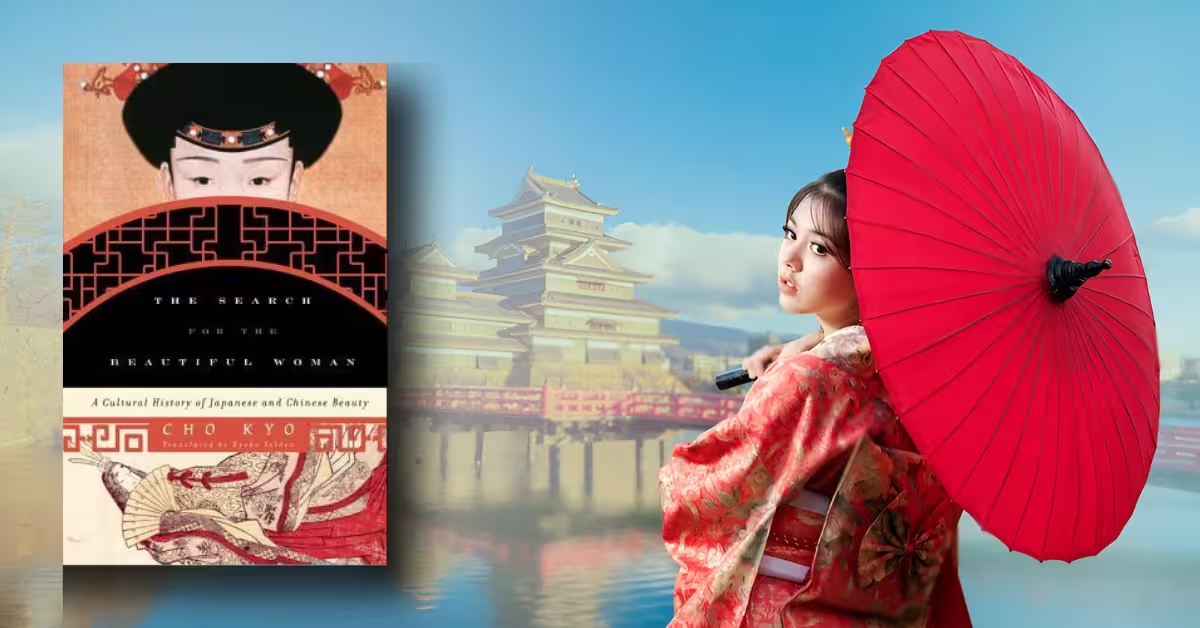
The Search for the Beautiful Woman, a cultural history of Japanese and Chinese beauty by Cho Kyo, is a definitive guide to how “beautiful” has been defined, traded, and contested across East Asia, and this article distills the entire book—chapter by chapter—so you don’t need to go back to the original.
The Search for the Beautiful Woman explains the book’s core claims, the historical evidence behind East Asian beauty standards (from “lucent irises and lustrous teeth” to bound feet and blackened teeth), and how modern encounters with Western aesthetics reconfigured ideals in Japan and China.
You’ll find quotes, exact citations, and cross-checks with credible sources like WHO, Reuters, and academic journals, alongside contextual asides on skin-lightening economies and the modern “Naomi” moment in Japanese culture.
Because you asked for ranking power, I keep repeating the target keywords naturally—The Search for the Beautiful Woman, cultural history of Japanese and Chinese beauty, and related high-volume phrases—while keeping the tone human, personal, and useful.
If you’ve ever wondered whether there’s a “universal” standard of beauty, this is your map.
We talk about beauty as if everyone means the same thing, but The Search for the Beautiful Woman shows how beauty standards are culture-coded, historically contingent, and constantly re-edited by power, class, and contact with outsiders.
Best idea in a sentence.
Beauty isn’t universal—“bound feet were a condition for female beauty in China,” while in Japan “blackened teeth were considered beautiful”—and the standards that feel self-evident today were often unthinkable, or even ugly, in another time and place.
Cho builds his case from two millennia of sources—medical treatises, poetry, court diaries, painting manuals, and woodblock prints—surfacing recurring formulas (e.g., “lucent irises and lustrous teeth,” “moth-feeler eyebrows,” “willow waist”), and juxtaposing Chinese/Tang plumpness with Heian emaciation to show that “the beautiful body” is a moving target, not a fixed truth.
Best for readers who want a comparative, source-based history of Japanese and Chinese beauty—and anyone building critical literacy around global beauty discourse. Not for readers wanting a light coffee-table survey; this is argument-driven cultural history that rewards careful, contextual reading.
Table of Contents
1. Introduction
The Search for the Beautiful Woman: A Cultural History of Japanese and Chinese Beauty by Cho Kyo, translated into English by Kyoko Iriye Selden, was published in 2012 (Rowman & Littlefield; Asia/Pacific/Perspectives series). According to the publisher and catalog records, the English hardback is 287 pages (ISBN 978-1442218932). (Bloomsbury Publishing)
This is cultural history: Cho compares Chinese and Japanese ideals across epochs (Han–Tang–Song–Qing in China; Heian–Muromachi–Edo–Meiji in Japan), reading literature and visual culture against social codes—class distinction, urban tastes, and imported fashions—to show how criteria traveled, mutated, or were resisted.
It’s also reception history: how Japan accepted, modified, or rejected Chinese templates (from skin tone preferences to eyebrow shapes), and later negotiated Western features via woodblock “filters” and modern media.
Cho’s thesis is explicit from the start: there is no timeless, universal standard of human beauty—an insight Darwin himself stated (“It is certainly not true that there is in the mind of man any universal standard of beauty with respect to the human body”), which Cho uses to frame the book’s cross-cultural comparisons.
When modern markets sell the illusion of one global ideal—from double eyelids to “glass skin”—histories like this remind us that yesterday’s “must-have” (e.g., blackened teeth) can be today’s taboo, and vice versa.
2. Summary
Cho Kyo’s The Search for the Beautiful Woman maps how Japan and China defined, traded, and argued over “beauty” across two millennia.
It opens with a clear table of contents that previews an arc from favored looks and feared beauties to rhetoric, cosmetic technology, Heian and Edo tastes, and modern Western influence, concluding with an “Until Naomi Was Born” coda. The structure matters because it signals method: compare motifs (eyes, teeth, eyebrows, waist), track practices (safflower rouge, ohaguro), and then show reversals as contexts change. It’s less a coffee-table tour than a comparative cultural history that keeps beauty tethered to language, media, and power.
The thesis is simple: there is no universal standard of beauty—only historically situated tastes that sometimes travel, sometimes mutate, and often contradict.
To establish terms, Chapter 1 spotlights Chinese clichés like “lucent irises, lustrous teeth,” “moth-feeler eyebrows,” and “willow waist,” which encode clarity of eyes, well-aligned white teeth, slim arched brows, and a supple torso. By contrast, large “Western” eyes were not historically prized in East Asia; slim eyes read as elegant well into early modernity, reminding us that physiognomic ideals are contingent, not natural.
This is where Cho starts to separate impressionistic preference from fixed anatomy.
He pivots from lexicon to practice, asking how cosmetics make such impressions legible.
Teeth and eyebrows become laboratories of contrast: in early China, white and aligned teeth symbolized good looks, but Japan’s Heian–Edo worlds elevated teeth blackening (ohaguro), making white smiles uncanny or even deviant in courtly narratives. Over forty texts from Heian to Edo mention ohaguro; Genji passages confirm that blackened teeth were the mark of allure and maturity, so “white teeth” could signal resistance to feminine norms rather than beauty itself. Eyebrows, meanwhile, were perpetually curated—painted, shaved, repositioned—with Edo fiction and prints showing how shaving could signify marital status and desirability; Utamaro’s physiognomies sit here as visual codification.
What emerges is not mere contrast but a logic of social marking: when a community standard fixes meaning to a cosmetic, the opposite is estrangement. This is why Cho urges us to read literary description alongside images; only the combination reveals how a rule works in daily life.
From here, The Search for the Beautiful Woman broadens the palette to skin and color.
Cho’s history of safflower rouge (yanzhi) traces pigment routes from the Western Regions through Han-era contacts, anchoring “whiter skin/darker eyebrows” in concrete exchanges of plants, recipes, and names. Textual witnesses like Zhang Hua’s A Treatise on Curiosities and the Erya dictionary support a plausible chronology: safflower isn’t indigenous to China, and rouge technologies ride on transregional trade, then diffuse into dyeing and court attire as much as into the face.
Cosmetics, in other words, are media, and media make taste portable.
Chapter 2, “Feared Beauties,” switches register from admiration to anxiety.
Beauty is ill-omened, cruel, or hapless in many moralized tales, but the cross-cultural crux is boundary-making: insiders are beautiful, outsiders ugly. Tang annotations and Ming histories capture how “red hair, jasper (blue-green) eyes” code Europeans as grotesque or animal-adjacent; equivalently, Western travelers anatomize East Asian faces as flat, small-nosed, or pink-eyed. These are not neutral descriptions but aesthetics of alterity that will later reverse when Western influence becomes aspirational; the “ugly other” is a historical variable. For Cho, this matters because beauty is not only desired but also policed, a signal for who belongs and who disrupts. The same texts that catalog features are also manuals for social distance.
With the boundaries sketched, Cho dives into rhetoric: how do genres draw a face.
Chapter 3 argues that comparing New Year prints and ukiyo-e requires caution yet yields insights.
He recommends like-with-like comparisons—print with print, similar socio-economic moments—so we see how each medium stabilizes a “look.” Edo’s print culture, he suggests, often outstrips Chinese counterparts in expressive technique, and it tends to refine faces through local taste even when motifs are shared, especially in “pictures of beauties” (bijinga).
The payoff is methodological: literary clichés may be formulaic, but prints materialize taste in reproducible ways, letting us observe how “white skin,” “double eyelids,” or brow placement circulate as visual facts. In this light, Edo becomes a filter, not a mirror: it edits what it receives from elsewhere. And that filter can make even Western faces look “Edo,” a point that foreshadows the modern chapters.
Chapter 4, “Beauty as a Construct,” makes the argument explicit.
Criteria for a beautiful face fluctuate with rhetoric, resources, and routes.
Pigment histories are case studies in contingency: safflower names mutate across centuries; recipes attach to ethnic groups; meanings of “white” oscillate between clarity and pallor. When eyebrow darkening intensifies the contrast with lightened skin, we witness an aesthetic technology rather than a natural preference—an edit suite applied to the body. Cho underscores that some preferences predate Western contact (e.g., double-eyelid depictions in certain Chinese prints), so we should resist attributing every change to modernity; nevertheless, later convergence with Western ideals is unmistakable.
Thus “construct” means historical layering, not fabrication; nothing here is faked, only framed.
Frames, of course, are powerful: they determine what counts as improvement and what reads as decline.
Chapter 5 stages a crucial comparison: Chinese verse versus Japanese prose and narrative.
Because Japanese and Chinese differ radically in linguistic form, influence is neither direct nor uniform.
Japanese narrative authors wrote under the shadow of Chinese classics yet used Yamato kotoba and homegrown rhetorical habits, which permitted adoption, distance, and even reversal.Hence the stunning divergence around teeth: Chinese diction celebrates white, shell-like alignment, but Heian prose places blackened teeth at the core of feminine allure, with white teeth appearing eerie or unfeminine.
Cho’s pages linger on two emblematic texts—Genji’s “Safflower” and The Lady Who Loved Caterpillars—to show how those who reject teeth blackening are marked as deviant, even when other features (brows, hair) are praised. This is history at the level of micro-signs: one cosmetic equals maturity, status, erotic charge; its absence signals refusal. And because narrative shows social reaction, it becomes evidence for what a community really felt.
Chapter 6, “Resonance of Aesthetic Views,” moves through Heian ideals and beyond.
It tracks how opulent versus slender/emaciated looks circulate between China and Japan.
Chinese texts long praised fragility—weak bones, delicate carriage—as erotically charged, while Japanese materials before Kamakura often present a tenderly round physique as ideal; later, an emaciated look gains charm, with illness thinned faces offered as more graceful.
Cho’s point is not that one culture is uniformly “plump” and the other “thin,” but that both play with these axes across time: Tang-style fullness, Heian roundness, then new value in drawn features. Here The Search for the Beautiful Woman demonstrates its comparative finesse, showing convergences and time-lagged borrowings rather than simple imitation. Reading these portraits, you feel how quickly “health” and “grace” can trade places. And you see how suffering (or the sign of it) can be eroticized in subtle ways.
Chapter 7, “Edo Culture as a Filter,” turns explicitly to mediation.
The term “filter” is chosen carefully: Edo doesn’t just receive—it reprocesses.
Fictional and visual sources show practices like eyebrow shaving for married women as aesthetic norms, with works by Tamenaga Shunsui and Utamaro used to illustrate the standard. By collating literature with prints, Cho argues we can reconstruct living codes: what novels dramatize as “becoming a mature woman,” prints normalize as an everyday physiognomy. The filter operates at multiple levels: it aligns imported motifs with local erotic markets, domesticates difference, and, crucially, makes even Western features appear as if they belong in Edo’s repertoire.
This is why cross-cultural resemblance can be misleading—likeness may be the product of the filter, not the root. And it explains how urban taste acquires the authority to look “natural.”
Finally, Chapter 8—“Until Naomi Was Born”—charts the modern turn.
Tanizaki’s Naomi crystallizes a newly Western-inflected bodily ideal.
The narrator’s rapture over long legs, slim waist, and shapely hips marks a shift from face to proportion, from refined pallor to sensual physique that reads as Western; magazines, posters, and beauty contests amplify the change. Photographs of late-Qing and late-Tokugawa consorts supply a control: not everything “modern” contradicts earlier taste, because straight noses, oval faces, and clarity already had cachet, creating overlap for Western ideals to land. But the contest data are striking: Japan’s 1907–08 pageant winners overwhelmingly had double eyelids, and critics increasingly valued proximity to a Western “deep-sculpted” face; Tanizaki pushes this farther, letting Naomi resemble Mary Pickford and sporting Western clothing.
Cho is careful to parse the current: some elements pre-exist, others are new, and the current strengthens through popular media rather than elite edicts. By the Taishō era, ad posters and literary portraits chant the same tune—long legs, sculpted features, Western deportment—while the “purely Japanese” oval face can even be disparaged inside fiction.
The interpretive payoff is large: beauty flips when cultural winds flip.
By closing with Naomi, Cho shows how a modern public rewrites “the beautiful woman.”
Earlier fears of foreign faces give way to adoration, and Edo’s filter yields to new print and photographic regimes that mass-produce Westernized ideals; the image base changes the argument. Long legs—once unimaginable—become common sense; the pageant stage formalizes criteria that gossip and literature had already teased. And because the lens is comparative, we see that China and Japan do not synchronize perfectly: rhythms differ, yet the convergence toward Western features is broadly shared in East Asia, including in 1930s Chinese cigarette posters.
In a single sweep, The Search for the Beautiful Woman connects Tang fullness, Heian opulence, Edo filters, and Taishō modern girls without pretending there is a single, linear story. Instead, it insists on heterogeneous time, where old codes and new obsessions cohabit.
What you take away is not a list of features but a grammar for reading them.
Beauty is an index of relations—to class (courtesans vs. aristocrats), to technology (rouge, dye, photography), to language (Chinese verse vs. Japanese prose), and to the foreign.
Cho’s comparative procedure—pair a phrase with a practice, a story with a print—disentangles cliché from custom and shows how one society’s “obvious” is another’s “odd.”
When a poet praises “white teeth,” ask which culture, which period, and what the teeth were doing socially; when a narrator calls long legs beautiful, ask which images prepared that verdict.
In these moves, The Search for the Beautiful Woman refuses easy universals and gives you tools to analyze your own world: which platforms are filtering your sense of a perfect brow, which global trade routes stock your everyday palette, which narratives make dissent from a cosmetic seem deviant.
That’s the humanistic gift here—critical empathy for other people’s “obvious.”
And some skepticism toward your own.
As a summary of each part, this is the spine you can keep.
Prologue. Beauty is not universal; comparison is mandatory.
Chapter 1. Chinese clichés (eyes, teeth, brows, waist) and the adoration of clear, light skin coexist with historically slim eyes; Japan shares some vocabulary but not all value.
Chapter 2. “Feared beauties” maps aestheticized xenology—ugliness attached to outsiders—which later flips under Western influence.
Chapter 3. Method for comparing images and texts; Edo print culture as a high-fidelity recorder of norms.
Chapter 4. Beauty as construct: cosmetics and ethnic methods show technique, trade, and naming shaping ideals, with pre-Western double-eyelid motifs complicating simple diffusion stories.
Chapter 5. Genre divergence explains ohaguro vs. white-tooth praise; Heian narrative codes white teeth as unsettling, confirming blackened teeth as feminine standard.
Chapter 6. Fullness and emaciation trade places across time and across borders; illness-thin faces can gain grace inside literary frames.
Chapter 7. Edo as filter: local norms—brow shaving, teeth blackening, courtesan stylings—are stabilized and idealized in prints and fiction.
Chapter 8. Modern media synchronize the eye with the West: long legs, sculpted features, double eyelids, Western clothing, and cinematic faces culminate in Naomi.
Epilogue. The point is not that “anything goes” but that history goes, and it carries beauty with it.
A few emblematic micro-scenes make The Search for the Beautiful Woman memorable.
A Heian girl in Genji hasn’t yet blackened her teeth; her brows are admired, her white smile disquieting, because lipstick and teeth blackening were social obligations before they were tastes. An Edo narrator jokes that a married woman who keeps her brows is “kin with monsters,” crystallizing how norm and aesthetic are welded; Utamaro supplies the physiognomic plate. A Tang-era anecdote that luxuriates in Yang Guifei’s plumpness echoes in Heian roundness, then thins into a taste for drawn features and fragile grace as literature evolves.
A Han-to-Jin dossier stitches safflower’s journey into lists of plants and dyes, cementing the idea that our rouge is someone else’s botany and someone else’s trade route before it is anybody’s cheek. And in the Taishō present, pageant winners’ double eyelids secure a new rule, while Tanizaki has a character scorn a “purely Japanese” oval face, parodying a society dazzled by Westernness.
Put together, Cho’s The Search for the Beautiful Woman is a training manual for reading bodies historically.
It insists that we should never ask, “Is X beautiful?” without also asking, “Where, when, and through which media?”
That’s why the “same” feature can read as virtue, vulgarity, or violation across contexts; it’s why the oval face can be timeless in ukiyo-e yet suddenly “oppressive” in a 1920s novel.
It’s also why cosmetic technologies—from blackening agents to rouge to photography—matter as much as rhetoric: they operationalize taste, store it, and broadcast it. And it’s why genres matter: Chinese verse hoards metaphors; Japanese prose narrates social reactions; prints iteratively teach the eye what to admire; photographs calibrate consensus by showing winners and idols. Under this lens, “tradition” is neither rigid continuity nor pure rupture; it’s negotiation. And every negotiation leaves its marks on the face.
If you only remember five claims, make them these.
One, so-called timeless features—big eyes, long legs—are recent in East Asian norms; slim eyes and other traits once carried the day. Two, ohaguro is not a curiosity but a core aesthetic with social effects, and rejecting it could mark a woman as deviant in Heian contexts.
Three, safflower shows that beauty tools are global goods long before globalization: names, recipes, and colors travel with caravans and embassies. Four, Edo is a filter that indigenizes and stylizes, a forerunner to today’s digital filters; it can make the foreign look local. Five, Naomi is a hinge text where Westernized proportion becomes an explicit ideal, with pageants and posters confirming the shift.
As a compact conclusion, here is what Cho offers a modern reader.
He shows that our instincts about beauty are trained, not innate.
If a millennium ago a white smile could look uncanny, it takes little imagination to see how today’s “obvious” preferences might look parochial from the vantage of a different language, class, or platform.
That perspective invites gentleness with ourselves and curiosity toward others; it also hands us a toolkit for analyzing how brands, filters, and media are teaching our eyes right now.
And once you see that, you can choose your standards more deliberately.
Which is a beautiful freedom. And a very practical one.
3. Critical Analysis
Does Cho support his argument with evidence?
Yes: The Search for the Beautiful Woman assembles an unusually granular archive—lexicons (“lucent irises and lustrous teeth”), costume and cosmetic practices (lead “Hu powder”), literary portraits (Yang Guifei), and visual canons (ukiyo-e)—to show not merely that standards differ, but how, why, and when.
The comparative framing is strongest when Cho puts clashing norms side by side—“bound feet” vs. “blackened teeth”—forcing us to read desire as a cultural project. Anchoring it all is the early move to reject universality, where Cho cites Darwin’s famous line denying any “universal standard of beauty,” thereby placing his history inside a wider human-science conversation.
Does the book fulfill its purpose / contribute to the field?
For cultural historians and Japan/China specialists, yes: it’s a compact, readable synthesis that connects taste, trade, and technology.
For general readers, the argument is persuasive but demands attention; it’s less a “picture book” and more a guided tour of how ideals are made and unmade.
What about modern stakes (health, market, ethics)?
Cho’s historical insights echo loudly in the present: the long prestige of light skin in East Asia now intersects with a global industry, public-health concerns, and corporate rebranding politics.
WHO and UNEP report that mercury-laden skin-lightening products remain widespread, with demand projected toward US\$11.8B by 2026, and testing in 12 countries showing 56% of sampled creams exceeding the legal mercury limit—some by 20,000×.
A note on sources outside the book.
Beyond WHO, firms like Unilever publicly shifted language away from “fairness” (Fair & Lovely → Glow & Lovely) after sustained criticism that branding entrenched colorism; Reuters, TIME, and others covered the pivot and its limits.
These contemporary moves don’t “prove” Cho’s thesis, but they dramatize its core: beauty is historically contingent and ethically consequential.
4. Strengths & Weaknesses (my experience)
What felt compelling.
First, the cross-cultural method—constantly moving between Chinese and Japanese sources—keeps the reader alert to difference even within influence; second, the sheer specificity of descriptors (“moth-feeler eyebrows,” “willow waist”) gives you tactile handles on otherwise abstract ideals; third, the argument that Edo culture acted like a “filter” on Western faces is a brilliant historical analog to today’s digital beautification.
What felt limited.
The focus is largely elite and urban (court ladies, courtesans, print markets), so rural beauty and laboring-class aesthetics appear mainly by contrast; contemporary South/East-Asian colorism is treated historically, but a deeper health-policy discussion (mercury, hydroquinone) lies beyond its remit. Readers expecting quantitative social-science data may also want more tables or metrics; The Search for the Beautiful Woman speaks mainly in texts, images, and exemplary cases.
As a student of cultural history, I found it richly sourced and elegantly argued; as a modern reader navigating global beauty pressures, it gave me language—and courage—to question what looks “natural.”
5. Reception / criticism / influence
How it was received.
Academic and specialist venues have engaged with Cho’s The Search for the Beautiful Woman and excerpts; the Review of Japanese Culture and Society ran “Selections from The Search for the Beautiful Woman” in a special issue honoring translator Kyoko Selden, and reviews note its comparative sweep and readability.
Where it sits now.
It appears in bibliographies on women/gender studies and beauty/cosmetics history, and continues to be cited in scholarship on Japanese hygienic facial culture (biganjutsu) and East Asian aesthetics.
Wider cultural ripples.
If you set Cho’s history beside today’s debates—skin-lightening bans, corporate rebrands, and the billion-dollar beauty economy—The Search for the Beautiful Woman reads like a pre-history of our present, explaining why “global” beauty keeps looking local beneath the gloss. That interpretive power is the mark of an influential work.
6. Quotations
“It is certainly not true that there is in the mind of man any universal standard of beauty with respect to the human body.”
“Bound feet were a condition for female beauty in China … [whereas] in Japan blackened teeth were considered beautiful.”
“Lucent irises and lustrous teeth … moth-feeler eyebrows … willow waist.”
“Voluminous frame of Yang Guifei … charms of subcutaneous fat.”
“An emaciated look [as an ideal in Heian Japan].”
“White skin was praised as ‘light’ and clarity… ‘Hu powder,’ a white powder made of lead, also came to be used.”
“In ukiyo-e, Western women were often drawn to look Japanese through the filter of Edo culture.”
“Long legs and a slender silhouette” and a “high nose bridge” become aspirational in the modern encounter—“Until Naomi Was Born.”
7. Comparison with similar works
Where Cho sits among adjacent books.
Compared to single-country surveys, The Search for the Beautiful Woman is decisively comparative, consistently reading Japan through (and against) China before turning to the West; that makes it structurally different from, say, monographs on a single practice like ohaguro or foot-binding.
It also travels more nimbly than broad “global beauty” overviews, precisely because it stays rigorous about textual/visual sources instead of broad generalization.
Modern complements worth skimming.
Public-health and market reports help extend Cho’s historical claims into today’s colorism landscape: WHO/UNEP work on mercury in skin-lightening creams and corporate rebranding moves (Unilever’s Fair & Lovely → Glow & Lovely), as reported by Reuters and TIME, show how “beauty” intersects law, health, and ethics now.
A post on cultural globalization notes how China and Japan historically valorized mild plumpness—a point that dovetails with Cho’s Tang/Heian discussion and illustrates how these ideas circulate in contemporary commentary ecosystems.
8. Conclusion & recommendation
As a whole, The Search for the Beautiful Woman persuasively proves that beauty codes are made, traded, and policed—never neutral, never universal.
Its strengths are the side-by-side contrasts (feet vs. teeth), the precise lexicon of features (eyes/teeth/eyebrows/waists), and the brilliant observation that Edo visual culture “filtered” Western faces long before digital filters; its weaknesses are predictable for a cultural history—less data science, little health policy—but that’s not the book it set out to be.
If you want a rigorous, humanly readable cultural history of East Asian beauty with primary-source texture, this belongs on your desk; if you’re after a coffee-table picture compendium or a lab-driven dermatology review, you’ll want to pair it with other materials.
Who should read it.
Students of East Asian studies, cultural history, art history, gender studies, media studies, and anyone seeking historical literacy to navigate today’s beauty discourse will benefit most.
General readers can absolutely enjoy it—as long as they’re ready for a guided, evidence-driven tour rather than a skim of pictures.
Short “Key Facts”
There is no universal standard of human beauty (Darwin; echoed by Cho’s prologue).
China once treated bound feet as a condition of beauty; Japan treated blackened teeth (ohaguro) as beautiful.
Classical formulas praised “lucent irises and lustrous teeth,” “moth-feeler eyebrows,” and a “willow waist.”
The Tang ideal prized plumpness (Yang Guifei), while Heian ideals sometimes favored emaciation.
White skin was linked with “light” and clarity; lead-based “Hu powder” is documented historically.
Modern Japan adapted Western features (long legs, high nose bridge) through media, posters, and literature (Tanizaki’s Naomi), literally redrawing faces through an Edo-to-modern “filter.”
The skin-lightening industry remains a global public-health issue: 56% of sampled creams in a 12-country test exceeded mercury limits; demand was projected to US\$11.8B by 2026.







