
Did Pakistan’s founder really want a separate nation, or was he bargaining for something else entirely? Ayesha Jalal’s The Sole Spokesman reveals you the secrets
Overview
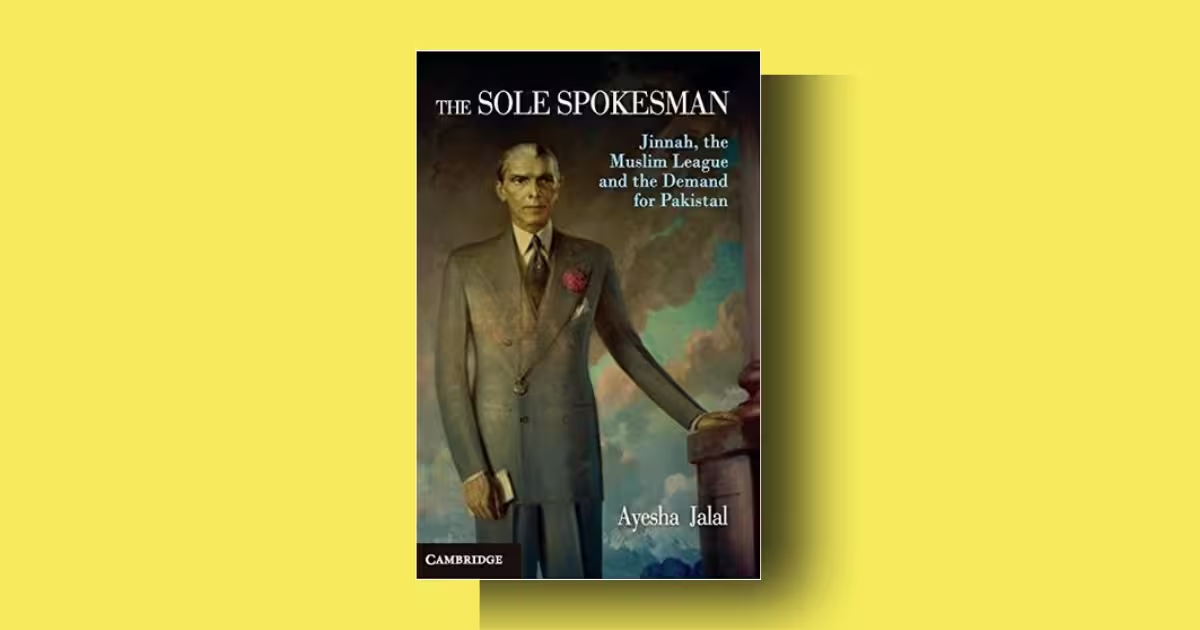
The Sole Spokesman: Jinnah, the Muslim League and the Demand for Pakistan (Cambridge University Press, 1985) is a revisionist masterpiece that fundamentally challenges how we understand the partition of India. Jalal, a Pakistani-American historian who is now the Mary Richardson Professor of History at Tufts University, argues that Jinnah never actually wanted a separate Muslim state.
Instead, she contends, he used the demand for “Pakistan” as a political bargaining chip, a strategic tool to secure equal power for Muslims at an all-India centre.
The book is dense, academic, and occasionally reads like the PhD dissertation it originally was (Cambridge, 1982). But it’s also brilliantly argued, meticulously researched, and utterly indispensable for anyone trying to understand why South Asia was carved up in 1947.
Reader Recommendation: Who Will Actually Love The Sole Spokesman
You should read this book if:
- You’re tired of nationalist mythology, Pakistani or Indian, and want a historian who follows the evidence wherever it leads.
- You’ve ever wondered why Jinnah kept the meaning of “Pakistan” deliberately vague for years.
- You want to understand how provincial politics, British manoeuvring, and Congress’s ambitions shaped partition far more than religious ideology ever did.
- You’re a student of South Asian history, political science, or international relations.
You might want to skip it if:
- You prefer narrative biography over dense political analysis.
- You’re looking for a warm, humanising portrait of Jinnah, Jalal keeps her distance and stays clinical.
- You struggle with academic prose. This isn’t a light read.
Table of Contents
1. Introduction
The Sole Spokesman: Jinnah, the Muslim League and the Demand for Pakistan
Author: Ayesha Jalal
Publisher: Cambridge University Press (Cambridge South Asian Studies series)
First published: 1985
Paperback edition: 1994
Context of The Sole Spokesman
The book grew out of Jalal’s doctoral dissertation at the University of Cambridge. At the time of writing, she was based at Trinity College, Cambridge; she later became a professor at Columbia University and is now at Tufts University.
Jalal is one of the most distinguished historians of South Asia working today, known for her work on the military-industrial complex, post-colonial politics, and Muslim identity. But The Sole Spokesman remains her most influential, and most controversial, work.
Purpose of The Sole Spokesman
The book’s central question is devastatingly simple: “How did a Pakistan come about which fitted the interests of most Muslims so poorly?” Jalal’s answer is that Pakistan was never the goal Jinnah was actually pursuing. He wasn’t a two-nation ideologue. He was a constitutional lawyer and a pragmatist who wanted to secure a share of power for Muslims at an all-India centre.
The demand for Pakistan was, in her view, a bargaining counter, one that Congress and the British ultimately called, leaving Jinnah with a truncated, “mutilated and moth-eaten” state he had repeatedly rejected.
2. Background
Before 1937, the All-India Muslim League was practically moribund. In the 1937 provincial elections, Jinnah’s party was routed in the Muslim-majority provinces. In the Punjab, the Unionists won 71 of 75 Muslim rural seats.
The League won a grand total of one seat. In Bengal, the League scraped together 39 seats, but only by aligning with Fazlul Huq’s Krishak Praja party. In Sind and the N.W.F.P., the League won nothing at all.
Jinnah’s claim to speak for all Muslims was, at that point, a joke. Yet just seven years later, Pakistan was created. Jalal’s book is the story of how that transformation happened, and, more importantly, why the Pakistan that emerged was not the one Jinnah had supposedly been demanding.
3. The Sole Spokesman Summary
The Argument in a Nutshell
Jalal’s core thesis is that Jinnah’s “Pakistan” did not entail the partition of India; rather, “it meant its regeneration into a union where Pakistan and Hindustan would join to stand together proudly against the hostile world without.
This was no clarion call of pan-Islam; this was no pitting Muslim India against Hindustan; rather, it was a secular vision of a polity where there was a real political choice and safeguards, the India of Jinnah’s dreams”.
This is a radical claim. It means that the man celebrated as Pakistan’s founder was, in Jalal’s reading, never actually committed to creating a separate state. He was using the threat of separation to force the Congress and the British to give Muslims a genuine share of power in a united India.
The Lahore Resolution (1940): A Deliberate Ambiguity
The Lahore Resolution, often called the “Pakistan Resolution”, is the founding document of Pakistan’s national mythology. But Jalal shows that Jinnah deliberately kept it vague.
The resolution didn’t use the word “Pakistan.” It called for Muslim-majority provinces to be “grouped to constitute Independent States,” but it said nothing about what the relationship between those states and the rest of India would be.
The critical word, Jalal notes, was “finally”, as in, the provinces would assume powers “finally”, implying a transitional period and plenty of opportunity for negotiation.
Jinnah, she argues, was forced to make large concessions to get the backing of the Muslim-majority provinces. But he prevented their more specific proposals for the centre from being adopted. The resolution was a bargaining counter, not a blueprint.
The Cripps Offer (1942): The Threat That Almost Broke Jinnah
One of the book’s most revealing sections concerns the Cripps Mission of 1942. Cripps proposed that provinces could opt out of an Indian union, local option, which would have given Punjab and Bengal exactly what the Lahore Resolution seemed to demand.
But Jinnah rejected the offer. Why? Because local option would have let the Muslim-majority provinces go their own way, leaving Muslims in minority provinces stranded. Jinnah needed a strong centre where Muslims had an equal say, not a weak federation where provinces could secede.
As Jalal writes, “Cripps’s offer, far from being a step in the direction of giving Jinnah what he was after, represented the gravest threat to his entire strategy”.
The Cabinet Mission (1946): Jinnah’s Last Best Hope
The Cabinet Mission’s May 1946 proposal offered Jinnah something close to what he actually wanted: a three-tier federation with compulsory grouping of Muslim-majority provinces, giving the League a real say at the centre. Jinnah accepted it.
But Congress, scenting victory, rejected it in practice, and Nehru’s public statements made it clear that Congress intended to destroy the grouping scheme.
Jalal’s conclusion is damning: “It was Congress that insisted on Partition. It was Jinnah who was against Partition”.
The End Game: Mountbatten and the Truncated Pakistan
By early 1947, Jinnah’s strategy had collapsed. The British had set a firm date for withdrawal. Congress had demanded the partition of Punjab and Bengal. Jinnah was forced to accept a “mutilated and moth-eaten” Pakistan, precisely the outcome he had always rejected.
Jalal’s account of Mountbatten’s treatment of Jinnah is withering. Mountbatten, she writes, “consistently failed to understand the inwardness of Jinnah’s true aims”.
In one of the book’s most memorable passages, she describes how Mountbatten bullied Jinnah into accepting the partition plan: “Mr Jinnah! I do not intend to let you wreck all the work that has gone into this settlement. Since you will not accept for the Muslim League, I will speak for them myself”.
Jinnah, who had claimed to be the sole spokesman of India’s Muslims, was forced to nod in silent acquiescence.
4. The Sole Spokesman Analysis
What Works
Jalal’s scholarship is extraordinary. She draws on the Transfer of Power documents, the Muslim League papers, and Jinnah’s private correspondence, much of which had only recently become available.
Her analysis of provincial politics is particularly strong. She shows, province by province, how little control Jinnah actually had over the Muslim League’s regional branches.
In Punjab, he was a bystander. In Bengal, he was repeatedly outmanoeuvred. In Sind and the N.W.F.P., the League barely existed.
Her central argument, that Jinnah used “Pakistan” as a bargaining counter, is supported by extensive evidence. As late as February 1947, “nobody in the Muslim League knew” what Pakistan meant.
British officials in 1941 noted that “every Muslim Leaguer…interpreted Pakistan as consistent with a confederation of India for common purposes like defence, provided the Hindu and Muslim element therein stood on equal terms”.
What Doesn’t Quite Land
The book has been criticised for overstating its case. Jinnah was a constitutional pragmatist, but was he only that? Some scholars argue that Jinnah’s use of religious rhetoric, while tactical, also reflected a genuine commitment to Muslim identity.
Others point out that Jalal’s emphasis on high politics neglects the social and cultural forces that made the Pakistan demand resonate with ordinary Muslims.
The book also reads like a thesis.
The prose is clear but dense, and the transitions can be rough. Jalal keeps her distance from Jinnah the man, we get little sense of his personality, his relationships, or his inner life. This is a deliberate choice, but it makes the book less accessible than a biography.
5. Strengths and Weaknesses
Strengths
Meticulous research: Jalal draws on archival sources that were new at the time.
Clear argument: The thesis is bold, consistent, and well-supported.
Provincial focus: She doesn’t treat “Muslims” as a monolith; she shows how regional interests shaped the League’s strategy.
Revisionist courage: She challenges nationalist mythologies on both sides of the border.
Weaknesses
Dense academic prose: This is not a book for casual readers.
Over-reliance on high politics: Jalal pays less attention to social and cultural factors.
Minimal personal detail: Jinnah remains somewhat distant.
Controversial thesis: Her argument that Jinnah never wanted partition is still debated.
6. Comparison with Similar Works
| Book | Author | Approach | Key Difference |
|---|---|---|---|
| The Sole Spokesman | Ayesha Jalal | Revisionist, political-strategic | Jinnah used Pakistan as a bargaining chip |
| Jinnah of Pakistan | Stanley Wolpert | Traditional biography | Jinnah as a sincere nationalist |
| Jinnah, Pakistan and Islamic Identity | Akbar Ahmed | Revisionist, cultural | Jinnah as an Islamic figure |
| Creating a New Medina | Venkat Dhulipala | Revisionist, ideological | Pakistan had deep ideological roots |
Jalal’s book stands apart for its emphasis on strategy over ideology. Wolpert’s biography is more sympathetic but less analytically sharp. Ahmed’s work is more speculative and less grounded in archival evidence.
Dhulipala’s recent book challenges Jalal directly, arguing that the Pakistan movement was far more ideologically driven than she allows.
7. Conclusion
The Sole Spokesman is not a comfortable book. It tells Pakistanis that their founding father never really wanted the state they got. It tells Indians that Congress, not Jinnah, insisted on partition. It tells everyone that the “two-nation theory” was less a deep conviction than a strategic move in a high-stakes political game.
But uncomfortable doesn’t mean untrue. Jalal’s argument has held up remarkably well over four decades. Her book remains “the most important scholarly study of the central event in modern South Asian history, the partition of India in 1947”.
It’s a book that forces you to think, to question, and to see one of the twentieth century’s most traumatic events in a new light.
Who should read it? Anyone who wants to understand why South Asia is the way it is today. Anyone tired of nationalist mythology. Anyone willing to follow a brilliant historian into the uncomfortable territory where certainty dissolves and complexity remains.