
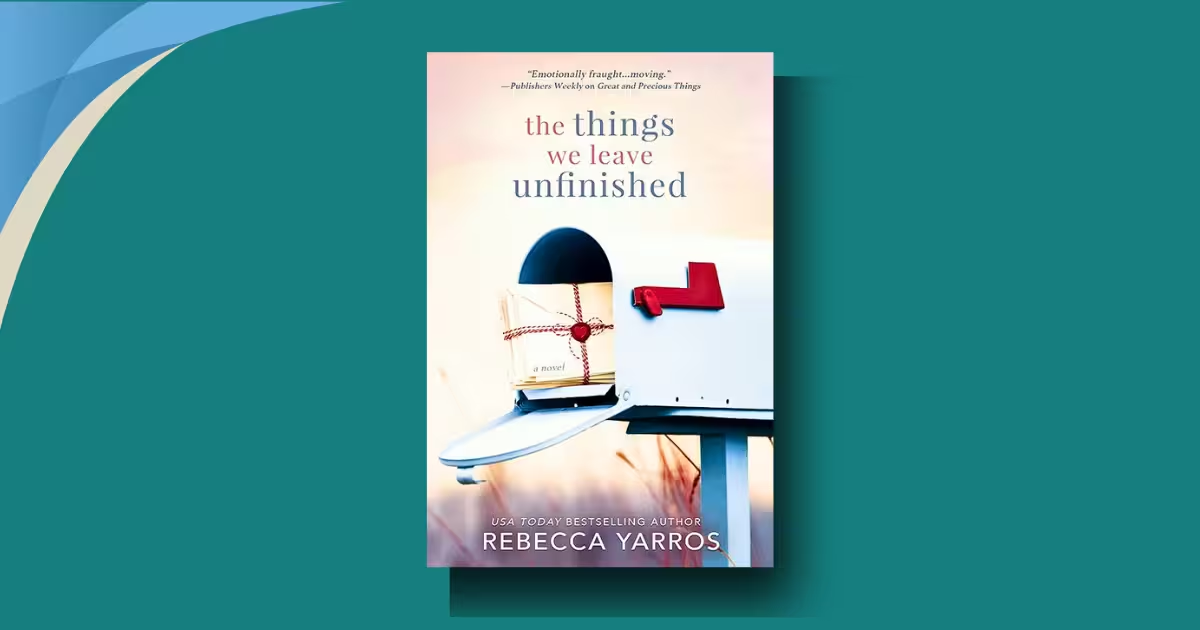

Do you ever wonder how much of our family’s past is hidden in unfinished stories, and what it would mean to finally give them an ending? The Things We Leave Unfinished by Rebecca Yarros explores that question in a poignant and powerful manner.”
The Things We Leave Unfinished is a sweeping dual-timeline romance novel that explores the weight of legacy, the courage to trust again, and the heartbreaking beauty of love letters left behind.
The Things We Leave Unfinished is best for readers who love emotionally rich, dual-timeline narratives, wartime romance, and stories about healing from betrayal. Not for readers seeking a light, straightforward romance or who are uncomfortable with themes of infidelity and familial estrangement.
1. Introduction
The Things We Leave Unfinished is a contemporary romance novel by Rebecca Yarros, a USA Today bestselling author known for her deeply emotional storytelling.
Published in February 2021 by Entangled Publishing (Amara imprint), this standalone novel masterfully intertwines a modern-day enemies-to-lovers story with a poignant World War II epistolary romance.
It’s a book about the stories we inherit, the ones we’re afraid to finish, and the transformative power of love across generations.
Table of Contents
2. Background
While a work of fiction, the historical timeline is steeped in the very real setting of the Battle of Britain in 1940.
Yarros integrates details of the Women’s Auxiliary Air Force (WAAF) and the American volunteers in the RAF’s Eagle Squadrons, grounding the past narrative in authentic historical tension.
The contemporary storyline taps into modern themes of public scandal, divorce, and the complex dynamics of literary inheritance.
3. The Things We Leave Unfinished Summary
The Things We Leave Unfinished unfolds across two timelines, connected by an unfinished manuscript.
1940 Timeline:
We meet Scarlett Stanton, a young British aristocrat and WAAF officer stationed at RAF Middle Wallop. Defying her family’s wishes to marry a wealthy but abusive suitor, she falls passionately in love with Jameson Stanton, a charming American pilot volunteering for the RAF.
Their whirlwind romance, conducted through daring flights, secret picnics, and fervent letters, is set against the constant peril of war. Scarlett’s family disowns her when she chooses Jameson. The timeline follows their love, separation, and reunion as Scarlett and her sister Constance transfer to be near Jameson’s squadron.
The manuscript, written by the elder Scarlett (Georgia’s great-grandmother) decades later, ends abruptly as they plan to escape war-torn England for America, their future heartbreakingly uncertain.
Present-Day Timeline:
Georgia Stanton has just returned to her hometown of Poplar Grove, Colorado, reeling from a very public and humiliating divorce from Hollywood director Damian Ellsworth. Her only solace is inheriting her beloved great-grandmother Scarlett’s estate.
However, she discovers her manipulative mother, Ava, has been scheming to sell Scarlett’s last, unfinished manuscript. The publisher, desperate for this literary treasure, has hired Noah Harrison—a famously brooding, critically acclaimed author known for his tragic endings—to complete it.
Georgia and Noah’s first meeting in a bookstore is combative; she criticizes his novels as depressing, and he scoffs at romance tropes. The tension escalates when they meet again at Georgia’s home, and she realizes Noah is the writer tasked with finishing her gran’s most personal story.
Despite her misgivings, Georgia signs the contract but lays down one non-negotiable condition: the book cannot have a happy ending. She believes the real story, which she knows ended with loss, must be honored.
What follows is a battle of wills. Noah, who has fallen in love with Scarlett and Jameson’s story through their letters, is determined to give them the happy ending he feels they deserve. Georgia, guarding her heart and her gran’s legacy, refuses.
Their professional clashes are charged with a powerful attraction, forcing Georgia to confront her own walls built by betrayal. Noah’s persistent, respectful pursuit—including moving into a rental cottage next door—slowly chips away at her defenses.
The climax hinges on the discovery of the truth. Georgia reads the final letters. She learns that Jameson died in the war, just before he was to reunite with Scarlett in America. Scarlett, pregnant with their son (Georgia’s grandfather), went on alone, carrying a love that lasted a lifetime.
This revelation shatters Noah’s plan for a fictional happy ending and makes Georgia understand that her gran’s true “happily ever after” wasn’t a long marriage, but the profound, lifelong love she carried for Jameson.
In the end, Noah writes a faithful, poignant conclusion. He and Georgia, having healed each other’s wounds, find their own second chance at love. The novel closes with them honoring the past while building a future, showing that some stories, though tinged with tragedy, ultimately lead to new beginnings.
4. The Things We Leave Unfinished analysis
4.1. The Things We Leave Unfinished Characters
Georgia Stanton: Her development is the core of the modern narrative. Initially, she is the “Ice Queen” (Page 11-12), armored by public humiliation and private betrayal.
Her journey is one of reclamation—of her name, her home, and her capacity to trust.
Her fierce protection of Scarlett’s story mirrors her need to protect her own heart. Her complexity lies in the conflict between her deep love for her gran’s romantic legacy and her hardened disbelief in happy endings for herself.
Noah Harrison/Morelli: More than just a handsome, arrogant author, Noah is revealed to be deeply principled and empathetic. His commitment to his family, his respect for Scarlett’s work, and his patience with Georgia subvert the “broody bad boy” trope.
His motivation isn’t just professional pride; as he tells Georgia, “It’s personal” (Page 33), linking back to reading Scarlett’s books to his injured mother. He becomes the steady, promised belay line Georgia never had.
Scarlett Stanton (Past): Headstrong, intelligent, and courageous. She represents a woman forging her own path against societal and familial expectations.
Her love for Jameson is all-consuming and brave, making the ultimate loss profoundly moving. Her character is preserved beautifully through her evocative letters, which pulse with immediacy and desire (e.g., “I wish I could fly to you, even if just for a few hours…” Page 121).
Jameson Stanton: The epitome of a devoted, daring wartime hero, but with tangible vulnerability. His letters reveal a homesick man anchored by love.
His proposal—“Marry me, Scarlett. It’s a foregone conclusion” (Page 114)—shows his unwavering certainty, making his fate more tragic.
Ava (Georgia’s Mother): A brilliantly crafted antagonist who is more pitiable than purely villainous.
She embodies the cycle of abandonment and selfishness, showing how the lack of maternal love can warp a daughter’s self-worth. Her final abandonment of Georgia for a man, taking the book advance with her (Page 107-109), is the emotional low point that catalyzes Georgia’s final break from seeking her approval.
4.2. The Things We Leave Unfinished Themes and Symbolism
Legacy and Unfinished Business: The manuscript is the literal symbol of the “unfinished” business of the past. It represents unresolved grief, untold truths, and love interrupted. Completing it becomes a metaphor for healing generational wounds—both for the Stanton family and for Georgia personally.
The Nature of Love Stories: The novel debates what constitutes a “love story.” Is it the guaranteed happy ending (Noah’s initial professional view), or is it the depth and truth of the emotion, regardless of duration (Georgia’s and eventually Scarlett’s truth)? The book argues that a great love story is defined by its impact, not its length.
Trust vs. Betrayal: This theme bridges both timelines. Scarlett trusts Jameson against her family’s wishes. Georgia learns to trust Noah after Damian’s betrayal. The climbing scene (Pages 128-132) is a powerful symbolic act: Georgia’s refusal to let Noah belay her is a direct result of Damian breaking his vow to “keep her safe.”
Letters as Artifacts of Love: The wartime letters are not just plot devices; they are tangible symbols of enduring love. They physically connect the past to the present, allowing Noah and Georgia to fall in love with Scarlett and Jameson, and ultimately, with each other. As Noah says, they are “precious” (Page 20).
5. Evaluation
Strengths
- Emotional Depth: Yarros’s writing is immersive and wrenching. The wartime romance is captivatingly sweet and urgent, while Georgia’s emotional recovery is raw and relatable.
- Dual-Timeline Execution: Both narratives are equally compelling and beautifully integrated. The transitions feel natural, and the parallels between Scarlett/Jameson and Georgia/Noah are drawn with nuance, not heavy-handedness.
- Character Chemistry: The antagonistic banter between Georgia and Noah crackles with wit and undeniable attraction. Their relationship develops through authentic vulnerability, not just physical desire.
- The Payoff: The emotional payoff in the final act is immense. Learning the true ending of Scarlett’s story is devastating yet beautiful, and it perfectly justifies the entire narrative conflict.
Weaknesses
- Pacing of the Central Conflict: The middle section, revolving around the repeated arguments over the book’s ending, can feel slightly repetitive. While it mirrors real creative disputes, some readers might wish for a quicker narrative progression.
- Ava’s Characterization: While effective, her actions are so consistently selfish that she borders on caricature at times, potentially reducing the complexity of the mother-daughter dynamic for some readers.
Impact
The book leaves a lasting impression about the resilience of the human heart. It celebrates love in all its forms—the fiery, tragic romance of the past and the hard-won, healing love of the present. It made me reflect on the stories and secrets within my own family history.
Comparison with Similar Works:
Fans of Kristin Hannah’s The Nightingale will appreciate the vivid WWII setting and strong female protagonists.
Readers of Katherine Center’s or Emily Henry’s contemporary romances will enjoy the witty dialogue and the “author” romance trope, though Yarros delves into deeper historical trauma.
6. Personal Insight & Contemporary Relevance
The Things We Leave Unfinished resonates profoundly in an era where we are increasingly focused on personal legacy and uncovering hidden family histories. According to a 2023 survey by Ancestry.com, over 70% of Americans believe knowing their family history is important to understanding themselves.
The novel taps into this desire, framing it as an emotional rather than purely genealogical quest.
Furthermore, Georgia’s narrative mirrors a modern phenomenon: public healing after private betrayal. In the age of social media and “cancel culture,” personal heartbreaks can become public spectacles, much like Georgia’s tabloid-branding as the “Ice Queen.”
Her journey from defined-by-scandal to self-defined is a powerful lesson in reclaiming one’s narrative. The book reminds us that our most important endings are not the ones written about us by others, but the ones we have the courage to write for ourselves.
7. The Things We Leave Unfinished Quotes
- “You are strong, my love, and braver than I ever could be… I love you, Scarlett Stanton. I have loved you since our first dance, and I will love you the rest of my life.” (Jameson’s letter)
- “I’m in love with you, Scarlett Wright… This war isn’t going to give us that time, and after last night, I’m not hiding it anymore.”
- “Earn it.”
- “The last man who promised to keep me safe screwed his lead and dropped me on my ass.” (Georgia)
- “It’s personal.” (Noah)
- “We’re going to face it all head-on. Your parents, the war, the whole Royal Air Force… You are mine, Scarlett Wright, and I am yours, and from this second on, we don’t keep secrets.”
8. Conclusion
The Things We Leave Unfinished is a triumph of romantic fiction. Rebecca Yarros has crafted a novel that is both a breathtaking love story and a moving examination of grief, trust, and legacy. It will make you swoon, it will make you cry, and it will ultimately leave you full of hope.
Recommendation: I highly recommend this book to readers who want their romance layered with historical depth and emotional intelligence. It’s perfect for book clubs, as it offers rich material for discussion on love, loss, and family dynamics.
Final Reflection: This book is significant because it honors the idea that some loves are so powerful, they shape generations. It argues that healing is possible, and that sometimes, finishing an old story is the very thing that allows a new one to begin.