
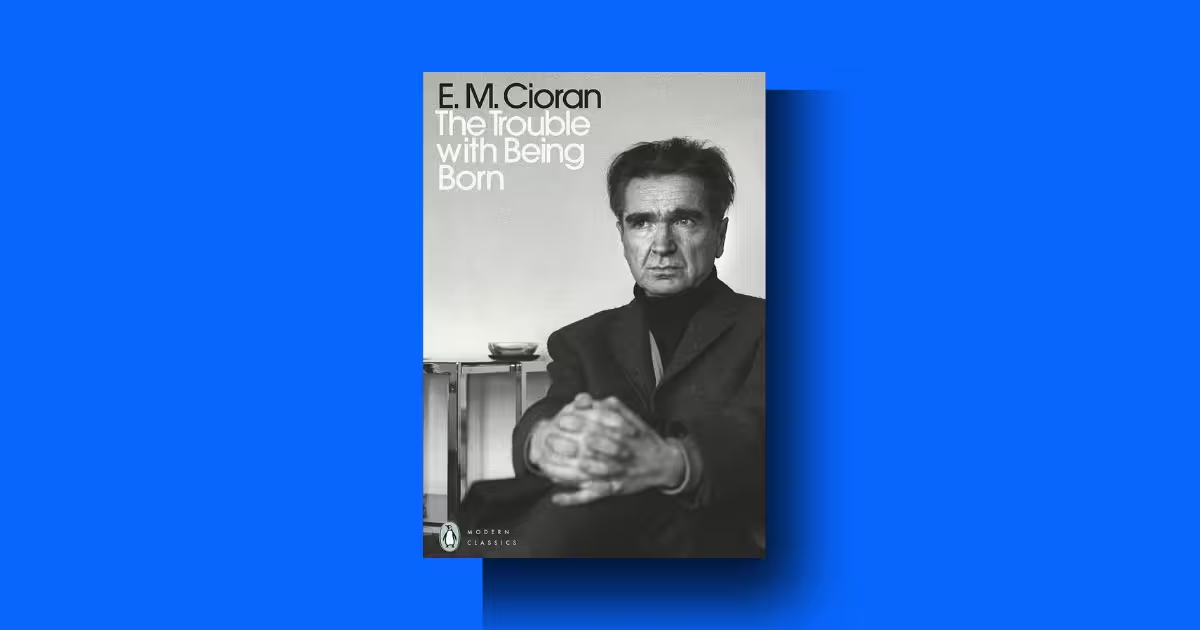
Ever wonder why you feel exhausted by the simple fact of waking up each morning? Do you sometimes catch yourself thinking that existence itself—not just your job, your relationships, or your problems—is the real burden? The Trouble With Being Born by E. M. Cioran doesn’t just ask these questions; it answers them with a ferocity that will either terrify you or set you free.
This isn’t a self-help book. It won’t teach you to be happier, more productive, or more successful. In fact, it argues that those goals are precisely the problem. What Cioran offers instead is something rarer: the cold, exhilarating permission to stop pretending that life makes sense.
Overview
The Trouble With Being Born (French: De l’inconvénient d’être né) is a 1973 philosophy book by Romanian-born French philosopher E. M. Cioran, presented as a collection of aphorisms—fragmented, poetic, and brutally honest reflections.
The central argument is that the real catastrophe isn’t death, but birth itself. Cioran argues that consciousness is a disease, that time is a torment, and that the only honest response to existence is a kind of laughing despair. Written in a style that one reviewer called “a stand-up routine at the gates of hell,” the book is nihilistic yet strangely humorous, depressing yet oddly liberating.
The Trouble With Being Born is one of the most uncompromising works of philosophical pessimism ever written.
Reader preferences
The Trouble With Being Born is best for:
- Readers who enjoy philosophical pessimism (Schopenhauer, Zapffe, Ligotti)
- Anyone who has ever felt that existence is fundamentally absurd
- People who appreciate fragmentary, aphoristic writing over systematic philosophy
- Those going through existential crises who want company, not solutions
- Fans of dark humor and intellectual provocation
The Trouble With Being Born may disappoint:
- Readers looking for practical advice or self-improvement
- Those who prefer structured, argument-based philosophy
- Anyone currently experiencing severe depression (the book can be triggering)
- People who believe life has inherent meaning and don’t want that challenged
- Casual readers expecting a conventional narrative or thesis
Table of Contents
Introduction
Title: The Trouble With Being Born (French: De l’inconvénient d’être né)
Author: Emil Michel Cioran (1911–1995)
Publication Details: Originally published in French in 1973, the English translation by Richard Howard was published in 1976 and received the PEN Translation Prize. Arcade Publishing released the edition referenced here, and in 2020, the book became a Penguin Modern Classic.
Author’s Background: Cioran was born in Rășinari, Romania, on April 8, 1911, the son of an Orthodox priest. He studied philosophy in Bucharest and Berlin before moving to Paris in 1937, where he lived in seclusion until his death in 1995. Though Romanian was his native tongue, he wrote most of his mature work in French and is considered one of the finest stylists in that language.
His work is noted for its pervasive philosophical pessimism, its aphoristic style, and its engagement with suffering, decay, and nihilism.
Contex of The Trouble With Being Born
The Trouble With Being Born is not a conventional philosophical treatise. There are no arguments laid out in chapters, no systematic progression of ideas, no conclusions reached. Instead, the book is a series of aphorisms—short, self-contained fragments that circle around Cioran’s central obsessions.
As one reviewer put it, the book “riffs on Cioran’s favourite themes: suicide; metaphysical exile; disdain for humankind (‘that hideous and immemorial riffraff’); civilisational decline; the unreality of existence, and the wisdom of cultivating ‘the long serene disgust of detachment'”.
The book grapples with the major questions of human existence: birth, death, God, the passing of time, how to relate to others, and how to make ourselves get out of bed in the morning. But unlike most philosophers, Cioran doesn’t offer answers. He offers something more unsettling: the refusal to pretend that answers exist.
Purpose of The Trouble With Being Born
The book’s central argument is contained in its title. The problem is not that we die, but that we are born to begin with. Cioran describes birth as a “laughable accident” and argues that the real, unique misfortune is “to see the light of day”.
This isn’t merely pessimism for its own sake. Cioran is making a profound philosophical claim: that existence itself is a kind of violence, that consciousness is a wound, and that all our struggles—for meaning, for success, for happiness—are merely attempts to forget the fundamental catastrophe of having been born.
“The real, the unique misfortune: to see the light of day.”
Background
To understand “The Trouble With Being Born,” it helps to know something about the man who wrote it. Cioran’s life was marked by a series of peculiarities that shaped his philosophy.
The Insomniac Philosopher
Cioran suffered from chronic insomnia from his adolescent years. He would spend entire nights awake, staring into the dark, and he claimed he could never write except “in the midst of the depression”. This experience of sleeplessness fundamentally shaped his philosophy. As he writes in the book:
“Three in the morning, I realize this second, then this one, then the next: I draw up the balance sheet for each minute. And why all this? Because I was born. It is a special type of sleeplessness that produces the indictment of birth.”
The Exile
Cioran left Romania in 1937 and never returned. He lived in Paris for the rest of his life, often in near-total seclusion. This experience of exile—both geographical and metaphysical—runs through his work. He writes:
“All my life, I have lived with the feeling that I have been kept from my true place. If the expression ‘metaphysical exile’ had no meaning, my existence alone would afford it one.”
The Stylist
Perhaps most remarkably, Cioran wrote in French, a language he learned as an adult. Yet many consider him one of the finest prose stylists in that language. His writing is marked by what one critic called “savage, unsettling beauty”. The aphoristic form he chose for this book was deliberate. As he explained:
“Explaining bores me terribly. When I’ve written aphorisms it’s because I’ve sunk back into fatigue – why bother?”
The Trouble With Being Born Summary
Reading The Trouble With Being Born is unlike reading any other philosophy book. There’s no narrative to follow, no argument to track. Instead, you encounter one provocative statement after another, each one landing like a small explosion. Here’s what I learned.
The Catastrophe of Birth
Cioran’s central claim is that birth itself—not death, not suffering, not failure—is the fundamental problem. He returns to this idea again and again throughout the book.
“I know that my birth is fortuitous, a laughable accident, and yet, as soon as I forget myself, I behave as if it were a capital event, indispensable to the progress and equilibrium of the world.”
This is more than mere pessimism. Cioran is arguing that our entire civilization—our ambitions, our achievements, our loves—is built on a kind of forgetting. We have to forget that we are accidents in order to take ourselves seriously.
“Not to be born is undoubtedly the best plan of all. Unfortunately it is within no one’s reach.”
Consciousness as Disease
For Cioran, consciousness is not a gift but a curse. It is what separates us from the peace of animals and plants.
“Better to be an animal than a man, an insect than an animal, a plant than an insect, and so on. Salvation? Whatever diminishes the kingdom of consciousness and compromises its supremacy.”
This is one of the book’s most shocking claims. Cioran isn’t just saying that life is hard; he’s saying that the very thing that makes us human—our awareness, our self-reflection, our ability to suffer consciously—is what makes life unbearable.
The Illusion of Action
One of the book’s recurring themes is the futility of action. Cioran argues that everything we do is ultimately meaningless, and that the wisest response is a kind of detachment.
“The satisfaction we take from performing a task (especially when we have no belief in the task and even disdain it) shows to what degree we still belong to the rabble.”
But Cioran doesn’t advocate suicide as a solution. In fact, he dismisses it with characteristic dark humor:
“It’s not worth the bother of killing yourself, since you always kill yourself too late.”
Time as Torment
Another major theme is the experience of time. For Cioran, time is not a neutral medium but an active torment.
“This very second has vanished forever, lost in the anonymous mass of the irrevocable. It will never return. I suffer from this, and I do not. Everything is unique—and insignificant.”
The insomnia that plagued Cioran gave him a unique perspective on time. He experienced it not as something that passes but as something that presses down on him.
“Pure time, time decanted, freed of events, beings, and things, appears only at certain moments of the night, when you feel it coming on, with the one intention of sweeping you off toward an exemplary catastrophe.”
The Wisdom of Detachment
Despite all this darkness, Cioran does offer something like a path forward: detachment. The goal is not to find meaning but to stop needing it.
“The wise man consents to everything, for he identifies himself with nothing. An opportunist without desires.”
This is not the detachment of the stoic, who endures suffering with dignity. It’s something more radical: the refusal to take anything seriously, including oneself.
“I long to be free—desperately free. Free as the stillborn are free.”
The Unreality of Everything
Perhaps the book’s most consistent theme is the unreality of existence. Cioran returns again and again to the idea that nothing is real, that everything is a kind of dream or illusion.
“Everything exists; nothing exists. Either formula affords a like serenity. The man of anxiety, to his misfortune, remains between them, trembling and perplexed, forever at the mercy of a nuance, incapable of gaining a foothold in the security of being or in the absence of being.”
This is not mere skepticism. It’s a kind of mystical insight, the recognition that the distinction between being and non-being is itself an illusion.
“Everything is without basis, without substance,’ and I never repeat it to myself without feeling something like happiness. Unfortunately there are so many moments when I fail to repeat it to myself.”
The Trouble With Being Born Analysis
Reading The Trouble With Being Born is a disorienting experience. It’s like being hit by a truck and then realizing the truck was driven by a comedian. The book is savage, relentless, and uncompromising. Yet it’s also strangely funny, even uplifting in its own perverse way.
The Power of Aphorisms
Cioran’s decision to write in aphorisms is not a stylistic quirk but a philosophical choice. Aphorisms allow him to say things that systematic philosophy cannot. They are self-contained explosions of insight, each one complete in itself, requiring no justification or development.
As the Irish Times review put it: “No summary of Cioran’s thought can do justice to the visceral euphoria of reading him. Most of his ideas repackage the Eastern metaphysics of the Void and the Western sceptical traditions in which he was steeped; the distinction lies in his mode of attack, his ecstatic spleen”.
Eastern Influences
Cioran’s thought has strong connections with Buddhist conceptions of life as suffering and the abnegation of the self. He writes:
“In Buddhist writings, mention is often made of ‘the abyss of birth.’ An abyss indeed, a gulf into which we do not fall but from which, instead, we emerge, to our universal chagrin.”
But Cioran is no Buddhist. He doesn’t offer a path to enlightenment or liberation. He simply describes the situation with brutal clarity and leaves the reader to draw their own conclusions.
The Paradox of Pessimism
One of the strangest things about this book is that it’s not depressing to read—at least not in the way you might expect. There’s something exhilarating about Cioran’s refusal to pretend. As one reviewer noted, the book is “nihilistic yet strangely hopeful, beautiful yet faintly repulsive, coherent yet deliberately self contradictory, and frankly depressing, though at times darkly hilarious”.
The paradox is this: by acknowledging the worst, Cioran somehow makes it bearable. There’s a kind of freedom in admitting that nothing matters, that everything is meaningless, that we are all accidents waiting to end.
The Question of Sincerity
Is Cioran serious? This is one of the most debated questions about his work. The Irish Times review captures this ambiguity perfectly:
“Cioran lays it on so thick, the rancour is so extravagant, you start to wonder if he’s taking the piss. And that’s the thing: the writing is relentless and splenetic and nihilistic, but it’s never devoid of humour – a stand-up routine at the gates of hell”.
I think the answer is that Cioran is both serious and not serious. He means what he says, but he also knows how absurd it is to say it. The humor comes from the gap between the extremity of his claims and the banality of the situation: a man sitting in a room, writing sentences.
What Cioran Gets Right
What makes this book so powerful is its honesty. Cioran refuses to pretend that life makes sense, that suffering has a purpose, that death is anything but an end. He articulates thoughts that most of us have but are afraid to admit.
“Each time I fail to think about death, I have the impression of cheating, of deceiving someone in me.”
This is the book’s great gift: it gives voice to the unspoken dread that haunts so many of us. Reading Cioran, you feel less alone in your despair.
What Cioran Misses
Of course, there are criticisms to be made. Cioran’s philosophy is ultimately a dead end. He describes the problem with brilliant clarity but offers no solution—not even the solution of acceptance. His detachment is so complete that it becomes a kind of paralysis.
Moreover, there’s something almost performative about his despair. One critic called him “a Romantic figure manqué, a kind of Rimbaud with a degree in philosophy and more staying power”. The suspicion lingers that Cioran enjoyed his misery, that it was a kind of luxury.
Strengths and Weaknesses
Strengths
Uncompromising Honesty: Cioran says what others are afraid to think. There’s no sugar-coating, no consolation, no easy answers.
Brilliant Prose: Even in translation, the writing is exquisite. Every sentence is crafted with care, every aphorism is a small work of art.
Dark Humor: Despite its subject matter, the book is often funny. Cioran’s wit keeps the despair from becoming merely dreary.
Intellectual Range: The book draws on Eastern and Western traditions, mysticism and skepticism, poetry and philosophy. It’s a rich, layered work.
Aphoristic Form: The fragmentary structure suits the content. Cioran doesn’t pretend to have a system; he just offers insights.
Weaknesses
No Solution: Cioran diagnoses the problem but offers no cure. The book can leave you feeling stranded.
Repetitive: The same themes recur again and again. After a while, the aphorisms can start to blur together.
Performative Despair: There’s something self-indulgent about Cioran’s pessimism. It can feel like a pose rather than a genuine philosophy.
Not for Everyone: The book is likely to be impenetrable to the casual curious reader. It requires a certain frame of mind to appreciate.
Potentially Harmful: For someone in a vulnerable state, the book could be genuinely triggering. It’s not a work to be taken lightly.
Comparison with Similar Works
Schopenhauer
Arthur Schopenhauer is the obvious comparison. Both are philosophical pessimists who argue that existence is suffering.
But Schopenhauer offers a way out (aesthetic contemplation, asceticism), while Cioran offers only detachment. Schopenhauer is a system-builder; Cioran is a fragmentist.
Nietzsche
Cioran was deeply influenced by Nietzsche but ultimately rejected his solution. Nietzsche’s response to nihilism was to create new values, to affirm life despite everything. Cioran’s response is to stop caring. As he writes:
“I have long since stopped reading him. Why? ‘I find him too naive….’ I hold his enthusiasms, his fervors against him. He demolished so many idols only to replace them with others”.
Ligotti
Thomas Ligotti’s The Conspiracy Against the Human Race is the most direct contemporary heir to Cioran. Both argue that consciousness is a curse and that birth is a catastrophe. But Ligotti is more systematic, more argumentative. Cioran is more poetic, more fragmented.
Camus
Camus’s The Myth of Sisyphus also deals with the absurdity of existence. But Camus concludes that we must imagine Sisyphus happy, that we must rebel against the absurd by continuing to live. Cioran finds this ridiculous. As he might say: why bother?
Conclusion
The Trouble With Being Born is not a book for everyone. It’s not a book for people who want to feel better about themselves, for people who believe in progress, for people who think life has meaning.
It’s a book for people who have looked into the abyss and want to know if anyone else has looked too.
If you’re in that category, this book will be a revelation. It will give you words for feelings you couldn’t articulate. It will make you feel less alone in your despair. It will make you laugh at the absurdity of it all.
Recommendation
I recommend this book to:
- Anyone who has ever lain awake at 3 a.m. wondering why they exist
- Readers who appreciate dark, aphoristic writing
- People who want to understand philosophical pessimism
- Anyone going through an existential crisis who wants company, not solutions
- Fans of Nietzsche, Schopenhauer, or Ligotti
I do not recommend this book to:
- Anyone currently experiencing severe depression
- People looking for practical advice or self-help
- Those who prefer systematic, argument-based philosophy
- Casual readers expecting a conventional narrative
As one reviewer put it: “I have to warn you that this book will be impenetrable to the casual curious reader. It is more a book of quotes than a book of discussion and it is a book of riddles”.
But if you’re ready for riddles—if you’re ready to confront the trouble with being born—this book will change you. It won’t make you happier. It won’t give you answers. But it will give you something rarer: the truth, or at least one version of it, delivered with style, wit, and savage beauty.
“A book is a postponed suicide.”
Cioran wrote this book instead of killing himself. Reading it, you understand why. Sometimes the only way to survive is to articulate the horror. Sometimes the only way to keep going is to admit that there’s no reason to keep going.
That’s the trouble with being born. And that, paradoxically, is also the gift.







