
I walked into my research on The Uprising (2026) expecting a fairly standard awards-season history lesson dressed up in chainmail.
What I found instead was messier and more interesting: a film that spent four years, three titles, and two leading men trying to figure out what it wanted to be, and then landed in theaters on September 11, 2026, still carrying some of that identity confusion in its bones.
If you searched for The Uprising 2026 review hoping for a straight yes-or-no answer on whether Paul Greengrass and Andrew Garfield pulled off their retelling of England’s 1381 Peasants’ Revolt, here is the honest version: the filmmaking roars, the lead performance roars louder, and the script never quite catches up to either one.
This review pulls together the film’s production history, its plot and historical background, early critical reaction from the film’s first public screenings, and my own take on why a 644-year-old tax revolt suddenly feels current again.
I have tried to verify every date, name, and figure against primary reporting rather than repeating whatever the marketing copy says, because a movie about ordinary people demanding honesty from people in power deserves a review that bothers to check its facts.
Table of Contents
Quick Summary
The Uprising is a 2026 historical action drama written, produced, and directed by Paul Greengrass, starring Andrew Garfield as the rebellion’s central figure and Jamie Bell, Cosmo Jarvis, Woody Norman, Thomasin McKenzie, and Katherine Waterston in supporting roles. It dramatizes the 1381 Peasants’ Revolt, when a punishing third poll tax pushed tens of thousands of English commoners to march on London and confront the 14-year-old King Richard II.
Focus Features released it domestically on September 11, 2026, after Blumhouse Productions backed the project through a winding development process that saw it go from “The Hood” (2022, with Benedict Cumberbatch) to “The Rage” (2025, with Matthew McConaughey) to its final form with Garfield.
Early reactions out of the film’s first press screenings were split down the middle: critics and viewers praised Greengrass’s handheld, documentary-style action and called Garfield’s performance a career highlight, but several also flagged a thin script, rushed character work, and an uneasy relationship with the Robin Hood legend the marketing briefly leaned on.
If you want medieval spectacle with real teeth and don’t need every character fully drawn, this is worth your evening.
If you want the emotional depth of “Captain Phillips” or “United 93,” you may leave wanting more.
Who Should Watch This
Fans of Greengrass’s earlier work (Captain Phillips, United 93, the Bourne sequels) will recognize his fingerprints immediately and should find plenty to like here, even with the reservations noted below. History buffs interested in medieval England, labor history, or the roots of the Robin Hood legend will get real value from this, since the film is at least trying to engage with actual events rather than pure fantasy.
Viewers who want a tight, emotionally rich character drama might find the pacing frustrating. Parents should note this is a violent, R-rated-leaning war drama built around a bloody uprising and its equally bloody suppression, so it is not for younger viewers, though I could not confirm an official MPA rating at the time of writing.
Background
Before getting into The Uprising itself, it helps to know what actually happened in 1381, because Greengrass is not inventing his premise from scratch.
By the summer of 1381, England had already been through three separate poll taxes in four years. The first, in 1377, charged every adult four pence, a flat tax that hit poor and wealthy alike. The second, in 1379, raised the burden further.
The third, levied in 1381, jumped to twelve pence per head, a threefold increase that landed on a population still reeling from the Black Death, which had killed a large share of England’s people in 1348 and 1349. That plague had, ironically, given surviving laborers more leverage in the job market, since fewer workers meant higher demand for their labor. The ruling class responded with wage caps and legal restrictions meant to keep peasants tied to their land and their social station.
The gap between what commoners now believed they deserved and what the law allowed them was, by 1381, about to snap.
The revolt broke out in Essex in late May 1381, when villagers in Brentwood refused to pay a tax collector and drove him off. Unrest spread quickly through Kent and Essex, then into Suffolk, Hertfordshire, and Norfolk. Rebel bands attacked manor houses, burned tax records, and broke open jails, freeing prisoners including the radical preacher John Ball, who had spent years arguing that England’s rigid class system had no basis in scripture or reason.
Ball is remembered for a rhyming couplet he is said to have preached at Blackheath on June 13, 1381, summarizing the entire rebellion’s argument in a single line: “When Adam delved and Eve span, who was then the gentleman?” In other words, if humanity’s first parents worked the earth with their own hands, what gave any nobleman the right to rule over anyone else?
Wat Tyler, a man of uncertain background (historians place his birth anywhere from around 1320 to 1341, and his origins in either Kent or Essex), emerged as the rebellion’s most visible leader. On June 14, 1381, the rebels met the 14-year-old King Richard II at Mile End, where the young king agreed to several of their demands, including an end to serfdom.
That same day, rebels stormed the Tower of London and killed Archbishop Simon Sudbury, the country’s chancellor and a deeply unpopular tax administrator. The following day, June 15, a second meeting took place at Smithfield.
During negotiations there, Tyler was fatally stabbed by William Walworth, the Lord Mayor of London, in front of the king. Richard, remarkably composed for a teenager, rode toward the shocked rebel crowd and reportedly declared himself their new captain, defusing the immediate crisis.
Within weeks, the promises made at Mile End were withdrawn, the revolt was crushed, and John Ball was executed in July 1381. The poll tax, however, was never collected again in that form, a small but real victory buried inside an otherwise failed uprising.
That is the historical record Greengrass is working from, and it is worth knowing going in, because The Uprising treats it less as background trivia and more as the entire emotional engine of The Uprising.
The Uprising Plot
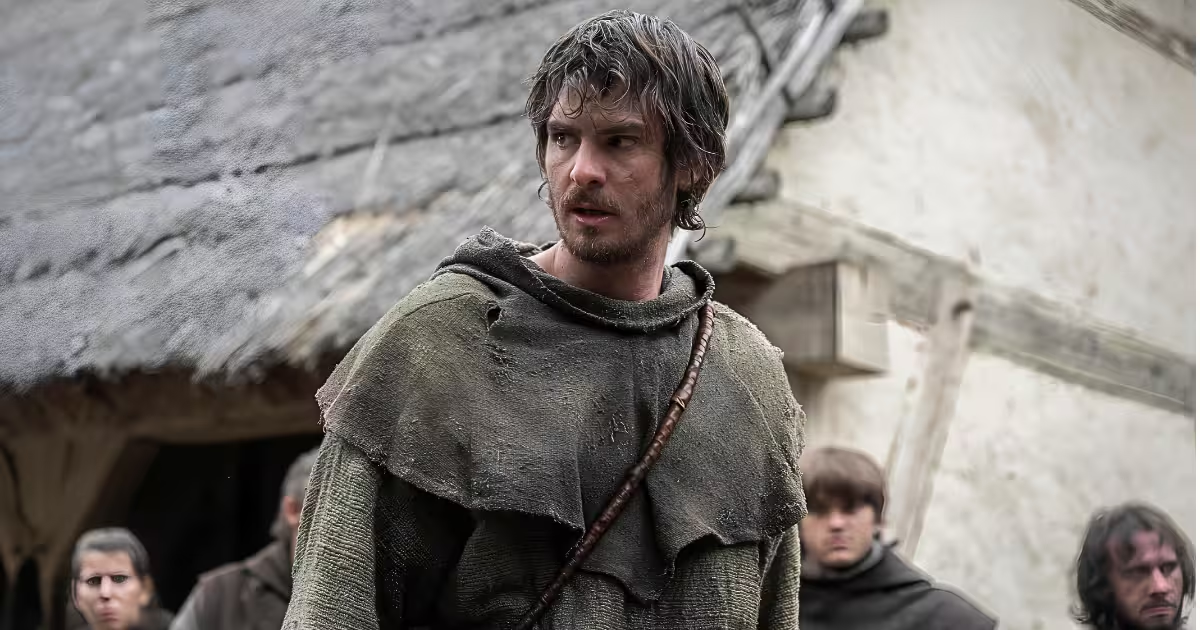
According to Focus Features’ official synopsis, Garfield plays “the legendary leader of a ferocious rebellion against the tyranny of King Richard II,” who forms an army of commoners to fight for justice as war spreads across England.
Notably, that synopsis never actually names Garfield’s character, and here is where I found something most other coverage of this film has glossed over: sources disagree on exactly who Garfield is playing. One detailed trade report (The Week) describes Garfield’s role as a composite, semi-fictional farmer named “Ploughman” who represents the spirit of Wat Tyler, while the actual historical Wat Tyler is played separately by Cosmo Jarvis. Other outlets and cast listings simply shorthand Garfield’s role as “Wat Tyler” outright.
If that distinction holds up once full reviews and cast breakdowns arrive, it means Greengrass built his film around an invented, composite protagonist standing alongside the real historical figures rather than making Garfield play Tyler directly, a structural choice that would explain a few things about how the film reportedly handles its ending.
The Uprising opens in the aftermath of the Black Death, with Garfield’s farmer character having lost his family to the plague. The crown’s escalating poll taxes, meant to fund Richard II’s war effort in France, push him from grief into rebellion. Jamie Bell plays John Ball, the radical priest whose preaching supplies the uprising’s moral and political language. Woody Norman plays the teenage King Richard II, a role that by historical record requires the character to go from a frightened boy watching his chancellor murdered to a young monarch composed enough to personally ride into a hostile crowd and claim leadership of it.
Katherine Waterston plays Joan of Kent, Richard’s mother, a historically significant figure in her own right who reportedly played a moderating role during the crisis. Cosmo Jarvis’s Wat Tyler, Jamie Bell’s John Ball, and Garfield’s farmer figure lead the march on London together, with the film reportedly depicting the rebel force mobilizing more than 10,000 commoners, according to The Week’s reporting on the production.
Because the actual history ends with Tyler’s death at Smithfield on June 15, 1381, and the swift collapse of the rebellion’s gains afterward, the film’s third act almost certainly follows that same arc, whatever creative license Greengrass took with individual scenes along the way. Paul Greengrass told NPR’s “Fresh Air” that his goal was not to deliver “a dry history lesson,” and he has spent his career (going back to “Bloody Sunday” and “United 93”) making films about ordinary people caught inside forces bigger than themselves, so it is a safe bet that the film’s climax leans into the tragedy of a movement that briefly forced a king to bend before being crushed within weeks.
One more plot wrinkle worth knowing before you go in: the film’s marketing briefly rebranded it “The Uprising: The Rise of Robin Hood” in the weeks before release, then reverted to the simpler title.
In his NPR interview, Greengrass explained that the term “Robin Hood” was originally just a generic label for an outlaw before 1381, and that the legend as we know it began crystallizing around figures connected to this exact rebellion.
Whether the finished film actually draws that connection clearly, or whether it was mostly a marketing swing that got walked back, appears to be one of the more debated points among early viewers, and I will get into that in the reception section below.
Direction and Cinematography
Paul Greengrass built his reputation on a specific visual language: handheld cameras, tight framing during chaos, and an almost documentary refusal to smooth out violence into something comfortable to watch.
That style served him well in “United 93,” “Captain Phillips,” and the two Bourne sequels he directed, where institutional panic and physical danger needed to feel immediate rather than choreographed. Applying that same handheld intensity to fourteenth-century England is, on paper, a strange fit for a genre that usually leans on sweeping, painterly wide shots (think “Braveheart” or “The Last Duel”).
According to early reactions from the film’s first public screening, that gamble mostly paid off.
Cinematographer Pål Ulvik Rokseth reportedly gives the Kent countryside and the streets of London a grounded, lived-in texture rather than a glossy period-drama sheen, and one early viewer specifically praised how the handheld approach lent the mud-and-blood set pieces “an intimacy and propulsion” the genre often lacks.
Production took place in Bavaria, in Germany’s Franconia region, around Nuremberg, and at the Penzing Studios near Munich, standing in for medieval England, which is itself a fairly common practice in modern historical filmmaking given how well-preserved certain German towns are compared to England’s own redeveloped cities.
Acting Performances
By every account I could verify, Andrew Garfield is the film’s strongest asset. Multiple early viewers singled him out specifically, with one describing his performance as “powerful rage” and another calling him “thunderously good,” even while criticizing other elements of the film.
That tracks with Garfield’s recent career trajectory; he has spent the last several years building a reputation for throwing himself completely into emotionally raw roles. The supporting cast fares well too. Cosmo Jarvis, Jamie Bell, and Thomasin McKenzie all reportedly deliver what one early reviewer called “fiery and compelling” work, even in a script that, according to that same source, does not always give them enough room to breathe.
Woody Norman, playing a 14-year-old king forced to make impossible decisions in real time, has a genuinely difficult assignment, since the character has to project both childlike fear and sudden, unnerving authority within the same afternoon of the historical record. Stephen Dillane and Tom Hollander round out the ensemble in supporting roles that had not been individually detailed in the reporting available at the time of writing.
Script and Dialogue
This is where the early consensus turns notably more critical, and it is worth taking seriously given that Greengrass wrote the screenplay himself, without a co-writer, which is unusual even for him. Multiple early viewers flagged the same basic issue from different angles: a script that moves fast but does not slow down enough to develop its characters beyond their historical function.
One reviewer described The Uprising as “unfortunately” falling short, praising the craft around the edges (the action, the atmosphere) while arguing the material “often doesn’t meet” the cast “at their level.” Another was blunter, writing that outside of Garfield’s performance, the film “did very little” for them, and that the underlying anger of the Peasants’ Revolt was “never given enough weight” by Greengrass’s approach.
That is a meaningful criticism for a film explicitly built around class rage and betrayal; if the script does not earn that rage on the page, all the handheld camerawork in the world will not manufacture it.
A third early reaction was more positive, calling the film “dark, tragic, and captivating,” so it would be inaccurate to say the reception was uniformly negative on this point, but the pattern across multiple independent early reactions suggests a script that prioritizes momentum over depth.
The Uprising Themes and Messages
Strip away the medieval costuming and The Uprising is fundamentally a film about what happens when ordinary people run out of patience with a tax system, and a political system, that asks them to sacrifice everything while the people making the decisions sacrifice nothing.
That is not a subtle theme, and it does not need to be. The poll tax of 1381 was not just expensive; it was a flat tax that charged a struggling laborer the same twelve pence as a wealthy landowner, which is exactly the kind of structural unfairness that tends to radicalize people who otherwise might never have picked up a weapon.
John Ball’s Adam-and-Eve rhyme is, in effect, one of the earliest recorded arguments for social equality in English history, and the film’s decision to center a preacher’s plain-language theology alongside Tyler’s more direct confrontation gives it two different registers for the same underlying argument: that hierarchy is a human invention, not a law of nature.
There is also a theme running through Greengrass’s choice of project that connects directly to his larger body of work. As he told NPR, he has spent decades making films about “the choices ordinary people make when they’re trapped inside forces they cannot control,” whether that is passengers on a hijacked plane, a cargo ship captain facing pirates, or, now, medieval farmers facing a king’s army.
The through-line is institutional failure and individual courage inside it, and The Uprising slots into that pattern even while working in a genre (the sword-and-shield historical epic) he had not previously tackled.
How It Compares
Set against Greengrass’s own filmography, The Uprising is his first true medieval or ancient-world project, which makes direct comparison tricky, but it clearly shares more DNA with United 93 and Captain Phillips (ordinary people, real historical crisis, handheld urgency) than with the Bourne franchise’s more polished spy-thriller aesthetic.
Within the broader genre of medieval rebellion films, comparisons to Braveheart (1995) and Ridley Scott’s Robin Hood (2010) are inevitable, especially given the marketing’s brief flirtation with the Robin Hood angle.
Where Braveheart leans hard into mythic, romanticized nationalism, and Scott’s “Robin Hood” struggled with a muddled, overstuffed plot, early reaction suggests Greengrass’s film sits somewhere in between: more grounded and less mythologized than Braveheart, but reportedly sharing some of the same “too much plot, not enough character” problem that dogged Scott’s take on the outlaw legend.
What sets The Uprising apart, at least on paper, is its refusal to fully commit to the Robin Hood branding, choosing instead to stay closer to the actual, verifiable Peasants’ Revolt, a choice that gives it more historical credibility even if it costs it some mainstream, mythology-driven marketability.
Audience Appeal and Early Reception
Focus Features positioned The Uprising as one of its clearest prestige plays for the fall 2026 corridor, releasing it on September 11, right alongside the opening of the Toronto International Film Festival and near the tail end of Venice and Telluride.
That timing signals genuine awards-season ambition from the studio, even though, as of this writing, no award nominations or wins have been announced, and it would be dishonest to pretend otherwise this early.
Blumhouse Productions, Jason Blum’s company, is best known for high-return horror titles like the “Paranormal Activity,” “Insidious,” and “The Purge” franchises, but it has also backed prestige, awards-caliber work before, most notably “Get Out,” which won the Academy Award for Best Original Screenplay in 2018.
Betting on a mid-budget historical epic (Focus Features reportedly paid around $11 million for domestic distribution rights) represents a real stretch outside Blumhouse’s usual lane, and early reaction suggests that gamble produced a film that is more admired for its craft and lead performance than beloved as a complete package.
As for the audience it will land with: this is a film for people who like their history with real dirt and real stakes rather than a glossy fairy tale, and for people who enjoy Greengrass’s specific brand of tense, handheld filmmaking.
Casual moviegoers looking for a clean, crowd-pleasing underdog story may find the film’s more clipped character development frustrating, based on the early word.
No verified box office figures were available at the time of writing, since the film’s wide release date is the same day this article was researched, so any specific opening-weekend numbers you see elsewhere should be treated with appropriate caution until confirmed by a studio report or a tracking service like Comscore.
Personal Insight – Why a 1381 Tax Revolt Still Matters
I keep coming back to one detail from the historical record while thinking about this film: the poll tax that triggered the Peasants’ Revolt was not designed to be cruel on paper. It charged every adult the same flat rate, which, in a narrow legal sense, treated everyone equally.
The cruelty was in the gap between what that flat rate meant for a wealthy landowner and what it meant for a laborer already stretched thin by a labor market still recovering from a plague that had killed a huge share of the population.
That is not a medieval problem. It is a pattern that shows up any time a tax, a fee, or a policy applies the same number to people standing on wildly different ground, and it is worth noticing how often modern debates over flat taxes, regressive fees, or across-the-board cuts to public services echo that same structural blindness.
What strikes me most, though, is how quickly the actual gains of the 1381 revolt evaporated. Richard II made real promises at Mile End, in front of a large and armed crowd, and within weeks those promises were withdrawn once the immediate danger passed. John Ball was executed.
The rebellion’s leaders were hunted down. And yet the poll tax itself was never levied again in that specific form, a small, almost buried outcome that took centuries before England tried a comparable flat-rate tax again (and, notably, that later attempt, the 1989 to 1990 “Community Charge” under Margaret Thatcher, also collapsed under public fury and was scrapped within a few years, a historical echo that is hard to ignore once you notice it).
That is the tension I find genuinely compelling about The Uprising as a subject, independent of how well the finished film executes it. Movements built on righteous anger rarely win outright and rarely get the full, permanent victory their participants were fighting for.
What they sometimes manage instead is to make a specific policy too politically costly to ever attempt again in the same form, which is a smaller, quieter kind of win than the one usually depicted in triumphant historical dramas.
If Greengrass’s film manages to sit inside that discomfort, the gap between the immediate defeat and the longer, slower vindication, rather than smoothing it into a clean underdog arc, it will have done something genuinely useful with this material.
Based on the early, mixed reaction around its script and pacing, it sounds like the film gets closer to that discomfort in its action and its lead performance than it does in its writing, which is a shame, because the real history practically hands a screenwriter that theme on a plate.
Still, even a film that only partially lands its themes can send a curious viewer back to the actual events with fresh eyes, and on that count alone, The Uprising seems likely to succeed.
The Uprising Quotations
John Ball, the rebel priest, preaching at Blackheath on June 13, 1381 (a centuries-old, public-domain historical quotation, not a line from the film): “When Adam delved and Eve span, who was then the gentleman?”
Paul Greengrass, describing his goals for the film to NPR’s “Fresh Air,” said he wanted to avoid making “a dry history lesson” out of one of England’s defining rebellions.
Entertainment reporter Jonathan Sim, after the film’s first public screening, called it “dark, tragic, and captivating.”
Awards Radar’s Joey Magidson, in a more critical early reaction, wrote that “the anger of the Peasants Revolt is never given enough weight” by the film.
Pros and Cons
Pros:
- Andrew Garfield delivers what early viewers are calling a career-highlight performance
- Greengrass’s handheld, documentary-style direction reportedly gives the action real intimacy and weight
- Strong, grounded production design shot on location in Bavaria’s Franconia region
- A genuinely compelling, well-researched historical subject that most viewers will not know in detail
- Supporting performances from Cosmo Jarvis, Jamie Bell, and Thomasin McKenzie are reportedly fiery and committed
Cons:
- Multiple early reactions flag a script that moves fast but underdevelops its characters
- The rebellion’s emotional and political anger reportedly does not land with full force on the page
- Some ambiguity and possible marketing confusion around the brief “Rise of Robin Hood” subtitle
- No verified box office or aggregate critic score data available at the time of writing
Conclusion
The Uprising (2026) is a film I would describe as worth seeing rather than a must-see, at least based on everything verifiable at the time of this review.
Andrew Garfield’s performance and Paul Greengrass’s handheld, visceral direction give it real teeth, and the underlying history, a genuine, under-told story of English commoners briefly forcing a teenage king to bend, deserves the big-screen treatment it is finally getting.
Where it falls short, according to the earliest and most consistent thread across multiple independent reactions, is in a script that prioritizes momentum over the character depth this material has earned. If you go in expecting a tense, well-acted historical action film rather than the emotionally layered character study Greengrass has delivered in the past, you are less likely to walk out disappointed.
Frequently Asked Questions
Is The Uprising (2026) based on a true story?
Yes. It dramatizes the 1381 Peasants’ Revolt in England, a real historical uprising triggered by a third poll tax, led in part by the historical figures Wat Tyler and John Ball against the government of the 14-year-old King Richard II.
Who directed The Uprising?
Paul Greengrass, known for “United 93,” “Captain Phillips,” and two Bourne franchise films, wrote, produced, and directed The Uprising.
Who stars in The Uprising?
Andrew Garfield leads the cast, with Jamie Bell, Cosmo Jarvis, Woody Norman, Thomasin McKenzie, Katherine Waterston, Jonny Lee Miller, Tom Hollander, and Stephen Dillane in supporting roles.
When was The Uprising released?
Focus Features released The Uprising in United States theaters on September 11, 2026.
Is The Uprising connected to the Robin Hood legend?
The film’s marketing briefly used the subtitle “The Rise of Robin Hood” before reverting to the simpler title. Director Paul Greengrass has said the Robin Hood legend as we know it began forming around the period of this exact rebellion, though how directly the finished film draws that connection is still being debated by early viewers.
Why does Andrew Garfield’s character go unnamed in the official synopsis?
Focus Features’ official synopsis never names Garfield’s character directly, and sources give conflicting accounts, with at least one report describing his role as a composite farmer figure distinct from the historical Wat Tyler, who is played separately by Cosmo Jarvis.