

What Is the Theory of Stupidity? Did you ever argue with someone using facts, sources, and plain logic, and watch them get more certain of their own position with every sentence you spoke? I have, more times than I’d like to admit, and for years I assumed I was just bad at arguing.
Then I read a short, strange essay written by a German pastor in a Nazi prison cell, and I realized I wasn’t failing at persuasion. I was up against something persuasion was never built to beat.
Table of Contents
Overview
Dietrich Bonhoeffer, a Lutheran pastor executed by the Nazis in 1945, wrote that stupidity is a more dangerous enemy of the good than malice. His reasoning wasn’t about IQ. He argued that stupidity is what happens when people give up their inner independence under the pressure of power, propaganda, or a crowd, and that once this happens, facts stop working on them.
Modern psychology, from Stanley Milgram’s obedience experiments to Robert Sternberg’s work on foolishness, backs up large parts of this idea, even though the researchers weren’t citing Bonhoeffer directly.
Below, I’ll walk through what he actually wrote, where the science lines up with him, where it doesn’t, and what any of this has to do with your life right now.
Who Was Dietrich Bonhoeffer, and Why Should You Care What He Thought About Stupidity?
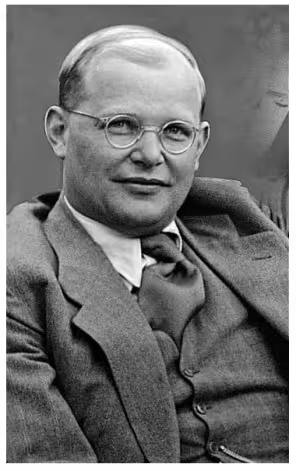
Dietrich Bonhoeffer was born on February 4, 1906, in Breslau, and by his twenties he was already a respected Lutheran theologian. He wasn’t a bystander during the rise of the Third Reich. He spoke out against the Nazi euthanasia program, opposed the persecution of Jews from the pulpit, and joined a resistance network that worked, among other things, to help Jewish refugees escape Germany under a rescue operation known as Operation 7.
The Gestapo arrested him in April 1943, and he spent close to two years in Tegel Prison in Berlin before being moved through Buchenwald and finally to Flossenbürg concentration camp. He was hanged there on April 9, 1945, only weeks before the war ended and Hitler died by suicide.
His brother Klaus and brother-in-law Hans von Dohnányi were also executed by the regime around the same time.
Here’s the detail most short explainers get slightly wrong: the reflection on stupidity wasn’t scribbled during his prison years, at least not the version we now read. It comes from an essay called “After Ten Years,” which Bonhoeffer wrote as a Christmas gift for close friends and family in December 1942, a few months before his arrest.
It was later collected, after his death, into the book we know as Letters and Papers from Prison. So technically, he wrote it as a free man watching his country come apart around him, not as a prisoner reflecting backward. That distinction matters if you want to actually understand the essay instead of just repeating the popular version of the story.
What Did Bonhoeffer Actually Say About Stupidity?
This is where a lot of internet summaries get lazy, so let’s be precise. Bonhoeffer’s argument, in his own words, was this: “Stupidity is a more dangerous enemy of the good than malice.” That’s the whole thesis in one sentence, and everything else in the essay is him defending it.
His logic goes roughly like this. Evil, he says, at least announces itself. You can point at it, argue against it, organize a resistance to it, or in extreme cases stop it by force. Evil also carries, in his phrasing, the seed of its own unraveling, because it tends to leave people uneasy even when they go along with it.
Stupidity doesn’t work that way. According to Bonhoeffer, a stupid person can’t be reached with facts, because facts that contradict what they already believe simply get rejected, reframed, or waved off as unimportant. Reasoned argument doesn’t puncture the belief. If anything, in his view, being challenged sometimes makes a stupid person more combative, not less certain.
And unlike someone acting out of malice, who at least knows on some level that they’re doing wrong, the stupid person is, in his words, “utterly self-satisfied.” There’s no inner unease to appeal to, because there’s no sense that anything is wrong.
The Part Everyone Skips: Bonhoeffer Didn’t Think Stupidity Was About Intelligence
Here’s the twist that most short social media posts leave out entirely, and it’s the part that actually makes the essay worth reading in full. Bonhoeffer explicitly separates stupidity from a lack of brainpower. He wasn’t talking about people who couldn’t understand complex ideas. He was talking about otherwise capable, sometimes highly educated people who had, in a sense, outsourced their thinking.
His explanation for how this happens is almost sociological rather than psychological. He noticed that whenever power surges upward in a society, whether through a political movement or a religious one, a large share of the population becomes susceptible to this kind of thinking failure. Not because their intellect suddenly stops working, but because, under the weight of that rising power, people lose their inner independence.
They stop forming their own judgment about what’s happening around them and instead adopt the slogans, the catchphrases, and the group’s official story as if those things were their own conclusions.
Talk to someone in that state, Bonhoeffer wrote, and it barely feels like talking to a person anymore. It feels like you’re arguing with a set of borrowed talking points that have taken over the person speaking them. And because the person has, in effect, surrendered their independent judgment, Bonhoeffer warns that they become capable of real harm while being unable to recognize that harm as harm. This, to him, is where stupidity becomes genuinely dangerous rather than merely annoying: a stupid person under the sway of a movement can be turned into an instrument of evil without ever believing, even for a second, that they are doing anything evil at all.
That’s a bleak thought, and it’s also a strangely comforting one. Bonhoeffer makes a point of saying that this observation shouldn’t lead you to write off entire groups of people as permanently stupid, because whether a person falls into this trap seems to depend heavily on the situation, not just their character. In other words, it’s less a fixed trait and more a condition that certain circumstances bring out in people who might otherwise think perfectly clearly.
Does Modern Psychology Actually Back Up Bonhoeffer’s Theory of Stupidity?
Bonhoeffer wasn’t a psychologist, and he wasn’t running controlled experiments in his prison cell. Still, several strands of twentieth and twenty-first century research land surprisingly close to what he described, even though the researchers involved weren’t building on his essay directly.
Milgram’s obedience experiments. In 1961, at Yale, the psychologist Stanley Milgram began a series of studies in which ordinary volunteers were told to deliver what they believed were increasingly painful electric shocks to another person whenever that person answered a memory test incorrectly. In the original, most-cited version of the study, 65 percent of the forty participants continued all the way to the maximum 450-volt shock, despite hearing what sounded like screams of pain from the other room.
It’s worth being honest about the nuance here, since later researchers who went back through Milgram’s full archive of roughly twenty variations found obedience rates ranging anywhere from 0 percent to more than 90 percent depending on the exact setup, averaging closer to 43 percent overall. The headline 65 percent figure is real, but it describes one condition, not the whole picture.
Even with that caveat, the broader pattern supports something Bonhoeffer intuited without any lab equipment: ordinary, non-malicious people will hand over their independent judgment to an authority figure far more readily than most of us would like to believe.
Hannah Arendt’s banality of evil, and why it’s not quite the same idea. People frequently mash this concept together with Bonhoeffer’s essay, and that’s actually a mistake worth correcting rather than repeating. Arendt covered the 1961 trial of Adolf Eichmann, a chief organizer of the Holocaust’s logistics, and concluded that what made him disturbing wasn’t monstrous genius but a kind of bureaucratic hollowness.
Her own phrase for it was pointed: “It was not stupidity but thoughtlessness.” Arendt was drawing a real distinction between a person who fails to think and a person who is incapable of thinking, and she placed Eichmann in the first category. Bonhoeffer’s stupid person and Arendt’s thoughtless bureaucrat are cousins, not twins. Both describe people who do terrible things without inner resistance, but Bonhoeffer frames it as a loss of independent judgment under pressure, while Arendt frames it as a failure to engage in the internal dialogue that thinking requires.
If you want the fuller picture of Arendt’s argument and how it plays out against the actual trial record, I’ve written a separate breakdown of Eichmann in Jerusalem and the controversies around it.
Carlo Cipolla’s laws of human stupidity. In 1976, the Italian economic historian Carlo M. Cipolla wrote a tongue-in-cheek essay called “The Basic Laws of Human Stupidity,” and it has since become something of a cult favorite among people who study organizational behavior. Cipolla sorted people into four rough categories based on whether their actions helped or hurt themselves and others: the helpless, the intelligent, the bandits, and the stupid.
His most quoted claim is that a stupid person is someone who causes damage to others while gaining nothing for themselves, sometimes even losing out personally in the process, which is precisely what makes this group so hard to predict or defend against.
Where Bonhoeffer saw stupidity as something a totalitarian regime manufactures at scale, Cipolla treated it as a near-constant percentage present in every group, profession, and country, regardless of education or status.
The two men were writing decades apart, in completely different registers, one solemn and one satirical, yet they arrive at a similar warning: don’t assume power, credentials, or intelligence rule this category out.
Robert Sternberg’s foolishness research. More recently, the Cornell and Yale psychologist Robert Sternberg has spent years studying why intelligent, accomplished people still make catastrophically bad decisions.
His answer isn’t that they’re secretly unintelligent. Instead, his “imbalance theory of foolishness” argues that smart people fall into specific traps: overestimating how much they know, assuming rules that apply to everyone else don’t apply to them, believing their own reasoning is beyond question, and letting short-term thinking override long-term consequences.
This is a genuinely useful addition to Bonhoeffer’s picture, because it explains a case his essay doesn’t fully cover: highly capable people who aren’t swept up by any mob or dictator, and who talk themselves into disaster all on their own, using their own intelligence as the instrument.
Why Stupidity Spreads Faster Than Evil in the Age of Algorithms
Bonhoeffer was diagnosing a totalitarian state with a monopoly on radio broadcasts and newspapers. You’re living through something he never had to reckon with directly: a media environment where anyone with a phone can broadcast a claim to millions of people before anyone fact-checks it.
I won’t pretend I have hard, verified statistics on exactly how misinformation spreads through any particular platform in 2026, and honestly, you should be suspicious of any article that throws out a precise-sounding number here without a named, checkable source.
What I can say with confidence, based on Bonhoeffer’s own framework, is that the mechanism he described doesn’t need a dictator to function. It needs three ingredients: a rising surge of some kind of power or momentum, whether political, financial, or algorithmic, a large group of people willing to trade independent judgment for belonging, and a feedback loop that rewards repeating the group’s slogans over forming your own view.
Social platforms that reward engagement over accuracy supply exactly that third ingredient, whether or not anyone designing them intended it that way.
This is also where Sternberg’s research becomes genuinely practical rather than academic. A lot of the most confident, most viral misinformation isn’t spread by people who can’t think. It’s spread by people who are perfectly capable of thinking, but who’ve stopped applying that capability to the specific claim in front of them because it already matches what their group believes.
How Do You Actually Protect Yourself From This Kind of Thinking?
Bonhoeffer’s own answer to the puzzle was almost as unsettling as his diagnosis. He argued that you can’t fix stupidity through more information, more facts, or better arguments, because none of that reaches the actual problem. In his view, only liberation, some kind of inner or outer act that frees a person from the grip they’re under, could do the job, not instruction. That’s a hard thing to hear if you’ve ever tried to argue someone out of a conspiracy theory using nothing but a well-sourced article.
Still, his diagnosis points toward a few concrete habits, even if he didn’t spell them out as a checklist:
- Notice when you’re relying on someone else’s slogans instead of your own reasoning. If you can’t explain a position in your own words, using your own examples, you might be borrowing it rather than holding it.
- Pay attention to how you react when you’re proven wrong. Genuine thinking allows for the discomfort of being corrected. If new facts make you angrier instead of curious, that’s worth sitting with.
- Be suspicious of unanimity, especially your own. Bonhoeffer noted that stupidity tends to show up in groups, not in isolated individuals. If everyone around you agrees instantly and completely, that’s a moment to slow down, not speed up.
- Separate your identity from your opinions. A lot of what looks like stubbornness is really self-protection. If changing your mind feels like losing part of who you are, you’re far less likely to update it, no matter how good the evidence is.
- Apply Sternberg’s warning to yourself, not just to other people. It’s easy to imagine “stupid” behavior as something other people fall into. The imbalance theory of foolishness is specifically about smart people, which almost certainly includes you and me.
None of these fixes are dramatic, and Bonhoeffer would probably say that’s the point. He wasn’t describing a problem you solve with a slogan of your own.
How Does the Theory of Stupidity Compare to Similar Ideas?
It helps to see these frameworks side by side rather than treating them as interchangeable, since they’re often lumped together online.
| Thinker | Core Claim | What Causes It |
|---|---|---|
| Dietrich Bonhoeffer | Stupidity is more dangerous than malice because it resists facts and argument | Loss of inner independence under a surge of power |
| Hannah Arendt | Great evil can come from thoughtlessness, not monstrous intent | Failure to engage in internal moral reasoning |
| Carlo Cipolla | Stupid people harm others while gaining nothing themselves | A roughly constant trait spread across every group |
| Robert Sternberg | Intelligent people act foolishly through specific reasoning traps | Overconfidence, false invulnerability, and poor tacit judgment |
If Bonhoeffer’s essay is the one that grabs you, it’s worth sitting with a related question that theidealised.com has tackled elsewhere: how much of what looks like moral failure is really a failure of independent thought rather than a deliberate choice to do wrong.
That question runs directly through the review of Robert I. Simon’s Bad Men Do What Good Men Dream, and through a broader piece on the most dangerous ideas in Western philosophy, both of which wrestle with where personal responsibility ends and situational pressure begins.
A Personal Note on Why This Essay Still Bothers Me
I’ll admit that reading Bonhoeffer’s essay changed how I argue with people, and not in a way that made arguing easier. It made it harder, because it took away my favorite tool. I used to think that if I just found the right fact, the right statistic, the right source, I could move someone off a bad position.
Bonhoeffer’s whole point is that this almost never works on the specific kind of belief he’s describing, and once you accept that, you have to find a different way to disagree with people that doesn’t rely on winning.
What I find genuinely uncomfortable, and I think this is where the essay earns its reputation, is that it doesn’t let me off the hook either. It would be easy to read this as a description of “other people,” the ones on the opposite side of whatever argument I happen to be having that week. Bonhoeffer doesn’t offer that comfort.
He’s describing a condition that any of us can slide into under the right pressure, which is exactly why he insists it isn’t about intelligence. Nobody gets to assume they’re naturally immune.
Frequently Asked Questions About the Theory of Stupidity
Who came up with the theory of stupidity?
Dietrich Bonhoeffer, a German Lutheran pastor and anti-Nazi resistance member, laid out the core argument in his 1942 essay “After Ten Years,” later published in Letters and Papers from Prison.
Did Bonhoeffer write this while he was in prison?
Not quite. He wrote it in December 1942 as a Christmas letter to friends and family, a few months before the Gestapo arrested him in April 1943. It was compiled into the prison letters collection after his death.
Is the theory of stupidity the same as Hannah Arendt’s banality of evil?
No, though they’re related. Arendt argued that Eichmann’s evil came from thoughtlessness, not stupidity, and she was explicit about that distinction. Bonhoeffer’s essay is about the loss of independent judgment under power, which is a different, if neighboring, idea.
How did Bonhoeffer die?
He was executed by hanging at Flossenbürg concentration camp on April 9, 1945, weeks before the end of World War II in Europe.
Can a stupid person, in Bonhoeffer’s sense, become intelligent again?
Bonhoeffer’s own view was pessimistic about persuasion but not about people. He argued that facts and arguments can’t reach someone in this state, but that some kind of liberating event, rather than instruction, can restore their independent judgment.
Conclusion
Bonhoeffer wrote his reflection on stupidity as a private letter to people he loved, during a period when he had every reason to expect he might not survive what was coming.
He wasn’t trying to build a following or win an argument online. That context matters, because it means the essay was never designed as a weapon to use against people you disagree with. It was closer to a warning label he wanted his closest friends to carry with them into an uncertain future.
Reading it eighty years later, in a world with entirely different tools for spreading both truth and nonsense, the warning hasn’t aged out of relevance. If anything, it reads like it was written for exactly this moment, which is either a strange coincidence or proof that some patterns in human behavior don’t need new technology to repeat themselves.
References:
- Bonhoeffer, Dietrich. “After Ten Years,” in Letters and Papers from Prison, Dietrich Bonhoeffer Works, vol. 8. Minneapolis: Fortress Press, 2010.
- Wikipedia, “Dietrich Bonhoeffer.”
- Milgram, Stanley. “Behavioral Study of Obedience.” Journal of Abnormal and Social Psychology, 1963; cited via Simply Psychology and EBSCO Research Starters summaries.
- The Conversation, “Revisiting Milgram’s shocking obedience experiments.“
- Arendt, Hannah. Eichmann in Jerusalem: A Report on the Banality of Evil, 1963
- Cipolla, Carlo M. The Basic Laws of Human Stupidity, 1976/1987
- Sternberg, Robert J. “Smart People Are Not Stupid, But They Sure Can Be Foolish: The Imbalance Theory of Foolishness,” in Why Smart People Can Be So Stupid, Yale University Press, 2002.







