
Ever wonder why some people seem to have life figured out while the rest of us are just trying to keep our heads above water?
I certainly did. For years, I chased productivity hacks, morning routines, and success formulas like they were hidden treasure maps. I’d read a book, feel inspired for a week, and then slip right back into my old patterns. The cycle was exhausting.
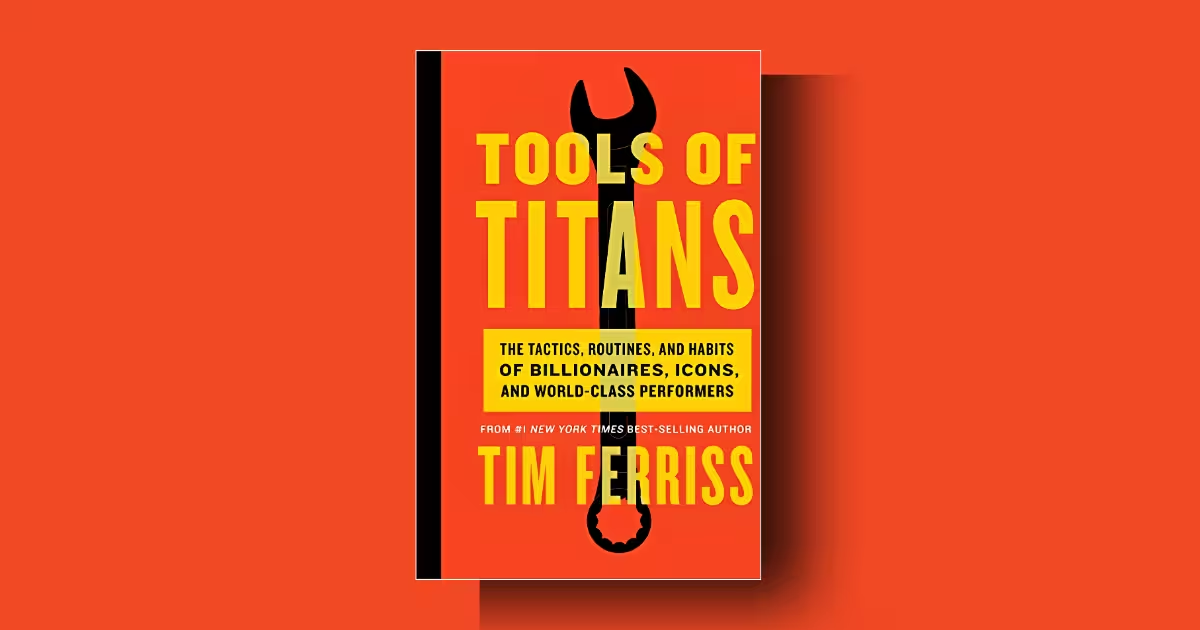
Then I picked up Tools of Titans by Tim Ferriss. At nearly 700 pages, it looked less like a book and more like a weapon. But what I found inside wasn’t a rigid blueprint for success, it was something far more useful: a massive, chaotic, and surprisingly honest collection of what actually works for people who have achieved extraordinary things.
Overview
Tools of Titans is the condensed notebook of Tim Ferriss’s podcast interviews with over 200 world-class performers, billionaires, athletes, artists, scientists, and icons. The book is divided into three sections, Healthy, Wealthy, and Wise, and is designed to be a “buffet” you can pick and choose from.
Here’s the thing: this isn’t a traditional self-help book with a linear narrative. It’s a reference guide. You don’t read it cover to cover; you explore it. The core message? There is no one-size-fits-all formula for success. Instead, Ferriss offers a toolkit of tactics, routines, and philosophies, and it’s up to you to experiment and find what fits your life.
Who Will Actually Love Tools of Titans
You’ll benefit most if:
- You’re curious about how high-performers think, train, and operate.
- You enjoy bite-sized, actionable advice (each guest profile is 2-6 pages).
- You’re open to unconventional ideas, from psychedelic therapy to ketogenic diets.
- You’re tired of generic “follow your passion” advice and want specific, testable tactics.
You might bounce off it if:
- You prefer a structured, linear narrative with a clear beginning, middle, and end.
- You’re skeptical of “biohacking” or alternative health practices.
- You’re looking for a deep dive into a single topic rather than a wide survey.
Table of Contents
1. Introduction
Title and Author Information
Book: Tools of Titans: The Tactics, Routines, and Habits of Billionaires, Icons, and World-Class Performers
Author: Timothy Ferriss
Publication Date: December 6, 2016
Publisher: Houghton Mifflin Harcourt
Pages: ~700
Tools of Titans Context
Tim Ferriss is no stranger to the self-improvement scene. He’s the author of the mega-bestseller The 4-Hour Workweek, which has sold over 2.1 million copies and spent years on the New York Times bestseller list. But Tools of Titans is different. It wasn’t originally intended for publication. Ferriss wrote it as a personal playbook, a “notebook to end all notebooks”, to distill the lessons from his podcast, The Tim Ferriss Show, which became the first business/interview podcast to surpass 100 million downloads.
Purpose of Tools of Titans
The central thesis is simple: Success is achievable if you collect the right field-tested beliefs and habits. Ferriss argues that the superheroes we admire are “nearly all walking flaws who’ve maximized 1 or 2 strengths.” You don’t succeed because you have no weaknesses; you succeed because you find your unique strengths and develop habits around them.
The book is structured around a framework borrowed from Hermann Hesse’s Siddhartha: the ability to think, wait, and fast. These translate to having good decision-making rules, playing the long game, and building resilience.
2. Background
Before Tools of Titans, Ferriss was already a cultural phenomenon. His “4-Hour” series had challenged conventional wisdom on work, fitness, and cooking. But his podcast became a new kind of laboratory.
By conducting long-form, uncut interviews with world-class performers, he wasn’t just asking for soundbites, he was digging for the systems, the failures, and the often-absurd tactics that actually worked.
The book emerged from a month-long retreat in Paris, where Ferriss reviewed thousands of pages of transcripts and hand-scribbled notes. The result is a book that feels less like a polished manuscript and more like a curated collection of wisdom from a brilliant, obsessive note-taker.
3. Tools of Titans Summary
Part 1: Healthy
This section is a deep dive into physical and mental performance. It’s not about generic “eat less, move more” advice. Instead, it’s packed with specific protocols from athletes, doctors, and scientists.
Amelia Boone, an obstacle course racing legend and full-time Apple attorney, introduces tools like the RumbleRoller and dry needling for recovery. She also shares a powerful philosophy: “I’m not the strongest. I’m not the fastest. But I’m really good at suffering.”
Dr. Rhonda Patrick explains the benefits of “hyperthermic conditioning”, using saunas to increase growth hormone and improve endurance. She cites a study showing that two 20-minute sauna sessions at 176°F can elevate growth hormone levels two-fold over baseline.
Coach Christopher Sommer, a former U.S. National Team gymnastics coach, stresses that consistency trumps intensity. He notes that connective tissue adaptations take 200 to 210 days. His mantra? “If you want to be a stud later, you have to be a pud now.”
Dr. Dominic D’Agostino provides a comprehensive primer on the ketogenic diet and therapeutic fasting. He explains that fasting before chemotherapy can sensitize cancer cells to treatment while protecting normal cells. Ferriss himself reports that deep ketosis eradicated his Lyme disease symptoms.
Wim Hof, “The Iceman”, demonstrates how controlled breathing and cold exposure can improve immune function and mood. His breathing exercise can dramatically increase endurance.
James Fadiman, a pioneer in psychedelic research, describes psychedelics as “non-specific amplifiers of the psyche.” He notes that low doses of LSD or psilocybin can enhance creative problem-solving, with one study showing that 44 out of 48 problems were “solved” (resulting in a patent, product, or publication) when participants used psychedelics.
Martin Polanco and Dan Engle discuss ibogaine, a psychoactive substance from an African plant that can eliminate more than 90% of opiate withdrawal symptoms. They also recommend flotation therapy as a legal alternative for achieving a “psychedelic” state of deep relaxation and introspection.
Pavel Tsatsouline, a former Soviet special forces physical training instructor, outlines principles for building strength without burnout. He emphasizes that “strength is a skill, and, as such, it must be practiced.”
One of the most striking patterns in this section, and throughout the book, is the emphasis on meditation and mindfulness. Ferriss notes that more than 80% of his guests practice some form of daily meditation or mindfulness. He presents his own five morning rituals, including meditation and journaling, and argues that meditation is a “meta-skill” that improves everything else.
Part 2: Wealthy
This section shifts focus to business, investing, and productivity. The profiles here are less about tactics and more about mindsets and decision-making frameworks.
Chris Sacca, an early-stage investor in Twitter, Uber, and Instagram, describes moving to a rural cabin to prioritize focus over reactive meetings. He credits this period as his best investment. His advice? “Go to all the meetings you can, even if you’re not invited to them, and figure out how to be helpful.”
Marc Andreessen, co-creator of the Mosaic browser and co-founder of Netscape, argues that most companies fail by not charging enough for their product. His billboard message would be simple: “Raise prices.” He also advocates stress-testing ideas with a “red team” assigned to argue the opposing case.
Arnold Schwarzenegger recounts how he made millions in real estate before his film career and never auditioned, instead waiting for roles that matched his unique physique. His advice? “I wasn’t there to compete. I was there to win.”
Derek Sivers, who sold CD Baby for $22 million and donated the proceeds to charity, introduces his “hell, yeah! or no” decision framework. If it’s not a “hell, yeah!” it’s a no.
Tony Robbins shares insights from billionaires like Warren Buffett and Richard Branson. He notes that they are all obsessed with capping the downside and finding asymmetrical risks and rewards.
Casey Neistat, the YouTube filmmaker, offers a raw look at his grueling daily routine: waking up at 4:30 a.m., editing until 1 a.m., and uploading a video every single day at 8 a.m. His philosophy? “You can always work harder than the next guy.”
Ferriss also candidly describes his own struggles with procrastination and manic-depressive tendencies. He presents a productivity process centered on identifying the 3 to 5 things that are making you the most anxious and blocking out 2 to 3 hours to focus on just one of them.
Part 3: Wise
This final section is the most philosophical. It explores meaning, relationships, and the art of living.
BJ Miller, a palliative care physician, offers a profound perspective on death and dying. He argues that our relationship with mortality shapes our relationship with life.
Jocko Willink, a former Navy SEAL commander, delivers his signature mantra: “Discipline equals freedom.” He also emphasizes the importance of extreme ownership, taking full responsibility for everything in your life, even things that aren’t your fault.
Naval Ravikant, the founder of AngelList, talks about how real wealth is about freedom, not money, but control over your time. He argues that “you are more powerful than you think you are. Act accordingly.”
Kevin Kelly, co-founder of Wired, offers a simple but powerful observation: “A lonely place is an unmotivated place.”
Maria Popova, the creator of Brain Pickings, shares her love for Tara Brach’s guided meditations. She listens to the same recording every morning, Tara Brach’s Smile Guided Meditation recording from the summer of 2010.
Tim Kreider, an essayist and cartoonist, writes about the importance of laziness. His essay Lazy: A Manifesto argues that busyness is a form of laziness, lazy thinking and indiscriminate action.
4. Tools of Titans Analysis
Tools of Titans is not a perfect book. It’s sprawling, inconsistent, and sometimes feels more like a glorified podcast transcript than a polished manuscript. But that’s also its greatest strength.
What Ferriss does brilliantly is capture the texture of wisdom. He doesn’t just tell you what successful people do; he shows you their contradictions, their failures, and their often-absurd workarounds. The book is messy because life is messy.
Where the book falls short is in its lack of critical distance. Ferriss is a fan, not a journalist. He rarely pushes back on his guests’ claims, even when they verge on the pseudoscientific. The sections on psychedelics, ketogenic diets, and biohacking can feel less like exploration and more like advocacy.
From a literary perspective, the book is a triumph of curation over authorship. Ferriss’s voice is present but not overpowering. He acts as a guide, not a guru. This is a book that trusts its readers to take what they need and leave the rest.
5. Strengths and Weaknesses
Strengths
Actionable Advice: This isn’t philosophy; it’s a toolbox. You can literally try a new tactic from the book every day for months.
Diverse Perspectives: From Navy SEALs to movie stars to scientists, the range of voices is staggering.Honesty: Ferriss doesn’t pretend to have all the answers. He shares his own struggles with depression, procrastination, and self-doubt.
Buffet Format: You can skip what doesn’t interest you and focus on what does.
Weaknesses
Lack of Structure: The book is organized by guest, not by topic. If you want to learn about meditation, you have to hunt for it.
Uneven Quality: Some profiles are brilliant; others feel like filler.
Uncritical Acceptance: Ferriss rarely challenges his guests, even when their advice is controversial or dangerous.
Length: At nearly 700 pages, it’s intimidating and can feel like a chore.
6. Comparison with Similar Works
Tools of Titans sits in a unique space between biography, self-help, and reference guide. It’s most similar to:
The 4-Hour Workweek by Tim Ferriss: Ferriss’s earlier book is more focused and prescriptive. Tools of Titans is broader and more exploratory.
The Tim Ferriss Show (Podcast): The book is essentially a condensed, curated version of the podcast. If you’re a regular listener, you’ll recognize many of the stories.
Tribe of Mentors by Tim Ferriss: Ferriss’s follow-up book uses a similar format but focuses on short, punchy answers to a set of 11 questions.
The Power of Habit by Charles Duhigg: Duhigg’s book offers a more scientific and structured look at habit formation. Tools of Titans is more anecdotal and personal.
7. Conclusion
Tools of Titans is not a book you read; it’s a book you use. It’s a reference guide, a source of inspiration, and a permission slip to experiment with your own life.
Who should read it?
- Anyone who feels stuck in a routine and wants fresh ideas.
- Anyone who is curious about how the world’s most interesting people think.
- Anyone who is willing to experiment, fail, and try again.
Who should skip it?
- Anyone looking for a quick fix or a step-by-step formula for success.
- Anyone who is uncomfortable with unconventional ideas.
- Anyone who prefers a tightly argued, linear narrative.
For me, Tools of Titans was a wake-up call. It reminded me that success is not about having a perfect plan; it’s about collecting the right tools and using them when they matter most. It’s a book I’ll return to again and again, not because I agree with everything in it, but because it’s full of ideas that make me think.







