
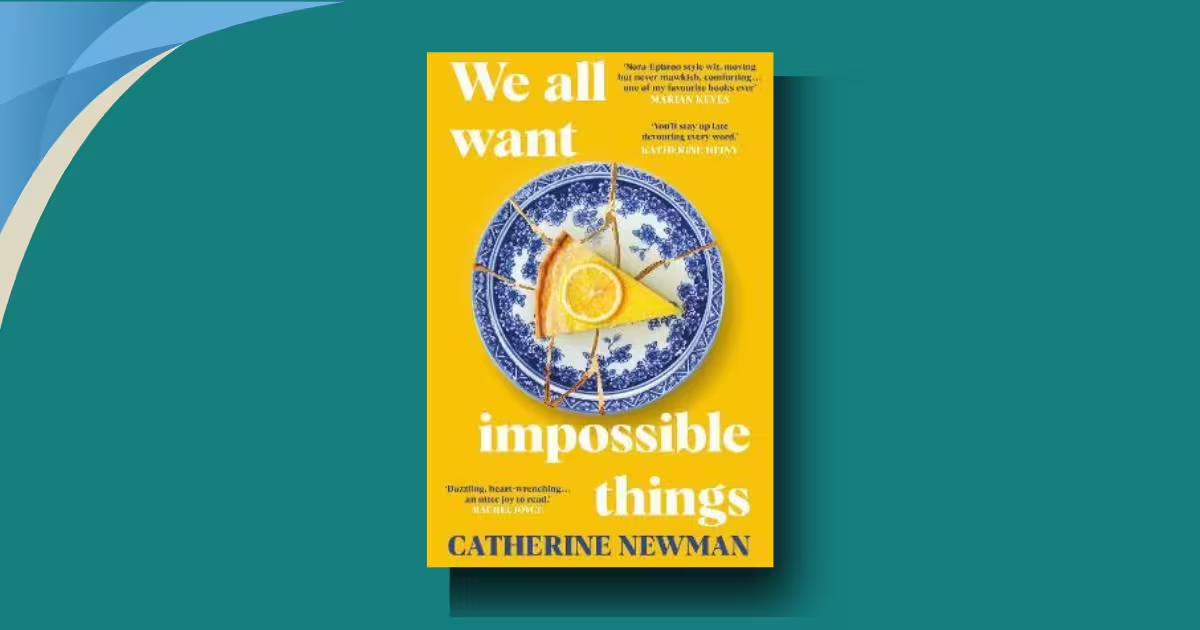

Have you ever watched a friend navigate the final weeks of life and wondered how love, laughter, and mundane daily rituals somehow coexist with the profound terror of goodbye? This is the heartbreaking, yet strangely joyful, territory Catherine Newman masterfully charts in her novel We All Want Impossible Things.
A lifelong friendship is put to the ultimate test when one woman moves into hospice, forcing them both to navigate the absurd, tender, and devastating realities of dying while trying to hold onto the vibrant life they’ve shared.
We All Want Impossible Things is best for readers who appreciate character-driven, emotionally authentic fiction about female friendship and grief; those seeking a portrayal of end-of-life that is unsentimental yet deeply loving; fans of books that can make you laugh through tears.
Not for: Readers seeking a fast-paced plot, a traditional romantic narrative, or an escapist read; those who prefer to avoid themes of terminal illness and raw grief.
Table of Contents
1. Introduction
We All Want Impossible Things is the 2022 debut novel by Catherine Newman, known previously for her non-fiction and memoir work.
Published by HarperCollins, the novel translates Newman’s sharp, observant, and deeply humane voice into fiction, offering a story that feels less invented and more intimately revealed. It is a book that sits with you, a poignant exploration of the “impossible” demand to say goodbye to someone who is the mirror to your own soul.
2. Background
While not a historical novel, We All Want Impossible Things is steeped in the contemporary reality of hospice care and the modern experience of prolonged illness.
It arrives in a cultural moment where conversations about death positivity, palliative care, and how to “die well” are becoming more mainstream.
Newman draws from a deeply personal place—the novel is dedicated to a real friend—which lends an aching authenticity to its depiction of cancer, hospice routines, and the chaotic grace of caregiving. It’s a story that couldn’t have been told with such specific, unflinching detail in an era less open about the physical and emotional processes of dying.
3. We All Want Impossible Things Summary
The novel is narrated by Ash, a 45-year-old woman whose life is in a state of suspended disintegration. She’s separated from her kind, steady husband, Honey, and is engaging in a series of unfulfilling sexual encounters. Her anchor, her true north since nursery school, is her best friend Edi, who is dying of ovarian cancer.
When Edi’s New York hospital can no longer treat her and Brooklyn hospice care isn’t an immediate option, Ash proposes Edi move to “The Graceful Shepherd” hospice near Ash’s home in Western Massachusetts. In a heart-wrenching decision, Edi agrees, leaving behind her husband, Jude, and their seven-year-old son, Dash.
This sets the stage for the novel’s central journey: Edi’s final weeks in hospice, tended to by Ash, who becomes her primary companion, advocate, and witness.
The plot is not event-driven but moment-driven, unfolding in a series of visceral, everyday scenes. We see Ash plucking Edi’s chin hairs, battling a leaking PEG tube that drains stomach fluids, and trying to fulfill Edi’s craving for a long-lost Sicilian lemon polenta pound cake.
The hospice itself, nicknamed “Shapely,” is a character—a place of lemon drops, haunting repetitions of Fiddler on the Roof, gentle nurses like Olga and Violet, a wise doctor nicknamed “Dr. Soprano,” and a music therapist named Cedar with a gravel-angel voice.
Amidst this, Ash’s personal life continues its messy orbit. Her teenage daughters, practical Jules and sharp-witted Belle, provide both exasperation and deep comfort. Her almost-ex-husband Honey remains ever-present, cooking meals and offering a quiet, steadfast love that Ash feels unworthy of.
She sleeps with Edi’s brother, Jonah, and even Dr. Soprano, seeking validation and oblivion. As Ash confesses, “I just want this. Not even the sex exactly, but the being wanted. The oblivion of it” (Page 40).
Edi’s condition follows the unpredictable arc of terminal illness. There are rallies where she sits up, jokes, and reminisces. There are steep declines marked by confusion, pain, and haunting questions like, “What do you think happens after you die?” (Page 74). A pivotal moment comes when Edi falls trying to get out of bed, an event that signals a turning point. Dr. Soprano gently tells Ash, “Probably, you’ll want to get the people up here now who want to be up here” (Page 109).
The novel culminates in a gathering. Jude, Jonah, Ash’s family, and Edi’s glamorous friend Alice all converge at Shapely for a final, impromptu party—a bittersweet celebration with Thai food, toasts, and laughter in the face of the inevitable.
The long-sought cake arrives, and in a moment of perfect, dark humor, Edi takes a bite and declares, “Eh… It could use a lemon drizzle or something” (Page 113). It’s a testament to her enduring, unfiltered self.
Edi’s death is not dramatized with a final spoken line. Instead, the focus stays on Ash. In the final pages, Ash is at home, surrounded by sleeping loved ones, finally allowing herself to rest after being “dragged to the bottom of the ocean floor” by sleep (Page 129).
The ending implies that Edi has died, with Ash left in the quiet aftermath, carrying the love and the loss forward. The story closes not with an end, but with the beginning of Ash’s new reality—one forever shaped by the impossible, glorious gift of her friendship with Edi.
4. We All Want Impossible Things Analysis
4.1. We All Want Impossible Things Characters
- Ash: She is a spectacularly flawed and relatable narrator. Her grief manifests as chaotic energy—sexual misadventures, avoidance, and a dark, witty internal monologue. She calls herself “a coward. A jerk” (Page 99), but her actions—the relentless, hands-on care she provides—prove otherwise. Her arc is toward self-forgiveness and a shaky understanding that being imperfectly present is enough.
- Edi: Seen through Ash’s adoring eyes, Edi is vibrant, sharp, and fiercely loving even as she dwindles. Her humanity never evaporates. She is vain about her mustache, cranky about bad soup, and obsessed with finding a mythical cake. Her relationship with Ash is the novel’s core, a bond so deep that Ash notes, “Edi’s memory is like the backup hard drive for mine” (Page 70).
- Honey: The emotional anchor. His love is practical, patient, and enduring. He is the one who quietly shovels Ash’s walkway and shows up with food. His flaw, in Ash’s eyes, is his equanimity, which she mistakes for a lack of passion. He represents the stable love Ash is not yet ready to receive.
- Belle & Jules: Ash’s daughters provide grounding and generational perspective. Belle’s teenage angst and profound wisdom (“Feeling sorry for yourself is not a pie… There’s plenty of it to go around” (Page 116)) are crucial counterpoints to Ash’s turmoil.
4.2. We All Want Impossible Things Themes and Symbolism
- The Impossibility of Grief: The title encapsulates the central theme. We want to keep our loved ones alive. We want to be perfect caregivers. We want to spare our children pain. The novel argues that sitting with these impossible wants is the work of love and loss.
- Hospice as a Microcosm of Life: Shapely is not a morbid waiting room but a condensed, intensified version of living. It has kitchen gossip, kindness, petty annoyances, love stories, and community. It’s where, as Ash observes, “you are kind of officially dying” but also where you watch Fiddler on the Roof and crave a good grilled cheese (Page 13).
- Sustenance and Memory: Food is a powerful symbol of care, love, and the persistence of self. The quest for the Sicilian lemon polenta pound cake symbolizes the human desire for completion, for tasting a perfect memory one last time. Its anticlimactic arrival underscores that the search—the act of loving—was the real point.
- The Body as a Betrayal and a Testament: Edi’s failing body is a source of horror and dark comedy (leaking tubes, bloating). Yet, it is also the site of her life’s story—her C-section scar intersecting with her surgery scar, a “topographical mapping of birth and death” (Page 36).
5. We All Want Impossible Things Evaluation
- Strengths: Newman’s greatest achievement is her tone. She captures the precise alchemy of hospice—how profound sorrow and laugh-out-loud humor are not opposites but bedfellows. The dialogue crackles with authenticity. The portrayal of female friendship is unparalleled in its depth and lack of sentimentality. It feels less like reading a story and more like overhearing a life.
- Weaknesses: Readers who prefer strong plot propulsion may find the narrative meandering. Ash’s sexual escapades, while illustrating her fragmentation, can sometimes feel like a distracting subplot from the more compelling central relationship.
- Impact: The book leaves an indelible emotional mark. It doesn’t just make you cry; it makes you recognize the beautiful, terrible contract of loving people. It’s intellectually resonant in its philosophical musings on death, and emotionally transformative in its celebration of imperfect, enduring love.
- Comparison: It shares the unflinching look at dying found in Joan Didion’s The Year of Magical Thinking but with a warmer, more communal, and humorous spirit. In its celebration of lifelong female friendship, it calls to mind Elena Ferrante’s Neapolitan novels, though set against the specific backdrop of end-of-life care.
6. Personal Insight & Contemporary Relevance
Reading We All Want Impossible Things amidst a growing cultural dialogue about death is profoundly educational. In the U.S., according to the National Hospice and Palliative Care Organization, over 1.7 million patients received hospice care in 2020, yet public understanding of what that entails remains limited.
Newman’s novel serves as a vital, empathetic primer. It demystifies the process—the PEG tubes, the morphine pumps (“Harbinger” brand, a darkly perfect detail), the role of social workers and aides—and argues for its dignity.
The book’s deeper lesson is about the contemporary crisis of community. In an age where families are often geographically scattered, the novel asks: Who shows up? Who holds the cup with the straw? Who chases the mythical cake? It shows that “care” is not just medical but emotional, culinary, and mundane.
In a world often avoidant of death’s realities, this novel is a brave, necessary act of witness, teaching that leaning into the hard, messy, and hilarious moments of farewell is not just a service to the dying, but a vital part of living fully ourselves.
Resources like The Conversation Project (theconversationproject.org) help guide these difficult discussions, but fiction like Newman’s prepares the heart for them.
7. We All Want Impossible Things quotes
- “Grief is crashing over our heads like a tsunami, this miraculous soul is about to be homeless, but thirst is thirst.” (Page 75)
- “I picture her mind like a bar, her thoughts and memories nursing their last round. It’s closing time, and you don’t have to go home, but you can’t stay here.” (Page 15)
- “It’s tricky, mourning a person who’s still alive.” (Implied throughout)
- “What I’m losing? You’re choosing to give it up.” (Edi to Ash, Page 101)
- “I want impossible things.” (Ash, Page 55)
8. Conclusion
We All Want Impossible Things is a rare gem: a novel about dying that is bursting with life.
It is achingly sad, brilliantly funny, and unbearably honest. Catherine Newman has written a love letter to friendship in its most fierce and final stage.
This book is highly recommended for anyone who has ever loved deeply, for anyone preparing to accompany someone on a final journey, and for anyone who needs to remember that joy and sorrow are inextricably linked.
Its significance lies in its fearless heart, its compassionate gaze, and its ultimate, hard-won affirmation that love, in all its impossible forms, is what remains.