

Last updated on October 29th, 2026 at 12:05 pm
When God Doesn’t Fix It is Laura Story’s memoir about a brain tumor that was removed, a recovery that went badly wrong, and a husband who survived but never got his short-term memory back. Her answer to the title question is direct: when God leaves the broken thing broken, he is still repairing something bigger, your relationship with him, and you can change for the better even if your circumstances never do.
Story is the songwriter behind “Blessings,” which won the 2012 Grammy for Best Contemporary Christian Music Song, and she wrote this 2015 book with Jennifer Schuchmann as the long answer to a song’s short question.
I read it with one filter: what it says to someone holding a diagnosis, a disability, or a caregiver’s car keys. Below you get the full argument, all eighteen myth and truth pairs, the research that backs up what she lived, and my honest verdict.
What does When God Doesn’t Fix It teach in one minute?
It teaches that God’s first goal is mending your relationship with him, not your circumstances, and that you can get better even when your situation does not. The rest of When God Doesn’t Fix It unpacks that claim in twenty short chapters.
Trials are an opportunity, not a curse. Story’s broken arm at college was her first lesson.
God’s primary desire is to fix your relationship with him. Healing the body comes second, and sometimes it does not come.
You cannot earn good treatment. She searched Scripture for a promise God broke and could not find on.
Faith is held up by God, not by your effort. Her quiet times shrank to a few minutes and God still held on.
Swap “why” for “how.” “Man asks why. Jesus asks how.”
Letting go is how you gain. Abraham and Isaac are her model.
Your unfinished story is useful now. You do not need a happy ending before you share it.
Practical care matters. Alarms, routines, and letting Martin fail safely did more than any slogan.
Joy and brokenness coexist. “Joy is in the Lord. Brokenness is in the world.”
Who will love this book, and who may bounce?
You will love When God Doesn’t Fix It if you are living inside a situation that is not going to be fixed, such as a spouse’s brain injury, a chronic illness, years of infertility, or the quiet exhaustion of caring for someone who cannot thank you, because Story writes about all of it without a single seven-step plan.
She says outright that she would be “a fraud” if she offered one. You will also enjoy it if you like memoir with real jokes in it, since the hospital chapters are funnier than the subject should allow.
You may bounce if you want a rigorous philosophical treatment of evil, because this is a pastor-style Bible application book, not an argument built for skeptics.
In the same way, if you do not share her evangelical framework (sin, the fall, salvation by grace, spiritual warfare), several chapters will read as sermons.
And if you want a medical memoir with diagnoses named and treatment decisions debated, you will not find that here.
When God Doesn’t Fix It never names Martin’s tumor type.
What is When God Doesn’t Fix It about, and who wrote it?
It is a Christian memoir and Bible-application book about suffering that does not resolve, told through the author’s marriage to a man who survived brain surgery with lasting memory loss. The full title is When God Doesn’t Fix It: Lessons You Never Wanted to Learn, Truths You Can’t Live Without, by Laura Story with Jennifer Schuchmann, published in 2015 by W Publishing Group, an imprint of Thomas Nelson, in Nashville.
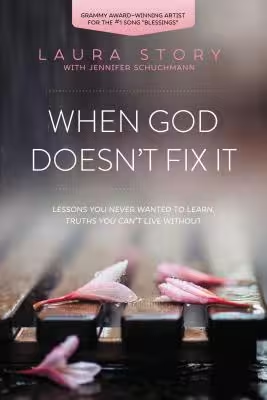
Retail listings put the paperback at 304 pages, and the story itself runs about 280 numbered pages across 20 chapters. Schuchmann is described by the publisher as a New York Times bestselling author.
Story’s credentials are practical rather than academic. She graduated from Columbia International University, a Bible college, served as a worship leader at Perimeter Church in Atlanta, and wrote “Indescribable,” a song that Chris Tomlin recorded.
Wikipedia notes that Billboard ranked her 40th among Top Christian Artists of the 2010s and that she has won a Grammy and six Dove Awards. The copyright page adds a trust note worth knowing: some names and details were changed, a few scenes use composite characters, and conversations are “best recollection” rather than transcripts.
The central thesis is stated in the book’s closing run of chapters.
Her circumstances may never improve, but she can, and the way forward is to stop blaming the brokenness for her own selfishness, pride, and impatience. That is the argument in one sentence, and everything earlier is evidence for it.
Who is Laura Story, and what was happening before she wrote this?
Story was a newly married worship leader with a surprise hit when her husband’s health fell apart. Before Atlanta, she and Martin lived in Greenville, South Carolina, planning a move to Savannah so he could study graphic design.
A friend’s call about a job at Perimeter Church changed the plan, and the church’s pastor told her to bring Martin and let the congregation care for them.
That promise mattered more than anyone knew.
The public side of the timeline is easy to verify. “Blessings” was released as the lead single from her 2011 album, and in 2012 it won a Grammy. The Columbia International University alumni news reports her Grammy in February 2012, Dove Awards that April, and her announcement that she and Martin were expecting a daughter.
Baptist Press lists four Dove categories for the song and album (CIU’s item counts three, so sources differ on the total). When God Doesn’t Fix It, Josephine Grace was born on September 14, 2012, and twin boys followed on September 18, 2014.
When God Doesn’t Fix It Summary
A young couple’s plan collapses over one hospital summer, and Story spends the rest of When God Doesn’t Fix It unlearning eighteen things she thought were true about God. Chapters 2 through 19 each end with a boxed “Myth” and “Truth,” which the book gathers again on its last pages.
Chapters 1 to 3: the call, the Mongolian hillside, and the surgery that looked like a win
Chapter 1, Unexpected Calls. In February 2006, Story is at a worship conference in St. Louis when a voicemail from Martin turns into the news that changed everything: “I have a brain tumor”.
The warning signs had stacked up for about a year. Martin, once a go-getter, slept constantly, forgot simple tasks, fell asleep at church and dinner, and hit a guardrail while driving drowsy. Story had been frustrated and embarrassed, and now she felt ashamed of that.
Alone at the airport, she asks herself whether she will “let my circumstances determine my view of God” or let God determine how she views her circumstances.
Chapter 2, Inner Encounter in Outer Mongolia. She goes back to college. A football-toss accident breaks her arm, she ends the relationship with Martin in anger, and everything that made her feel significant disappears in a week: the bass, the music classes, the boyfriend, the car.
A mission trip to Mongolia strips her down further. Sitting on a hillside with only a Bible, she decides she has earned nothing from God, and God becomes real to her in a new way at nineteen. Her takeaway is the first myth and truth of the book: trials are not a curse, they are an opportunity.
Chapter 3, When God Doesn’t Fix What We Want Fixed. The neurosurgeon says the mass is “malignant” but probably not cancer, and that it is pressing on the adrenal-related hormone system, which explains the exhaustion and surges.
Surgery goes through the nose and takes four hours and forty-five minutes. It succeeds, but it leaves Martin’s pituitary non-functioning and his vision at risk.
He wakes confused and thrilled to learn he is married. Then, about a week after he comes home, a leak of spinal fluid sends him back to the hospital, and days later, at about 3:30 a.m. he stops breathing from meningitis. The book’s hinge is here. Story reads Mark 1, where Jesus leaves a town full of people waiting for healing and says he must preach elsewhere, and concludes: “Our desire is for God to fix broken things.
But God’s desire for us is to fix our relationship with him”.
If you want a sense of how real those complications are, the medical literature agrees. A systematic review of 25,034 transsphenoidal operations found cerebrospinal fluid leaks in about 3.4% of adult cases, and an older Dutch series calls postoperative meningitis a well-known complication of that surgery.
Rare does not mean never, and When God Doesn’t Fix It is honest about the odds the doctors quoted.
Chapters 4 to 7: trouble, the ICU, the plan, and the church
Chapter 4, Don’t Be Surprised by Trouble. Story admits that she once believed in a bargain. If she and Martin did enough for God, God would repay them. After Mongolia, she hunted the Bible for the verse where God promised that and found none.
She puts the Bible’s big story in four beats, creation, the fall, the rescue through Jesus, and final restoration, and argues that illness belongs to the second beat, not to the verdict on a person.The truth she wants you to hold: salvation is gained by what Jesus did, not by what you do.
Chapter 5, Complications. Martin is kept in a medically induced coma, and the surgeons drill a second hole to stop the swelling. Story fields visitors who ask “How are you doing?” twice, and one woman offers that God “needs more angels”. When the breathing tube comes out, Martin wakes blind in the moment, frightened, and convinced meteors are falling.
What follows is a month of “Where am I?” asked dozens of times a day, hospital-bed delusions (he believes Story is pregnant and that he chose brain surgery as an optional extra), and the slow discovery that his short-term memory is gone.
She reads James 1 with new eyes. “Count it all joy” does not mean cartwheels at bad news. It means holding on to God while the test runs. The lesson is the one most people quote from the book: when things look dark, God’s light shines brightest.
Chapter 6, The Best-Made Plans. One Saturday Martin turns paranoid and accuses Story of compromising his care. A nurse asks her to leave. Her father, a cardiologist, tells her at lunch that Martin might not ever go home. In the ICU waiting room she prays and senses God say, in effect, that he does for her every day what she is trying to do for Martin.
She connects this to the Judeans in Babylon and Jeremiah 29, the “plans to prosper you” verse, which was first spoken to exiles told to settle in for seventy years. Sodium levels, not betrayal, caused the paranoia, and a medication change cleared it in twenty-four hours. The truth: where God has you right now is the best place for you.
Chapter 7, The Church Came to Us. Martin spends more than two months in hospital care, then moves to inpatient rehab, where Story must tie him to the bed at night because the staff refuses to. Then, with about a day’s notice, the doctor says Martin is “healthy” and will be discharged. “Functional,” she learns, means walking, feeding, and bathing himself eventually, not finishing his degree.
The short-term memory loss, the doctor says, is like a phantom limb, and exercise will not make it work. The senior pastor’s wife, Carol Pope, meets her at a Chick-fil-A and invites them to live in the Popes’ guest suite. The next morning Martin walks into the senior pastor’s kitchen and orders two eggs.
Church, she decides, is not a building with services. It is the people of God serving one another, and they served “not because we were worthy”.
Chapters 8 and 9: coming home, and the grief that arrives after the miracle
Chapter 8, New Life. Home is harder than the hospital. Martin nearly drowns while believing he is swimming. The bills have gone unpaid for three months, and the bank will not talk to her because she does not know the PIN or the password.
He wanders off during a cruise dinner and is found ninety minutes later. Even trusted friends keep him for a weekend and miss that he skipped his medication, a mistake that could be dangerous within three days . She brings him to work, where he sleeps on a futon in her office, and he starts radiation to shrink any remaining tumor.
In the middle of it, she rewrites her idea of faith. She had believed it was the sum of quiet times, memorized verses, and church attendance. She learns it is the strength of the one holding you: “It’s not what I do. It’s what he does”. The truth for this chapter: the strength of my faith rests on the strength of my God.
Chapter 9, New Grief. The surprise is that the loss deepens after the crisis ends. Martin’s memory fails by the minute. He brushes his teeth for five minutes and spends ten choosing a shirt, with no sense of how long things take. She becomes his wife, mother, nurse, tutor, and life coach, and the marriage starts to buckle under resentment on both sides.
Their mentors, Bill and Sherri, tell her to stop managing him like a child, and she agrees to step back and let him miss a lunch so he learns to own his calendar. “Martin’s life is a series of snapshots,” she writes, while everyone else lives in a movie. She eventually realizes the brain tumor was not a detour. “It was the road”.
Then comes the cruise-deck prayer about children, where God asks if a loving marriage will be enough, and the Abraham and Isaac lesson in letting go. Her line for the pair: “We don’t gain God’s blessings by hanging on. We gain them by letting go”.
Chapters 10 to 14: why, worship, and the case for telling your story
Chapter 10, Why?. Story admits that the word why haunts her more than she likes to say, and that people line up after her concerts with their own versions of it.
She turns to John 9, where the disciples ask whose sin made a man blind and Jesus answers that it was neither, so that the works of God might be displayed. She quotes a commentary by Gary Burge to argue that God did not cause the blindness to show off, he sent Jesus to heal it. She adds that the blindness was likely preventable with modern hygiene, which she reads as a result of the fall rather than a punishment.
I could not verify that medical aside, and it is not essential to her point. Then she hands you homework: write your why questions on one side of a page, your how questions on the other, and see which list gives you more to work with. The line most readers remember is “Man asks why. Jesus asks how”. Her truth for the chapter: contentment starts when you ask how God might use this for his glory.
Chapter 11, Record Emotions. Back at Perimeter, Story cannot make herself sing the upbeat songs she once loved, and a friend tells her to set them aside for now. “Mighty to Save” becomes her prayer instead. Then a record executive, James Rueger of Fair Trade Services, invites her and Martin to lunch at Macaroni Grill and proposes a worship album.
Her heart says no, because her story has no ending and “no one gives their testimony in the middle of their trials”. She studies the Psalms, sees David lament and praise in the same voice, and reads Psalm 40:3, where God puts a new song in the singer’s mouth, as permission to lead worship without manufacturing a feeling. Worship, she decides, is an act of the will. You sing because he is good, not because you feel good.
Chapter 12, Exposing My Vulnerabilities. After three years without time alone, both spouses realize they are disappointed in the marriage. She describes a camping trip to a waterfall that was easy going down and brutal climbing out, then notes where the metaphor fails: friends congratulate you for “making it through,” but this climb never ends. Her high expectations set Martin up to fail.W
hen he forgets to ask about her day, she can sulk, accuse, or set him up to win, and she chooses to open with “I led a great Bible study today!” so he can ask the follow-up. Mentors on speakerphone at 11 p.m. keep them from going to bed angry. When the label wants a more personal album, she is afraid to admit her doubts on stage.
Then on a night drive home from Birmingham, she catches herself using “the e-word,” expected, and realizes she has joy anyway. She writes the song that became “Blessings” with a Sharpie on a gas receipt. Truth: God can use your story while you are still in the middle of it.
Chapter 13, Chosen to Tell. Story did not want to be an ambassador because she had doubts, no ending, and none of the “perky, inspiring anecdotes” she saw in other leaders. She turns to the Samaritan woman in John 4, a woman with five prior husbands whom Jesus meets at midday and who then tells her whole village.
Her point is practical. You would rather get help from someone who has been where you are than from someone who has never struggled.“God didn’t use her in spite of her story.
He used her story”. Truth: God redeems my past and gives me a future.
Chapter 14, Your Story Brings God Glory. Sunday school taught her to copy Bible heroes so God would favor her, and she kept falling short. Reading the stories again, she finds Abraham lying, David coaxing Bathsheba, and Noah drunk, and concludes the heroes are not there to be copied. God is the hero, and the only thing to imitate is their dependence on him.
She gives everyday examples of people telling the truth: a woman who finally confessed a decades-old abortion to her husband and found relief, two Bible-study friends trading honest seasons, and a minister who told his church about his child’s addiction. The emotional center is January 15, 2013, a concert in Newtown, Connecticut, a month after the Sandy Hook shooting, with Max Lucado as emcee and an arena of ten thousand that sold out in thirty-eight minutes.
Story had no words of comfort. The one person who did was Mary Beth Chapman, who had lost her five-year-old daughter Maria Sue in 2008 and told the crowd that God would carry them. Truth: my story is my greatest offering.
Chapters 15 to 18: children, Lazarus, “Blessings,” and abundance
Chapter 15, Trusting My Role. Over sushi, Story tells her mother she has accepted a life without children, and her mother gently disagrees. At the same time, Martin longs for a role of his own, and a roadie job does not suit him. A private adoption falls apart when the birth mother changes her mind. The couple does what they always do and asks five couples to pray, and one friend says a line I underlined: “Don’t let the death of one dream lead to the death of another”.
Nine months later, “our life looked exactly the same”. What arrives instead is a friend and former bandmate, Marcus Myers, who moves in with his wife Katie and their two small daughters, Sadie and Reece. Christmas morning with the girls heals more than Story expected. Truth: God wants my trust, not my help.
Chapter 16, Resurrected Dreams. Using the raising of Lazarus in John 11, Story argues that Jesus sometimes lets a dream die so its return shows his power, and that he works on his schedule, not ours.
In late January she goes to the doctor for fatigue, and “there in the doctor’s office, I saw my Lazarus,” a positive pregnancy test. She also sees that the year spent watching Marcus and Katie parent had been training for her and Martin. Truth: I can rest when I release my dreams to my loving Father.
Chapter 17, The Blessings of “Blessings”. Every morning she prays that God would completely heal Martin, and she senses him asking whether she would still give him the glory if the healing is slow. That exchange became the song. It almost missed the album, because the budget was gone and it was recorded with just piano and voice. She worried she had shared too much, and the opposite happened: concerts sold out and letters arrived.
The chapter is mostly listener stories. A father wrote after his young daughter was killed in an accident involving his son. A mother described raising a brain-injured son who will never speak.
A woman wrote that alcohol took her husband’s mind and sent him to a nursing home. A girl born with half a heart found the song on a used iPod Touch. Story says she fully believed her own lyrics only after she watched others live them.Truth: when God withholds what you want, it is not punishment, he has something better.
Chapter 18, Abundantly Extravagant. The pregnancy terrifies her. Martin cannot drive her to the hospital, and she wonders whether he will find his way back to the delivery room.
Sherri reminds her that children are a gift and that her doubts may be spiritual warfare. Josephine Grace arrives on September 14, 2012.
Martin learns baby care through repetition, with supplies laid out where he can see them. A tour collapses when a promoter in Omaha disappears with the ticket receipts, leaving the bus driver unpaid, and she ends up crying on an airport floor with her first migraine while holding a sleeping baby.
Still, life on the road suits the family, and Josie becomes the “tour mascot”. Martin finds his own place coaching a high school baseball team, and a player gives him a Father’s Day card. Truth: God is able to do abundantly more than we ask or imagine.
Chapters 19 and 20: a better broken, and a messy ending
Chapter 19, A Better Broken. At a Texas radio panel on brain injury, Story meets “Cindy,” whose husband was hurt in a motorcycle accident a few months earlier. She refuses to promise that things will improve. Her message is narrower: “your circumstances may not get better, I believe you can get better”.
She admits she has no program to sell and then makes When God Doesn’t Fix It‘s hardest claim. For years she blamed every argument on Martin’s disability, but the real problem was sin, and the disability was only the mirror. “Martin’s disability wasn’t preventing our marital happiness”.
She also insists God did not give Martin a tumor to teach her patience, since tumors came into the world with sin, but that God wastes nothing.
She closes on Paul’s thorn in 2 Corinthians 12, where Paul begs three times and receives the promise of sufficient grace instead of healing. Truth: my situation may not get better, but I can.
Chapter 20, Messy Endings. She has won awards, but she will never win Mother of the Year, and she proves it with the story of Josie’s split lip, a bloodied white blouse, and a nursery line of perfectly dressed girls. That morning she decides God has not called her to a tidy life for her glory but to a messy one for his. Twin boys, Benjamin Cary and Griffin James, arrive on September 18, 2014.
She ends with the mustard seed and a house where the good towels mildew in a basket labeled “not yet urgent”. Her last lines are a three-part charge: “Share your story. Give God the glory. And live a better broken”.
What are the eighteen myths and truths in When God Doesn’t Fix It?
When God Doesn’t Fix It teaches eighteen myth and truth pairs, one for each of chapters 2 through 19, and Story gathers them in a pull-out list on the last pages. I have put them in my own words below so you can use the table as a quick reference.
| Chapter | The myth | The truth |
|---|---|---|
| 2 | Hard times mean God has cursed you. | Hard times are an invitation to trust and follow. |
| 3 | God’s main aim is to repair what is broken in your life. | God’s main aim is to repair your relationship with him. |
| 4 | You earn salvation by what you do. | Salvation rests on what Jesus did. |
| 5 | When life gets dark, God has left. | God’s light is brightest in the dark. |
| 6 | Your own life plan beats where God has you now. | Where God has you now is the best place for you. |
| 7 | Church is a building with services. | Church is God’s people serving each other. |
| 8 | Faith is as strong as your belief. | Faith is as strong as the God who holds it. |
| 9 | You gain by holding on. | You gain by letting go. |
| 10 | Contentment starts with understanding why. | Contentment starts with asking how God can use this. |
| 11 | You worship when you feel good. | You worship because he is good. |
| 12 | God can use your story only after a happy ending. | God can use it while you trust him in the middle. |
| 13 | Your past defines you. | God redeems your past and gives you a future. |
| 14 | Your story is not worth much. | Your story is your greatest offering. |
| 15 | God needs your help. | God wants your trust. |
| 16 | You must work to keep your dreams alive. | You can rest once you release them to him. |
| 17 | God withholds what you want to punish you. | God withholds it because he has something better. |
| 18 | God does not care about your heart’s desires. | God can do far more than you ask or imagine. |
| 19 | Things must improve before you can. | Your situation may not improve, but you can. |
What does the book add to what researchers say about caregiving and ambiguous loss?
It adds a first-hand, faith-based portrait of what psychologists call ambiguous loss, even though Story never uses the term (I searched the text of the edition I read, and it does not appear).
Pauline Boss coined the phrase in the 1970s for grief that has no clear ending, such as the injury of a loved one who is still alive. In a 2016 paper on brain injury, Jeffrey Kreutzer and colleagues write that family members most often become the long-term caregivers, and that their feelings, relationships, and life plans are often hurt as a result.
They also describe the situation where a person is physically present but psychologically absent. Boss herself stresses that the cause of this pain is the external situation, not a weak psyche.
That research matches When God Doesn’t Fix It closely. Martin is alive and funny and recognizably himself, while the doctors tell Story that one area, short-term memory, will probably never improve. She describes grieving someone who is sitting across the table.
I would add one caution. Story says the disability was a mirror for her own sin. Boss’s work says chronic grief in this situation is a normal reaction to an abnormal circumstance. Those two ideas can sit side by side, because Story is judging her own temper, not her exhaustion, but a tired caregiver should not read chapter 19 as proof that burnout is a moral failure.
The scale of the caregiving problem is also bigger than most readers realize. AARP and the National Alliance for Caregiving report that 63 million Americans, nearly one in four adults, were providing care in 2025, and the number has risen 45 percent since 2015. The same report says nearly one in four caregivers provide 40 or more hours of care a week.
Story’s book is one woman’s account, not a study, but it puts a human face on those numbers.
What practical tips can you borrow from Story and Martin?
Several of the most useful ideas are small and mechanical, which is why I trust them more than the slogans. These are the ones Story actually describes.
Put medication on alarms plus a pill case. The family set a series of phone alarms, and a friend’s weekend visit showed why: Martin walked to the bathroom on cue and still skipped his pills.
Write things down. Lists and notes became Martin’s memory.He also keeps short descriptions of the boys on his team, such as “tall, dark hair,” and it can take him months to learn every name.
Repeat the routine in the same place. Baby supplies were always laid out where Martin could see them, so the next step cued itself.
Give the cue instead of the quiz. Opening with “I led a great Bible study today” works better than demanding he remember to ask.
Schedule hard things for his best hour. Breakfast out beat dinner out because his confusion peaked at the end of the day.
Ask what the pain scale means first. In the ICU, she asked the nurses to start with aspirin before morphine, which kept him alert enough to make progress.
Let the person own a piece of life. Handing Martin the phone so he scheduled his own lunch felt heartless to her and was the right call.
Add a neutral third party. Two mentors on speakerphone settled late-night fights.
These are her family’s methods, not medical advice. Anyone caring for a person after a brain injury should check them against what the treating team recommends.
Does When God Doesn’t Fix It deliver on its promise?
Mostly yes. When God Doesn’t Fix It is a plainspoken, funny, and sometimes aching memoir that taught me more about love in a hospital room than it did about theology, and it is a little too tidy in places.
On evidence and logic, When God Doesn’t Fix It is a pastor’s argument, not a researcher’s. Story supports each claim with a Bible passage and a personal story, and she repeats that pattern across eighteen chapters.
The logic holds together on its own terms, and she is careful to say what God did not do. For instance, she insists God did not give Martin a tumor so she would learn patience.
She cites no outside studies, which is why I added the caregiving research above. On purpose, the book delivers what it promises. It never claims to fix anything, and it gives a reader a way to keep going when nothing is fixed. In my reading, its main contribution is the spouse-as-caregiver view of suffering, written by someone who was still in the situation when she wrote it.
What are the strengths and weaknesses of the book?
The biggest strength is candor. Story admits she snapped at Martin for sleeping through her services before she knew he had a tumor, that she once wanted God to remember all the good the couple had done, and that she cried in front of him and then lied about why.
The humor works because it never mocks him.
The cheese-milk, the two eggs, and the baby that Martin announced to every visitor made me laugh and then made me feel the loss behind the joke. I also found the why and how exercise in chapter 10 genuinely useful, because it is a task, not a slogan.
The weaknesses are real. The structure is predictable: anecdote, passage, myth, truth. After a few chapters, I could guess the turn, and a couple of conclusions arrived faster than the pain deserved. The claim that the disability “was just the mirror” for sin could land hard on a caregiver who is already ashamed of being tired.
Martin never speaks for himself at length, so the whole marriage is seen through Story’s eyes.
The copyright page admits that some names and details were altered and some characters are composites, which is normal for memoir but worth knowing. A skeptical reader will not be moved by lines such as the suggestion that doubts about parenting might be spiritual warfare.
Finally, the tumor is never named, so anyone hoping for medical detail will have to look elsewhere.
Which books are similar to When God Doesn’t Fix It?
If you want a more philosophical treatment, read Tim Keller; if you want a sharper and less tidy voice, read Kate Bowler. I am relying on publisher and library descriptions for both, not a full reading, so treat this as a map, not a verdict.
Tim Keller, Walking with God through Pain and Suffering (Dutton, October 2013). Reader descriptions say it is divided into three parts, understanding, facing, and walking through the furnace.
It surveys how cultures explain pain before turning pastoral. It is heavier and more argumentative than Story, and it suits readers who want a case, not a companion.
Kate Bowler, Everything Happens for a Reason and Other Lies I’ve Loved (Random House, 2018). Publishers Weekly describes a Duke divinity professor who is diagnosed with stage IV colon cancer at 35. It attacks the same bargain Story unlearns in chapter 4, that goodness earns good treatment, but it comes from the patient’s chair, not the spouse’s.
Laura Story’s own follow-ups. She also wrote the 30-day devotional What If Your Blessings Come Through Raindrops? (Worthy Publishing, 2012), and this book has a Bible study guide and video study for small groups.
What do readers most often ask about the book?
Is When God Doesn’t Fix It a true story?
Yes. It is a memoir, with the caveat on the copyright page that some names and details were altered, some characters are composites, and conversations are the author’s best recollection.
What is wrong with Martin in When God Doesn’t Fix It?
He has a brain tumor that causes exhaustion, forgetfulness, and hormone problems. Surgery leaves his pituitary non-functioning, a leak and meningitis follow, and he ends up with lasting short-term memory loss, balance problems, and a need for daily medication. The book does not name the tumor type.
Do Laura and Martin have children?
In When God Doesn’t Fix It, yes. Josephine Grace is born on September 14, 2012, and twin boys Benjamin Cary and Griffin James arrive on September 18, 2014.
How does the book connect to the song “Blessings”?
The song came out of the same prayers for Martin’s healing, was drafted on a gas receipt, and was recorded last with piano and voice only. It won the 2012 Grammy for Best Contemporary Christian Music Song, and chapter 17 collects letters from listeners.
Is there an audiobook or study guide?
Yes. The audiobook is narrated by Jill Blackwood, and a Bible study guide with a companion video study exists for groups.
Should you read When God Doesn’t Fix It?
Read it if you are a spouse, parent, or friend living with a problem that will not be solved, or if you lead a small group and want a text that makes room for honest doubt. It works best for general Christian readers, not specialists, and it works best a chapter at a time.
Skip it if you want apologetics for skeptics or a medical memoir. I closed it thinking less about answers and more about small, repeatable acts of care, an alarm on a phone, a cue instead of a quiz, a casserole delivered without a speech.
Story’s last line is her whole method: share your story, give God the glory, and live a better broken. If your prayer for a cure has gone unanswered, this book will not hand you a cure. It will keep you company while you wait, and that is worth more than I expected.
When God Doesn’t Fix It: Lessons You Never Wanted to Learn, Truths You Can’t Live Without

When God Doesn’t Fix It is Laura Story’s memoir about a brain tumor that was removed, a recovery that went badly wrong, and a husband who survived but never got his short-term memory back. Her answer to the title question is direct: when God leaves the broken thing broken, he is still repairing something bigger, your relationship with him, and you can change for the better even if your circumstances never do.
URL: https://www.sopranu.com/when-god-doesnt-fix-it-laura-story-review
Author: Laura Story
4
Pros
- Array
Cons
- Array







