
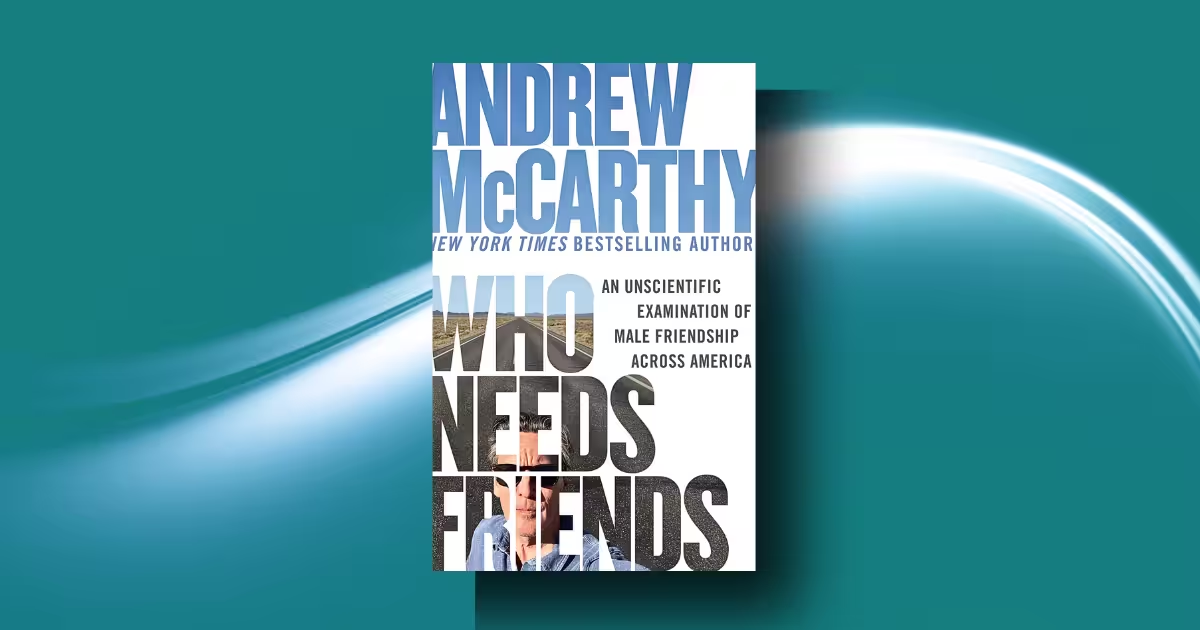
Ever wonder why you feel surrounded by people yet utterly alone? Or why your father seems content with zero close friends while you secretly ache for a deeper male connection? Andrew McCarthy’s latest book, “Who Needs Friends: An Unscientific Examination of Male Friendship Across America,” doesn’t just ask these uncomfortable questions—it forces you to sit with them until you find an answer.
Who Needs Friends is best for
- Men (and the women who love them) who have felt the quiet creep of isolation but couldn’t name it.
- Readers of memoirs like “Brat” or “Walking with Sam” who appreciate McCarthy’s introspective, literary style.
- Anyone curious about the real state of male loneliness in 2026 America—not abstract statistics, but flesh-and-blood stories.
- Men who suspect their friendships have atrophied but don’t know how to revive them.
Not for:
- Readers seeking a rigid, scientific study with controlled variables and peer-reviewed conclusions (the subtitle says “unscientific” for a reason).
- Those who prefer their nonfiction neatly packaged with clear takeaways and step-by-step solutions.
- Anyone uncomfortable with raw, unflinching depictions of vulnerability, shame, and emotional nakedness between men.
Table of Contents
1. Introduction
Title: Who Needs Friends: An Unscientific Examination of Male Friendship Across America
Author: Andrew McCarthy
Publisher: Grand Central Publishing (Hachette Book Group)
Publication Date: March 24, 2026
Pages: 320 (hardcover)
Andrew McCarthy is not the person you might expect to write a book about male friendship. The former Brat Pack heartthrob from “Pretty in Pink” and “St. Elmo’s Fire” spent decades dodging the spotlight, battling alcoholism, and cultivating a life of quiet solitude.
But in recent years, McCarthy has reinvented himself as a New York Times bestselling author, an award-winning travel writer, and a documentary filmmaker. His previous memoirs—Brat: An ’80s Story, The Longest Way Home, and Walking with Sam—have all explored themes of identity, fatherhood, and self-discovery.
“Who Needs Friends” sits at the intersection of travelogue, memoir, and social commentary. The book’s central argument is deceptively simple: American men are in the midst of a friendship crisis, and most of us don’t even realize how deeply we’re suffering.
McCarthy argues that the modern male’s retreat into solitude—fueled by work, family obligations, geographic mobility, and a toxic cultural script that equates vulnerability with weakness—has created an epidemic of loneliness that is literally killing men.
But rather than lecture from an armchair, McCarthy gets behind the wheel of a rental car and drives nearly 10,000 miles across 22 states to see for himself.
2. Background: The Silent Epidemic of Male Loneliness
Before diving into McCarthy’s journey, it’s worth understanding the statistical landscape that frames the entire book. The data is genuinely alarming.
In May 2023, U.S. Surgeon General Dr. Vivek Murthy issued an 82-page advisory declaring an “epidemic of loneliness and isolation” in America. The report found that about half of U.S. adults report experiencing measurable loneliness, and the health risks are staggering: chronic loneliness increases the risk of premature death by 26% to 32%—comparable to smoking 15 cigarettes a day.
The numbers for men are even worse. According to research cited by McCarthy, 15% of men confess to having no close friends at all, up from just 3% in 1990. The percentage of men with at least six close friends has been cut in half, dropping from 55% to just 27% over the same period.
Only one in five men report receiving any form of emotional support from a friend in a given week. And among men with only a high school diploma, nearly a quarter admit to having zero friends whatsoever.
The situation is particularly dire for younger generations. A 2020 study found that 79% of Gen Zers and 71% of millennials confess to being lonely. American men aged 15 to 34 are now the loneliest in the Western world.
Perhaps most haunting: men are four times more likely to die by suicide than women. As McCarthy writes after a late-night deep-dive into the research, “What the fuck” is the only appropriate response.
3. Who Needs Friends Summary
Part I: The Spark (New York City)
The book opens not on a highway but at a kitchen table in Manhattan. McCarthy’s 21-year-old son Sam, messing with his electric guitar, looks up and asks: “You don’t really have any friends, do you, Dad?” The question isn’t meant to wound—it’s an honest observation. And it lands like a gut punch.
McCarthy’s defensive response—“I have friends, Sam.
I just don’t see them, but I know they’re there. And that’s enough”—rings hollow even to his own ears. What follows is a painful inventory: Seve, a surrogate big brother he hasn’t seen in years; Matthew, a show business confidant who keeps canceling their plans; Eddie, his oldest friend and early role model, buried in work; John and Don, friends made later in life who now seem more like acquaintances.
The chapter establishes the book’s central tension: What happens to friendships when life gets in the way? And is it too late to reclaim them?
Part II: Seve (Baltimore, Maryland)
McCarthy’s first stop is Baltimore, where his old friend Seve (real name Stephen) lives in a waterfront condo. The visit is uncomfortable from the moment McCarthy arrives unannounced.
Seve is bent forward from the waist, barely able to walk, his apartment buried under an avalanche of Amazon boxes. McCarthy spends hours breaking down 36 boxes and filling 11 trash bags while Seve watches from the couch, ashamed and defensive.
“I can see why Seve didn’t want to let me in—and how Jeff Bezos became a billionaire. There are delivery boxes of all shapes and sizes. Everywhere. Piled high, tipped over, torn open, torn half open, empty, still sealed.”
But the real revelation comes later. Seve admits, “I feel like a failure,” and McCarthy, channeling Joseph Conrad, responds: “Nobody, nobody is good enough.” It’s a moment of genuine connection that neither man expected.
By the end of the chapter, McCarthy has learned a crucial lesson: showing up—even when it’s awkward, even when you’re not wanted—is the single most important ingredient in friendship.
Part III: Matthew (Lexington, Kentucky)
After a detour through West Virginia (where McCarthy encounters a surprising range of perspectives on male friendship), he arrives in Lexington to see Matthew. The two haven’t seen each other in 14 years.
The reunion is surprisingly easy—they fall back into old rhythms, quoting Springsteen’s “Glory Days,” turning their heads in unison at the same lyric, just as they did as young men in Los Angeles.
But there’s also painful news: Matthew had a heart attack 13 years ago, and McCarthy never knew. “How the fuck did I not know you had a heart attack?” he asks, shaking his head. The answer is obvious: they stopped paying attention to each other’s lives.
The chapter also introduces Aristotle’s taxonomy of friendship—utility-based, pleasure-based, and character-based (“perfect friends”)—which becomes a recurring framework throughout the book.
McCarthy and Matthew, it turns out, are the third kind: friends who see each other’s inherent good and take pleasure in that awareness. But even perfect friendships require maintenance.
Part IV: Eddie (Cleburne, Texas)
From Kentucky, McCarthy drives to Texas to see Eddie, his high school English teacher turned lifelong friend. Eddie is renovating old buildings and living a quiet life, but he’s also wrestling with big questions about aging, purpose, and legacy. The two spend a memorable evening gambling in Bossier City, Louisiana, where McCarthy finally asks Eddie what he thinks keeps their friendship alive.
“Probably our similarities,” Eddie says. “We have complex things in common. It’s almost genetic. We just have a brother thing. When you can communicate and not have to talk, that says something.”
The chapter also includes a detour to the Fort Worth Stock Show and Rodeo, where Eddie and McCarthy watch children riding sheep in an event called “mutton busting.” Eddie is horrified: “We ban Diary of Anne Frank in school, but we let five-year-old kids get their heads kicked in riding a sheep? What the fuck is happening to America?” It’s a rare moment of levity in a book that mostly takes itself seriously.
Part V: Don (Berkeley, California) and The Road Back
The final leg of McCarthy’s journey takes him to Oakland, California, to see Don—a travel writer friend he met through a publishing project. Their reunion is the most relaxed of the book, perhaps because Don is the most emotionally articulate of McCarthy’s friends. When McCarthy asks Don for one word to describe friendship, Don says “Understanding.” McCarthy says “Safety.”
The book closes where it began: at McCarthy’s kitchen table in Manhattan. His son Sam notices that McCarthy has been talking differently with his friends lately. “It’s really nice,” Sam says.
And when his daughter Willow asks if McCarthy actually believes the Vietnamese currency scheme (a running joke with Matthew) will pay off, he shrugs: “Do you know how many laughs we’ve gotten out of those dong over the past six months? Worth every penny.”
4. Who Needs Friends Critical Analysis
“Who Needs Friends” is a poignant, life-affirming, and quietly devastating book. It is not a self-help manual, nor does it pretend to be.
There are no checklists, no “five steps to better friendships,” no actionable takeaways. What it offers instead is something rarer and perhaps more valuable: permission to feel lonely, permission to admit that you need other people, and permission to do something about it—even if that something is as simple as getting in the car.
The book’s greatest strength is McCarthy’s voice. He writes with the self-deprecating humor of someone who has spent decades in therapy, the observational precision of a travel writer, and the emotional honesty of a recovering alcoholic who has learned that secrets make us sick.
When he describes his own failures—the friendships he neglected, the calls he didn’t return, the vulnerability he couldn’t express—he never wallows in self-pity. Instead, he treats his shortcomings as data points, useful information for the journey ahead.
The book also benefits from McCarthy’s willingness to let other men speak.
The “unscientific” approach—stopping at diners, gas stations, and bars to ask strangers about their friendships—yields a rich tapestry of voices: Lew and Bobby, two retired cops in Ohio who have been best friends for 60 years; Chris and Ryan, two recovering addicts in Austin who saved each other’s lives; Will, a Navajo guide in Monument Valley who claims to have 30 close friends; Aaron, a former roughneck in Marfa, Texas, who says he has only three “get in the truck” friends but would trust them with his life.
If the book has a weakness, it’s that McCarthy sometimes pulls his punches.
He acknowledges the dark side of male isolation—the link between loneliness and suicide, the way that isolated men can become radicalized, the tragedy of Uvalde—but he doesn’t linger there. The book’s tone remains hopeful, even optimistic, which may frustrate readers looking for a more forensic examination of the problem.
Additionally, McCarthy’s own privilege occasionally goes unexamined. He is a wealthy, famous, white man who can afford to drop everything and drive across the country for six weeks.
His ability to reconnect with friends is not replicable for most readers. To his credit, McCarthy never pretends otherwise—but a more thorough exploration of class and economic barriers to friendship would have strengthened the book.
Overall, “Who Needs Friends” is an important, timely, and deeply human contribution to the growing literature on male loneliness.
It joins works like Jordan Ritter Conn’s “American Men” (published simultaneously) and Richard Reeves’s “Of Boys and Men” in sounding an alarm about the state of American masculinity—but McCarthy’s approach is uniquely personal, and all the more powerful for it.
5. Strengths and Weaknesses
Strengths
- Emotional honesty. McCarthy is willing to admit his own failures as a friend, a father, and a human being. This vulnerability disarms the reader and creates space for genuine reflection.
- Rich, memorable characters. The men McCarthy meets along the way—from the bored teenager in Lake Tahoe to the retired cops in Ohio to the recovering addicts in Austin—are rendered with empathy and specificity. You will remember them long after you close the book.
- Prose that sings. McCarthy is a travel writer by trade, and it shows. His descriptions of the American landscape—the haunted motels, the empty highways, the majestic deserts—are gorgeous without being precious.
- Timely and urgent. The book arrives at a moment when the “male loneliness epidemic” is finally getting the attention it deserves. McCarthy’s unscientific approach feels perfectly suited to a problem that defies easy quantification.
Weaknesses
- Lack of structural analysis. McCarthy identifies the problem but offers few solutions. Readers looking for practical advice on how to make friends as an adult will be disappointed.
- Unacknowledged privilege. McCarthy’s ability to drop everything and drive across the country is a luxury most readers don’t have. Acknowledging this more explicitly would have strengthened the book.
- Occasional sentimentality. Some of the encounters feel too neat, too perfectly tailored to the book’s themes. It’s hard to know whether McCarthy is selecting his conversations or simply getting lucky—but the effect can feel manufactured.
6. Comparison with Similar Works
“Who Needs Friends” sits in a growing subgenre of books about male loneliness and friendship.
- American Men by Jordan Ritter Conn (2026): Published the same month as McCarthy’s book, Conn’s work takes a more journalistic approach, profiling four men across America and examining their struggles with intimacy, sexuality, and identity. Where Conn is analytical, McCarthy is personal. Both are valuable.
- Of Boys and Men by Richard Reeves (2022): Reeves, a Brookings Institution scholar, focuses on the systemic failures—educational, economic, social—that have left men behind. McCarthy’s book is the emotional complement to Reeves’s policy-focused analysis.
- The Longest Way Home by Andrew McCarthy (2018): McCarthy’s earlier travel memoir about his journey to emotional maturity is a clear precursor to “Who Needs Friends.” The new book is more focused, more urgent, and ultimately more successful.
- Bowling Alone by Robert Putnam (2000): The classic text on the decline of American social capital. McCarthy is essentially writing the 2026 update, with a specific focus on men.
7. Conclusion: Should You Read This Book?
If you are a man—any man—who has ever felt the quiet ache of loneliness, who has wondered why your friendships feel shallower than you’d like, who has struggled to say “I love you” to another man without feeling embarrassed, then yes, you should read this book. It will not give you a step-by-step plan, but it will give you something arguably more important: permission to care.
If you love a man—a father, a husband, a brother, a son—who seems to be retreating into himself, this book will help you understand what he’s going through and why he can’t (or won’t) ask for help.
“Who Needs Friends” is not a perfect book, but it is a necessary one. McCarthy ends his journey not with a triumphant reunion but with a quiet acknowledgment that the work of friendship never ends. “Nobody, nobody is good enough,” he quotes Conrad. But with friends, we are capable of being much, much more.







