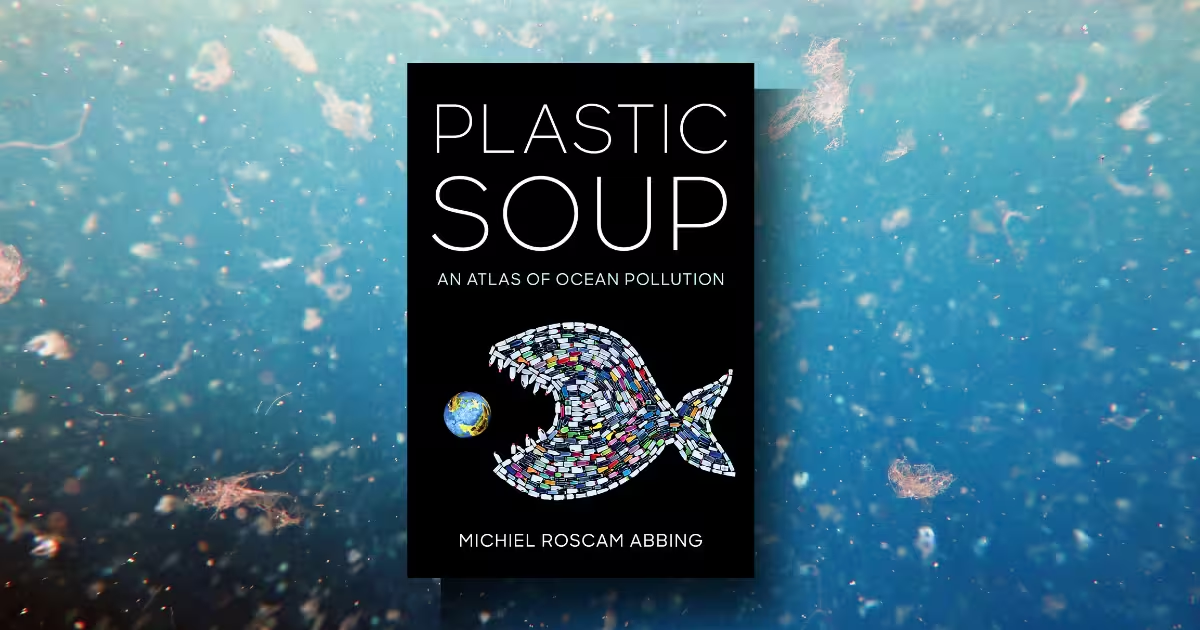

Does the plastic you throw away today end up inside the fish you eat tomorrow? I asked myself that question after finishing Michiel Roscam Abbing’s Plastic Soup: An Atlas of Ocean Pollution, and the answer, as it turns out, is both terrifying and complicated. This 124-page investigation, published by Island Press in 2019, completely reshaped how I see the world around me.
Now, every plastic wrapper, every synthetic shirt, every bottle I see feels different. And honestly? I think you need that shift in perspective too.
Table of Contents
Overview
Plastic Soup is exactly what its subtitle promises: an atlas. But this isn’t a collection of dry maps, it’s a visual and narrative journey through the global plastic crisis, backed by hard data, stunning (and often heartbreaking) photography, and a surprisingly hopeful look at what we can actually do about it.
The book is divided into two parts: the first lays out the scale of the problem, from how plastic became the miracle material of the 20th century to how it’s now breaking down into invisible particles that are entering the food chain.
The second half focuses on solutions, everything from plastic-free supermarkets to international treaties, from laser-marked fruit to the infamous Ocean Cleanup project.
Michiel Roscam Abbing is a political scientist who has been working with the Plastic Soup Foundation in Amsterdam since 2011.
He’s not a marine biologist or a chemist, and that’s actually part of what makes this book work. He approaches plastic pollution as a systemic failure, not just an environmental one. His background gives the book a sharp, policy-oriented edge that many purely scientific accounts lack.
Who Will Actually Love Plastic Soup
Let me be upfront: this isn’t for everyone. If you’re already deep in the environmental space and know your microplastics from your nanoplastics, you might find some of the material familiar. But if you’re someone who:
- Has ever wondered where your recycling actually goes
- Feels guilty about single-use plastic but doesn’t fully understand why
- Wants concrete, actionable information rather than just doom-and-gloom
- Teaches or works with young people and needs accessible, visual resources
- Is looking for that one book to hand to a skeptical friend or family member
…then this book is for you. The Seattle Book Review put it well: it “should be part of every school curriculum.” I’d add that it should be in every household that uses plastic, which is to say, every household on Earth.
Plastic Soup Summary
Part One: The Scale of the Disaster
Plastic Fantastic: The book opens with the uncomfortable truth that plastic became dominant for good reasons. Abbing points out that “at first glance, plastics seemingly have environmental benefits when compared with other materials”, they’re lighter than paper, require less energy to transport, and help reduce food waste.
But that calculation leaves out one massive factor: what happens when plastic enters the environment. Paper breaks down. Plastic does not. The book notes that “all the plastic that has ever ended up in the environment is still present in some form or other.”
The numbers here are staggering. The average American produces about 85 kilograms (roughly 185 pounds) of plastic waste each year. A plastic bag is used for just twelve minutes on average. And yet, “if global plastic production continues to grow at the current rate, the world will have produced 34 billion tons by 2050.”
Floating Plastic: This chapter demolishes the myth of floating garbage islands. Yes, there are five major ocean gyres where plastic accumulates, but “even in the centers of the gyres, you see surprisingly little floating plastic.”
Most plastic either sinks, gets suspended in the water column, or breaks down into pieces too small to see. The famous image of a sea of floating bottles is more metaphor than reality.
But that doesn’t make it less dangerous. On Midway Atoll, albatross chicks are dying with stomachs full of plastic, sometimes hundreds of pieces in a single bird. Photographer Chris Jordan’s images of these dead chicks, which Abbing includes in the book, are the kind of thing you can’t unsee.
From Soup to Broth: This is where things get really unsettling. The book explains that plastic doesn’t biodegrade, it fragments. And it keeps fragmenting. What starts as a bottle becomes microplastics (invisible to the naked eye) and then nanoplastics (so small they can enter cells).
The book cites a 2010 estimate that 192 coastal countries were responsible for about eight million tons of plastic entering the ocean that year alone, about a truckload every minute.
By 2050, if nothing changes, that will be four truckloads per minute, and “by weight, the seas will contain more plastic than fish.”
The chapter also covers microfibers from washing machines. Here’s a number that blew my mind: a single wash of synthetic clothing (about five kilograms) can release between 600,000 and 17.7 million fibers. And wastewater treatment plants aren’t designed to catch them. So every time you wash a fleece jacket, you’re sending thousands of plastic fibers straight into the water system.
RIP: Rest in Plastic: This chapter documents the toll on wildlife. Over 1,200 animal species are now known to be affected by plastic in some way. One-third of those, largely seabirds and fish, end up with plastic inside their bodies. In one study, oysters exposed to microplastics produced 41 percent fewer larvae.
A sperm whale found dead in Spain had 26 large plastic items and 30 square meters of plastic sheeting in its stomach.
The chapter also tackles toxins. Plastics contain additives like BPA, phthalates, and flame retardants, chemicals that leach out over time. Meanwhile, floating plastics absorb persistent organic pollutants from the surrounding water, concentrating them at levels “between ten thousand and one million times greater than the surrounding water.”
These toxins then work their way up the food chain.
A Planet Full of Plastic: This chapter introduced me to a term I’d never heard before: plastiglomerate. Geologists discovered this new type of rock at Kamilo Beach in Hawaii, a fusion of melted plastic, coral, sand, and lava that basically lasts forever.
Abbing notes that plastic is now a defining characteristic of the geological strata currently forming. Future geologists will date our era by the plastic in the rocks.
The chapter also covers the plastisphere, the ecosystem of microbes that now lives on every piece of floating plastic. Some of these microbes include Vibrio species, some of which can cause disease. And it covers how microplastics are falling from the sky: a study in Paris found between 3 and 10 tons of synthetic fibers precipitating out of the air each year.
Part Two: What We Can Actually Do About It
Art – This chapter showcases how artists are using plastic waste to create powerful, thought-provoking work. From Steve McPherson’s beach-found plastic mosaics to Peter Smith’s floating globe made from 6,000 PET bottles, the message is clear: this material isn’t going away, and we need to confront that fact.
Between Belief and Hope: This is the chapter that tests your optimism. Abbing covers major proposed solutions, and doesn’t pull punches.
The Ocean Cleanup, Boyan Slat’s ambitious project to remove plastic from the gyres, gets a balanced treatment. Oceanographers have been skeptical, and Abbing acknowledges the technical challenges: floating plastic is only a small fraction of the total, and the rest has sunk or is suspended deeper in the water.
But Slat’s iterative approach has led to improvements, and in May 2017 he claimed he could clean up half the plastic soup in five years.
Recycling gets similarly honest treatment. The book notes that only 9 percent of all plastic discarded since 1950 has been recycled. The rest has been landfilled, incinerated, or ended up in the environment. Even when plastic is collected, it’s often downcycled into inferior products that will eventually be discarded anyway.
Bioplastics are presented as a partial solution, but not a magic bullet. Abbing is careful to distinguish between plant-based plastics that behave like conventional plastic and genuinely biodegradable plastics. He warns that “oxo-degradable” plastics, which break down into invisible particles, are actually worse for the environment, they’re still there, just smaller.
Inspirational Initiatives – This is where the book gets practical. Abbing profiles a range of projects that are actually making a difference:
- Beat the Microbead: A campaign that started in the Netherlands in 2012 to pressure cosmetics companies to stop using plastic microbeads. It worked, Unilever announced it would voluntarily remove microbeads from its products by the end of 2012, and the U.S. passed a federal ban in 2015. But the campaign continues, because microplastics are still used in lipstick, mascara, deodorant, and many other products.
- Fishing for Litter: A program in Northern Europe where fishermen separate the waste they catch in their nets and bring it to port for disposal. About 75 vessels in the Netherlands participate without compensation.
- Plastic-Free July: What started as a personal challenge for one Australian woman in 2011 has grown to over 2 million participants in 159 countries.
- Plastic-free supermarkets: The first packaging-free shop opened in Berlin in 2014. Since then, similar stores have appeared worldwide, and in 2017 the Dutch chain Ekoplaza replaced three-quarters of its own-brand plastic packaging with degradable or non-plastic alternatives.
- Ocean Clean Wash: A cooperative venture launched by the Plastic Soup Foundation in 2016 to tackle microfibers from washing machines. Brands like G-Star Raw are involved, and products like the Guppy Friend (a washing bag that catches fibers) and Cora Ball are now available to consumers.
No Time to Lose: This chapter focuses on the “low-hanging fruit”, the easy wins that could make a big difference. Abbing points out that 500 million plastic straws are used every day in the United States alone. In 2018, Seattle became the first U.S. city to ban them.
In South Korea, polystyrene buoys used in aquaculture crumble into millions of particles each, and could easily be replaced with more durable materials.
The chapter also covers plastic bags. An estimated 1 million plastic bags are used every minute worldwide. Countries that have banned them or charged for them have seen immediate reductions.
Bangladesh became the first country to ban thin plastic bags in 2002, largely because they were blocking drainage systems and causing floods. Kenya banned bags in 2017 after earlier attempts had limited success.
Deposits are another proven solution. In countries with deposit systems, more than 90 percent of bottles and cans are returned. But soft-drink giants like Coca-Cola have historically fought deposits with everything they’ve got, in Germany, the industry filed more than 7,000 lawsuits to try to sabotage a working deposit system.
Turning the Tide – The final chapter lays out a framework for action. Abbing introduces the “three Rs” (Reduce, Reuse, Recycle) and adds several more: Reject, Redesign, Repair, Replace, Recover, and Restore. He emphasizes the key principles that should guide policy: the precautionary principle (don’t wait for scientific certainty to act), the polluter pays principle, and the source principle (tackle pollution at its origin).
The book ends with a call for an international treaty specifically targeting plastic soup. Abbing notes that existing treaties, like MARPOL for ships’ waste, fall short because they don’t address plastic from land-based sources. In December 2017, the United Nations Environment Assembly agreed to establish a working group to identify legally binding options for combating plastic soup. A new treaty, Abbing argues, would provide worldwide recognition of the problem and force countries to take meaningful action.
My Take: What This Book Gets Right
This book is, without exaggeration, one of the most important environmental books I’ve read in years. And I say that as someone who’s read a lot of them.
What makes Plastic Soup stand out is its balance. It doesn’t sugarcoat the problem, but it also doesn’t leave you feeling hopeless. The Electronic Green Journal called it “an empowering educational tool with maps and figures plus many feasible solutions for all issues related to pollution and waste.” I agree completely.
Abbing lays out the science, shows you the evidence, and then gives you concrete things you can do, both as an individual and as a citizen pushing for systemic change.
The photography deserves special mention. This isn’t a text-heavy academic book; it’s a visual experience. The images of albatross chicks on Midway, of beaches buried in plastic, of microplastics under microscopes, they hit hard.
The Canadian Field Naturalist noted that “heart-wrenching images bring home very effectively the message of the damage plastic has done to our planet and wildlife.” I couldn’t agree more.
What Could Have Been Better
I have two criticisms, though they’re minor.
First, the book is short, 124 pages. That’s a strength in terms of accessibility, but it also means some topics get only a surface treatment.
I wanted more detail on nanoplastics, for example, which Abbing identifies as potentially the most dangerous component of plastic soup but which gets relatively little space. Given that nanoplastics are “so tiny that they can permeate anywhere in the body: into tissues, organs, the brain, and individual cells,” I would have liked a deeper dive.
Second, the book was originally published in Dutch in 2018. While Abbing and the translators have done a good job updating it for the English edition, some of the data and examples are already starting to show their age.
The microbead ban in the U.S. is covered, but the book doesn’t fully anticipate the wave of plastic bag bans and straw bans that have swept through cities and countries since 2019.
That’s not Abbing’s fault, the science and policy landscape is moving fast, but it’s worth noting.
How It Compares to Other Books
If you’ve read The Story of Stuff by Annie Leonard or Plastic: A Toxic Love Story by Susan Freinkel, you’ll find familiar territory here. But Plastic Soup is different in two key ways.
First, it’s more visual. Where Leonard and Freinkel rely primarily on text, Abbing uses infographics, maps, and photographs to make his points. The Otago Daily Times called it “essential reading” and noted that it’s a “124-page investigation into how plastic has damaged our environment.” The visual approach makes it more accessible and more memorable.
Second, it’s more solution-focused. Abbing devotes roughly half the book to what’s being done and what could be done. The UCLA Electronic Green Journal noted that the book has “an optimistic balance since it allows more room for real solutions than pages about a somber diagnostic that we already know.”
That’s a refreshing change from many environmental books that leave you feeling paralyzed.
In terms of depth, Plastic Soup is lighter than Junk Raft by Marcus Eriksen (the co-founder of 5 Gyres), which goes deeper into the science of ocean plastics. But Plastic Soup is broader in scope, covering everything from cosmetics to clothing to construction materials. It’s a better entry point for someone who’s new to the topic.
Final Verdict
If you care about the environment, if you use plastic (which you do), if you eat seafood, if you wear synthetic clothing, if you have children or grandchildren who will inherit this mess, read this book.
The Midwest Book Review called it “a seminal and ground-breaking work that will hold intense interest for environmentalists and unreservedly recommended.” I can’t say it better than that.
Plastic Soup is the kind of book that changes how you see the world. I can’t walk past a plastic bottle on the sidewalk without thinking about where it might end up.
I can’t wash my fleece jacket without wondering how many fibers are going down the drain. I can’t buy a piece of fruit wrapped in plastic without asking myself if I really need it.
That’s the power of this book. It doesn’t just inform you, it transforms you.
So pick it up. Read it. And then do something about it.