


Most books entertain you for a few hours and then sit on a shelf. A rare few change the direction of human history: they start wars, end them, build economies, or rewrite what an entire nation believes about itself. This is a list of ten books that changed the world in ways you can actually measure, in laws passed, in movements launched, in millions of lives touched.
These ten books changed the world by reshaping religion, politics, science, and human rights: the Bible, The Communist Manifesto, On the Origin of Species, Uncle Tom’s Cabin, Silent Spring, 1984, The Wealth of Nations, The Rights of Man, The Diary of a Young Girl, and Common Sense. Each entry below covers what the book actually says and why it mattered, so you get the full picture without needing to track down a copy.
When people say a book “changed the world,” it is usually a compliment thrown around loosely. The ten books on this list earned the phrase the hard way. They toppled governments, reshaped economies, sparked revolutions, and forced entire societies to look at themselves differently. Some did it through careful science.
Others did it through a pamphlet that fit in a coat pocket. All of them prove that ideas printed on paper can outlast empires.
Table of Contents
What makes this list different from the usual “greatest books” roundup is the standard for inclusion. A novel can be beautifully written and still have zero measurable effect on politics, law, or public behavior.
Every entry here cleared a higher bar: a law that changed because of it, a government that fell or rose partly because of it, a movement that traces its origin story back to its pages, or a body count and sales figure large enough to leave a permanent mark on the historical record.
Where the numbers are disputed, that gets flagged rather than smoothed over, because a claim only holds up if it can survive scrutiny.
1. The Bible
The Foundation of Western Civilization
What it’s about: The Bible is not one book but a library of 66 books written over roughly 1,500 years by around 40 authors, in Hebrew, Aramaic, and Greek. It opens with an account of creation, moves through the history of ancient Israel, and closes with the life of Jesus and the letters of the early Christian church.

Along the way it delivers law codes, poetry, prophecy, and moral teaching that would shape entire legal and ethical systems.
How it impacted: According to Guinness World Records, the Bible is the best-selling book of all time, with an estimated 5 to 7 billion copies printed and distributed.
The complete text now exists in more than 700 languages, with some portion available in thousands more, giving most of the world’s population access to it in a language they speak. Western law, art, literature, and political thought all carry its fingerprints, from the wording of national constitutions to the moral vocabulary used in courtrooms today.
Few books that changed the world did so as slowly, or as permanently.
2. The Communist Manifesto by Karl Marx and Friedrich Engels
The Book that Reshaped the Global Politics
What it’s about: Karl Marx and Friedrich Engels wrote this short pamphlet for the Communist League, and it went to print in London, in German, in late February 1848.
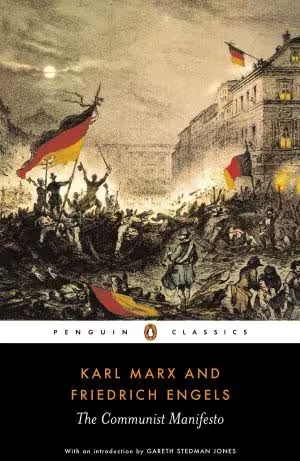
It argues that “the history of all hitherto existing society is the history of class struggles” and predicts that industrial workers, the proletariat, will eventually overthrow the property-owning class, the bourgeoisie. It closes with the famous call: “Workers of the world, unite!”
How it impacted: The pamphlet made almost no impact when it first appeared. Over the following century, that changed dramatically. By 1950, close to half the world’s population lived under governments that claimed Marxism as their guiding philosophy.
Whatever your politics, it is hard to name another document under 50 pages that reshaped the map of the twentieth century so directly. This is one of those books that changed the world without its authors living to see how far the fallout would travel.
3. On the Origin of Species by Charles Darwin
The Ulimate Evolution’s Game Changer
What it’s about: Charles Darwin spent over two decades gathering evidence before publishing this book on November 24, 1859. He laid out the theory of evolution by natural selection: organisms with traits suited to their environment survive and reproduce more successfully, and over long stretches of time this reshapes entire species.

Darwin built his case using specimens and observations collected during his years aboard HMS Beagle.
How it impacted: The first print run of 1,250 copies sold out on the day it went on sale.
The book did not just add a new idea to biology, it rewired how people understood humanity’s place in nature and sparked a fight with religious orthodoxy that has never fully ended.
It has since been translated into dozens of languages and remains one of the most cited scientific works in history, a reminder that books that changed the world sometimes do it with data instead of drama.
4. Uncle Tom’s Cabin by Harriet Beecher Stowe
Literature That Sparked a War
What it’s about: Harriet Beecher Stowe published this novel on March 20, 1852. It follows Tom, an enslaved man sold away from his family and passed between owners, ending with the cruel Simon Legree.

Stowe wrote the book to put a human face on the daily reality of slavery for Northern readers who had never seen it firsthand.
How it impacted: The novel sold around 300,000 copies in the United States in its first year and roughly a million more in Britain, making it the best-selling novel of the 19th century, behind only the Bible.
It hardened Northern opposition to slavery and the Fugitive Slave Act, and historians credit it with helping build momentum toward the Civil War.
The famous story that Lincoln greeted Stowe by calling her “the little lady who started this great war” is worth knowing, but historians consider it likely apocryphal, since it never appeared in print until decades later and Stowe’s own letters from that meeting make no mention of it.
Even without that quote, this remains one of the books that changed the world by making an abstract injustice personal.
5. Silent Spring by Rachel Carson
The Birth of Environmentalism
What it’s about: Rachel Carson, a marine biologist, published Silent Spring on September 27, 1962.
The book opens with a fictional American town where pesticide use has silenced the birds, then spends the rest of its pages laying out the scientific case against the indiscriminate use of DDT and other chemical pesticides, arguing they poison far more than their intended targets.
How it impacted: Carson faced a fierce, well-funded pushback from the chemical industry, but her research held up.
Within a decade, the United States banned DDT for agricultural use in 1972, and the book’s influence helped drive the creation of the Environmental Protection Agency in December 1970.
Modern environmentalism, in large part, traces its roots back to this one book, one of the clearest cases of books that changed the world by changing federal law.
6. 1984 by George Orwell
Dystopia That Defined Modern Surveillance
What it’s about: George Orwell published Nineteen Eighty-Four on June 8, 1949, just months before his death.

Set in a totalitarian superstate called Oceania, the novel follows Winston Smith, a low-level government worker who secretly rebels against a regime that rewrites history, monitors citizens through telescreens, and punishes independent thought itself.
Orwell modeled Oceania’s government on Stalinist Russia and Nazi Germany.
How it impacted: The novel gave the world a vocabulary it still uses. “Big Brother,” “doublethink,” “thoughtcrime,” “Newspeak,” and the adjective “Orwellian” all trace back to this book, and they get pulled out every time a government or company is accused of overreach.
By the symbolic year 1984, Nineteen Eighty-Four and Orwell’s earlier Animal Farm had together sold roughly 20 million copies. It remains one of the most quoted books that changed the world every time a new surveillance scandal breaks.
7. The Wealth of Nations by Adam Smith
The Capitalism’s Blueprint
What it’s about: Adam Smith published this economic treatise on March 9, 1776, the same year the American colonies declared independence.
Smith argued against the mercantilist thinking of his day and made the case that free trade, division of labor, and individuals pursuing their own self-interest, guided by what he called an “invisible hand,” would produce more prosperity than tight government control of commerce.
How it impacted: The first edition sold out within six months, and the book has never gone out of print since. It became the founding text of classical economics and supplied the intellectual backbone for modern free-market capitalism.
Governments and economists still argue over Smith’s ideas today, which is itself a sign of how far this one book’s reach extends. Few books that changed the world are still assigned reading in economics departments 250 years later.
8. The Rights of Man by Thomas Paine
Democracy’s true Defense
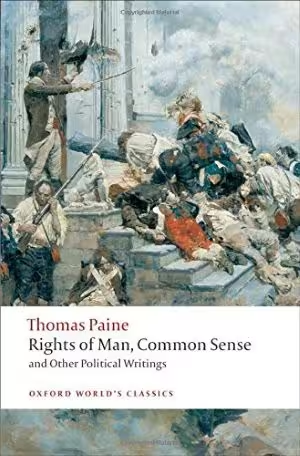
What it’s about: Thomas Paine published Rights of Man in March 1791 as a direct rebuttal to Edmund Burke, who had attacked the French Revolution in his own book the year before.
Paine argued that political rights belong to people by nature, not because a government hands them out, and that hereditary rule has no real claim to wisdom or legitimacy.
How it impacted: The book sold close to a million copies in Britain, an enormous number for the era, and it got Paine tried in absentia and convicted of seditious libel by the British government.
It helped seed reform movements across Britain and inspired activists on both sides of the Atlantic, feeding directly into the era’s push toward representative democracy. Paine wrote two of the books that changed the world on this list, and neither one made him rich.
9. The Diary of a Young Girl by Anne Frank
Thr Face of Humanity Amid Horror
What it’s about: Anne Frank kept this diary while hiding with her family in an Amsterdam annex during the Nazi occupation of the Netherlands, from June 1942 to August 1944.

Her father, Otto Frank, the only member of the family to survive the war, published it in Dutch as Het Achterhuis on June 25, 1947. The diary captures a teenage girl’s daily fears, hopes, arguments, and dreams while the Holocaust closed in around her.
How it impacted: The diary has since been translated into more than 70 languages and has sold more than 30 million copies. It became one of the most personal and widely read accounts of the Holocaust ever published, turning an abstract historical tragedy into the voice of one specific, relatable teenager.
Of all the books that changed the world on this list, this is the one written by someone who never got to see what her words would do.
10. Common Sense by Thomas Paine
The Pamphlet That Sparked Revolution
What it’s about: Thomas Paine published this 47-page pamphlet anonymously in Philadelphia on January 10, 1776. It made a plain-spoken case for full independence from Britain at a time when most colonists still hoped for reconciliation with the Crown.

Paine rejected monarchy outright and argued that the American cause was, in his words, “in a great measure, the cause of all mankind.”
How it impacted: Paine’s own estimate put early sales at 120,000 copies in the first three months, and later biographers claimed the total reached as high as 500,000 by the end of the war, though modern historians dispute how reliable that higher figure really is, given how loosely records were kept at the time.
Whatever the exact number, the pamphlet shifted public opinion fast enough that the Declaration of Independence followed just six months later. Of all the books that changed the world, this one did it in the fewest pages.
Final Thoughts
Every book on this list did the same basic thing: it took an idea that felt dangerous or impossible at the time and put it in front of enough people that the idea became unstoppable.
That is the common thread running through these books that changed the world, from a 47-page pamphlet written in a few weeks to a scripture assembled over 15 centuries.
None of them changed anything by sitting quietly on a shelf. They changed the world because people actually read them, argued about them, and acted on what they read.
FAQs
1. What is the best-selling book that changed the world?
The Bible holds that title by a wide margin. Guinness World Records estimates between 5 and 7 billion copies distributed since printing began, a figure no other book on this list comes close to, though The Diary of a Young Girl and Uncle Tom’s Cabin each reached tens of millions of readers in their own right.
2. Did a single book actually start a war?
Not on its own. Uncle Tom’s Cabin came closer than almost any other book in history, but historians are careful to point out that it did not cause the American Civil War by itself. What it did was harden Northern public opinion against slavery at a critical moment, adding real political pressure to a conflict that was already building.
3. Which book changed the world the fastest?
Common Sense. Thomas Paine’s pamphlet went from anonymous publication in January 1776 to helping shape the Declaration of Independence just six months later, an unusually short gap between a piece of writing and a nation founding itself partly in response to it.
4. Are these books still relevant today?
Yes, in different ways. 1984 gets quoted every time a surveillance story breaks. Silent Spring is still cited in environmental policy debates. The Wealth of Nations still shows up in economics syllabi, and the sales figures around Common Sense and Rights of Man are still argued over by historians. These are not museum pieces. They are still doing work in the present.


