
Does the spark in your marriage seem to flicker out despite your best efforts, or do you feel like you and your partner are speaking two completely different languages?
As someone who has navigated the highs and lows of long-term partnership, I can tell you that the frustration of “trying” without “connecting” is a unique kind of exhaustion.
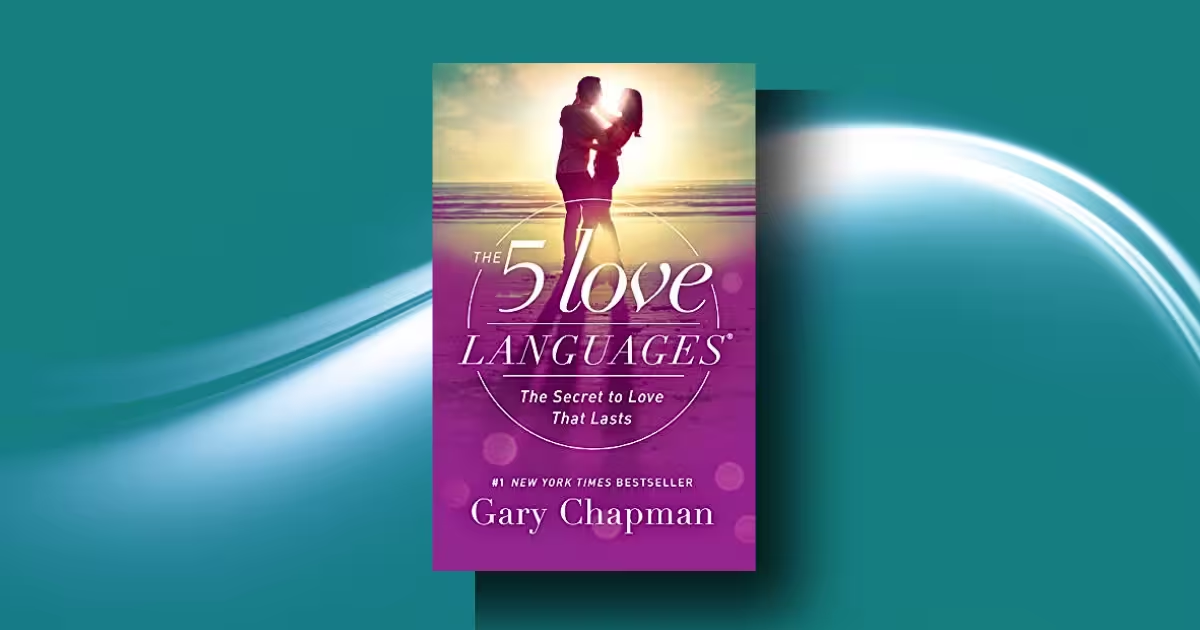
We often pour our energy into the wrong buckets, wondering why the other person doesn’t feel the weight of our effort. This book, The 5 Love Languages by Gary Chapman, is the blueprint I wish I had on day one. It’s not just a manual; it’s a decoder ring for the human heart.
Table of Contents
1. Introduction
The seminal work, The 5 Love Languages: The Secret to Love That Lasts, is authored by Dr. Gary Chapman, a man whose name has become synonymous with relationship longevity. Originally published in 1992, this New York Times bestseller has transcended its origins as a marriage counseling tool to become a global cultural phenomenon.
Categorized primarily as a relationship and self-help guide, the book is built on the bedrock of Dr. Chapman’s thirty-plus years of marriage counseling experience. Chapman isn’t just an academic; he is a practitioner who has sat in the “inner chamber” of thousands of marriages, from Seattle to Miami, listening to the secret pains of couples whose dreams of “living happily ever after” were dashed against reality.
The central thesis is deceptively simple: people speak different emotional love languages.
Much like a person who speaks only English cannot communicate with one who speaks only Chinese, a husband who expresses love through “Acts of Service” will never reach a wife whose primary language is “Words of Affirmation” unless he learns to “speak” her language.
The book aims to provide the key to a long-lasting, emotionally rich marriage by teaching readers how to identify and speak their spouse’s primary love language.
The 5 Love Languages is best for couples who feel “stuck” or unheard, newlyweds wanting a head start, and anyone seeking to improve their emotional intelligence in relationships.
Not for those looking for a quick “hack” without the willingness to put in the work, or individuals in abusive situations where “speaking a language” cannot replace the need for professional intervention or safety.
2. The 5 Love Languages Summary
To understand Chapman’s philosophy is to understand that the “love tank” is as essential to a marriage as oil is to an automobile. If you run your relationship on empty, the engine will eventually seize.
Here is the breakdown of what I learned from this transformative text, so you can apply it immediately.
The Concept of the “Emotional Love Tank”
Chapman adopts a metaphor from psychiatrist Dr. Ross Campbell: every person has an invisible “emotional love tank”. When this tank is full, the world looks bright and we reach our highest potential.
When it is empty, we feel used, unloved, and the world turns dark. Much of the misbehavior in both children and adults is actually a desperate “craving” of an empty tank.
Language #1: Words of Affirmation
For some, “the way to express love emotionally is to use words that build up”. This includes:
Compliments: “I can live for two months on a good compliment,” Mark Twain famously said. Simple statements like “You look sharp in that suit” or “I really appreciate how you handled that” go a long way.
Encouraging Words: This involves “inspiring courage,” not pressuring your spouse to do what you want, but encouraging them in their own interests.
Humble Requests: Love makes requests, not demands. “We cannot get emotional love by way of demand… it is an act of fear or guilt, but not love”.
Language #2: Quality Time
This is not just sitting on the couch together watching Netflix. It is “giving someone your undivided attention”.
Quality Conversation: This means “sympathetic dialogue where two individuals are sharing their experiences, thoughts, feelings, and desires in a friendly, uninterrupted context”.
Quality Activities: Doing things together that one or both of you enjoy. The point isn’t the activity itself, but the fact that you are spending time together.
Language #3: Receiving Gifts
To some, a gift is a visual symbol of love. It says, “He was thinking of me” or “She remembered me”.
Cost is Irrelevant: “Gifts need not be expensive… they may be purchased, found, or made”.
The Gift of Self: Being there when your spouse needs you—the physical presence in a time of crisis—is the greatest gift you can give if this is their language.
Language #4: Acts of Service
This means “doing things you know your spouse would like you to do”. This could be cooking a meal, washing the car, or “getting the hairs out of the sink”.
Breaking Stereotypes: It often requires overcoming traditional gender roles to serve each other effectively.
Love as a Choice: Doing these things should be an expression of love, not a response to “nagging,” which is often a “tag” indicating what the spouse needs most.
Language #5: Physical Touch
“Babies who are held, hugged, and kissed develop a healthier emotional life than those who are left for long periods of time without physical contact”. In marriage:
Explicit Touch: Sexual intercourse, hugging, and kissing.
Implicit Touch: A hand on the shoulder as you walk by or holding hands while walking.
Crisis Presence: In a time of crisis, “we hug each other almost instinctively… because physical touch is a powerful communicator of love”.
The Vital Distinction: “In Love” vs. True Love
Chapman explains that the “falling in love” experience is an instinctual, euphoric obsession that usually lasts no more than two years. After this high, we return to the real world where differences become divisive.
True, long-lasting emotional love, however, “is a choice”. It is a “pro-active” effort to meet a partner’s needs regardless of how we “feel” at the moment.
3. The 5 Love Languages Analysis
Evaluation of Content
The 5 Love Languages is an outstanding and ground-breaking piece of relationship literature that manages to be both profoundly simple and practically revolutionary.
Chapman effectively supports his arguments with anecdotal evidence from decades of counseling. While the book doesn’t rely on “psychological research jargon” that many find incomprehensible, it aligns with basic human needs for intimacy and security.
The author fulfills his purpose by offering a clear, actionable solution to the “evaporating love” phenomenon that plagues modern marriages.
However, some critics—myself included—might note that the book’s theological roots (frequently citing Scripture and Christian perspectives) might feel exclusive to some secular readers, though the core psychological principles are universal.
According to the BBC and other cultural critics, the book’s enduring popularity—over 20 million copies sold—is a testament to its effectiveness in “naming” a phenomenon that many feel but cannot articulate.
4. Strengths and Weaknesses
Strengths
Practicality: The inclusion of “Profiles” for husbands and wives allows readers to move from theory to application instantly.
The “Nagging as a Clue” Insight: Chapman’s suggestion that “what your spouse nags about is likely their primary love language” is a brilliant reframe of a common relationship friction point.
Accessibility: The writing is human, relatable, and free of clinical coldness.
Weaknesses
Oversimplification: While the five categories are helpful, human psychology is often more complex than five buckets. Some people may be “bilingual” or find their needs shift significantly over time.
Gender Roles: Some of the earlier examples in the text reflect traditional 1990s gender dynamics (e.g., the husband mowers the lawn, the wife sews buttons) which may feel dated to modern readers.
5. Comparison with Similar Works
Compared to John Gottman’s The Seven Principles for Making Marriage Work, which focuses on the “Four Horsemen” of conflict (criticism, contempt, defensiveness, and stonewalling), Chapman’s work is more about the “positive offense.”
While Gottman teaches you how to stop the bleeding, Chapman teaches you how to nourish the heart. Both are essential, but Chapman’s “love tank” concept is easier for the average reader to grasp and apply in daily life.
6. Conclusion
I would recommend The 5 Love Languages to any couple, whether you are celebrating your first anniversary or your fiftieth. It is suitable for a general audience and acts as a much-needed bridge between “feeling” love and “communicating” it. As Chapman notes, “Keeping the emotional love tank full is as important to a marriage as maintaining the proper oil level is to an automobile”.
For more in-depth reviews and utility tools for personal growth, check out www.probinism.com, where we explore the intersection of human psychology and digital utility.