Last updated on October 29th, 2026 at 11:09 am
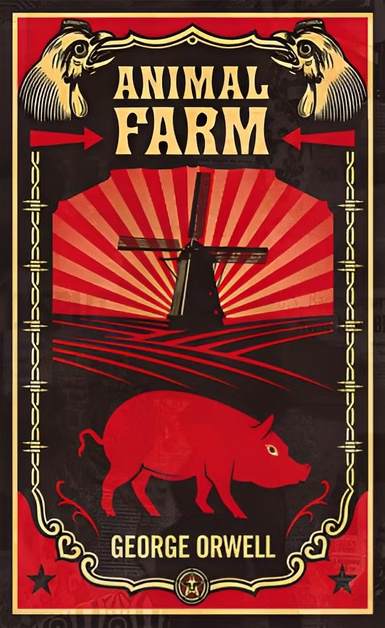
Animal Farm ends with pigs and human farmers sitting at one card table, so alike that the watching animals cannot tell them apart. That one image is why a 1945 fable about barnyard animals still reads like a news report. I went back through the whole book for this review.
It is worth your time: about two hours of reading, a lot of discomfort, and a clearer picture of how a revolution becomes the thing it replaced than most political science chapters give you.
Table of Contents
At a Glance
What it is: George Orwell’s allegorical novella about farm animals who expel their human owner, then watch the pigs who lead them rebuild the same hierarchy.
Verdict: Short, savage, and almost perfectly aimed. Rating: 4.5/5.
The ending in one sentence: The pigs walk on two legs, the Seven Commandments shrink to one corrupted line, and the animals can no longer tell pig from man.
Best single lesson: Power rarely seizes a farm. It edits the record until nobody can prove what was promised.
Who should skip it: Readers who want a hopeful arc or a rounded psychological novel.
Introduction
Animal Farm is by George Orwell (the pen name of Eric Arthur Blair). Secker & Warburg published it on 17 August 1945 in an edition of 4,500 copies, and Orwell gave it the subtitle “A Fairy Story” (see the Penguin edition notes).
Orwell wrote the manuscript between November 1943 and February 1944, and the book appeared in 1945 (City AM).
If you cite Animal Farm, use 1945.
Quick Verdict
A bitter, beautifully compact fable that proves political satire can be funny, tender, and merciless in under 100 pages. Recommended for anyone who has ever watched an institution quietly rewrite its own promises.
Should You Read It?
| What works | What may bother you |
|---|---|
| Finishes in one or two sittings | Characters are types, not full psychologies |
| The ending lands like a slap | Offers almost no hope or alternative |
| Squealer’s lies are funny, then chilling | Some allegory is easier with Russian history in hand |
| Boxer’s chapter is hard to forget | Female characters (Mollie, Clover, Muriel) are thinly drawn |
| Works at school level and adult level | Cruelty to animals can be upsetting for young readers |
What Is It About?
Animals at Manor Farm overthrow their drunken owner and run the farm by seven shared commandments. The pigs, who can read and plan, slowly take control, bend the rules, and punish dissent. By the last page, the new rulers look and act exactly like the humans they replaced.
Rating
4.5 out of 5 stars. The half star I hold back is for the thin characterisation, explained in section 6.2.
Background
Orwell fought in the Spanish Civil War and came away hostile to Moscow-directed Stalinism. In a letter to the French writer Yvonne Davet he described the book as a satirical tale against Stalin, and he suggested a French title that abbreviates to URSA, the Latin word for bear.
The timing made publication hard. He finished the draft while Britain was allied with the Soviet Union against Nazi Germany. Victor Gollancz and T. S. Eliot (for Faber & Faber) turned the book down, as did Jonathan Cape (Penguin).
In New York, Dial Press reportedly refused it on the grounds that animal stories could not be sold in the United States (The Critic). There is also a vivid detail about the manuscript itself.
A V-1 flying bomb wrecked Orwell’s London flat in June 1944, and he dug through the rubble to recover the pages (City AM).
Animal Farm Plot Summary
The Dream and the Rebellion (Chapters 1 and 2)
Mr. Jones of Manor Farm locks the hen-houses but is too drunk to close the pop-holes. Once his lantern goes out, the animals gather in the big barn. Old Major, a twelve-year-old prize boar, wants to share a dream. He tells them their lives are miserable, short, and laborious, and he blames one cause.
His words: “Man is the only creature that consumes without producing.” Remove humans, he says, and hunger and overwork disappear.
Major lays out the principles of the coming Rebellion. No animal may adopt human habits such as living in a house, sleeping in a bed, wearing clothes, drinking alcohol, smoking, touching money, or trading. No animal may tyrannise another, and no animal may kill another. All animals are equal. He teaches them a song, “Beasts of England.” Three nights later he dies.
The pigs, the cleverest animals, turn his speech into a system called Animalism. Three of them lead the work: the persuasive Snowball, the forceful Napoleon, and the silver-tongued Squealer.
The Rebellion arrives sooner than anyone expects. Jones gets drunk in Willingdon, his men skip the feeding, and the hungry cows break into the store-shed. Jones and his men arrive with whips, the animals attack as one, and the humans flee.
The animals rename the place Animal Farm and paint the Seven Commandments on the barn wall. Four-legged and winged creatures are friends, two-legged creatures are enemies, and no animal may wear clothes, sleep in a bed, drink alcohol, or kill another. The seventh says all animals are equal.
Then the first crack appears. The cows are milked, and by the time the animals return from the harvest, the milk has vanished into the pigs’ mash.
Early Success and the First Battle (Chapters 3 and 4)
The harvest is the best the farm has ever seen.
The animals work gladly because the food is theirs. Boxer, the huge cart-horse, takes on the labour of several animals and adopts the personal motto “I will work harder.” The pigs supervise but do no manual work. Snowball starts reading classes, and when the dimmer animals cannot learn all seven commandments, he boils them down to one slogan: “Four legs good, two legs bad.”
The sheep chant it until it becomes a weapon against any argument.
Then the milk and the windfall apples are reserved for the pigs. Squealer explains why. Pigs are brainworkers, these foods are essential to their health, and if the pigs fail, Jones will return. The fear of Jones works every time.
Jones and the neighbouring farmers attempt to retake the farm in the Battle of the Cowshed. Snowball, who studied Julius Caesar’s campaigns in one of Jones’s old books, plans an ambush.
The animals win. Snowball and Boxer receive medals, and Jones’s gun is placed at the foot of the flagstaff to be fired on ceremonial days. The animals feel tested and proven.
The Windmill and the Fall of Snowball (Chapters 5 and 6)
Mollie, the vain mare who loves ribbons and sugar, disappears to work for a human. The animals never speak of her again. The real conflict is between Snowball and Napoleon, who oppose each other on every proposal. Snowball dreams of a windmill that would power a dynamo, bring electric light and heating to the stalls, and cut the working week to three days.
Napoleon denounces it and, in a memorable gesture, urinates on Snowball’s plans.
On the day of the vote, Snowball’s speech is winning the room. Napoleon whimpers, and nine huge dogs, secretly raised from stolen puppies, burst in and chase Snowball off the farm for good. Napoleon abolishes the Sunday debates and puts all decisions in a committee of pigs. Squealer defends the change by calling it sacrifice and discipline.
Three weeks later Napoleon announces that the windmill will be built after all. Squealer explains that Napoleon never opposed it: he only pretended to, as a trick to remove Snowball. “Tactics, comrades, tactics!”
The animals now labour sixty hours a week, with extra Sunday work that is “voluntary” but punished by halved rations if skipped. Napoleon opens trade with human farms through a solicitor named Whymper, which contradicts the early resolutions. Some animals feel sure such a rule existed, but Squealer asks, “Is it written down anywhere?” Nobody can show that it was, so they decide their memories are faulty. The pigs move into the farmhouse and sleep in beds.
The Fourth Commandment now reads that no animal shall sleep in a bed “with sheets.” A November gale topples the half-built windmill, and Napoleon blames Snowball by name and puts a bounty on him.
Terror and the Battle of the Windmill (Chapters 7 and 8)
A hard winter brings near starvation. Napoleon hides the shortage from outsiders by filling the grain bins with sand and topping them with real grain, so Whymper reports that all is well.
When the hens refuse to surrender their eggs for sale, Napoleon starves them into submission, and nine die. Everything that goes wrong is blamed on Snowball.
Then Napoleon summons the farm. His dogs drag four pigs forward, the same four who protested when the debates ended, and they confess to working with Snowball. The dogs tear out their throats. Hens, a goose, and several sheep confess to equally absurd crimes and are killed on the spot. Clover and the others retreat to the knoll, shaken and silent.
Boxer concludes the fault must be their own and decides to work harder, getting up an hour earlier. The Sixth Commandment now says no animal shall kill another “without cause,” and “Beasts of England” is banned.
By Chapter 8 the farm is a personality cult. Napoleon takes grand titles, Minimus writes poems in his honour, and a dead hen is not mentioned again.
He negotiates the sale of timber to Frederick of Pinchfield, whom he had called a monster, and Frederick pays in forged banknotes. Frederick’s men attack, blow up the finished windmill with blasting powder, and are driven off at heavy cost. Boxer is wounded. Squealer announces a great victory, and the animals, though sceptical, accept it. The pigs find whisky, get drunk, and an alarmed Napoleon declares that drinking is punishable by death.
A few days later, the Fifth Commandment is found to read that no animal shall drink alcohol “to excess.”
Boxer’s Betrayal and the Last Image (Chapters 9 and 10)
Boxer, still working on the windmill with a split hoof, dreams only of retirement. The pension promises have not been honoured.
Rations are cut again while the pigs gain weight and drink beer. Animal Farm is declared a Republic, Napoleon is elected president unopposed, and new “revelations” claim that Snowball fought on Jones’s side at the Cowshed.
Then Boxer collapses. Squealer promises the best veterinary care in Willingdon, but a closed van arrives. Benjamin, the cynical donkey who can read as well as any pig, gallops in for the first time anyone has seen and shouts that the van belongs to a horse slaughterer and glue boiler.
The animals chase it, Clover cries out, and Boxer’s hoofs drum against the inside until he is too weak to kick. Squealer then reports a touching deathbed scene in a hospital. The pigs soon afford a new case of whisky.
Years pass. The old animals die off, the farm grows richer, and the common animals grow no richer. Only the pigs and dogs thrive. The windmill grinds corn for profit rather than powering electric stalls.
One day the pigs walk out of the farmhouse on their hind legs, Napoleon with a whip in his trotter, and the sheep bleat a new version of the slogan: “Four legs good, two legs BETTER!”
Clover, her sight failing, asks Benjamin to read the barn wall. Only one commandment remains: “All animals are equal but some animals are more equal than others.” The pigs now read newspapers, wear Jones’s clothes, and host neighbouring farmers. Mr. Pilkington toasts the farm and jokes that the pigs have lower animals to manage while humans have lower classes.
Napoleon bans the title “Comrade,” buries the boar’s skull, strips the hoof and horn from the flag, and renames the place Manor Farm.
A quarrel erupts when Napoleon and Pilkington both play an ace of spades. Outside the window, the animals look from pig to man and back again and find it “impossible to say which was which.”
The Ending Explained
The last scene is not a reversal. It is a confirmation. The Seven Commandments were always the only legal protection the animals had, and the pigs have erased them one amendment at a time. The two-legged pigs show that the original enemy, “Man,” was less a species than a position of power.
Whoever takes that position takes on its habits, its comforts, and its contempt for those below. The card game proves that the new rulers and the old are now negotiating among themselves, with the lower animals as the stakes.
Analysis and Critique
Characters
Napoleon. Napoleon is the allegory of Stalin. He is Animal Farm‘s least talkative animal and its most effective, which is the point. He rarely argues. He lets others speak, then lets the dogs finish the discussion. His only real skill is patience, and that skill is enough.
Snowball. The usual reading ties him to Trotsky. He is brilliant, eloquent, and slightly naive, and his windmill is a real idea that Napoleon steals. Orwell does not make him a saint. His reductions of Animalism to a slogan fed the later chanting of the sheep. Still, he is the one character who offers a future, and his erasure is the first sign of how this story will end.
Squealer. He is the voice of every spokesperson who has ever called a cut a “readjustment.” His method is worth studying. He never forbids anyone from remembering; he only asks whether memory can be trusted. That is more powerful than censorship, because it makes the victim do the work.
Boxer. Boxer is the working class at its most loyal and most exploited. He is also the emotional centre. Orwell gives him two mottoes, “I will work harder” and “Napoleon is always right,” and the book shows how a decent animal can hand its judgement to someone else and be betrayed for it. His death scene is the hardest to read.
Clover and Benjamin. Clover senses that something is wrong but cannot name it, and she has no tools to check. Benjamin can read and chooses silence until Boxer is in danger, which makes him the book’s most uncomfortable character. His cynicism is not wisdom. It is a failure of nerve dressed as realism.
Old Major, Mollie, Moses, the sheep, the dogs. Major carries the founding ideal and dies before he can see it used. Mollie is the escapist who leaves for comfort. Moses the raven, with his talk of Sugarcandy Mountain, stands for organised religion as a pain reliever.
The sheep are a loudspeaker for slogans, and the dogs are the secret police. They are not deeply drawn, and they do not need to be.
Themes and Symbolism
Language as control. The Seven Commandments are the book’s central symbol. They are written down, public, and permanent in appearance, yet they change, and the animals cannot prove it. Each alteration adds two or three words that reverse the meaning: “with sheets,” “without cause,” “to excess.” The final version abandons the pretence and reverses the principle outright.
The corruption of memory. Squealer’s most effective tool is doubt. When the animals recall a resolution, he asks for the written record. When Boxer remembers Snowball’s courage, Squealer produces “secret documents” nobody can read. History becomes whatever the leadership says it was this week.
Scapegoating. Snowball is blamed for storms, lost keys, spoiled milk, and bad wheat. The more the farm struggles, the more he grows. A permanent enemy lets a government explain every failure without changing anything.
Labour and exploitation. The windmill is both a promise and a trap. It is meant to lighten work, yet building it raises the workload, and when it is finished it is used to mill grain for profit instead of electricity. The reward always arrives later, and the sacrifice is always now.
Class without a name. Orwell never lets the pigs call themselves a class. They are “brainworkers.” The distinction between those who manage and those who work becomes the gap between those who eat and those who starve.
Education and its misuse. Literacy fails the animals in a quiet way. Only the pigs and Benjamin read well, so those who can read the wall control what the wall says. Boxer’s dream of learning the remaining twenty-two letters of the alphabet never comes true.
The ending’s symbol. The windows of the farmhouse turn the animals into spectators. They are outside, looking in, as they were always meant to be.
Evaluation
Animal Farm is a ninety-page ambush: it charms you with talking animals, then pins you to the barn wall and makes you read your own forgetfulness back to you.
Strengths
Economy. There is not one wasted chapter. Each one adds a new betrayal.
Tone. The narrator stays calm and almost cheerful, which makes the cruelty worse.
Clarity. The allegory works even if you know nothing about 1917.
Boxer. The slaughterhouse van is a perfect piece of scene-building.
Weaknesses
Thin characters. Almost everyone represents an idea, so you may admire the design more than you feel for the animals.
Limited women. Mollie, Clover, and Muriel are functions rather than people.
No way out. Animal Farm diagnoses well and prescribes nothing. A reader who wants a remedy has to look elsewhere.
Impact and Controversy
For me, the sting is not Napoleon’s cruelty. It is how reasonable Squealer’s explanations sound while they are being delivered. I spent the middle chapters nodding along and then realised I had been nodding at lies. That is the real experience of Animal Farm.
It also became a Cold War object. The 1954 animated film was only possible because of CIA funding, according to historian John Newsinger (ETOL). National Archives research reported that the CIA obtained the film rights from Orwell’s widow (Sunday Express via PressReader).
The irony is hard to miss: a book about the rewriting of history was itself rewritten for propaganda.
Comparison With Similar Works
Nineteen Eighty-Four (Orwell, 1949) takes the same interest in rewritten records and makes it a full world, with a protagonist you can follow inside his mind. Animal Farm is leaner, funnier, and easier to start with.
Brave New World (Huxley) warns about control by pleasure where Orwell warns about control by fear.
Lord of the Flies (Golding) also watches a new order collapse, but from within a group of children, so it is about human nature more than about institutions.
The Handmaid’s Tale (Atwood) shares the theme of a regime that manages language and memory.
Adaptations
1954 animated film. The film premiered in New York on 29 December 1954, and the CIA insisted on changes, including an ending in which the animals rise up against the pigs (ETOL). That departs from the book, which closes with no uprising and no hope. The film is polished and historically interesting. As a reading of Orwell, it is the opposite of faithful.
1999 TNT film. John Stephenson directed it, Jim Henson’s Creature Shop built the animatronic animals, and the cast included Patrick Stewart as Napoleon, Ian Holm as Squealer, and Kelsey Grammer as Snowball. One critic noted that it adds a narrator, a dog named Jessie, who is not in the novel (Alex on Film). Trade coverage put its cost at about $24 million (NextTV).
2026 animated film by Andy Serkis. It premiered at Annecy on 9 June 2025, and Angel scheduled a wide US release for 1 May 2026 (Angel press release). Seth Rogen voices Napoleon, Kieran Culkin voices Squealer, Woody Harrelson voices Boxer, and Laverne Cox voices Snowball (Dark Horizons).
Serkis said a live-action approach would have made the story bleaker, so he moved to animation to keep some innocence (TheWrap). That choice shows. Compared with the book, which has no safety net, the film softens and adds new animal characters.
Reception was weak. As of 29 April 2026, one report listed a 26% critics score on Rotten Tomatoes and 33 on Metacritic (ComingSoon). The Numbers listed an opening weekend of about $3.3 million and a worldwide total of about $6.3 million at the time I checked (The Numbers).
Treat those box office figures as a snapshot, because they may have moved. The BBFC lists a UK release date of 24 July 2026 (BBFC).
My verdict: read Animal Farm first. A two-hour read does more than any of the three screen versions.
Personal Take With Contemporary Relevance: The Question “Is It Written Down Anywhere?”
The line that haunts me is not the famous last commandment. It is a smaller question Squealer asks in Chapter 6. When the animals feel sure they once voted against trade, he asks whether any record exists. None does, so they decide they imagined it. Power does not need to seize the barn wall if it can convince people their own memories are unreliable.
That is not just an old-fashioned fear. Freedom House reported that global freedom declined for the 20th consecutive year in 2025, with 54 countries worsening and 35 improving (Freedom in the World 2026). Portuguese coverage of the report said only 21% of the world’s people live in countries rated “free,” down from 46% twenty years earlier (Renascença).
There is a counterweight worth keeping in view. The same organisation noted that of the 87 countries rated Free in 2005, 76 have stayed Free throughout (Freedom House). Decline is real, but so is resilience.
Five lessons I took from Animal Farm:
- Keep your own record. Write down promises, dates, and numbers. Memory is the first thing a rewrite attacks.
- Distrust the word “readjustment.” When a cut gets a gentler name, ask for the before and after figures.
- Notice who explains. If every difficult question is answered by the same spokesperson, find a second source.
- Do not outsource your doubt to a slogan. “Napoleon is always right” felt like loyalty to Boxer. It was surrender.
- Watch the small amendments. The Commandments never vanished in one night. Two words at a time did the damage.
Quotable Lines
“Man is the only creature that consumes without producing.” Old Major names the enemy in Chapter 1, and the line later fits the pigs.
“Four legs good, two legs bad.” The slogan that ends debate (Chapter 3).
“Napoleon is always right.” Boxer’s second motto after Snowball’s exile (Chapter 5).
“Tactics, comrades, tactics!” Squealer turns a reversal into genius (Chapter 5).
“Is it written down anywhere?” The question that makes the animals doubt themselves (Chapter 6).
“No animal shall kill any other animal without cause.” Two added words make murder legal (Chapter 7).
“All animals are equal but some animals are more equal than others.” The only commandment left (Chapter 10).
“Impossible to say which was which.” The final judgement on pigs and men (Chapter 10).
Conclusion
Animal Farm is the rare book that is both a school staple and a genuine masterpiece. Its power comes from restraint: a plain voice, a short length, and a refusal to comfort. I would recommend it to readers of political fiction, to anyone interested in propaganda, and to teachers who want a text that works for teenagers and adults alike.
I would not recommend it as your only Orwell, because Nineteen Eighty-Four gives you the inner life this book leaves out.
It is worth reading now because the central trick is still in daily use: change the record, then ask the people to prove what they remember.
Animal Farm

Animal Farm ends with pigs and human farmers sitting at one card table, so alike that the watching animals cannot tell them apart. That one image is why a 1945 fable about barnyard animals still reads like a news report. I went back through the whole book for this review.
URL: https://www.sopranu.com/animal-farm-symbolism-explained/
Author: George Orwell
4.5
Pros
- Compact and fast to read; devastating ending; memorable satire of propaganda; works for teenagers and adults
Cons
- Characters are types rather than individuals; minimal female characterisation; offers diagnosis but no remedy