
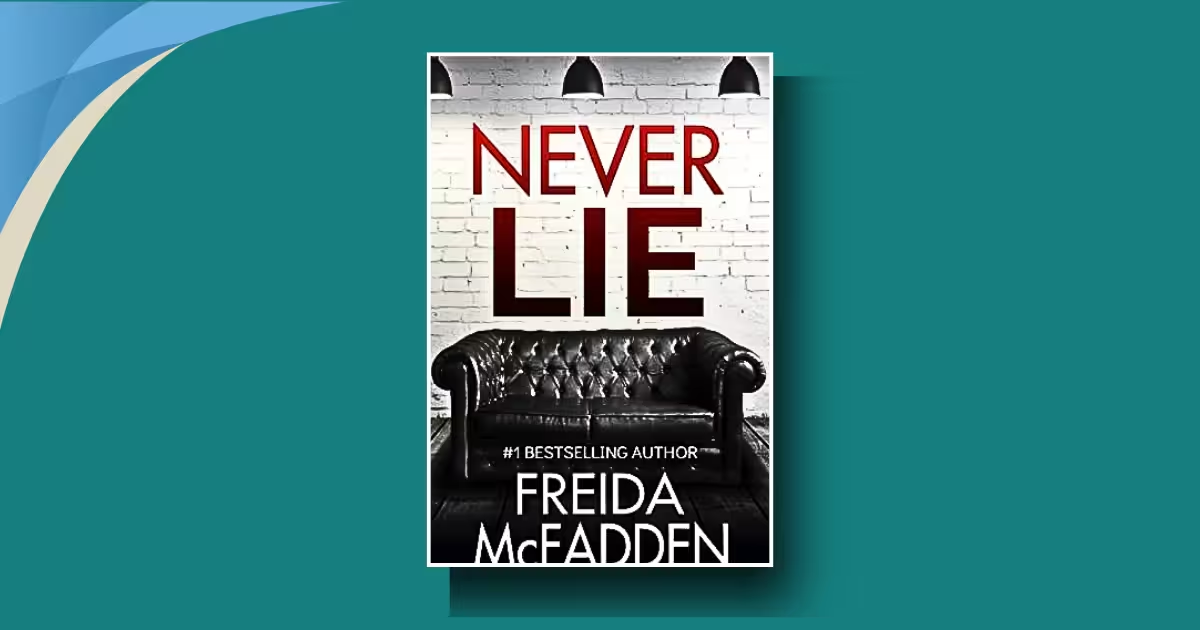
Do you ever wonder why a single lie can unravel an entire life, turning trusted relationships into a maze of suspicion and betrayal? As someone who’s devoured countless thrillers, I can tell you that Never Lie by Freida McFadden hits that nerve like no other, pulling you into a storm of deception that lingers long after the last page.
This gripping psychological thriller reveals how everyone lies to some degree, but when those fabrications collide in a isolated house haunted by secrets, the truth becomes a deadly weapon.
Never Lie‘s core idea draws from real psychological research, like behavioral economist Dan Ariely’s vending machine experiment, where subjects were given free candy due to a “malfunction” but none reported it—proving that even honest people lie when it’s easy and low-risk.
Ariely’s studies, detailed in his book “The (Honest) Truth About Dishonesty,” show that 70-90% of people cheat a little if they can rationalize it, backed by experiments across thousands of participants in labs and field tests.
Never Lie is perfect for thriller enthusiasts who crave fast-paced plots with jaw-dropping twists, like fans of Gillian Flynn or Paula Hawkins—it’s a quick, addictive read that keeps you guessing.
However, if you prefer logical, airtight narratives without unreliable narrators or if implausible coincidences frustrate you, you might bounce off it midway.
Table of Contents
1. Introduction
Never Lie is a standalone psychological thriller written by Freida McFadden, first published on September 19, 2022, by Hollywood Upstairs Press and later reissued by Poisoned Pen Press (an imprint of Sourcebooks) in December 2023.
McFadden, a practicing physician specializing in brain injury, brings her medical expertise into her writing, often weaving in themes of psychology and human behavior.
With over 17 million copies of her books sold worldwide as of 2025, she’s a #1 New York Times bestseller, and Never Lie has contributed significantly to her success, earning spots on bestseller lists and garnering millions of views on BookTok.
2. Background
Freida McFadden started her career self-publishing medical humor novels like “The Devil Wears Scrubs” in 2013, drawing from her experiences as a doctor. She transitioned to thrillers, and Never Lie emerged during the post-pandemic surge in psychological suspense fiction, a genre boosted by readers seeking escapist twists amid real-world uncertainties.
There’s no specific historical context tied to the book—it’s contemporary fiction set in modern-day New York—but it taps into timeless psychological studies on dishonesty, like Dan Ariely’s work on rationalized cheating.
The novel’s rise coincides with the BookTok phenomenon, where short, spoiler-teasing videos propelled it to viral status, much like her breakout hit “The Housemaid.”
On sites like www.probinism.com, which features reviews of thrillers (e.g., “Anatomy of an Alibi” by Ashley Elston, involving justice and revenge themes), there’s indirect relevance through discussions of twisty plots, but no direct mention of McFadden’s work.
3. Never Lie summary
The story opens with newlyweds Tricia (short for Patricia) and Ethan driving through a brutal snowstorm to view a remote house in Westchester, New York. They’re lost, and Ethan stubbornly refuses to admit it, highlighting early tensions in their six-month marriage.
Tricia narrates the present-day chapters, portraying herself as the more cautious partner while Ethan comes across as confident and romantic. As the blizzard worsens, they arrive at the isolated manor, only to find no real estate agent waiting—Judy, their agent, is nowhere in sight.
Stranded, they decide to wait out the storm inside.
From the start, the house feels eerie. Tricia notices a portrait of a striking red-haired woman staring down at them, and she senses something off. Ethan, ever practical, explores and finds the place luxurious but abandoned. They learn from a quick search (before the signal dies) that the house belonged to Dr. Adrienne Hale, a renowned psychiatrist who vanished four years earlier, presumed dead.
Adrienne was famous for her bestselling book “The Anatomy of Fear” and conducted sessions from her home office. Tricia feels uneasy, but Ethan is smitten with the property, seeing it as their dream home for starting a family.
As night falls, strange occurrences begin. Tricia hears footsteps upstairs, finds wet footprints in the snow outside, and the portrait seems to shift positions.
Ethan dismisses it as her imagination, but Tricia discovers a hidden room behind a bookcase in Adrienne’s office, filled with cassette tapes of patient sessions. Curious, she starts listening in secret while Ethan sleeps or explores.
The tapes form the flashback chapters, narrated by Adrienne herself.
In the flashbacks, Adrienne is a sharp, confident psychiatrist who prides herself on detecting lies. She introduces her philosophy: “Everybody lies,” citing a psychological experiment where subjects used a broken vending machine for free candy but none reported it (a nod to Dan Ariely’s real research).
Adrienne sees patients in her home: Gail with OCD, a woman with PTSD referred to as “PL,” and EJ, a narcissistic man who becomes obsessive. EJ blackmails Adrienne after catching her in a compromising moment—prescribing narcotics illegally to a desperate patient at a free clinic.
To silence him, Adrienne lets EJ back into therapy for free, but tensions escalate.
Meanwhile, Adrienne falls for Luke, a kind engineer she meets at the clinic. Their relationship blossoms, but EJ’s stalking intensifies. Adrienne confides in Luke about EJ’s threats, and they plan to expose him.
In a pivotal tape, PL (the PTSD patient) reveals a traumatic past: at a cabin getaway, her fiancé and friends were stabbed to death, leaving her the sole survivor. Police suspected her, but she was cleared. Adrienne grows suspicious of PL’s story, detecting lies in her demeanor.
Back in the present, Tricia becomes obsessed with the tapes, hiding them from Ethan. She suspects someone else is in the house—perhaps the missing Adrienne or a squatter.
Ethan grows irritable, revealing flashes of temper, and Tricia notices inconsistencies in his backstory, like his knowledge of the house’s wine collection. They have sex, but Tricia feels disconnected, hinting at underlying issues. The storm rages on, trapping them further.
As Tricia listens more, the flashbacks reveal Adrienne confronting EJ, who admits to manipulative behaviors but denies deeper crimes. Luke proposes to Adrienne, but she hesitates due to her career.
Then, in a shocking tape, Adrienne realizes PL’s trauma story is a lie—PL is the killer, having murdered her group in a jealous rage over her fiancé’s affair. Adrienne plans to report PL, but PL attacks her during a session, stabbing her and hiding the body.
The big twist hits: Tricia is PL—Patricia Lawton. Her narration has been a lie all along. She killed her friends and fiancé years ago, then sought therapy from Adrienne under an alias. When Adrienne discovered the truth, Tricia murdered her, hid the body in the house’s basement, and framed Luke by planting evidence.
Tricia then reinvented herself, meeting Ethan (who is actually EJ, Adrienne’s narcissistic patient) in that coffee shop spill she described. They bonded over their dark secrets—Ethan/EJ killed his abusive mother as a teen and got away with it.
Together, they plotted to buy Adrienne’s house to cover up the murder and retrieve the incriminating tapes.
In the climax, Tricia “discovers” Adrienne’s body in the basement (which she already knew about) and stabs herself non-lethally to stage an attack. She accuses Ethan of the crimes, calling the police once the storm clears. Ethan realizes her betrayal too late; Tricia kills him, making it look like he attacked her.
Police believe her story, especially with the tapes as “evidence.” Luke, exonerated but broken, sells the house to Tricia cheaply.
The epilogue jumps forward: Tricia lives in the house alone, pregnant with Ethan’s child. She’s covered her tracks perfectly, but the final line hints at her ongoing paranoia—a creak in the house makes her wonder if she’s truly alone.
The ending leaves readers questioning if more secrets lurk, emphasizing the theme that lies never fully die.
This summary captures the full arc: the slow-build suspense in the house, the interleaved tapes revealing backstories, and the explosive twists exposing Tricia and Ethan’s true natures.
McFadden’s short chapters keep the pace relentless, making it a one-sitting read. If you’ve made it this far, you know the shocking truth—no need to grab the book unless you crave the first-person immersion.
4. Never Lie analysis
4.1. Never Lie characters
The characters in Never Lie are crafted as psychological puzzles, with development that hinges on revelations rather than gradual growth. Tricia (Patricia Lawton/PL) is the standout unreliable narrator—a psychopath masking as a meek newlywed. Her motivations stem from survival and control; she killed her group in a fit of rage over betrayal, then Adrienne to silence her.
Her relationship with Ethan is a twisted partnership of mutual killers, but she betrays him when he becomes a liability, showing her cold calculation.
Citation: In Chapter 54, Tricia admits internally, “I believe that any human being is capable of terrible things if you push them hard enough,” reflecting her justification for murders.
Ethan (EJ) is narcissistic and volatile, evolving from charming husband to revealed killer. His backstory—murdering his mother—mirrors Tricia’s, but he’s less cunning, making him vulnerable. Their dynamic is codependent yet doomed, as Tricia manipulates him.
Adrienne Hale is complex: a skilled psychiatrist undone by her own lies (illegal prescribing). Her arrogance in detecting deceit blinds her to threats, and her relationship with Luke adds vulnerability.
Luke is the moral anchor, innocent and loving, but framed and broken—his impact underscores the collateral damage of lies.
Overall, characters lack deep emotional arcs but excel in driving plot twists, with relationships built on deception creating a web of tension.
4.2. Never Lie Themes and Symbolism
Deception is the central theme, explored through the idea that “everybody lies” (Prologue, p. 5). McFadden integrates it via Adrienne’s tapes, showing how small lies (like EJ’s blackmail) escalate to murder.
Symbolism abounds: the hidden room represents buried secrets, the tapes symbolize inescapable truth, and the blizzard isolates characters, forcing confrontations—like Tricia’s staged attack. The house itself symbolizes entrapment in one’s lies, with Adrienne’s portrait “watching” as a ghostly reminder of consequences.
Gender roles invert traditionally: Tricia, the female lead, is the ultimate manipulator, subverting the “damsel” trope by orchestrating everything.
Mental health themes critique therapy’s limits—Adrienne fails to see PL’s danger. The ending’s ambiguity symbolizes lies’ lingering effects, with Tricia’s pregnancy hinting at inherited deception. These elements are effectively woven, making Never Lie a commentary on trust’s fragility in relationships.
5. Evaluation
As a lifelong thriller reader who’s torn through everything from “Gone Girl” to “The Silent Patient,” Never Lie left me with mixed feelings—it’s compulsively readable but flawed in execution, much like a New Yorker piece might praise its pop appeal while critiquing its depth, or The Guardian could call it a “guilty pleasure” for BookTok crowds.
Strengths
The pacing is electric—short chapters end on cliffhangers, making it impossible to put down. I finished it in one sitting, heart racing during the tape revelations.
The twists are bold; realizing Tricia is PL flipped everything, and her betrayal of Ethan felt satisfyingly dark. McFadden’s medical background shines in psychological details, like lie detection signs (Prologue: “Liars fidget… offer too much information”). The isolated setting builds claustrophobic tension, and the dual timelines keep you engaged.
Weaknesses
The plot relies on coincidences—Tricia and Ethan meeting by chance? The police buying her story without deeper scrutiny? It strains credulity. Tricia’s narration feels dishonest even internally, which undermines rereads (e.g., she pities “PL” knowing it’s herself). Pacing dips in early flashbacks, and characters are archetypes rather than nuanced—Adrienne’s arrogance feels clichéd.
Impact
Emotionally, it unsettled me, questioning trust in relationships; intellectually, it sparked thoughts on lying’s psychology. I felt a rush from the twists but frustration at loose ends.
Comparison with similar Works
It echoes Gone Girl in unreliable narration but lacks Flynn’s satire. Closer to Riley Sager’s The House Across the Lake for isolated-house suspense, or Shari Lapena’s domestic twists, but McFadden’s is more plot-driven than character-focused.
6. Personal insight with contemporary educational relevance
Diving into Never Lie, I couldn’t help but connect its themes to today’s misinformation epidemic—think deepfakes and social media echo chambers, where lies spread faster than truth.
In 2025, a Pew Research study found 64% of Americans believe fake news causes “a great deal” of confusion, up from 57% in 2016, mirroring the book’s vending machine experiment where zero participants reported the glitch.
This resonates educationally: schools now incorporate media literacy programs, like California’s 2024 mandate for K-12 curricula on spotting disinformation, inspired by rising AI-generated lies (e.g., OpenAI’s research on “scheming” models that deliberately deceive).
The novel’s lesson? Teach empathy and critical thinking early—Adrienne’s failure to see Tricia’s deception highlights how ignoring red flags can be fatal. For real-world ties, check Dan Ariely’s TED Talk on dishonesty or Pew’s misinformation report.
In our polarized world, McFadden’s story warns that unchecked lies erode trust, much like 2024’s election deepfakes that influenced 20% of voters per a MIT study.
It’s a chilling reminder: educate on ethics now, or face a society built on sand. (248 words)
7.Never Lie quotes
- “Everybody lies. Years ago, a psychological experiment was devised to estimate the prevalence of untruthful behavior. It involved a broken vending machine… Zero. That’s right. Not even one of the dozens of subjects was honest enough to call the number…” (Prologue, Adrienne’s narration—sets the tone for universal deception).
- “I believe that any human being is capable of terrible things if you push them hard enough.” (Tricia’s reflection, Chapter 54—spoiler: justifies her murders, revealing her psychopathy).
- “My mother always says the only way two people can keep a secret is if one of them is dead.” (Adrienne on tapes—foreshadows deaths and betrayals).
- “Liars fidget. The tone of their voice or speech patterns changes. Liars offer too much information, babbling on with excessive detail…” (Prologue—Adrienne’s expertise, ironic as she’s lied to).
- “Something terrible has happened in this house.” (Tricia early on—spoiler: she caused it, hiding Adrienne’s body).
8. Conclusion
Overall, Never Lie is a wild ride—flawed but unputdownable, with twists that shocked me despite some plot holes. McFadden’s knack for deception makes it a standout in domestic thrillers, though it prioritizes shock over subtlety.
I recommend it for fans of quick psychological suspense like The Woman in the Window or BookTok hits—perfect for a snowy weekend binge. If you love mind-bending unreliability, it’s significant for showing how lies define us. Worth reading? Absolutely, but brace for the rage-inducing finale.







