
Last updated on January 26th, 2026 at 11:52 am
Did you ever wonder how memory shapes our truth, or how the stories we tell about ourselves become the very fabric of our identity? Alias Grace masterfully confronts this enigma, pulling you into a historical crime where the only evidence is a woman’s haunted, and possibly deceptive, recollection.
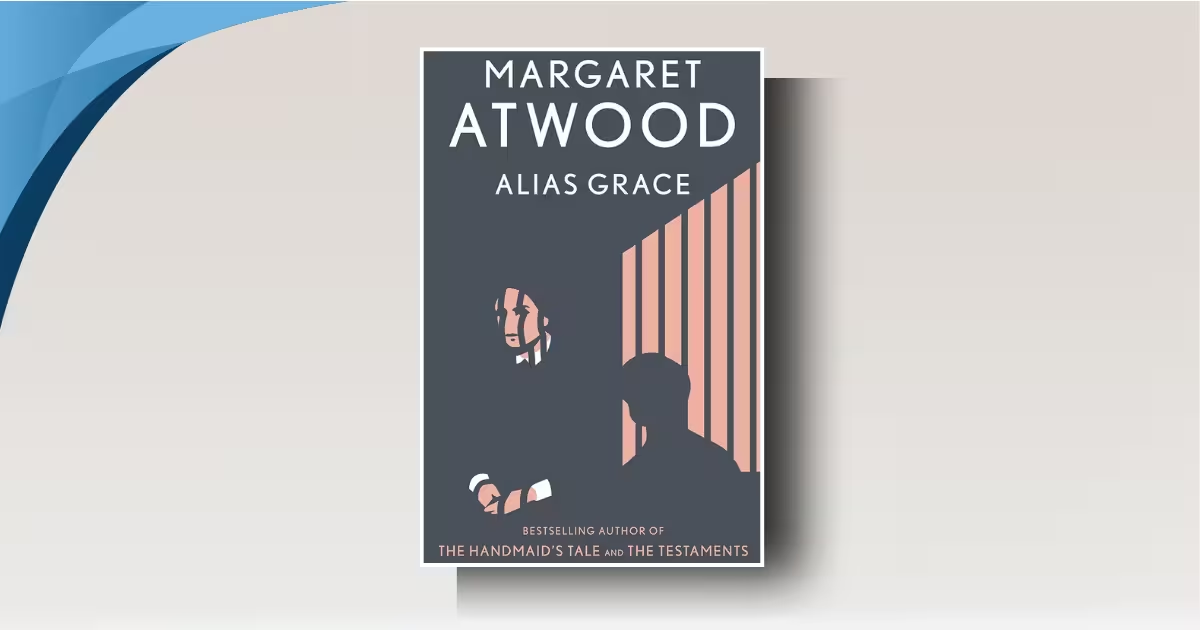
** Margaret Atwood’s Alias Grace is a meticulously researched and brilliantly imagined novel that explores the elusive nature of truth and memory through the story of Grace Marks, a 19th-century Canadian servant convicted of murder, as she recounts her life to an ambitious young doctor.
Alias Grace is best for readers who love literary historical fiction, psychological deep-dives, feminist reinterpretations of history, and morally complex, character-driven narratives. Not for: Those seeking a fast-paced thriller, a clear-cut resolution, or a story free of dark themes and psychological ambiguity.
Table of Contents
1. Introduction
Alias Grace is a historical fiction novel by the acclaimed Canadian author Margaret Atwood, first published in 1996. It arrived a decade after her seminal work, The Handmaid’s Tale, and further cemented her reputation for weaving profound feminist and psychological inquiry into gripping narratives.
The book won the Giller Prize and was shortlisted for the Booker Prize, demonstrating its significant literary impact.
2. Background
The novel is rooted in a sensational real-life case from 1840s Canada. Grace Marks, a poor Irish immigrant, was convicted at age 16 as an accessory in the murders of her employer, Thomas Kinnear, and his housekeeper-mistress, Nancy Montgomery. Her accomplice, James McDermott, was hanged, while Grace’s death sentence was commuted to life imprisonment, sparking decades of public debate about her true culpability and sanity.
Atwood draws from contemporary accounts, notably by Susanna Moodie, who visited Grace in prison and described her as having “an air of hopeless melancholy” and a “sidelong, stealthy look” (Page 26).
The 19th-century setting was a time of burgeoning, yet crude, scientific interest in the female mind (phrenology, hypnotism) and rigid social hierarchies, all of which Atwood meticulously reconstructs to frame her story.
3. Alias Grace Summary
Alias Grace is told through two primary perspectives: the first-person narration of Grace Marks herself, and the third-person perspective of Dr. Simon Jordan, a young American specialist in mental diseases.
The narrative unfolds in 1859, sixteen years after the murders. Grace, now a model prisoner, is allowed to work as a domestic servant in the Governor’s house. A committee of reformers and spiritualists, believing she may be innocent, hires Dr. Jordan to interview her and recover her lost memories of the crime, hoping a scientific assessment will support a petition for her pardon.
Their sessions in the sewing room form the novel’s core. With Grace calmly sewing quilt blocks—a recurring symbol of piecing together a narrative—Dr. Jordan employs association techniques, presenting objects like an apple or a potato to trigger her memory.
Grace proves to be a controlled, elusive, and highly intelligent narrator. She begins her story not with the murders, but with her childhood in Ireland, her family’s wretched emigration, and her mother’s death and burial at sea—a traumatic event she describes with chilling vividness: “my poor mother was tipped into the sea… there was something dreadful about it, to picture her floating down in a white sheet amongst all the staring fish” (Page 110).
She details her harsh early years in Canada, her father’s drunken violence, and her entry into domestic service.
A pivotal chapter is her friendship with the vivacious and rebellious Mary Whitney, a fellow servant who educates Grace about sex, class, and survival. Mary’s tragic death from a botched abortion after being seduced and abandoned by the household’s son leaves Grace profoundly scarred. She takes Mary’s name later, a symbolic act of survival and identity absorption.
Grace’s narrative eventually leads to her employment at the country home of Thomas Kinnear. She describes the tense, psychosexual atmosphere of the household: Kinnear’s open affair with the housekeeper Nancy, Nancy’s petty tyrannies over Grace, and the simmering resentment of the stable hand, James McDermott, who is infatuated with Grace. Grace paints herself as a passive observer, caught in a web spun by others.
She recounts the day of the murders in fragments: hearing noises, finding Nancy’s body in the cellar, being coerced by McDermott. She claims she remembers nothing of Kinnear’s murder, suggesting she was in a trance or that McDermott acted alone.
Intercut with Grace’s hypnotic storytelling are Dr. Jordan’s own struggles. He becomes professionally and sexually obsessed with Grace, his dreams blending with her narrative. His correspondence with his overbearing mother and a colleague reveals his doubts and ambitions. We also see the social world of Kingston through his eyes, including the spiritualists and reformers on Grace’s committee, like the enigmatic neuro-hypnotist Dr. Jerome DuPont.
The climax arrives when the committee, impatient with Jordan’s slow progress, brings in Dr. DuPont to conduct a hypnotic séance. Under hypnosis, Grace’s voice and manner change dramatically.
She speaks as Mary Whitney, claiming that Mary’s spirit—angry, vengeful, and sexually experienced—inhabited Grace’s body during the murders and committed the acts Grace cannot recall. This “Mary” persona provides a graphic, first-person confession to both killings.
The performance leaves everyone stunned, and Jordan, whose methods have been usurped, departs in confusion and professional failure, later wounded in the American Civil War.
The novel’s final section, “The Tree of Paradise,” fast-forwards. Grace, having finally been pardoned after nearly thirty years, marries her former laywer’s associate, Jamie Walsh (the boy who testified against her at the trial). In a blissfully mundane epilogue, she is a respectable housewife, packing away her famous quilt.
The final, devastating line is a letter from a doctor who attended her, noting that “the prison authorities could find no trace of a Mary Whitney ever having been employed at Mr. Parkinson’s, or indeed anywhere in Toronto” (implied from the afterword).
This throws everything into question: Was Mary Whitney ever real, or was she a fictional alter-ego created by Grace from the start? The ultimate truth of the murders remains as intricately stitched and hidden as one of Grace’s quilts.
4. Alias Grace analysis
4.1. Alias Grace Characters
Grace Marks: She is the ultimate unreliable narrator and the novel’s magnificent, sphinx-like center. Is she a cunning murderess, a traumatized victim, a hysteric, or a brilliant performance artist surviving within a system that gives her no power?
Atwood makes her all these possibilities simultaneously. Her character development is not about change, but about deepening mystery. From the girl who learns “it is not always good to say what you know” (implied throughout) to the woman who understands that “a murderess is a strong word to have attached to you.
It has a smell to it… like dead flowers in a vase” (Page 29), Grace’s intelligence is her primary trait. Her relationships—with Mary (absorption), with Nancy (rivalry), with McDermott (lethal manipulation?), and with Dr. Jordan (a subtle battle for control)—are all mechanisms for her survival.
Dr. Simon Jordan: He represents masculine, scientific rationality attempting to dissect the “female mystery.” His motivations are a mix of genuine scientific curiosity, careerism, and repressed erotic fascination.
His failure is inevitable because he tries to objectify a subjectivity he cannot comprehend. His own dreams and neuroses, such as his dream of drowning amidst his father’s possessions (Page 123-124), mirror the subconscious depths he seeks in Grace, revealing the “investigator” as deeply unstable himself.
Mary Whitney: Whether real or invented, Mary is the symbolic foil to Grace—brash where Grace is reserved, sexually aware where Grace is innocent, rebellious where Grace is compliant. Her spirit, or Grace’s channeling of it, represents the rage of oppressed women, the “unladylike” forces society tries to suppress.
Her “return” under hypnosis provides the confession the public wants, but in a form that preserves Grace’s core innocence.
4.2. Alias Grace Themes and Symbolism
Memory and Truth: This is the novel’s central engine. Atwood demonstrates that history, like memory, is a narrative construction. Grace’s story shifts depending on who is listening—the lawyer, the newspapers, Dr. Jordan, the hypnotist. The “truth” is not a buried fact to be uncovered, but a story that serves a purpose. As Grace says of the newspapers, “They will make up any old thing to suit themselves” (Page 93).
Power and Sexuality: The novel is steeped in the power imbalances of class and gender. Servant girls are sexually vulnerable to masters, as Mary’s fate shows. Grace’s entire life is dictated by the whims of men—her father, her employers, lawyers, doctors, jailers.
Her only power lies in her storytelling and her ability to reflect what others want to see: the penitent, the madwoman, the innocent.
Quilts and Sewing: The dominant symbol. Grace is constantly piecing together quilts—Log Cabin, Tree of Paradise—just as she pieces together her story. Quilting represents women’s domestic art, their historical silence, and the creation of a whole from fragments. It’s a metaphor for the novel itself and for identity construction.
The “Tree of Paradise” quilt, which she desires to make for herself, symbolizes the peaceful, ordinary life she ultimately crafts after her release.
Apples and Knowledge: Dr. Jordan’s first gift to Grace is an apple, a direct allusion to the Tree of Knowledge (Page 44). He seeks the knowledge of her crime, but the apple also symbolizes the forbidden knowledge of sexuality and sin that pervades the story.
Grace’s refusal to play along with his biblical allusion (“Apple pie… That’s what an apple pie is for”) shows her subverting his symbolic script (Page 45).
5. Evaluation
1. Strengths
Atwood’s greatest achievement is the mesmerizing voice of Grace Marks. The prose is precise, period-authentic, and deeply immersive. The research is seamlessly woven in; the novel feels less written than excavated.
The supporting documents—newspaper clippings, poems, asylum reports—create a robust, multi-layered authenticity. The psychological tension is superb, making a story about conversations in a sewing room utterly gripping. The unresolved ending is a strength, a bravura move that respects the reader’s intelligence and lingers for years.
2. Weaknesses
Some readers may find the middle sections, detailing Grace’s early life and service, to be slow-paced compared to the looming promise of the murder mystery. Dr. Jordan’s sections, while thematically crucial, can sometimes feel less compelling than Grace’s hypnotic narration. The novel demands patience and a willingness to dwell in ambiguity.
3. Impact
Intellectually, it forces a reckoning with how we judge historical figures, particularly women, with scant and biased evidence. Emotionally, it creates a profound empathy for Grace, regardless of her guilt, by immersing you in the brutal confines of her life and the prison of her own mind.
4. Comparison with Similar Works
It sits alongside Atwood’s The Handmaid’s Tale in its feminist interrogation of power, but is more historically grounded and psychologically interior.
It shares DNA with novels like Sarah Waters’ Fingersmith (Victorian suspense, unreliable women) and Emma Donoghue’s Slammerkin (the grim life of a poor woman), but its specific focus on memory and testimony aligns it with literary crime reconstructions like Josephine Tey’s The Daughter of Time or modern works like Hannah Kent’s Burial Rites.
5. Adaptation
The novel was adapted by Netflix into a superb six-part television miniseries in 2017 by Sarah Polley. It starred Sarah Gadon as Grace and Edward Holcroft as Dr. Jordan.
Comparison: The adaptation is remarkably faithful to the novel’s tone, structure, and major plot points. It visually realizes the stark settings and captures Grace’s inscrutability beautifully. Some subplots, like Dr. Jordan’s personal life, are streamlined.
The hypnosis scene is a stunning centerpiece, effectively translating the novel’s chilling ambiguity to screen.
6. Personal Insight with Contemporary Relevance
One of Alias Grace’s most urgent lessons is about the fallibility of narrative and the dangers of confident judgment in the court of public opinion. Grace’s trial was a media circus where she was portrayed as “an inhuman female demon” or “an innocent victim” based on prejudice and sensationalism (Page 29-30).
Today, with social media acting as a perpetual, unregulated courtroom, we see this dynamic amplified. Viral stories often force individuals into archetypes—hero or villain, victim or schemer—long before facts are established.
The 24-hour news cycle and online mobs create “celebrated murderesses” of their own, trying and convicting based on fragments and algorithms. Atwood’s novel teaches skepticism towards neat stories and empathy for the human complexity behind the headline. It reminds us that truth is rarely a single thread, but a tangled weave of perspective, memory, and power.
According to the Innocence Project, eyewitness misidentification and false confessions play a role in over 70% of wrongful convictions later overturned by DNA evidence—a stark, modern statistical echo of the unreliable testimony and coerced narratives that might have sealed Grace Marks’ fate.
7. Alias Grace quotes
- “I think of all the things that have been written about me… that I am an inhuman female demon, that I am an innocent victim… that I am soft in the head and little better than an idiot. And I wonder, how can I be all of these different things at once?” (Page 29-30)
- “Murderess is a strong word to have attached to you. It has a smell to it, that word—musky and oppressive, like dead flowers in a vase.” (Page 29)
- “When you are in the middle of a story it isn’t a story at all, but only a confusion; a dark roaring, a blindness… It’s only afterwards that it becomes anything like a story at all. When you are telling it, to yourself or to someone else.”.
- “He must mean that he has come to test me, although he’s too late for that, as God has done a great deal of testing of me already, and you would think he would be tired of it by now.” (Page 43)
- “But I don’t say this. I look at him stupidly. I have a good stupid look which I have practised.” (Page 43)
8. Conclusion
Alias Grace is a monumental work of literary fiction—a haunting, intellectually rigorous, and emotionally resonant novel that refuses to leave you. It is a masterclass in voice and historical imagination.
Margaret Atwood does not give us the comfort of solving a crime; instead, she immerses us in the crime of how history, story, and identity are made. You will finish the last page and immediately want to start again, searching for clues you missed in Grace’s impeccably stitched tale.
Recommendation: Highly recommended for readers of literary fiction, historical fiction, psychological drama, and feminist literature. It is essential for Atwood fans and anyone interested in true crime that probes deeper than simple culpability. Approach it not as a puzzle to be solved, but as a profound exploration of the human psyche to be experienced.







