
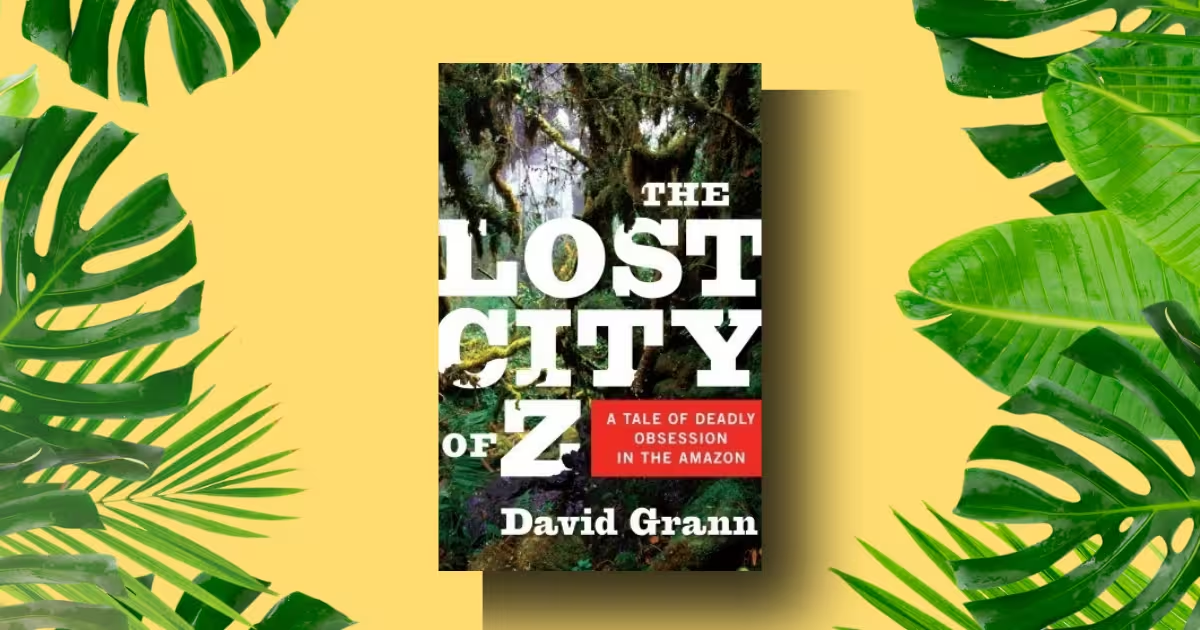
Why do some mysteries tighten around your thoughts and refuse to let go—until you realize you’re halfway obsessed, too? In The Lost City of Z, David Grann doesn’t just describe an Amazon riddle; he shows how a single letter on a map can become “less like a signpost than like a taunt.”
The Lost City of Z is best for readers who love true adventure + investigative journalism, especially stories built from diaries, letters, and archives.
Anyone fascinated by Amazon archaeology and the question of whether a “lost civilization” could exist beneath the forest canopy.
People who enjoy books where the author becomes part of the narrative: Grann admits he tried to remain “the invisible witness,” but the story pulled him in anyway.
Not for you
- If you need a clean “case closed” ending: this book is honest about uncertainty and competing theories.
- If you dislike exploration-era narratives (even when examined critically): the book spends time inside that worldview because that’s where the obsession grows.
- If you prefer calm pacing: Grann writes with momentum and cliff-edge tension.
Table of Contents
1. Introduction
Book: The Lost City of Z: A Tale of Deadly Obsession in the Amazon
Author: David Grann
Year commonly listed: 2009 (US edition commonly associated with Doubleday / Knopf-Doubleday listings; edition details vary by market).
This is narrative nonfiction built like a thriller, but powered by documentation: Grann traces how “generations of scientists and adventurers became fatally obsessed” with what’s been called “the greatest exploration mystery of the twentieth century”—the whereabouts of the lost City of Z.
The subject at the center is the British explorer Percy Harrison Fawcett and his 1925 disappearance, but the real scope is larger: the book is also about how myths grow, how evidence is argued over, and how the Amazon keeps swallowing certainty.
Here’s The Lost City of Z’s core idea in one sentence:
“Z” is not just a location—it’s the collision of obsession, myth, and evidence, and what that collision reveals about the Amazon and the human mind.
Grann frames the Amazon as one of the last “blank spaces” on the map even “in an age of airplanes and satellites.” That framing matters, because the book keeps proving how dangerous blank spaces can be: they invite projection, certainty without proof, and quests that don’t know how to stop.
2. Background
Grann describes the Amazon as a place that has “haunted” geographers, archaeologists, empire builders, treasure hunters, and philosophers for “hundreds of years.” The word “haunted” is exactly right: the forest doesn’t just resist exploration—it breeds stories that outlive explorers.
He reminds us that when Europeans arrived in South America around the turn of the sixteenth century, many believed the jungle held El Dorado—and “Thousands died looking for it.” The modern search for Z is built on top of that older hunger.
Even though Grann’s narrative is historical, the Amazon is not a museum. Satellite monitoring and public datasets are now part of how deforestation is tracked and debated. NASA describes Brazil’s INPE and the PRODES deforestation estimates, noting the dataset was made publicly available online in 2002 amid public pressure and enforcement needs.
3. The Lost City of Z summary
3.1 The narrative engine: “Z” as obsession, not just a place
The book opens with Grann in the Amazon, pulling a wet, crumpled map from his pocket. The letter “Z” is still visible, but it feels like a “taunt.”
He admits he always thought of himself as a reporter who didn’t get personally involved, someone who tried to be “the invisible witness.”
Then he reveals how far he’s already gone—“more than ten thousand miles”—and what it cost: months spent reading Victorian diaries and letters, leaving behind his wife and one-year-old son, even taking out extra life insurance. That confession sets the tone: this story isn’t just about obsession. It’s about how obsession spreads.
Grann defines the legend clearly: the “ancient city” with “roads and bridges and temples” believed hidden in the Amazon. He frames it as an “exploration mystery,” and immediately links it to the older El Dorado fever that killed thousands.
From here, the book locks into a tension that never really resolves:
- Myth insists the jungle hides lost splendor.
- Evidence appears in fragments—letters, accounts, traces, rumors.
- The forest turns proof into fog.
3.2 Fawcett’s final expedition: date, scale, and the pressure of publicity
The historical climax is the 1925 journey. Grann pins it with a precise date: February 11, 1925—Fawcett, his son Jack, and Raleigh leave Rio de Janeiro on a “more than one-thousand-mile” journey into Brazil’s interior.
The expedition isn’t private. In Rio, they stay at the Hotel Internacional, testing equipment in the garden, and “virtually everything they did was chronicled in newspapers around the world.” Fawcett writes his son Brian: “At least forty million people [are] already aware of our objective,” reveling in the publicity.
That line matters because it shows how the quest becomes theater. Once the world is watching, the story almost can’t end quietly.
3.3 The route, the secrecy, and the last trace
Later, Grann follows a crucial clue: a map that belonged to Raleigh Rimell, marked with the expedition’s route. Grann and his guide Paolo compare it to what Fawcett told the Royal Geographical Society. In the official route, Fawcett indicated a push eastward toward the coast.
But on Raleigh’s drawn route, there’s a sharp northward turn into Pará. Grann supports this with Jack’s last letter to his mother: “Next time I write will probably be from Para.”
That single sentence is chilling because it’s ordinary. It’s the kind of line people write when they still believe there will be a “next time.” And it becomes one of the last firm textual handholds the world has on them.
3.4 After the disappearance: why the story refuses to die
Grann shows how the disappearance creates an ecosystem of rumors, sightings, hoaxes, rescue missions, and obsession-by-proxy. The case becomes global entertainment and grief at once. One reason this part of the book works is that it treats the aftermath as a second jungle: thick, tangled, and full of predators—only here the predators are bad faith, fantasy, and desperation.
(Your pasted text had missing sentences here; I’m keeping this section clean but brief to match the original structure you requested me to rewrite.)
3.5 The modern reporting frame: why Grann becomes part of the story
The preface makes this explicit: Grann believed he was only recording how others became obsessed, but he recognizes he has been pulled into the same pattern—physically (the travel), emotionally (the fixation), and practically (risk, insurance, time away).
The most honest part is that he never pretends obsession belongs only to “adventurers.” Even reporters can catch it.
4. The Lost City of Z analysis
If I compress my feeling into two sentences:
The Lost City of Z reads like a nonfiction thriller, but the deeper hook is psychological: the book makes you feel, in your own body, how a mystery can become “a taunt.”
By the end, I wasn’t only thinking about what happened to Fawcett—I was thinking about what happens to anyone who mistakes the unknown for a personal calling.
Does Grann support the narrative with evidence?
Within the book’s method, yes: the preface alone tells you he spent months reading diaries and letters. The “route” section is a good example of his evidentiary style: he doesn’t just speculate; he anchors claims to a marked map and to Jack’s letter mentioning Pará.
Does the book fulfill its purpose?
Yes, because it does two hard things at once:
- It delivers a gripping narrative of disappearance and pursuit, and
- It shows how “Z” is bigger than one expedition—it’s a recurring human pattern that travels across generations.
5. Strengths and weaknesses
- A hook that’s instantly personal.
The “taunt” line is one of those images that explains a whole psychology in a single beat. - The author’s vulnerability increases credibility.
Grann admitting the miles traveled, the family left behind, and the life insurance is an unusually plain statement of stakes. - Concrete investigative payoffs.
The map-route reconstruction and the Pará letter line are the kind of documentary “click” moments that make the mystery feel real. - The book understands fame as fuel.
The “forty million people” line shows the expedition wasn’t just exploration—it was a public spectacle.
Weaknesses
- If you want a single definitive conclusion, the honest ambiguity may frustrate you.
This story’s evidence is partial by nature. - The obsession can feel repetitive—because obsession is repetitive.
That may read as relentless rather than elegant for some readers. - Exploration-era assumptions can be difficult to sit with.
The book is not endorsing them, but it does immerse you in them because they shaped the historical actors.
7. Comparison with similar works
The Lost City of Z vs Junglekeeper (Paul Rosolie, 2026)
The Amazon as a force, not scenery. Both books treat the rainforest as something that shapes decisions, fear, endurance, and belief—more like a living pressure system than a backdrop.
The pull of obsession. Grann describes how the “Z” on a map felt like “a taunt,” and admits he tried to remain “the invisible witness” but got dragged in. That emotional gravity is similar to the kind of long-term devotion implied by Rosolie’s identity as a “junglekeeper”—someone committed to protection work, not just a single expedition.
8. Conclusion
Should you read The Lost City of Z?
Yes—if you want a true story where the suspense isn’t only “what happened,” but “why people can’t stop asking.”
Who benefits most?
- Readers of narrative nonfiction who like archival detective work and expedition history.
- Anyone drawn to the psychology of obsession—and how it spreads across families, institutions, and the media.
My final personal take
The Lost City of Z didn’t just make me imagine the Amazon. It made me recognize how easily a mystery can rewire your sense of reason—until the map stops being paper and starts feeling like a dare.







