
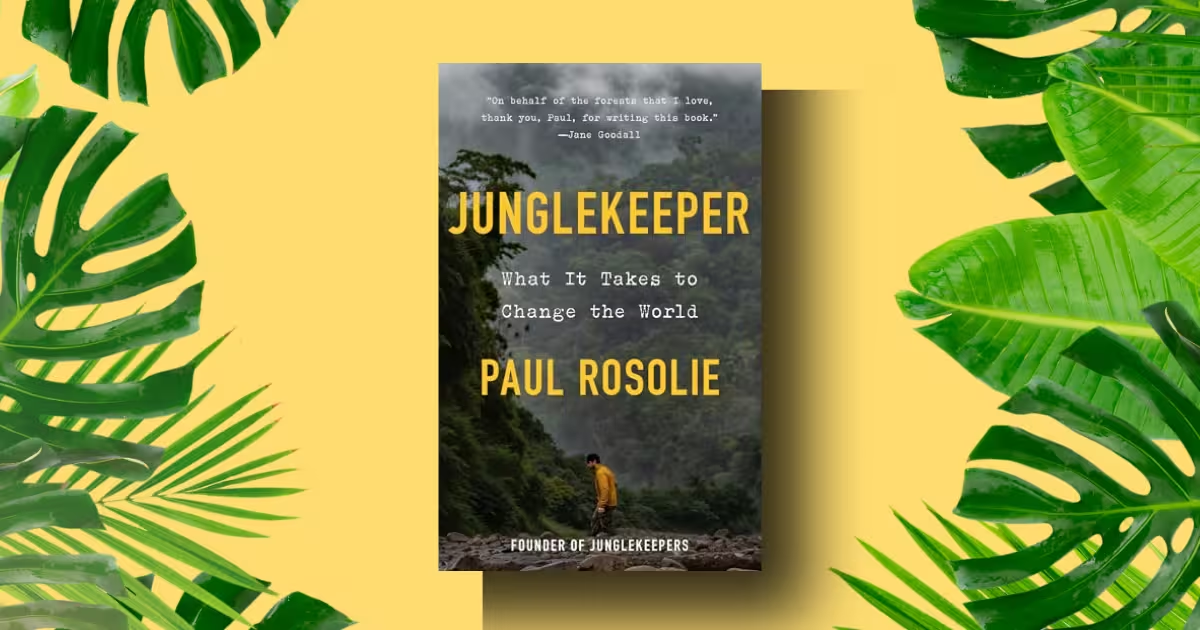
Why does a boy from Brooklyn feel more at home dodging stingrays in a Peruvian swamp than he ever did in a classroom? Junglekeeper is the answer—a raw, blood-and-mud testament to what happens when you stop asking for permission to save the world and just start pulling the starter cord until the motor catches fire.
Junglekeeper is best for readers who devoured The Lost City of Z or Into the Wild and wondered, “What happened next?” for the people who actually stayed; aspiring conservationists and biologists who need a dose of brutal reality before they sign up for grad school—this is the fieldwork they don’t teach you in lectures.
Anyone feeling the weight of “generational amnesia” (the slow forgetting of how wild the world used to be) and looking for a manual on how to fight back.
Fans of narrative non-fiction that reads like a thriller, complete with jaguar standoffs, encounters with uncontacted tribes, and the politics of saving a 1,200-year-old tree.
But not for readers seeking a detached, academic treatise on climate change. This book bleeds; it doesn’t cite abstracts; those who are squeamish about the “grotesque” reality of nature—there are passages about processing monkey meat and riding anacondas that will make you look away.
If you believe that conservation happens solely in boardrooms with PowerPoint presentations, Paul Rosolie’s method of “barefoot machete days” will seem like madness rather than methodology.
Table of Contents
1. Introduction
Junglekeeper: What It Takes to Change the World is a 2026 memoir by American naturalist, explorer, and filmmaker Paul Rosolie.
Published in 2026 by Convergent (an imprint of Penguin Random House), the book arrives with a searing endorsement from the legendary Dr. Jane Goodall on the very first page: “On behalf of the forests that I love, thank you, Paul, for writing this book.”
Junglekeeper is not merely a sequel to Rosolie’s 2014 debut, Mother of God. Where that book was the story of a love affair with the jungle—the discovery of a floating forest and the innocence of exploration—Junglekeeper is the hangover.
It is the story of what happens after you fall in love with a place and then watch it burn. Spanning nearly two decades (2006–2024), the book documents the transformation of a remote stretch of the Las Piedras River in the Peruvian Amazon from a pristine wilderness into a battleground.
The central thesis of Junglekeeper is deceptively simple: Purpose is found not in escaping the world, but in finding something worth fighting for, even when the fight seems impossible.
Rosolie argues that the “cynics” who tell us we live in the end of days are wrong. “This is just the beginning,” he writes, but only if we are willing to adopt the tactics of the jungle—relentlessness, adaptation, and a willingness to get hurt. It’s a rejection of hopelessness in favor of “tactics.”
2. Background: The Two Rivers
To understand Rosolie’s journey, you must understand the unique hydrology of his world. He introduces us to two rivers:
The Physical River: The Las Piedras, a tributary of the Madre de Dios (Mother of God) River. It is a place where the water is so clear you can drink it, where “butterflies swarm by the thousand” so thick you can “hear their wings.”
The Metaphorical River: The “mist river” or “sky river.” Rosolie spends much of the book trying to visualize the invisible—the 20 trillion liters of water the Amazon exhales daily, creating its own weather.
This concept becomes the book’s spiritual anchor: the idea that we are not separate from nature, but a part of a vast, living, breathing system. We are the “river and the sky flowing through us.”
3. Junglekeeper Summary
Junglekeeper is structured as a chronological narrative, jumping between the “barefoot machete days” of innocence and the high-stakes media wars and narco-conflicts of the present.
Part I: The Rarest Species (2006–2012)
The story begins with a murder. On August 2024, two illegal loggers are killed by the Mashco Piro, one of the last “uncontacted” tribes on Earth. Their bodies are found bloated, with maggots flowing from their eyes. Rosolie uses this shocking opener to frame the entire conflict: the jungle is not a passive victim; it fights back.
We are then taken back to 2006, when an 18-year-old Rosolie, dyslexic and a high school dropout, arrives at the Las Piedras Biodiversity Station. He meets Juan Julio Durand (JJ) , an Ese Eja native who grew up barefoot until he was 13. JJ’s father, Don Santiago, was a logger and a legend.
The relationship between Paul and JJ is the heart of the book. They explore a sacred stream—a “Lothlorien-level” paradise—full of jaguar tracks, giant otters, and 160-foot ironwood trees. They hunt with machetes, survive on fish guts, and learn the old ways.
The turning point comes when they discover a road. It appears suddenly, a “red tapeworm” cutting through the jungle. This is an offshoot of the infamous Trans-Amazonian Highway, a project originally funded by the World Bank in the 1970s that Rosolie calls “possibly the most environmentally devastating single project in the history of the world.”
The road brings loggers, squatters, and violence. Their sacred stream is burned to ash. “A hell of humans,” Rosolie writes.
Part II: The Serpent and the Shaman
Rosolie delves into the Indigenous worldview, largely through the eyes of Don Santiago and the shaman Don Ignacio Duri. Santiago’s stories are chilling—tales of being tracked by the Mashco Piro, who use the calls of tinamous and capuchin monkeys as a secret language to surround their enemies.
In a pivotal, hallucinatory chapter, Rosolie drinks ayahuasca with Don Ignacio. The brew is “overboiled,” leading to a terrifying near-death experience. Rosolie describes “falling through his own body,” experiencing the void of space, and witnessing a cosmic beetle the size of a building.
He emerges with a renewed, almost painful appreciation for being alive: “I had a hand.”
This vision—of a warm blue planet suspended in infinite, frigid darkness—cements his mission.
Part III: The Burden of Dreams (2014–2019)
This section details the Faustian bargain of modern conservation media.
The Anaconda: Rosolie and his team, including childhood friend Lee Rando and photographer Mohsin Kazmi, catch a world-record 18-foot-6-inch green anaconda they name Eleanor. It is the longest specimen of Eunectes murinus ever scientifically recorded.
The Backlash: A TV network offers millions to fund their research in exchange for a stunt. Despite catching Eleanor and contributing to vital science on mercury bioaccumulation in apex predators, the resulting show, Eaten Alive, is edited into a circus.
Rosolie is mocked by late-night hosts (Kimmel, Colbert). He describes this period as being consumed by a “Black Dog” of depression, leading to infidelity and the dissolution of his marriage.
Peter Beard’s Shadow: During this low point, Rosolie meets the late artist and conservationist Peter Beard in Manhattan. Beard’s bleak philosophy—”It really is the end of the game”—hits Rosolie hard. He is tempted to give up, to simply document the destruction rather than fight it.
Part IV: The Turning Point (2019)
The world catches fire. In August 2019, the Amazon burns at a rate not seen in years. Rosolie films himself standing in the flames, tears streaming down his face, and posts it with the now-viral line: “Welcome to the fucking Anthropocene.”
The video explodes. He is suddenly the “spokesperson for the Amazon” on MSNBC, CNN, and ABC. He walks through the art deco halls of 30 Rockefeller Plaza, a kid from Brooklyn who just weeks earlier was broke. He realizes his path: “It was time to get back on track.”
Part V: Dharma and the Light (2020–2023)
During the COVID-19 lockdown, Peru is hit hard. Rosolie’s friend Pico, JJ’s brother with a damaged leg from a childhood logging accident, develops a septic infection. His leg turns black.
Using social media, Rosolie, Mohsin, and Lee raise $17,000 to fly Pico to Lima for an emergency amputation, saving his life.
In the depths of his own despair, Rosolie receives a call from tech billionaire Dax Dasilva. Dasilva commits $3.5 million over multiple years to fund Junglekeepers, paying salaries for rangers and turning former loggers into protectors.
Simultaneously, Stephane Thomas, a former Apple engineer and banker who quit to travel the world, joins the team. He builds the tech infrastructure, pro-level DSLR camera traps, and the online donor platform that allows Junglekeepers to scale.
Part VI: The Ancient Forest and the Mashco (2023–2024)
The Mist River: Rosolie climbs a 1,000-year-old kapok tree. For the first time, he witnesses the “mist river”—the atmospheric flow of water vapor—with his own eyes. This is the book’s crescendo: the moment the invisible becomes visible.
The Treehouse: Inspired by this, the team builds the Alta Sanctuary, the world’s tallest luxury treehouse, to bring people into the canopy.
The Lex Effect: Rosolie appears on the Lex Fridman Podcast (Episode #369) . It goes viral, becoming one of Lex’s top episodes ever. This surge in support allows them to save the “Ancient Forest” —10,000 acres of untouched primary forest—in just a few days via a crowdfunding match.
First Contact: In October 2024, the Mashco Piro emerge again. Rosolie, Mohsin, and Stephane race upriver for two days through a biblical storm.
They witness a historic, peaceful exchange: the Indigenous anthropologist Rommel wades into the river naked, offering plantains to the warriors. For three hours, the Stone Age and the modern world share a beach. Rosolie stands in the sunlight, showing his empty hands, and shouts, “Nomolé!” (Brother!).
Afterword: The New War
Junglekeeper ends not with a victory lap, but with a gut punch. Weeks after the manuscript was finished, narco-traffickers flooded the Las Piedras to grow coca. They put a hit out on Rosolie and JJ. On June 23, 2024, their driver, Percy, was stopped at gunpoint on the Lucerna road.
The gunmen asked for “Juan Julio” and “the gringo.” If JJ had been in the car that day, he would have been murdered. “We are now actively being hunted,” Rosolie writes. The fight has changed.
4. Junglekeeper Analysis
Junglekeeper is an outstanding and profoundly important piece of narrative non-fiction.
It is, in a word, visceral. Rosolie manages to do something that few conservation writers achieve: he makes you feel the mud between your toes, the terror of the jaguar’s eyeshine, and the sheer, soul-crushing grief of watching a 1,200-year-old tree fall.
The book succeeds because it refuses to sanitize its hero. Rosolie is brutally honest about his own failures—his infidelity, his depression, his ego-driven deal with a TV network that nearly destroyed his credibility.
This isn’t the story of a saint; it’s the story of a deeply flawed human who found something worth being better for. It grounds the lofty ideals of “saving the world” in the messy reality of divorce, bankruptcy, and death threats.
However, the structure can feel sprawling. The timeline jumps between 2006 and 2024 frequently, and readers new to Rosolie’s work might occasionally get lost in the cast of characters—the nineteen Durand brothers alone require a scorecard. Furthermore, the final section, while gripping, feels rushed.
The transition from peaceful contact with the Mashco to an all-out narco-war happens in the space of a few pages, leaving the reader dizzy.
Nevertheless, Rosolie fulfills his stated purpose. He doesn’t just argue for hope; he demonstrates the mechanism of it.
By showing the step-by-step process—the failed expeditions, the broken motors, the parasitic board members, the eventual alliance with Dax Dasilva and Stephane Thomas—he demystifies conservation.
He proves that protecting 117,000 acres isn’t magic; it’s just “pulling the cord” enough times.
5. Strengths and Weaknesses
Strengths:
Immersive Prose: Rosolie’s writing is cinematic. Descriptions of the “mist river” swirling in the dawn light or the “lepidopteran confirmation of reality” as butterflies scatter before the Mashco Piro are stunning.
Unflinching Honesty: The confession of his personal failures makes the later redemption arc believable. It’s rare to read a conservation memoir where the author admits to being the “bad guy.”
Indigenous Centricity: Unlike many “explorer” narratives, JJ is not a sidekick. He is the hero. The book is as much JJ’s biography as it is Rosolie’s, culminating in JJ being named a TIME100 Climate Leader.
The Mashco Piro Chapter: The description of the encounter in October 2024 is the most compelling and responsible piece of writing about “uncontacted” people I have read. It balances the terror of the situation with profound respect and awe.
Weaknesses:
Information Density: The book is packed with names, dates, and scientific tangents (trophic levels, diploendozoochory). Some readers may find the pacing uneven.
The “Unbelievable” Factor: Rosolie acknowledges this himself. The story of riding an anaconda in the Floating Forest is so surreal that he preemptively begs the reader to trust him. For the hyper-skeptical, these passages might strain credibility.
6. Comparison with Similar Works
For fans of The Lost City of Z (David Grann): Both explore the lethal mystique of the Amazon. But where Grann’s Fawcett vanished, Rosolie stayed. Junglekeeper is the story of what happens to the people who don’t leave.
For fans of Into the Wild (Jon Krakauer): Both feature protagonists who reject modern society. But where McCandless sought to disappear, Rosolie sought to protect. His “freedom” is not solitude, but responsibility.
For fans of Jane Goodall: The endorsement is apt. Rosolie shares Goodall’s ability to see animals not as “subjects” but as individuals with personalities and souls, as evidenced by his deep connection with the elephant Dharma in India.
7. Conclusion
Junglekeeper is essential reading for anyone who has ever felt the “child’s dream of being an adventurer” and wondered if it was too late. It is suitable for a general audience, though a strong stomach is advised. This is not an armchair environmentalist’s handbook; it is a front-line dispatch.
If you are a student of biology, a burnt-out activist, or just someone who needs a reminder that the world is still full of “deep unknowable things,” read this book. It will leave you with a lump in your throat and, perhaps, the urge to go find your own stream to defend.
As Rosolie’s father reminded him with the story of the harmoniums from Kurt Vonnegut, we all just want a place “where I can do good without doing any harm.” For Paul Rosolie, that place is the Las Piedras. For the rest of us, this book is the map.







