
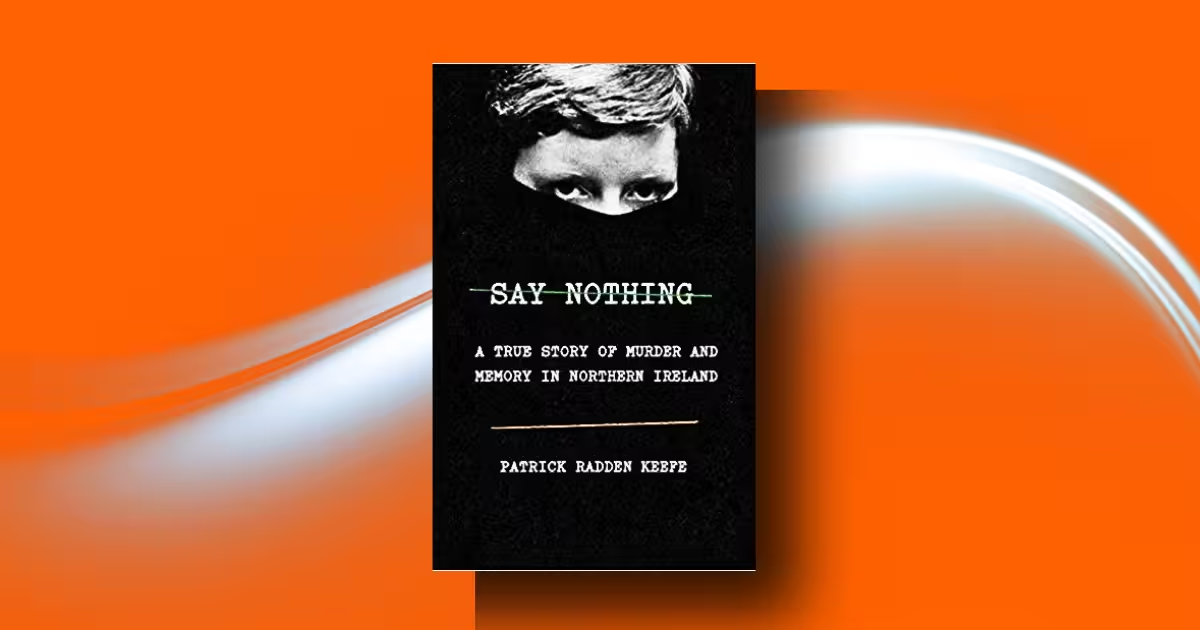
Do You Truly Understand Why Some Wounds Refuse to Heal? Say Nothing Will Haunt You Until You Finally Grasp the Silence
If you have ever felt that the real story of any conflict is never the one you find in the history books, but the one whispered behind closed doors and buried in the unmarked graves of memory, then Patrick Radden Keefe’s Say Nothing: A True Story of Murder and Memory in Northern Ireland is not just a book you will read; it is a forensic excavation of the soul that will rearrange your understanding of truth, loyalty, and the cost of keeping secrets.
Say Nothing is a good read for readers who crave narrative nonfiction that reads with the propulsion of a noir thriller and the emotional weight of a Greek tragedy. If you are fascinated by the psychology of radicalization, the ethical quicksand of guerrilla warfare, or the specific, searing history of Northern Ireland’s Troubles, this is your next essential read.
Not for this is not a dry, academic survey of the Troubles. If you are looking for a balanced, equidistant overview of British Army tactics versus IRA strategy, or a simple timeline of events, you may find Keefe’s intimate, character-driven focus disorienting.
Furthermore, if you are deeply uncomfortable with moral ambiguity, or if you require a neat, satisfying resolution where the “bad guys” are caught and the “good guys” find peace, Say Nothing will likely frustrate and perhaps even anger you.
Table of Contents
1. Introduction
Say Nothing: A True Story of Murder and Memory in Northern Ireland was first published in Great Britain by William Collins in 2018, with the eBook edition arriving that same November.
Written by Patrick Radden Keefe, an American investigative journalist and longtime staff writer at The New Yorker, the book quickly transcended its initial release to become a modern classic of narrative nonfiction.
It landed on the New York Times bestseller list, won the National Book Critics Circle Award for Nonfiction, the Orwell Prize for Political Writing, and was named one of the New York Times‘ 100 Best Books of the 21st century.
In 2024, it was adapted into a critically acclaimed, nine-episode FX limited series (streaming on Hulu and Disney+), which itself sparked renewed public interest and even new leads in the ongoing search for the “Disappeared”.
But what is this book, exactly?
It is neither a comprehensive history of the thirty-year sectarian conflict known as the Troubles (a period that claimed over 3,500 lives), nor is it a straightforward true-crime procedural.
Instead, Keefe uses a single, horrifying event—the 1972 abduction and murder of Jean McConville, a widowed mother of ten from the Divis Flats in West Belfast—as a lens through which to view the entire moral catastrophe of the era. Jean McConville was thirty-eight when she disappeared.
She had spent nearly half her life either pregnant or recovering from childbirth, bringing fourteen children to term and losing four, leaving her with ten kids ranging from twenty years old down to six-year-old twins.
In December of that bloodiest year of the Troubles, a gang of masked men and women burst into her flat and dragged her away. Her children were told she would be back in a few hours. They never saw her alive again.
Keefe’s central thesis is as bold as it is devastating: that the Irish Republican Army (IRA), in its ruthless pursuit of a united Ireland, committed a profound, intimate crime—the secret execution and burial of one of its own citizens—and then constructed an elaborate fortress of lies and silence to protect its leaders, most notably the enigmatic Gerry Adams.
The book argues that this act of “disappearing” Jean McConville was not an aberration of war, but a calculated policy, and that the refusal of those who ordered it to acknowledge their role has created a festering wound in the very heart of the peace process.
As Keefe writes in his epigraph, quoting Viet Thanh Nguyen: “All wars are fought twice, the first time on the battlefield, the second time in memory”. Say Nothing is the essential account of that second, more intimate and unending war.
2. Background
To understand the gravity of Jean McConville’s disappearance, you must first understand the world she inhabited.
The Belfast of the early 1970s was not merely a city in conflict; it was a city where the very air people breathed was thick with suspicion, fear, and a perverse, almost tribal, intimacy.
The working-class Catholic neighborhoods like the Falls Road and the Divis Flats complex existed in a state of siege.
The British Army, initially welcomed by Catholics as protectors against loyalist mobs, had become a hostile occupying force, their soldiers patrolling the streets in armored vehicles and subjecting residents to humiliating searches and brutal curfews.
It was in this pressure cooker that the Provisional IRA (the “Provos”)—a hardline splinter group that had broken away from the more politically-minded Official IRA in 1969—rose to prominence.
They styled themselves as the defenders of the Catholic ghettos. Keefe masterfully paints a portrait of this world as one where the lines between civilian and combatant were hopelessly blurred.
At Divis Flats, where the McConville family lived, a system known as “the chain” operated: when police or army came to search a flat for weapons, the resident would pass the gun out the back window to a neighbor, who would pass it along, until the weapon had vanished into the labyrinth of the complex.
It was a neighborhood where children like Michael McConville learned to sleep on the floor in the center of the flat to avoid stray bullets, and where a young boy could be casually stabbed in the leg by IRA youths with a warning: “Don’t talk to anyone about what happened to your mother”.
This was the milieu that forged a generation of revolutionaries. Among them were Dolours and Marian Price, two beautiful, fiercely intelligent sisters from a family steeped in republican mythology.
Their father, Albert, had been an IRA man; their aunt, Bridie, had lost both her hands and her sight in an accidental explosion while moving a cache of weapons for the cause, an injury the family regarded with “admiration for her willingness to offer up everything for an ideal”.
The Price sisters were not merely passive inheritors of this legacy; they were active, ambitious architects of its most violent chapter. Dolours, in particular, bristled at being relegated to the women’s auxiliary (Cumann na mBan), famously telling the IRA leadership, “Army or nothing”.
She wanted to be a “fighting soldier,” and in the intensely patriarchal, Catholic society of 1970s Belfast, her demand was both revolutionary and terrifying.
Keefe also introduces us to Brendan Hughes, the brilliant and fearless “officer commanding” of the IRA’s D Company in West Belfast—a man known to the British Army as “Darkie” or “the Dark.” Hughes was a pure soldier, a tactical genius who lived on the run, masterminding bank robberies, bombings, and assassinations with a relentless, almost manic energy.
He was the man in the arena, while his close friend and commanding officer, the “gawky fella with big black-rimmed glasses” named Gerry Adams, was the strategic mastermind, the “key strategist” who could perceive the broader political context and the shifting tectonics of the conflict.
The stage was thus set: a community in chaos, a secret army that demanded absolute loyalty, and a cast of characters whose youthful idealism was being forged into a weapon of immense, and ultimately self-destructive, power.
Jean McConville, a Protestant who had married a Catholic and was now a depressed, overwhelmed widow in a Catholic stronghold, was utterly vulnerable in this world. Her only crime, it seems, was a simple act of human decency.
One night, during a gun battle outside her flat, a wounded British soldier lay crying for help.
While her children cowered, Jean McConville rose from the floor, went to the door, and cradled the dying soldier’s head, murmuring a prayer. “That was somebody’s son,” she told her children later.
By the next morning, the words “BRIT LOVER” were daubed in fresh paint across her front door.
The rumors that she was a “tout”—an informer—had begun, and her fate was sealed.
3. Say Nothing Summary: The Machinery of Memory and Murder
Say Nothing is structured like a masterfully crafted novel, but every detail is anchored in Keefe’s exhaustive research, which included seven trips to Northern Ireland and interviews with more than one hundred people, as well as a trove of archival materials.
It weaves together three primary narrative threads, which ultimately converge in a devastating reckoning.
The Crime and Its Aftermath: The book opens with the chillingly chaotic abduction of Jean McConville. A gang of neighbors, some masked, burst into her flat on St. Jude’s Walk. Her children clung to her, screaming. She was told she would be back in a few hours.
A week later, her purse and wedding rings were returned to the flat by a young man who said, “I don’t know anything about your mother. I was just told to give you these”.
Her children, the eldest of whom was just twenty, were left to fend for themselves. They refused to be taken into state care at first, insisting their mother would return.
They were starving.
They were eventually scattered to a series of nightmarish Catholic orphanages and institutions, where they suffered horrific physical and sexual abuse. One of the twins, Billy, would later testify at an inquiry into institutional abuse, describing himself as having become “like a robot” from being so “institutionalized”.
The Rise and Fall of the True Believers: Parallel to this tragedy, Keefe traces the dizzying, violent careers of Dolours Price and Brendan Hughes.
We see Dolours transform from an idealistic student protester, beaten and radicalized at the Burntollet Bridge ambush in 1969, into one of the most dangerous women in Western Europe.
She joins an elite, secretive IRA unit called “the Unknowns,” which answers directly to Gerry Adams and is tasked with the most sensitive and brutal missions, including “disappearing” suspected informants.
She masterminds a catastrophic car-bombing campaign in London in March 1973, which injures over 200 people and kills one. Her subsequent trial, hunger strike (during which she is brutally force-fed), and years of imprisonment become a cause célèbre.
We witness Brendan Hughes’s daring escape from Long Kesh prison, his life on the run disguised as a dapper toy salesman, and his eventual leadership of the harrowing “dirty protest” and hunger strikes in the H-Blocks.
Both Hughes and Price are presented as true believers, warriors who gave their entire youth and sanity to the cause, only to be shattered by the peace process that followed.
They come to see the Good Friday Agreement of 1998, which formally ended the conflict without achieving their lifelong goal of a united Ireland, not as a hard-won compromise, but as a profound betrayal.
The Secret Archive That Blew It All Open: The third, and most riveting, thread concerns the “Belfast Project,” an oral history initiative secretly run by Boston College in the early 2000s.
The project’s aim was to create an archive of testimonies from former paramilitaries on both sides of the conflict, to be sealed until after their deaths. It was conceived as a historical time capsule, a way to record the raw truth before the participants took it to their graves.
However, the project’s promise of confidentiality would prove to be a ticking time bomb.
Interviewed by a former IRA prisoner-turned-researcher, Anthony McIntyre, both Brendan Hughes and Dolours Price unburdened themselves of decades of secrets.
On those tapes, they named names.
They described the inner workings of the IRA’s command structure. And, most explosively, they both identified the man they said had given the order for Jean McConville’s disappearance and execution: Gerry Adams.
Keefe then details the extraordinary, multi-year legal battle that ensued when the Police Service of Northern Ireland (PSNI), acting on a mutual legal assistance treaty with the US, subpoenaed the Boston College tapes as evidence in their investigation into McConville’s murder.
This unprecedented case pitted the promise of academic confidentiality against the demands of criminal justice, and it placed the aging, haunted participants of the Belfast Project in mortal danger from the very organization they had once served.
As a chilling piece of graffiti that appeared on Belfast walls put it, they were now “BOSTON COLLEGE TOUTS”.
Who Was Jean McConville? The Portrait of a “Simple Belfast Mother”
Jean McConville was not a revolutionary, a spy, or a woman of means. According to Keefe’s reporting, she was a figure of immense, quiet vulnerability. Born Jean Murray in 1934 to a Protestant family in East Belfast, she left school at fourteen to work as a servant for a Catholic widow.
It was there she met her husband, Arthur McConville, a tall British Army veteran. Their “mixed” marriage—Protestant and Catholic—was a transgression in the tribal landscape of mid-century Belfast. As the book details, “By entering Arthur’s mother’s house as a domestic employee, Jean had crossed these lines.
When she took up with Arthur, his mother resented it… one of Jean’s uncles, a member of the Orange Order, gave her a beating for the transgression” (p. 26-27).
Her life was defined by staggering maternal endurance. Keefe writes:
“Jean McConville was thirty-eight when she disappeared, and she had spent nearly half her life either pregnant or recovering from childbirth. She brought fourteen children to term and lost four of them, leaving her with ten kids who ranged in age from Anne, who was twenty, to Billy and Jim, the sweet-eyed twins, who were six” (p. 5).
When Arthur died of cancer in early 1972, Jean was left “a widow with a meagre pension but no paying job of her own” (p. 5).
She sank into a deep depression, seldom leaving the house, and Keefe notes that she was admitted to the local psychiatric hospital, Purdysburn, and made “several attempts at suicide” (p. 59).
The family had been driven from their East Belfast home by loyalist mobs and now lived in the notorious Divis Flats in West Belfast, a “dank and hulking” housing complex that Keefe describes as a “nightmare from an Escher drawing” (p. 6-7). She was, by any measure, a woman barely holding on.
Crucially, the book examines the casus belli—the reason the IRA gave for marking her as a “tout” (informer). Keefe documents a fateful night when Jean performed an act of simple human mercy. During a gun battle outside the flat, a wounded British soldier cried out for help.
“As her children watched, Jean McConville rose from the floor… and moved to the door. Peeking outside, she saw the soldier… The children remember her re-entering the flat and retrieving a pillow, which she brought to the soldier. Then she comforted him, murmuring a prayer… Archie… admonished his mother for intervening. ‘You’re only asking for trouble,’ he said. ‘That was somebody’s son,’ she replied” (p. 59).
By morning, the words “BRIT LOVER” were scrawled on their door (p. 60). This act of compassion, in the febrile atmosphere of 1972 West Belfast, was the fatal spark that lit the rumor mill.
How Jean McConville Was Killed: The Logistics of a Secret Execution
Keefe reconstructs the killing not through police forensics—the body would not be found for decades—but through the secret, recorded confessions of the perpetrators.
The abduction itself was a clinical military operation carried out by the neighbors she saw every day. On the evening of December 7, 1972, a gang of up to a dozen people burst into the flat.
“It happened so abruptly that none of the McConville children could say precisely how many there were… There were men and women. Some had balaclavas pulled across their faces; others wore nylon stockings over their heads… Michael McConville realised, to his horror, that the people taking his mother away were not strangers. They were his neighbours” (p. 6).
Jean was taken to a house for interrogation.
She was beaten severely. But the true, grim mechanics of her death were provided by Dolours Price, the former IRA bomber and member of the secretive “Unknowns” unit, in an interview she gave to journalist Ed Moloney years later.
That interview, deposited in the Boston College archive, is the Rosetta Stone of the murder. Keefe details how Price was ordered to take McConville across the border into the Republic of Ireland.
Initially, the local IRA unit in Dundalk refused to kill a woman. They dug the grave but couldn’t pull the trigger. Price was called back. She described the scene with a chilling, matter-of-fact tone in the transcripts obtained by Keefe:
“‘She’d been there for about four to five days. And we were called back to Dundalk.’ The local unit had dug a hole in the ground. All they had to do was take McConville across a field to the freshly dug grave and shoot her. But they hadn’t. ‘They didn’t want to do it,’ Price said. It was because McConville was a woman, she thought. ‘So you guys had to do it,’ Moloney said. Price said nothing, just made a small murmur… ‘Yeah'” (p. 349-350).
The execution was deliberately ambiguous to salve the conscience of the killers. Price and two other members of the “Unknowns”—Wee Pat McClure and a third, unnamed shooter—stood over the grave with one gun.
“‘We each in turn fired a shot,’ Price said. When Price fired hers, she deliberately missed. Then one of the others pulled the trigger, and McConville collapsed. ‘We left her in the hole,’ Price said. Then the local Dundalk unit sealed the grave” (p. 350).
How the Mystery Was Solved: The Boston Tapes and the Unpunished Truth
For over 25 years, the disappearance of Jean McConville was a cold case shrouded in the enforced silence of West Belfast.
As Keefe writes, “One by-product of the Troubles was a culture of silence. With armed factions at war in the streets, an act as innocent as making enquiries about a vanished loved one could be dangerous” (p. 111).
The IRA maintained the fiction that she had been a British spy, a narrative that her children spent their lives fighting. In 1999, the IRA even admitted to the killing but insisted she was an informer, a claim the Police Ombudsman would later find no evidence for.
The “solution” came not from a detective, but from an archive. The Belfast Project, an oral history run by Boston College, promised former paramilitaries that their testimony would be sealed until their deaths.
Feeling betrayed by the peace process and the denialism of Sinn Féin leader Gerry Adams, Brendan Hughes and Dolours Price unburdened themselves. Keefe reports that Hughes told interviewer Anthony McIntyre that Adams “gave the order for that woman to be executed” (p. 284).
Price’s confession to Moloney was even more damning, as she described being the one to pull her into the car and lie to her about her children.
Who Killed Her and Why?
According to the book’s evidence—the testimonies of Hughes and Price—the order came from Gerry Adams, the commanding officer of the Belfast Brigade. The actual execution was carried out by the “Unknowns”: Pat McClure, Dolours Price, and a third gunman (whom Keefe strongly implies was Marian Price, Dolours’s sister).
The Why is a grim, bureaucratic irony.
Keefe reports that Ivor Bell, a senior IRA man, argued against disappearing her. Bell said, “If you are going to kill her, put her on the fucking street… What’s the sense of killing her and burying her if no one knows what she was killed for?” (p. 284). But Adams overruled him.
The motive was image management.
Hughes explained to McIntyre that Adams feared “that because McConville was a woman, and a widowed mother, her murder could damage the reputation of the IRA” (p. 284).
Therefore, the order was given not just to kill her, but to erase her completely from the face of the earth.
The final, tragic irony, as documented by Keefe, is that the revelation of the truth did not lead to justice.
Adams was arrested and questioned in 2014 based on the Boston tapes but was released without charge.
The book ends not with a verdict, but with the image of Jean McConville’s son Michael holding a pigeon—a creature that, unlike his mother, will always find its way home.
4. Say Nothing Analysis: A Mesmerizing, Morally Unsparing Masterpiece
Say Nothing is a towering achievement of investigative journalism. It is a work of such staggering ambition and profound empathy that it feels less like a book you read and more like an experience you survive.
Keefe has accomplished something genuinely rare: he has written a narrative about a deeply complex, politically charged conflict that is both breathtaking in its scope and granular in its human detail.
The book is, in my estimation, the definitive account of the moral rot at the heart of the Troubles, not because it is a polemic, but because it is a work of almost surgical precision.
It lays bare the brutal machinery of a “just war” and forces us to stare, unblinking, at the human cost of its gears.
What sets Say Nothing apart from almost any other book on the subject is Keefe’s complete mastery of narrative structure.
He is a writer for The New Yorker, and it shows. He understands that the most compelling way to explore a sprawling, epochal conflict is not through broad historical sweeps, but through the intimate, flawed lives of a handful of unforgettable individuals.
He builds his case like a prosecutor, meticulously laying out evidence from declassified British army files (detailing the existence of a hand-held radio in Divis Flats that could have been used by an informer) to secret IRA comms written on cigarette papers.
He lets the participants indict themselves.
For instance, in the secret interview she thought would never be released in her lifetime, Dolours Price describes driving Jean McConville to her death. She lied to the terrified widow, telling her she was being taken to a place of safety.
McConville asked, “Will my children be brought to me?” Price lied again: “Yes, I’m sure they will.” Later, Price coldly recalls McConville saying, “I knew those Provo bastards wouldn’t have the balls to shoot me,” and adds, with chilling detachment, “And the ‘Provo bastards’ who were driving her thought, Oh, wouldn’t they?”.
Yet even as she condemns the woman, the armor cracks: “Those experiences, I mean…” she trails off. “I think about them… I do occasionally say, ‘Well, God bless them. I hope they are in a better place.”
The book is a monumental act of witness-bearing. It is not a polemic that seeks to condemn the IRA wholesale or exonerate the British state.
Keefe is too good a reporter for that. He acknowledges the structural discrimination against Catholics that fueled the civil rights movement, and he unflinchingly documents the British Army’s own “dirty war”—the use of the shadowy MRF unit to assassinate suspected IRA members, and the state’s deep collusion with loyalist death squads.
As Keefe notes, a subsequent investigation into state collusion found “frankly shocking levels” of complicity, with one former MRF officer admitting, “We were not there to act like an army unit. We were there to act like a terror group”.
This even-handedness is crucial, for it underscores the book’s central, uncomfortable truth: that in a long, intimate war, the moral distinctions between sides often dissolve, leaving only a residue of trauma and a ledger of unpunished crimes.
Say Nothing is also a profound, heartbreaking exploration of the psychology of “moral injury”—a concept distinct from PTSD that relates to the damage done to a person’s soul when they are forced to transgress their own deeply held ethical codes.
This is the torment that consumes Brendan Hughes and Dolours Price in their final years.
They are haunted not by the bombs they planted or the soldiers they killed—those were, to them, legitimate acts of war—but by the secret burials, the lies, and the ultimate sense that all their monstrous sacrifices were for nothing.
Hughes, living out his days as a chain-smoking recluse in a flat in Divis Tower, looks at his old friend Gerry Adams, now a tweedy statesman, and feels a burning, righteous rage. “I’m disgusted with the whole thing,”
Hughes says in his Boston College tapes. “It means that people like myself… have to carry the responsibility of all those deaths.” He concludes that “not one death was worth it”.
5. Comparison with Similar Works
Say Nothing occupies a unique place on the shelf of modern narrative nonfiction. It invites immediate comparison to Truman Capote’s In Cold Blood, the ur-text of the “nonfiction novel.”
Like Capote, Keefe uses the tools of a novelist—suspense, deep character development, and a keen eye for symbolic detail—to tell a true-crime story.
But where In Cold Blood is a closed case, a story of a senseless crime with a clear beginning, middle, and end (the execution of the killers), Say Nothing is an open wound.
The killers are still walking the streets, some of them are world leaders, and the victims’ families are still waiting for justice.
Another powerful comparison is London Falling.
They ask the same question Keefe asks: Is it possible to have peace without truth? Or is “moving on” just a polite way of saying “forgetting on purpose”?
6. Conclusion: The Unquiet Grave
Say Nothing is, without question, one of the most important and electrifying works of nonfiction published in the last decade.
It is a book that will appeal to a remarkably wide audience. General readers who simply want a gripping, beautifully written story will find themselves unable to put it down.
Students of history, political science, and journalism will find it a model of meticulous research and narrative craft.
And anyone, from any part of the world, who has ever wondered how a society can tear itself apart and then pretend to stitch itself back together will find its themes deeply resonant.
But be warned: this is not a book that offers easy answers. It will not make you feel good. It will, instead, leave you with a heavy heart and a head full of difficult, unanswerable questions.
It will make you think about the nature of loyalty and betrayal, the seductive power of a righteous cause, and the unspeakable damage that secrets can do—to individuals, to families, and to entire nations.







