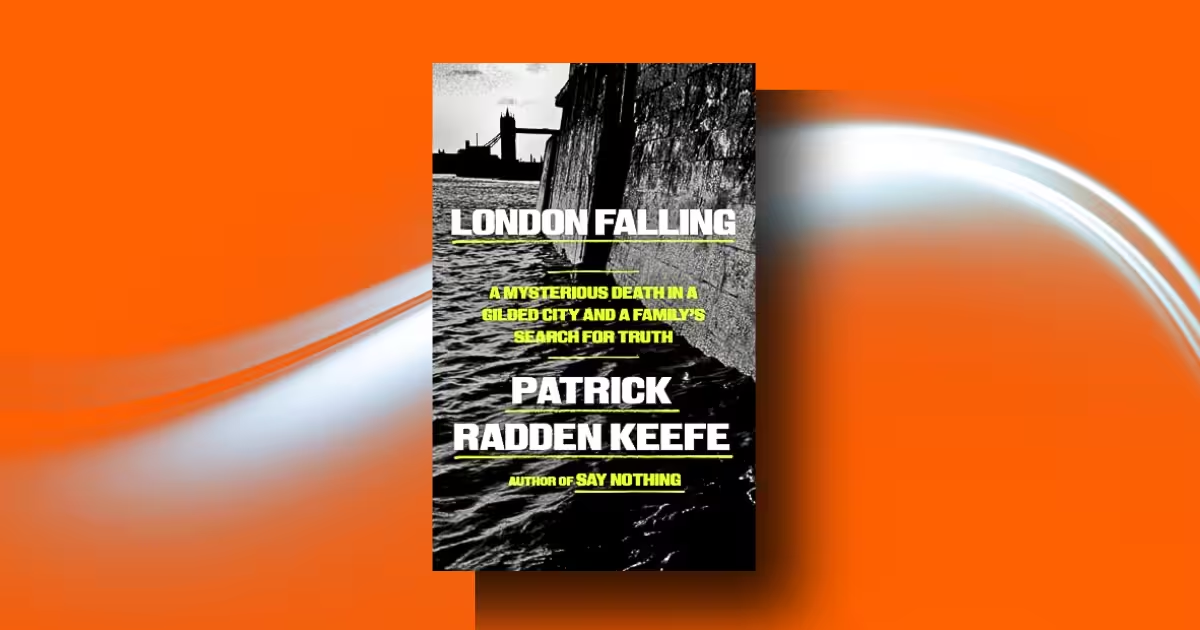
Ever wonder why you can live in a city for decades and still be blind to the secret life teeming right under your nose? London Falling will show you how a 19-year-old’s desperate bid to escape his own skin—and his own parents’ home—plunged an entire family into a labyrinth of oligarchs, gangsters, and a police force that, frankly, stopped caring.
London Falling is best for readers who devour immersive true crime with a social conscience—think Say Nothing or Empire of Pain. If you want to understand how post-Big Bang London became a laundromat for dirty money, and how that corruption trickles down to swallow the vulnerable, this is your next read.
It’s also a profound, and frankly devastating, exploration of parental grief and the terrifying realisation that you never truly knew your child.
Not for readers seeking a neat, satisfying courtroom ending. Zac Brettler’s story doesn’t come wrapped in a bow. The official inquest returned an “open verdict,” and Keefe’s narrative leaves you marinating in the maddening ambiguity that still haunts the Brettler family.
If you need a clear-cut villain in handcuffs, this book will leave you as frustrated as Scotland Yard made the victim’s parents.
Table of Contents
1. Introduction
In the early hours of November 29, 2019, a surveillance camera on the headquarters of MI6 captured a dark figure stepping out onto the fifth-floor balcony of Riverwalk, a luxury apartment complex directly across the Thames. The night was cold, the river was high, and the apartment—unit 504—blazed with light.
At 2:23 a.m., a slender silhouette paced the balcony, peered over the edge, and then jumped. Five days later, after a Kafkaesque delay by the Metropolitan Police, a body was identified: Zac Brettler, 19 years old.
London Falling: A Mysterious Death in a Gilded City and a Family’s Search for Truth is Patrick Radden Keefe’s masterful, deeply unsettling investigation into that night.
Published by Doubleday on April 7, 2026, it arrives as the latest from a writer who has redefined the true crime genre. Keefe, a New Yorker staff writer and the author of the Baillie Gifford Prize-winning Empire of Pain and the National Book Critics Circle Award-winning Say Nothing, doesn’t just dissect a death; he uses Zac’s fall as a scalpel to open up the belly of modern London—a city where, as Keefe writes, “everything is for sale, and aspirational fantasies are underwritten by dirty money and corruption.”
The central argument of London Falling is not merely that Zac Brettler died under suspicious circumstances, but that his death was the almost inevitable collision between a lonely teenager’s desperate fantasy life and the brutal, transactional reality of a city awash in oligarch cash and gangland violence.
It’s a story about the lies we tell ourselves and others, and the institutional failures—from the police to the health service—that let a boy slip through every possible crack.
2. Background: The Boy Who Wanted to Be “The Big I Am”
To understand why Zac’s story is so heartbreaking, you have to understand the soil he grew in.
His parents, Matthew and Rachelle Brettler, were not flashy. Matthew worked in structured finance but preferred cycling to supercars. Rachelle was a freelance journalist for How to Spend It, a magazine she ironically describes as “the Argos catalogue for rich people.” They were comfortable but, crucially, stable.
Both were the children of Holocaust survivors. Rachelle’s father, Rabbi Hugo Gryn, was a beloved BBC broadcaster and Auschwitz survivor.
Matthew’s father, Benny Brettler, arrived in England on the last Kindertransport from Germany in 1939, alone at thirteen. The family ethos was one of quiet survival, not ostentation.
But Zac? Zac craved the opposite. At Mill Hill School, a private school costing £30,000 a year, he was surrounded by the children of actual oligarchs—kids who took Ubers to avoid an eight-minute walk and partied at Annabel’s.
He began to change. He wore sharp suits, carried a briefcase, and told his friends his family owned a fleet of Range Rovers and an apartment at One Hyde Park, the Candy brothers’ bulletproof-glass fortress for the global super-rich.
He even showed his father a faked bank statement showing £850,000 in his HSBC account. “It was a whole life that was just an edifice of lies,” his father Matthew would later lament.
By 2018, Zac had crafted a new persona: Zac Ismailov, the son of a Russian oligarch, heir to a £200 million fortune. He had a thick accent, a dead father, and a mother in Dubai who had cut him off. It was a fiction, but in a London where property is often owned by anonymous offshore shell companies and billionaires actively scrub their digital footprints, it was a disturbingly plausible fiction.
3. London Falling Summary
Keefe’s narrative is a masterclass in controlled revelation, so I’ll walk you through the key disclosures, but trust me, the power is in the journey.
The Deception and the Entanglement
Zac’s alter ego worked. Through a Chelsea Football Club contact named Mark Foley, Zac was introduced as a wealthy young investor to Akbar Shamji, a 47-year-old entrepreneur living in a £10 million Mayfair apartment with his wife, fashion designer Daniela Karnuts, whose label Safiyaa dressed Michelle Obama and Meghan Markle. Shamji, perpetually on the edge of financial ruin and declaring bankruptcy, saw Zac as a golden ticket. He introduced Zac to Verinder Sharma—known on the street as “Indian Dave” —a 55-year-old gangster and debt collector with a history of extreme violence.
Indian Dave, who lived in the Riverwalk apartment (rent paid for by the shadowy financier Nick Gold), took Zac in as a “mentee.”
But this was a long con. Indian Dave’s specialty was “warming up the knife”—heating blades on the stove to terrify debtors into paying. He saw in “Zac Ismailov” not a surrogate son, but a payday.
By November 2019, the jig was up. Zac had blown through the £18,000 in real money he actually had, leaving just £4 in his account. Indian Dave, realising he’d been duped by a middle-class teenager from Maida Vale, was furious.
The Final Night: “He’s Not Allowed to Run Away Now”
On November 28, 2019, Zac was summoned to Riverwalk. He packed an overnight bag with neatly folded clothes for several days. He emailed his mum about booking a driving test. He was not planning to die.
Inside apartment 504, the atmosphere curdled. Text messages obtained by police show Indian Dave’s impatience: “I’m thinking fuck this little kid,” and at 4:30 p.m., “He’s not allowed to run away now.”
Later that night, Akbar Shamji texted a friend named Mervin Sealy: “I have just been heating up knives and clearing up blood.” Just before 2:04 a.m., Zac searched on his iPad: “what to do with skin burns.” Twenty minutes later, he was on the balcony.
He didn’t jump to die. Keefe’s investigation, along with Matthew Brettler’s own painstaking work, reveals that Zac aimed for the river. From that height, the water looks closer than it is. He was a fit, athletic kid. He was trying to escape. He nearly made it. But his hip clipped the embankment wall on the way down, and he drowned, likely unconscious.
The Aftermath and The Cover-Up
This is where the story curdles from tragedy into outrage. The Met Police, distracted by the London Bridge terror attack that same day, didn’t identify Zac’s body for five days.
During that time, Akbar Shamji met Zac’s distraught parents and lied to their faces, telling them Zac had confessed to a heroin addiction and probably “gone off to get some drugs.” Meanwhile, Indian Dave had his apartment professionally cleaned.
When police finally did investigate, they were spectacularly inept. They found blood-like smears in the bathroom and on the bedroom wall. They didn’t test them. They found a section of the balcony glass had been freshly wiped clean.
They didn’t fingerprint it. They failed to interview key witnesses like the doorman who recognised Zac’s body or the driver sent to the Brettlers’ home the morning after. They had GPS data from Shamji’s Mercedes showing he drove erratically near the scene just before the fall, and they never used it.
The coroner returned an “open verdict” in 2022, unable to rule it suicide or homicide. A year later, in December 2020, Verinder “Indian Dave” Sharma was found dead in the same apartment from a drug overdose, after a previous failed attempt on the exact anniversary of Zac’s death.
4. London Falling Critical Analysis
London Falling is a staggering, infuriating, and profoundly important book. It is Keefe’s most emotionally raw work to date.
Keefe doesn’t just report; he builds. The book is structured like a thriller, but the suspense comes not from whodunit—we know who the suspects are—but from the slow, dawning horror of institutional failure. Keefe effectively supports his thesis that Zac’s death was a “murder” of circumstance, driven by fear.
The evidence is damning: the broken jaw (unexplained by the fall), the “witness protection” search on his iPad, the “heating up knives” text, the wiped glass, the GPS data showing Shamji racing back to the scene.
Keefe contrasts the Met’s “bizarre passivity” with the relentless, amateur detective work of Matthew Brettler, who becomes the book’s true hero. Matthew’s methodical, spreadsheet-driven approach to his son’s death is both admirable and heartbreaking; it’s the only way he knows to keep loving Zac. “He is very analytical, but that doesn’t mean that he doesn’t feel pain,” a friend observes. “He focuses on the facts.”
The book brilliantly fulfills its purpose of exposing London’s “twenty-four-hour laundromat for dirty money.” Keefe draws a direct line from the “Big Bang” deregulation of the 1980s, through the influx of oligarchs like Roman Abramovich, to the glass towers of One Hyde Park, and finally to the fifth-floor balcony at Riverwalk.
Zac didn’t just fall for a gangster; he fell for a city that had made con artistry and crooked money the pinnacle of aspiration.
5. Strengths and Weaknesses
What I Found Compelling (Strengths)
The Humanity of the Brettlers: Keefe writes about Rachelle and Matthew with immense tenderness. The scene where Rachelle identifies Zac’s body and is told she cannot touch him, and then they go for coffee in Canary Wharf as if the world hasn’t ended, is devastatingly real.
The Historical Sweep: Keefe doesn’t just give us Zac. He gives us the history of the Shamji family (from Idi Amin’s Uganda to Margaret Thatcher’s inner circle) and the criminal ascent of Indian Dave. These digressions never feel like padding; they feel like the necessary backstory to explain how a 19-year-old could end up in such a dangerous room.
The Deception of Zac: Keefe handles Zac’s lies with nuance.
He wasn’t a sociopath; he was a lonely, anxious kid who discovered that pretending to be rich was the fastest way to make people want him. “In that boarding school environment, with people who had this mind-boggling access to money, Zac all of a sudden had a space in which he could create another version of himself.” That line, from his father, is the key to the whole tragedy.
Where It Left Me Frustrated (Weaknesses)
The Inevitable Ambiguity: This is not Keefe’s fault—it’s the fault of the case. But readers should be warned: you will finish this book angry. Angry at Akbar Shamji’s smirking evasiveness.
Angry at a police force that couldn’t be bothered to test blood stains. Angry that Indian Dave died before he could be properly held to account. The lack of a definitive legal resolution, while true to life, makes for a grim, almost nihilistic reading experience.
A Slight Over-Reliance on the Brettlers’ Lens: Because the Brettlers are Keefe’s primary sources, and Akbar Shamji refused to be interviewed, the book is overwhelmingly filtered through the parents’ perspective.
Keefe acknowledges this, but there are moments where you wonder if the full, messy truth of Zac’s own agency—his willing, even enthusiastic, dive into this dangerous world—gets slightly softened by the grief of his mother and father.
6. Comparison with Similar Works
London Falling sits in the same hallowed ground as Keefe’s earlier books. It has the sprawling historical sweep of Say Nothing (which explored the Troubles through a single murder) and the righteous anger of Empire of Pain (which took on the Sackler dynasty).
However, London Falling is more intimate and, in some ways, more desperate. Unlike the Sacklers, there is no corporate entity to sue. Unlike the IRA, there is no political movement to dissect. There is just a dead boy, two unpunished con men, and a family left to pick up the pieces.
If you enjoy the work of Heidi Blake (From Russia with Blood) or Tom Burgis (Kleptopia), this book is an essential companion piece—it shows the human cost of the financial crimes those authors chronicle.
7. Conclusion: Choose Life
London Falling is not a comfortable read. It is a book about the lies we tell, the cities we build on them, and the children we lose in the cracks. I would recommend this book to anyone who wants to understand modern London, anyone who has ever parented a teenager, and anyone who believes that justice should matter more than it did here.
At its core, this is a story about love. The Brettlers’ quest is a form of grief-stricken parenting that extends beyond the grave. In the book’s epilogue, Keefe notes that Matthew and Rachelle found some solace in the idea that Zac was trying to live when he jumped—trying to swim away to safety.
That image, of a boy desperate to escape but not to die, is the haunting, irresolvable heart of this remarkable book.
As the family motto from Deuteronomy reminds them: “Choose life—so that you and your children after you will live.” Zac didn’t get to choose. But his parents, in their relentless pursuit of the truth, are doing everything they can to choose life for the memory of their son.