
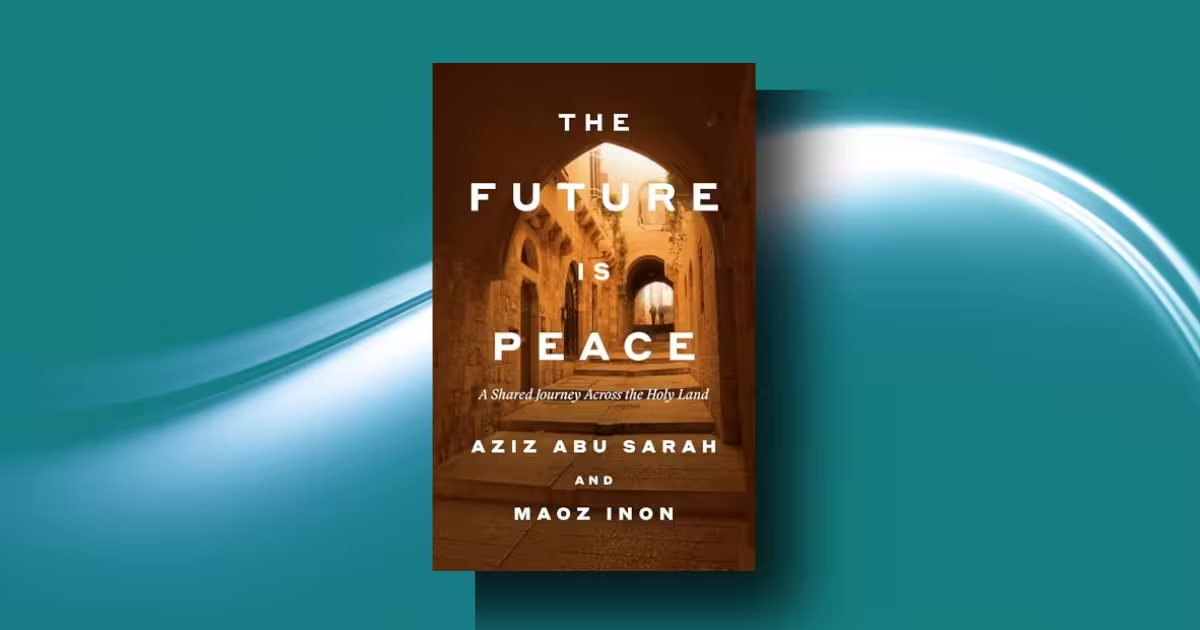
Do you find yourself scrolling through the news, feeling a knot tighten in your chest every time you see images from Gaza or Jerusalem? If you’ve ever whispered to yourself, “There has to be another way,” then Aziz Abu Sarah and Maoz Inon’s landmark 2026 book, The Future Is Peace: A Shared Journey Across the Holy Land, isn’t just a read—it’s a lifeline. This book will dismantle your cynicism and replace it with the radical, evidence-based belief that enemies can become brothers.
I’ve read the policy briefs. I’ve watched the UN debates. Nothing—absolutely nothing—has moved me or educated me about the human reality of the Holy Land like this volume. It’s not a dry history book or a political polemic; it’s a pilgrimage of the soul.
Written in alternating voices that read like a sacred conversation, this is the definitive text for anyone who wants to stop arguing about the Middle East and start understanding it. And here’s the truth: after reading this, you won’t need to Google “What is the Nakba?” or “Why is Jerusalem divided?” because this post, like the book itself, holds nothing back.
The Future Is Peace is best for you: if you are tired of doom-scrolling and need a blueprint for hope backed by real action and tangible results (like the $90 million Olive Oil Without Borders initiative mentioned in the text).
Students of Conflict Resolution: This is a masterclass in dual-narrative diplomacy. The structure—where a Palestinian and an Israeli guide you simultaneously—is a revolutionary pedagogical tool.
Spiritual Seekers & Pilgrims: Whether you are Christian, Jewish, or Muslim, the journey through Nazareth, the Galilee, and Jerusalem (where Jesus walked and where Abraham is revered as Khalil Allah) will deepen your faith in profound, unexpected ways.
Travelers & Cultural Explorers: The authors are founders of Mejdi Tours and Abraham Hostel. They understand the land not as a map of borders but as a living, breathing ecosystem of hospitality. You will smell the carob juice, taste the maqloubeh, and feel the dust of the Galilee on your skin.
The Future Is Peace is not for you: If you are looking for a text that justifies the violence of one side and dehumanizes the other, close this tab now.
The Future Is Peace refuses to sanitize terminology—it uses both “War of Independence” and “Nakba” (the Catastrophe); it mentions both “security fence” and “Apartheid Wall.” This is not a book that coddles; it challenges.
The Soundbite Seeker: This is not a quick fix. The journey is eight days long, and the emotional weight requires sitting with discomfort.
Table of Contents
Introduction
The Future Is Peace: A Shared Journey Across the Holy Land is co-authored by Aziz Abu Sarah (a Palestinian peacebuilder, National Geographic Explorer, and co-founder of Mejdi Tours) and Maoz Inon (an Israeli social entrepreneur, co-founder of Abraham Hostels, and peace activist).
Published by Crown in 2026, this hardcover volume spans 147 pages but carries the weight of millennia. The foreword is graced by none other than His Holiness Pope Francis, who states of the authors: “In the face of the suffering of these two brothers, the suffering of these two nations, I have no words. They have had the courage to embrace each other.”
This is not a theoretical treatise. It is a memoir of a specific, bold action. In August 2024, with the war in Gaza raging and the tourism industry in the Holy Land decimated, Aziz and Maoz embarked on an eight-day journey across Israel and the West Bank.
Their goal was to guide a virtual tour of their homeland, sharing a dual-narrative of the land’s contested history while confronting the ghosts of their personal losses. Maoz’s parents, Bilha and Yakov Inon, were murdered by Hamas in their home in Netiv HaAsara on October 7, 2023. Aziz’s older brother, Tayseer, was beaten and tortured to death in an Israeli prison during the First Intifada.
The Future Is Peace’s core argument is encapsulated in the title and a line from the epilogue: “We have shown the world that we can live without walls of division, that conflict does not inevitably lead to violence, and that security comes from community.” The thesis posits that peace is not a political concession but an act of survival and a daily, deliberate choice of humanity over hatred.
The authors argue that the current paradigm—where bombs and walls are the default—is the real naivety. True realism, they assert, is the hard work of reconciliation.
Background
Before the journey begins, the authors root the conflict in the very soil of the land. They note that by early spring 2024, the tourism economy had collapsed so completely that Maoz was forced to shutter the iconic Abraham Hostel in Jerusalem, and Mejdi Tours canceled all operations in the region.
This isn’t just a detail; it’s the scar tissue of a society at war with itself.
A foundational understanding is established through the lens of Jaffa oranges. The book traces how exports skyrocketed from 200,000 cases in 1845 to over 38 million annually by the 1920s, a symbol of a shared economic future that was shattered by the events of 1948. The text does not shy away from the asymmetry of the conflict, offering crucial statistical context that is often missing from mainstream discourse:
Water Disparity: Citing a 2023 B’Tselem study, the book highlights that Israelis use an average of 247 liters of water per day, while Palestinians in areas not connected to the grid survive on 26 liters—the equivalent of a disaster zone standard .
Demolition and Settlement: The Future Is Peace notes that since the Oslo Accords, the number of Israeli settlers in the West Bank and East Jerusalem has quadrupled to over 700,000, while Palestinian home demolitions have surged .
This section sets the stage for a journey not into a land of abstract “conflict,” but into a tangible, bureaucratic reality of checkpoints, permits, and structural inequality that affects whether Aziz’s elderly father can water the garden of a home he owns but can no longer legally live in.
The Future Is Peace Summary
This is the core of the review—the “walk” itself. I want you to feel like you were in the Mejdi van with them. I’m laying out the journey day-by-day because this is the curriculum of empathy that The Future Is Peace provides.
Day 1-2: Origins and Aftermath (The Negev & Tel Aviv-Jaffa)
The journey opens in Kibbutz Nir Am, the community founded by Maoz’s grandparents, Hanna’le and Zvi Gershoni, who arrived in 1943 fleeing Eastern European anti-Semitism to “redeem the land”. We stand at the Monument to the Fallen where Asaf Siboni and the Sacher brothers (Amos and Oded) are remembered.
The weight of Israeli sacrifice is palpable. Yet, just a few miles away, Aziz introduces us to the reality of Gaza through the eyes of Dr. Thaer Ahmad, the Palestinian-American ER physician. Ahmad’s testimony is chilling: “Palestinian healthcare workers…had to hold my hand for the first few days to show me how to function.” He recounts the double-tap strikes on ambulances and treating children on the floor.
This juxtaposition is the book’s superpower: Israeli trauma and Palestinian trauma are not in competition; they are coexisting, screaming realities.
Moving to Tel Aviv-Jaffa, the authors deconstruct the myths of the Sabra (prickly pear)—“tough on the outside, sweet on the inside”—and the Nakba. They recount how in Jaffa, a city of 120,000 Palestinians pre-1948, fewer than 4,000 remained after the war, confined to the Ajami Ghetto .
Abed Abu Shehadeh, a local guide, tells us his grandfather wept when asked about 1948: “‘You must wipe 1948 from your mind. Forgetting is a blessing from God. But I don’t forget, and I consider this a curse.'”
Day 3: The Green Line (East Jerusalem & Bethany)
This chapter is the heart of Aziz’s narrative. We learn of his brother Tayseer, a jokester who loved poetry. Tayseer was arrested, thrown into “the closet”—a 1.5-foot-by-2-foot cell—and beaten until he confessed. He died from internal abdominal trauma shortly after his release.
Aziz writes, “At the age of ten, all I knew was that someone had killed my brother, and I wanted to hit back. What I didn’t understand then was that the men who tortured Tayseer didn’t just murder my brother; they had also made me their prisoner.”
We then visit the family home in Bethany, just two miles from Jerusalem, where Aziz’s parents are forbidden from living lest they lose their Jerusalem ID.
Meanwhile, the settlement of Ma’ale Adumim is walking distance away. Maoz confesses a painful irony: he served at an IDF base just two and a half miles from this very house during his military service. Looking at Tayseer’s portrait, Maoz says to Aziz, “The day you were born was the happiest day of Tayseer’s life, and he was proud of you till the day he died and beyond.”
Days 4-6: The City of Peace & The Occupation (Jerusalem & Bethlehem)
In Jerusalem, the authors take us to the Church of the Holy Sepulchre, the Western Wall, and the Dome of the Rock. They share the profound observation that the divisions of the Old City into four quarters were not ancient but a 19th-century British cartographic invention designed to divide and conquer.
Aziz reflects on running for mayor of Jerusalem in 2018 under the slogan “Taxation without representation!”—not to win, but to protest the fact that only 10-12% of the municipal budget is invested in Palestinian East Jerusalem despite Palestinians making up nearly 40% of the population.
Crossing into the West Bank, we visit Aida Refugee Camp and see the Key of Return.
The physical and psychological impact of the wall is visceral. The Future Is Peace cites a 2017 UC Berkeley study finding residents of Aida Camp are exposed to more tear gas than any population on earth . We meet the founders of Combatants for Peace, former fighters who now risk their lives for non-violence.
The visit to Beit Sahour and the Shepherd’s Field is punctuated by a story of sheer terror: Aziz’s cousin Fidaa survived the 1994 Ibrahimi Mosque Massacre in Hebron, where settler Baruch Goldstein murdered 29 worshippers during Ramadan prayers .
Day 7-8: Nazareth & The Galilee (Seeds of the Future)
This is where the book pivots from documentation of pain to a blueprint for action. In Nazareth, we meet Odette Azar Shomar, the Palestinian matriarch who gave Maoz the key to her family’s 200-year-old mansion.
She did so on three conditions: “One, name it after my father, Fauzi Azar. Two, preserve our Palestinian heritage. Three, invest in the house, not in my pocket.” That trust sparked a revival; over 50 locally-owned businesses have since opened in the Old City .
The journey culminates in the Galilee, at the ruins of Lubya/Hittin and Kibbutz Lavi, founded by Holocaust survivors (the Kindertransport children). Here, Maoz hands Aziz a bottle of sesame oil from the new “Yakovi” strain—named after his father. In a land of wheat and weeds, this drought-resistant sesame is a metaphor for peace: “A dream you truly believe in can silence the noise of other people’s fears.”
The Future Is Peace Analysis
In an era where publishing on this topic often feels like a performative exercise in ideological purity, The Future Is Peace is a groundbreaking and profoundly important work. It is the most honest, raw, and pedagogically effective book I have ever encountered on this subject. Why? Because it refuses to be a monologue.
The Future Is Peace fulfills its stated purpose not by proposing a specific political solution (though it leans toward a confederation model like A Land for All), but by modeling the prerequisite for any solution: recognition of the other’s humanity.
The evidence is not just statistical; it’s experiential. When Maoz breaks the lock on the gate to the ruins of Hittin, saying, “Usually, we shouldn’t break locks. But other times, the lock is calling us to break it,” it’s a metaphor for the entire peace process. We are all locked out of our own shared future.
The dual-narrative structure is the book’s greatest asset. When Aziz recounts being a teenage boy running from gunfire to sneak into school, and Maoz immediately follows with his experience of “feigning injury or illness” to dodge checkpoint duty, the reader understands that the system dehumanizes both the occupied and the occupier.
As Maoz notes about his son Liad’s upcoming IDF draft, “The draft is mandatory for Israeli Jews… Economic and social opportunity is so entwined with military service that young Israelis don’t believe they have other options.”
The inclusion of poetry—from Mahmoud Darwish to Taha Muhammad Ali (specifically the poem “Revenge,” which Maoz reads after his parents’ murder)—elevates the text from journalism to literature. Taha’s verse, imagining a duel where he spares his enemy because “he had a mother waiting for him,” is the spiritual anchor of The Future Is Peace.
Strengths and Weaknesses
What I Found Compelling (Strengths):
Terminological Honesty: The authors state upfront: “We will not censor any terminologies.” They use “Nakba” and “War of Independence.” They note the term “Apartheid Wall” alongside “Security Fence.” This allows the reader to understand the weight of language without the authors acting as linguistic referees.
The Economics of Peace: This isn’t just a hippie dream. The book details concrete economic collaboration. The story of Olive Oil Without Borders, which pumped $90 million into the Palestinian economy before Trump-era funding cuts killed it, is a stark lesson in how policy directly impacts peacebuilding .
Generational Trauma Acknowledged: The visit to the Kibbutz Lavi memorial for Holocaust survivors, juxtaposed with the erased Palestinian village of Lubya, is a masterstroke of editorial balance. It screams: “Pain is not a competition.” Rabbi Paula Marcus notes, “Everyone’s pain is tribal, and we don’t necessarily see the pain of the other.”
The Personal Cost: Aziz’s confession about his marriage almost falling apart because he was a “peacemaker” who had not made peace with his own trauma is a necessary, unvarnished truth about activist burnout.
My Unpleasant/Negative Experience (Weaknesses):
Geographical and Historical Density: If you are completely new to the conflict, the sheer volume of place names (Bethany, Beit Jala, Wadi al-Joz, etc.) and acronyms (PLO, UNRWA, IDF, PCFF) can be overwhelming. The book assumes a baseline knowledge of the geography of Israel and the West Bank. I strongly recommend reading this with Google Maps open.
The Epilogue’s Tonal Shift: The Future Is Peace ends with a fictional, utopian vision of the future where Tayseer steps off a train. While emotionally resonant (I cried), it feels slightly jarring after the gritty realism of the preceding 130 pages.
It is a necessary act of imagination—the book’s subtitle is Peace Is the Future—but it might feel like a leap for readers anchored in the present despair of 2026.
Comparison with Similar Works
Unlike linear histories like Thomas L. Friedman’s From Beirut to Jerusalem or deep dives into specific events like Raja Shehadeh’s Palestinian Walks, this book shares the most DNA with Padraig Ó Tuama’s In the Shelter or John Paul Lederach’s The Moral Imagination.
It is a work of practical theology and conflict resolution. It stands shoulder-to-shoulder with the Parents Circle-Families Forum (PCFF) narratives. Where other books analyze the problem, The Future Is Peace demonstrates the solution in its very creation. It’s not just a book about co-existence; it is an act of co-existence.
Conclusion
The Future Is Peace is a must-read for students of international relations, diplomats, faith leaders, and anyone who believes the phrase “from the river to the sea” must be a prayer for shared life rather than a chant for singular victory.
If you are looking for a book that confirms your bias about the Israeli-Palestinian conflict, skip this. But if you are ready to have your heart broken open and then carefully, skillfully stitched back together with threads of stubborn hope, The Future Is Peace is your guide.
It reminds us, as Pope Francis did when he embraced the authors, that “ordinary people should take up the cause of peace.” The future isn’t a place we wait for; it’s a road we walk together.
And The Future Is Peace is the map.







