
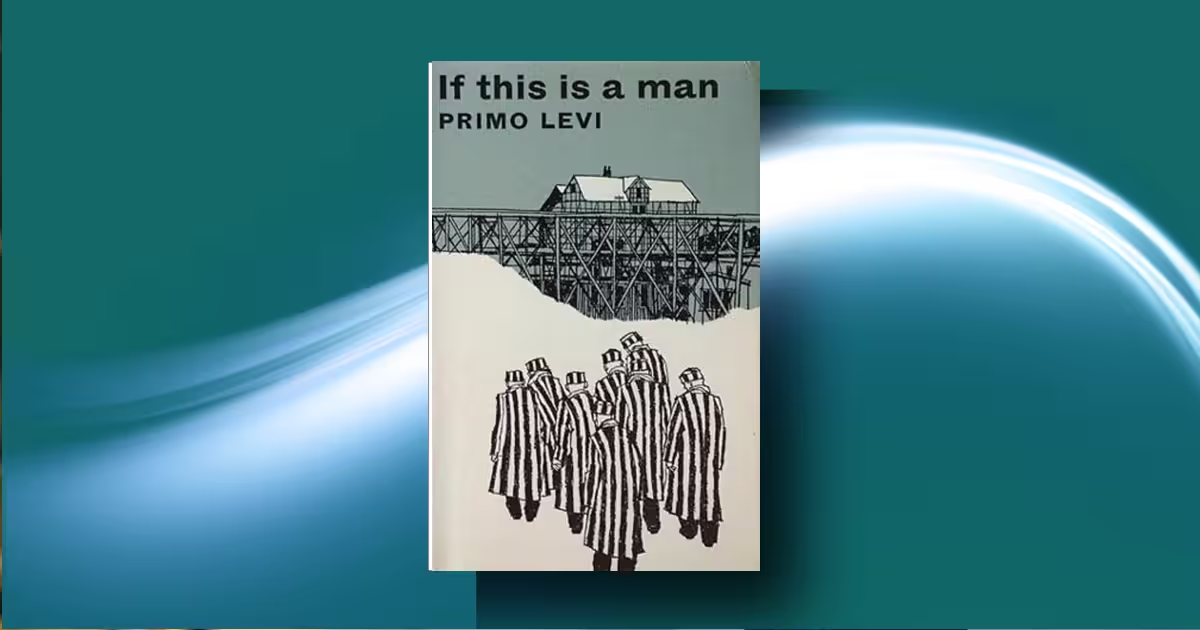
If This Is a Man is not just a book, it is a profound testament to the limits of human endurance. I want to share my deep analysis with you in a way that you will feel the cold, the hunger, and the quiet desperation of the Lager, ensuring that after reading this comprehensive guide, you will carry its heavy lessons with you forever.
Table of Contents
1. Introduction
The book under our lens today is If This Is a Man (often published in the US as Survival in Auschwitz). It was written by Primo Levi and translated from the Italian by Stuart Woolf. The edition I am referencing was copyrighted by Giulio Einaudi editore S.p.A. in 1958 and published by The Orion Press in New York in 1959.
If This Is a Man is about the systematic, horrific dehumanization of Jewish prisoners in the Auschwitz-Monowitz concentration camp (Buna) during World War II. Briefly, it falls into the genre of autobiographical memoir and Holocaust literature.
The author, Primo Levi, was a twenty-four-year-old Italian citizen of Jewish race and a chemist by profession.
Because of his participation in a poorly equipped partisan band affiliated with the Resistance movement Justice and Liberty, he was captured by the Fascist Militia on December 13, 1943. His background as an intellectual and a scientist deeply informs the objective, almost clinical tone he uses to dissect the anatomy of the camp.
2. Background
Traditionally, histories of the war focus on battles and politics. In contrast, Levi’s narrative zooms into the micro-society of the damned. Initially, it may seem like a mere recount of suffering, but it is deeply sociological. In fact, a major trait of this book is its exploration of how men behave when stripped of all property, social status, and fundamental rights.
3. Summary of If This Is a Man by Primo Levi
Overview
If This Is a Man (Italian: Se questo è un uomo) is Primo Levi’s seminal Holocaust memoir, first published in 1947. It recounts his deportation from Italy to Auschwitz in February 1944, his eleven months as a prisoner in the Monowitz-Buna labor camp, and his eventual liberation in January 1945.
The book is not merely a personal testimony but a profound philosophical meditation on human nature, dignity, and survival under systematic atrocity.
Narrative Summary
Part One: The Journey and Arrival
Levi, a 24-year-old Italian Jewish chemist from Turin, is captured by the Fascist Militia on December 13, 1943. After admitting his Jewish identity (believing this would spare him worse punishment for political activities), he is sent to the Fossoli detention camp.
On February 21, 1944, all 650 Jews at Fossoli are loaded into sealed freight wagons and transported to Auschwitz.
The journey lasts four days in unbearable conditions—thirst, cold, suffocation, terror. Upon arrival, a rapid selection occurs: those deemed “fit for work” (96 men and 29 women from the convoy) are separated from the others—the elderly, mothers with children, the sick, and the weak—who are sent directly to the gas chambers.
Levi’s mother, sister, and all other relatives disappear permanently at this moment.
Part Two: Initiation into the Lager
The new prisoners are stripped, shaved, disinfected, and tattooed with numbers. Levi becomes “Häftling 174517.” They are issued striped uniforms and wooden shoes.
The camp’s motto, Arbeit Macht Frei (“Work Makes Free”), is revealed as a cruel irony.
Levi describes the systematic destruction of human identity: prisoners lose their names, clothes, hair, possessions, and finally their sense of self. The “bottom” is reached when a prisoner has nothing left but suffering and the constant struggle for survival.
Part Three: The Camp’s Structure
Levi details the hierarchy of Auschwitz-Monowitz (also called Buna, after the synthetic rubber factory where prisoners labor):
- SS guards are the ultimate authority, but remain relatively distant
- Kapos (prisoner-functionaries, mostly German criminals marked by green triangles) exercise immediate, brutal control
- Political prisoners (red triangles) occupy middle positions
- Jewish prisoners (yellow stars) form the vast, powerless majority
The camp has its own economy based on theft, barter, and “organization”—the cunning acquisition of extra food, clothing, or tools. Bread becomes currency.
The prize-coupon system, the black market with civilian workers, and the internal trading network form a complex, amoral system where traditional ethics collapse.
Part Four: The Struggle to Remain Human
Levi introduces key figures who represent different survival strategies:
- Steinlauf (the ex-sergeant) insists on washing and maintaining dignity as a moral imperative—”to survive we must force ourselves to save at least the skeleton, the scaffolding, the form of civilization”
- Null Achtzehn (Zero Eighteen) represents the “drowned”—those who have lost all will, work until exhaustion, and inevitably die
- Schepschel survives through small, opportunistic schemes
- Alfred L. (the engineer) methodically builds a respectable appearance to gain privilege, sacrificing solidarity
- Elias Lindzin is a dwarf of immense physical strength and near-insanity who thrives in the camp’s brutal environment—”probably a happy person” but incapable of functioning in a free society
- Henri is a young, sophisticated manipulator who uses pity, seduction, and cold calculation to secure protectors; Levi respects but cannot embrace him
Part Five: The Chemistry Examination
Levi’s professional knowledge becomes his lifeline.
A chemistry examination determines who will work in the heated laboratory rather than in freezing outdoor labor. Despite his emaciated, filthy appearance, Levi successfully answers Doktor Pannwitz’s questions.
The encounter is described with unforgettable precision: Pannwitz looks at Levi as if through an aquarium wall, across an unbridgeable chasm between human and subhuman. Levi passes and gains a privileged position.
Part Six: The Canto of Ulysses
One of the book’s most celebrated passages. While walking to collect soup, Levi recites Dante’s Inferno (Canto XXVI) to his French companion Jean—the story of Ulysses’ final voyage beyond the Pillars of Hercules.
Levi struggles to remember and translate the lines about Ulysses urging his crew to pursue knowledge and experience. The act of reciting poetry becomes an assertion of humanity, memory, and connection amid degradation.
Part Seven: Lorenzo
An Italian civilian worker named Lorenzo brings Levi extra bread and a vest daily for six months, asking nothing in return.
Levi credits Lorenzo with his survival—not merely for the material aid, but because Lorenzo’s simple, uncorrupted goodness reminded him that “there still existed a just world outside our own.”
Lorenzo “was a man; his humanity was pure and uncontaminated.”
Part Eight: The October 1944 Selection
As winter approaches and the front draws nearer, the camp conducts a selection to reduce its population. Naked prisoners file past an SS officer who decides life or death in a fraction of a second.
Levi survives; many friends do not. He witnesses old Kuhn praying to God in thanks for not being selected—a gesture Levi finds obscene given the suffering of others.
Part Nine: The Last One
A prisoner is hanged for participating in the Birkenau crematorium revolt. As the noose tightens, he cries out: “Kamaraden, ich bin der Letzte!” (“Comrades, I am the last one!”) The crowd remains silent and docile.
Levi reflects that the Germans have succeeded in breaking them: “To destroy a man is difficult… but you Germans have succeeded.”
Part Ten: The Story of Ten Days
In January 1945, with the Russians approaching, the SS evacuates the camp.
Levi is in the infirmary with scarlet fever. The healthy prisoners depart on a death march (most perish; Levi’s friend Alberto is among them). Levi remains behind with a small group of eleven patients.
For ten days between worlds—neither prisoners nor free men—they struggle to survive without guards, electricity, or water. Levi and two French companions (Charles and Arthur) organize a stove, find potatoes, melt snow, maintain hygiene, and care for the dying. On January 27, 1945, the first Russian soldiers arrive.
Levi and Charles carry the corpse of their ward-mate Somogyi outside. “Charles took off his beret. I regretted not having a beret.”
Major Themes
1. The Drowned and the Saved
Levi distinguishes between those who survive (the “saved”) and those who are destroyed (the “drowned” or Muselmänner—the walking dead of the camp).
Survival depends not on virtue or strength alone but on luck, cunning, adaptability, and often moral compromise. The drowned—those who lose all will and identity—have no story; they simply disappear.
2. The Destruction of the Human
The camp systematically dismantles everything that makes a person human: name, clothing, hair, family, dignity, memory, and the capacity for choice.
Levi asks the reader to understand what it means “to lie on the bottom”—to be hollowed out until only suffering and hunger remain.
3. Shame and Complicity
Levi repeatedly expresses shame—not for actions taken in the camp, but for the condition of being reduced to a state where normal moral categories no longer apply.
He feels shame that the hanged man was braver than the silent crowd, shame that survival required selfishness, shame that he lived while others died.
4. The Gray Zone
Though not explicitly named in this book (it appears in his later work The Drowned and the Saved), Levi explores the moral ambiguity of the camp.
Prisoner-functionaries (“Prominents”) who collaborated with the SS are not simply evil but products of an impossible system. The line between victim and perpetrator blurs under extreme coercion.
5. Memory and Testimony
Levi writes to bear witness. The act of telling—precise, unflinching, unsentimental—is itself a moral duty. He refuses to exaggerate or claim exclusive suffering. His calm, analytical voice transforms horror into understanding.
6. Hope and Its Dangers
Hope is a double-edged sword in the camp. Too much hope leads to disappointment and collapse; too little leads to death as a Muselmann. Levi learns to live without planning for the future, to concentrate only on the next piece of bread, the next hour.
Stylistic and Structural Features
- Scientific precision: Levi the chemist describes the camp with detachment, measuring temperatures, counting numbers, cataloging behaviors. This restraint makes the horror more powerful than any melodrama.
- Philosophical interludes: Levi pauses the narrative to reflect on justice, morality, language, and human nature.
- Character sketches: Vivid portraits of fellow prisoners (Schepschel, Alfred L., Elias, Henri) serve as case studies in survival strategies.
- Symbolic moments: The icicle (“Hier ist kein warum”), the chemistry examination, the Canto of Ulysses, the final hanging.
- First-person plural: Levi often shifts from “I” to “we,” emphasizing collective experience and shared witness.
Critical Significance
If This Is a Man stands among the most important works of Holocaust literature, alongside Elie Wiesel’s Night and Anne Frank’s Diary. Its distinctive contributions include:
- The perspective of a scientist: Levi’s training as a chemist gives him an analytical, observational eye that transforms raw testimony into systematic knowledge
- The “gray zone” analysis: Levi refuses easy moral categories, forcing readers to confront uncomfortable questions about collaboration, privilege, and survival
- The Italian voice: While most major Holocaust testimonies come from German, Polish, or French survivors, Levi represents Italy’s Jewish community and the specific experience of Italian deportees
- Language and naming: Levi’s precise attention to the camp’s multilingual slang (Yiddish, German, Polish, Greek) captures the Babel-like confusion of the Lager
Final Assessment
If This Is a Man is not a book about revenge, heroism, or redemption. It is a book about what humans do to humans, what humans become under impossible conditions, and the fragile, nearly extinguishable spark that still constitutes a man.
Levi does not offer easy lessons or comforting conclusions. He offers testimony—clear, cold, precise—and asks the reader to look and remember.
The title poses an unanswerable question: If this—the beaten, starving, tattooed, nameless creature in striped rags—is a man, then what does “man” mean? And if this is not a man, then who is? The question haunts the reader long after the book is closed.
4. If This Is a Man Analysis
If This Is a Man is an outstanding, heartbreaking, and groundbreaking memoir. As a human reader, turning these pages feels like walking barefoot over shattered glass; it is deeply painful, yet incredibly necessary.
According to BBC cultural retrospectives and various historical analyses available through digital archives, Levi’s narrative stands preceding all others in its chilling, scientific objectivity mixed with an underlying scream of human agony.
Discuss whether the book fulfills its stated purpose or contributes meaningfully to its field:
Indeed, the book completely fulfills its purpose. Levi does not merely want us to pity the victims; he wants us to understand the mechanics of totalitarian evil. Importantly, he contributes to the field of philosophy and Holocaust studies by showing the social stratification of the oppressed.
Demonstrating this, he explains that the social structure of the camp is based on the human law that the privileged oppress the unprivileged. The green triangles (criminals), red triangles (politicals), and the Jewish stars form a hierarchy of misery.
As a result, the book serves as a permanent warning. Ultimately, human dignity is the greatest asset we have, and Levi proves how systematically it can be dismantled.
5. Strengths and Weaknesses (Criticism)
My Pleasant and Positive Experience
What I found foremost compelling and innovative about the book is its profound lack of overt hatred. Initially, it may seem impossible for a Holocaust survivor to write without blinding rage.
Yet, Levi writes with a terrifyingly calm clarity. A major trait of the text is its focus on the psychological minutiae of survival. For example, the detailed explanation of the “Babel” of languages, where a lack of understanding Polish or German meant immediate beatings, highlights the cognitive overload the prisoners faced.
I was deeply moved by the quiet heroism of characters like Alberto, who fought for his life but still remained everybody’s friend, and Steinlauf, who argued that washing one’s face without soap was a mechanism to refuse consent to their own dehumanization.
My Unpleasant and Negative Experience
On the other hand, reading this book is a heavy, dark emotional burden.
My negative experience does not stem from any shortcomings in Levi’s writing, but rather from the sheer, suffocating weight of the truth. However, there are drawbacks to his clinical detachment for readers who seek emotional catharsis; Levi rarely gives you a moment to cry, because he drags you into the cold, calculating reality of the struggle for a single ration of bread.
Furthermore, some readers might find the intricate descriptions of camp bureaucracy and the German/Yiddish terminology slightly overwhelming, though this complexity is arguably necessary to convey the confusing reality of the Lager.
6. Comparison: Books Like If This Is a Man
Traditionally, when we look at the pantheon of Holocaust literature, two other monumental works rank alongside Levi’s.
Night by Elie Wiesel: Whereas Wiesel’s Night is deeply rooted in theology, questioning the existence of God in the face of the crematoriums, Levi’s approach is strictly anthropological and secular. Supposing we compare them, Wiesel cries out to the heavens; Levi dissects the earthly hell built by men.
Man’s Search for Meaning by Viktor Frankl: Similarly, Frankl, a psychiatrist, analyzes the psychological states of prisoners.
Yet, Frankl attempts to extract a positive, life-affirming therapeutic method (Logotherapy) from his experience. In contrast, Levi remains profoundly cautious, offering no easy psychological cures, only the stark reality that many were simply “the drowned.”
In truth, Levi’s work stands apart due to its scientific detachment. Furthermore, in order to fully comprehend the Holocaust, reading all three is essential, but Levi provides the most comprehensive view of the physical and social mechanics of the camps.
7. Conclusion
To give a brief example of the power of literature, If This Is a Man is not just a book; it is a moral imperative. I offer my highest recommendation for potential readers. Who would benefit most from reading this book?
Everyone. It is absolutely suitable for general audiences, though it should be required reading for specialists in history, sociology, and political science. It is an incredibly dark journey, coupled with moments of startling human resilience.
Consequently, to put it in another way, if you want to understand what happens when a society abandons its humanity, you must read Primo Levi.
Make no mistake, the lessons enclosed in these pages—the fear of the Wstavac, the nightmares of the unlistened-to story, the tragic fate of Null Achtzehn—will haunt you. And they should. Therefore, we must remember.







