
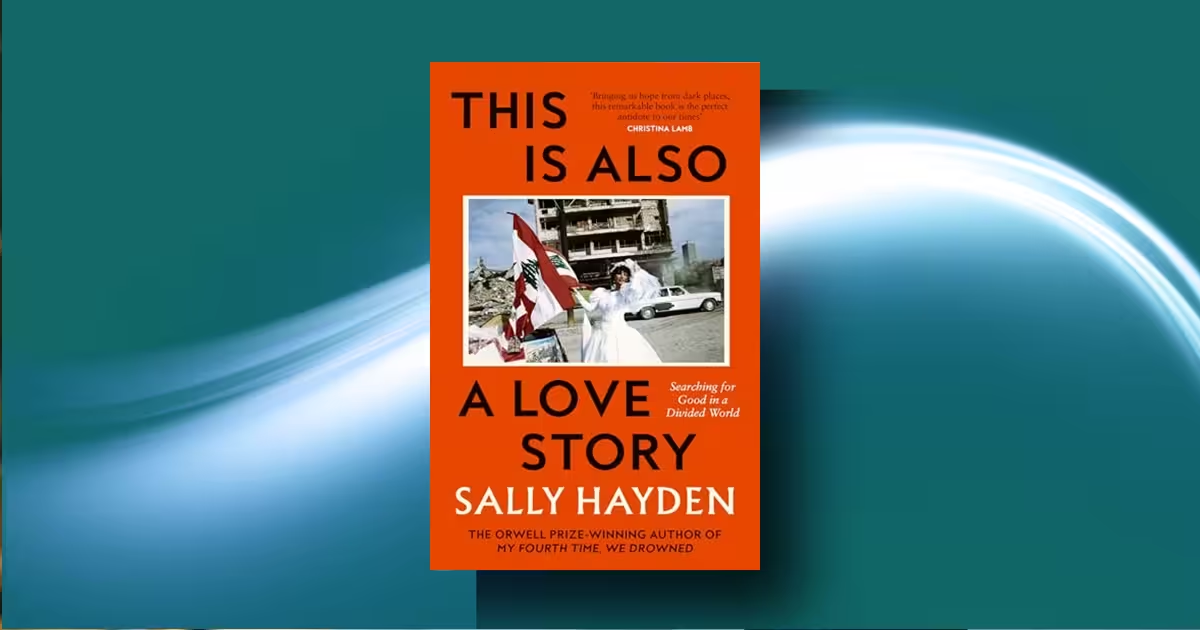
Does love survive when bombs fall, dictators disappear, people, and everything you have built is swallowed by debt, drought, or war? Sally Hayden spent more than a decade at the world’s worst frontlines asking exactly that — and what she tells in This Is Also a Love Story might change the way you read the news forever.
In nine countries fractured by war, genocide, occupation, and economic collapse, ordinary people keep loving each other with a ferocity that shames the powerful — and Hayden argues that noticing this is not sentiment but a political act.
This Is Also a Love Story is best for readers of narrative journalism, human rights literature, and international affairs who want depth, warmth, and moral seriousness in equal measure; anyone who has ever felt crushed by the relentless weight of bad news and wonders whether there is any goodness left to hold onto; fans of Ryszard Kapuściński, Patrick Radden Keefe, or Hayden’s own Orwell Prize-winning debut My Fourth Time, We Drowned.
Not for those seeking a straightforward travel memoir, conventional romance, or a quick read with tidy emotional resolutions; readers who prefer their non-fiction to stay at a clinical distance from its subjects.
Table of Contents
1. Introduction
This Is Also a Love Story: Searching for Good in a Divided World by Sally Hayden was published on 16 June 2026 by 4th Estate in the UK and Simon & Schuster in the US. It is Hayden’s second book.
The Irish journalist and correspondent, who reports internationally for The Irish Times, won the Orwell Prize in 2022 for her debut, My Fourth Time, We Drowned, a landmark work on the refugee crisis in the Mediterranean.
That book was also named An Post Irish Book of the Year 2022.
This Is Also a Love Story arrives at a moment when global attention is fragmented, empathy feels increasingly under siege, and the news cycle has become so relentless that many people — as Hayden notes, citing a 2024 Reuters Institute study — have simply stopped watching. The book is both a response to that crisis and a remedy for it.
2. Background
Hayden conceived the idea for this book in early 2018 after nearly a decade of reporting on human rights abuses: wars, forced displacement, migration, torture, and the indifference of the powerful.
She found herself “profoundly sad” — dulled, as she writes, by “a blunting ennui that hardens into cynicism and a sense of futility.” The observation that drove the book was simple: even while standing at the worst moments she had ever witnessed, she kept noticing love. Parents protecting children. Couples clinging to each other across frontlines.
Communities forming around the spaces grief left open. “Frequently, while listening to an account of something horrific,” she writes, “there will be a moment when I think to myself: ‘this is also a love story.'”
The historical context is crucial. Hayden’s nine country chapters span the 1994 Rwandan genocide and its aftermath; the ISIS occupation of Mosul between 2014 and 2017; the Lord’s Resistance Army’s decades-long campaign of abduction and violence in northern Uganda; Russia’s full-scale invasion of Ukraine from February 2022; the Boko Haram insurgency in northeast Nigeria; Lebanon’s catastrophic economic meltdown beginning in 2019 and the subsequent Israeli bombardments; Syria’s descent into civil war and decades of enforced disappearance under the Assad regime; and Japan’s March 2011 earthquake and tsunami.
These are not mere backdrops. They are the conditions under which love either survives or does not — and Hayden is tracking the conditions closely.
3. This Is Also a Love Story — Full Plot Summary
Prologue: Writing with Drones Overhead
Hayden opens This Is Also a Love Story in Lebanon in 2024, writing as Israel carries out one of the most intense aerial campaigns in the country’s recent history.
She is direct about her state of mind: she is exhausted and disillusioned, a journalist who once believed the profession could change the world and has since lost that certainty. She frames the book as both personal reckoning and journalistic mission.
If news reporting reduces people to “basic facts and figures or overly simplistic and reductive headlines,” she asks, what might be recovered if we told those same stories through the prism of love?
The prologue opens with two epigraphs that set up the book’s central tension: Albert Camus’s observation that “the greatest misfortune is not to be unloved, but not to love,” and Elon Musk’s declaration that “the fundamental weakness of Western civilisation is empathy.” Hayden’s book is, implicitly, an argument against Musk and for Camus.
Chapter 1 — Ukraine: A Wartime Christmas
This Is Also a Love Story‘s first chapter opens in December 2023, when Hayden travels to Kyiv to understand what the Russia-Ukraine war has done to relationships. She meets Irina, a former volunteer who smuggled sniper rifles to troops in eastern Ukraine, and her husband Sergei, a former marine turned makeup artist who volunteered on the first day of the full-scale invasion.
Their love story is shaped by absence, uncertainty, and a private code: “red lipstick” — the agreement to put on a brave face, to keep functioning, to refuse despair even when there is so much to be despairing about. Irina carries her marriage certificate in her handbag at all times, because she never knows “at which moment I will have to go to rescue him.”
Hayden describes a Kyiv where the war can feel distant in cafés and opera houses, but where a Christmas tree made of spent ammunition shells outside a bakery carries a QR code linking to a drone fundraiser.
She meets Olha and Andrii, a couple married for eleven years, sitting in a restaurant while Andrii — home briefly from the frontline near Bakhmut — describes what it feels like to be unable to distinguish a tram from artillery. “I feel like I live my life but at the same time I, for example, have no left arm,” Olha tells Hayden. “I don’t know how to explain it another way but I must learn how to live without a part of my body.”
Hayden attends Kyiv’s platform 11 to watch what passengers call the “love train” arrive from the Donbas — soldiers on leave and the partners who have travelled to meet them.
She witnesses a woman who has been holding a heart-shaped balloon for twenty-five minutes run towards the man she has been scanning for. She later discovers that Irina was on that platform too, having scrambled to put up a white artificial Christmas tree before Sergei arrived with six hours’ notice. When they are finally reunited, Irina nearly faints from the force of embracing him.
On the structural damage the war has done to relationships, Sergei speaks plainly: he knows of numerous divorces, of soldiers who found new partners and married them. “When they come back from war they will be different totally, psychologically they will never really be the same.”
Hayden also speaks to the Veteran Hub, an organisation documenting the risk of domestic violence once soldiers return, and to Maxim Potapovych, a communicator for LGBTQI+ military rights, who explains that the war has created a political “window of opportunity” for reforms.
Without legal recognition, LGBTQI+ soldiers who are killed cannot have their partners informed of their deaths or buried according to their wishes.
Chapter 2 — Rwanda: Forming New Families
This chapter begins in April 2014, when Hayden travels to Kigali for the twentieth anniversary of the genocide. She is twenty-four years old, and Rwanda is her first international assignment.
The chapter examines what happens when the most fundamental unit of love — the biological family — is destroyed by systematic murder. Between April and July 1994, as many as 800,000 Tutsis and moderate Hutus were killed in one hundred days.
Hayden discovers the work of the Association of Student Genocide Survivors (AERG), which formed “artificial families” from university and secondary school students who had lost their relatives.
On a sun-drenched afternoon at the University of Rwanda, she watches twenty-three-year-old Paul Henri give a speech to his twenty-four “children” — none of whom share his DNA. They pray together in a circle.
She speaks to Augustin, twenty-seven, who calls his artificial mother whenever he has run out of soap. She speaks to Kevin, twenty-one, who says the families gave orphaned students a place to process emotions that Rwandan culture otherwise demands remain suppressed.
Hayden gives us the raw language of the genocide through the memorial centre in Kigali:
Francine / Age: 12 / Favourite sport: Swimming / Favourite food: Eggs and chips / Cause of death: Hacked by machete.
And Fillette, aged two, whose cause of death is listed as: “Smashed against a wall.”
Hayden also tracks down Zula Karuhimbi, the woman known locally as a “witch” who hid more than one hundred Tutsis in and around her two-room house during the genocide. Zula covered her hands in herbs that caused skin irritation, convinced militias she was cursing them, and banged improvised percussion to simulate angry spirits. She lost her own son and daughter in the process.
When Hayden visits her, Zula is napping outside, hugging an orphaned boy she has adopted. “Love is the most important thing,” Zula tells her. “Find someone to love, and the future will always be bright.” She died in 2018, still in the same bullet-scarred home.
Ten years later, in 2024, Hayden tries to return to Rwanda to find out what happened to Paul Henri’s artificial family, only to discover she has been declared persona non grata — barred from the country, apparently because of reporting she had done in 2019 on refugees Rwanda was hosting. She conducts subsequent interviews via WhatsApp from Europe.
Emmanuel, now in his late thirties, tells her that more than half of his Facebook friends two decades on are people from AERG. “You can find family outside your family,” he tells Hayden. “And you can learn to trust others, to trust strangers, and to open up.”
Chapter 3 — Iraq: Secret Weddings
This chapter moves to Mosul, which Hayden examines across multiple time periods: the Iraq-Iran War; the sanctions of the 1990s; the US-led invasion of 2003; and the ISIS occupation from June 2014 to July 2017.
Through writer and analyst Rasha Al Aqeedi, born in Mosul in 1984, Hayden traces how each successive crisis narrowed the conditions under which love could exist. Sanctions meant families could not afford the gold required for the traditional mahr payment.
War meant weddings were attended only by immediate family. Growing conservatism meant couples who met at university were increasingly gossiped about.
Under ISIS, falling in love became a logistical nightmare and a potentially lethal act. Saif Muhammad, a former election official — whose background made even a secret celebration dangerous because ISIS would have killed him if they identified him — met Marwa through his mother’s traditional search for a suitable match.
Their courtship consisted of secret phone calls from her roof, at midnight, in the cold, risking death because ISIS had banned mobile phones and disabled cell towers. “The biggest challenge we faced was that if ISIS knew we were calling on the phone they would kill us, because they would believe we were spying,”
Saif explains. Marwa estimates 70 per cent of the couples she knew who married during the ISIS occupation later divorced. “They didn’t have enough connection with their wives in that period. They didn’t know each other.”
Their wedding took place with fewer than forty guests, in a relative’s house, with two small speakers turned so low that being detected might mean execution. Dancing was banned. Saif’s previous background as an election official meant the ISIS courts required him to demonstrate his religious knowledge before granting a wedding certificate. He was also required to take an HIV test.
When Hayden returns to Mosul in early 2024, she finds a city that has been physically rebuilt but is still processing its own history. She visits Shahad Safadin’s gift shop — which has nearly thirty thousand Instagram followers — and watches as Shahad’s husband Muhammad arrives to tease her from across the room, a scene of easy domestic happiness that would have been unimaginable a decade before.
She visits Qutaiba Yassin Hamid, a wedding photographer who fled Mosul under a false ID, watched his studio be torched by ISIS, and rebuilt it from nothing. By 2024, he says spring is the busiest season for weddings, and 29 February is the most in-demand date because couples want to celebrate an anniversary only once every four years.
The chapter’s implicit argument is that love — and the human desire to mark it publicly — is among the most persistent forces in any society, one that even the most totalitarian occupation cannot fully suppress.
Chapter 4 — Uganda: Radical Forgiveness
The longest chapter of This Is Also a Love Story turns to northern Uganda and the Lord’s Resistance Army, whose campaign of abductions terrorised the country from the 1980s until the LRA was driven out in 2006.
Hayden accompanies David Ocitti, himself a former LRA abductee, as he drives Charles, Ouma, and Robert — three former LRA fighters who have recently defected — home to Gulu for their family reunions.
Charles was nine when he was abducted in 2001. Robert was sixteen. Ouma was taken the same year as Charles. They spent nearly two decades in the bush, were forced into violence and survival, and held their unlikely friendship secret for years because even hinting at it could result in execution.
The reunions are stunning in their emotional power. When the car pulls into Kamdini, an hour from Gulu, crowds have lined the roads. Charles’s father thrusts his arm through the car window and tilts his son’s chin to look at the scar — an old head wound from a farming accident — that he described as Charles’s only ID. At the final reunion point, Charles’s mother pulls him onto her lap and sits with him there, eyes closed, for five minutes. Charles is smiling widely, his arms around her neck.
Hayden gives us the Ugandan government’s Amnesty Act of 2000, which offered pardons to all LRA combatants and included the traditional cleansing ritual Mato Oput, in which a bitter root is brewed and drunk together to symbolise reconciliation. More than twelve thousand former LRA combatants received amnesty over twelve years.
The Refugee Law Project found “overwhelming support” for this process. Some Ugandan civilians even supported amnesty for Kony himself, believing it necessary to end the violence. Hayden calls it a “policy of radical forgiveness.”
David Ocitti’s own story is the chapter’s spine. His father was killed by the LRA after David admitted — at gunpoint — that his father was the parent he loved more. David himself escaped after six months in the LRA, returned home, and was stigmatised as a killer.
He founded a non-profit, Pathways to Peace, and has spent his life driving tens of thousands of kilometres across northern Uganda searching for long-lost families and facilitating reunions. When asked what he would do if he came face to face with his father’s killer, David’s answer is immediate: “I would forgive him.”
Chapter 5 — Ghana: Love Under Siege
This chapter follows Ed Hanson, a thirty-three-year-old Cameroonian who has lived in Ghana since 2009 and is a co-founder of LGBT+ Rights Ghana, through Pride month in June 2024 — the first Pride after Ghana’s parliament voted in favour of one of the most repressive anti-LGBTQI+ bills in the world. If signed into law, it would allow security forces to arrest anyone who identified as queer and would require citizens to report LGBTQI+ people to the police.
Ed is openly queer but carefully compartmentalised — he teaches biology and chemistry at a school where, as far as he knows, no one is aware of his sexuality. “When people do that, life becomes a bit easier for you,” he tells Hayden.
Through voice-note testimonials submitted by queer Ghanaians, Hayden assembles a portrait of love under siege. Charlie (31, pronouns they/them) describes a spontaneous night out that is among the most gently romantic passages in This Is Also a Love Story — dancing between a man’s legs in a bar while he keeps his ankles around their leg, then going home to watch a documentary about Amy Winehouse until he falls asleep.
Gem (25, pronouns she/her) explains why long-term queer relationships are so structurally difficult: “To have a long-term relationship would include us going on dates, going in public together, and this is a society where we are not accepted.”
Hayden also visits transwoman artist Va-Bene Elikem Fiatsi in Kumasi, who has turned an artists’ residency into a safe space for queer people and has no intention of leaving Ghana despite the threats. “Even if I’m chased with machetes and bullets, I may prefer to die in Ghana than to relocate to Europe,” she says. “I owe it to Ghanaians.”
The Pride event itself is a rented bus to a secluded outdoor location, with fewer people than hoped because many are too frightened to attend. There are whisky shots, relay races, Uno cards, and ampe, the Ghanaian children’s clapping game.
Hayden watches the community repair a broken-down car together in the semi-dark outside a bar, and realises she is watching love in its most communal form.
Chapter 6 — Nigeria: Motherly Love and Acts of Bravery
This chapter focuses on the Boko Haram insurgency in northeast Nigeria, which Hayden has covered since 2016. The group’s campaign, launched in 2009, created more than two million displaced people.
Hayden’s central figure is Zainabeu Hamayaji, who hid her twelve-year-old daughter Hassana in a ditch underneath her compound — with stored water, non-perishable food, and leather bags as makeshift toilets — for months while Boko Haram occupied her town of Madagali.
To stop the militants from finding her daughter, Zainabeu stripped herself of her clothing, unplaited her hair, and covered herself in urine and excrement to perform madness convincingly enough that the fighters stopped searching.
They eventually left a note on her wall: “Nobody should attack this madwoman, it will be a curse.” Her three younger children participated in the deception, telling the militants their mother had a psychiatric history.
Esther Bello, another woman, did the same thing independently — pretending to be insane after her husband was killed in front of her and she was held captive with her five children. “I had to pretend that I was insane, that I was mad,” she tells Hayden. “I put dirt, mud, everything on my body. It was difficult to convince them, I had to use whatever was at my disposal.” She then walked barefoot for three days through the bush with her five children to find safety.
These two women never met and were more than a hundred kilometres apart. Hayden notes the extraordinary coincidence: “These mothers had never met each other, yet they both demonstrated the same audacious capacity for quick thinking.”
The chapter builds a portrait of maternal love as one of the most powerful forces she has ever documented, one that drove women to extremes that conventional courage does not easily account for.
Chapter 7 — Lebanon: Crimes in the Name of Love
Lebanon’s chapter centres on Bassam al-Sheikh Hussein, a man who raided his own bank in Beirut in August 2022 to retrieve the $210,000 of savings that the collapsing Lebanese banking system was refusing to release, money he needed to pay for his father Aqil’s hospital treatment after a fall.
He spent three months planning the raid, drove to the bank with a gun and a gallon of petroleum, held the staff hostage for more than six hours, and ended up with $35,000 before being taken into police custody for five days. Outside, a crowd gathered to cheer him on.
Hayden embeds his story in the broader collapse of Lebanon: a political system that had run a “giant Ponzi scheme” for three decades, as the World Bank put it in a report published the week before Bassam’s raid; an inflation rate that became the highest in the world; the August 2020 Beirut port explosion that killed more than two hundred people; and the energy crisis that left the country with electricity for barely four hours a day.
Lebanon, she writes, is “a city of unfinished dreams and unfulfilled promises.”
Through Bassam and Maryam (his wife, who was six months pregnant with their second child when Hayden first visited), through lawyer Fouad Debs and campaigner Alaa Khorchid, and through the brief, luminous presence of Sali Hafez — who raided a different bank with a toy gun to pay for her sister’s cancer treatment and told Al Jazeera she would do it again — Hayden builds the chapter’s central argument: that under a corrupt and broken system, love for family can become a form of justified criminality, and the line between criminal and hero dissolves.
When Hayden returns in 2024, Bassam’s father has died. He is grieving. Israel has been bombing Lebanon for months. His damaged building has not been repaired. He is still owed $175,000. “For us, it’s like one for all, all for one,” he says of his family. “If one is hurting, it’s like all of us are hurt.”
Chapter 8 — Syria: A Quest for Justice
This is arguably the most devastating chapter, tracing the fate of Syria’s enforced disappeared through the eyes of two women: Fadwa Mahmoud and Wafa Mustafa. Fadwa met her husband Abdulaziz Al Khair through their shared membership of the clandestine Communist Labour Party in Syria in the 1980s, both risking their lives. Abdulaziz spent nearly fourteen years in prison.
Fadwa was imprisoned too, for two years, during which she refused to name her comrades despite being kept in a basement for over a year in the same pyjamas she was arrested in. They married in 2008.
In 2012, Abdulaziz and Fadwa’s stepson Maher Tahan disappeared at Damascus airport, apparently taken by Assad regime security forces. More than a decade later, neither has reappeared.
Wafa Mustafa’s father, Ali, was arrested in 2012 after she returned to Masyaf to see a doctor for three months following the death of a friend in the shelling. Days after she left, armed men came to the door. Ali had instructed his family to flee if he was ever taken.
Wafa escaped to Turkey and later Germany on a scholarship. She has addressed the UN General Assembly and the UN Security Council.
She says: “To be very honest this is the part I’m least proud of … I’m sad for myself that I had to talk to a group of old men and convince them that my father deserves freedom.”
Mariam al-Hallak’s son Ayham was arrested at his university in November 2012 and died in detention. His death was eventually confirmed through the Caesar photographs — a massive cache of images of tortured and emaciated Syrian detainees, smuggled out of the country by a military photographer turned defector. Mariam identified Ayham from one of them.
He has a number written on paper placed on his chest: 2129. Mariam is now one of the founders of the Caesar Families Association in Berlin, which has introduced facial recognition software to help other families find their relatives in the photographs.
The chapter’s final section describes the fall of the Assad regime in December 2024, which Hayden witnesses from Beirut and then from inside Syria itself. She drives to Damascus, passes torn portraits of Assad being stamped on by an elderly man, and walks through Sednaya Prison — the “human slaughterhouse” — as thousands of families arrive searching for relatives.
It is at Sednaya that she receives a message telling her that her grandmother, Sheila de Courcy, has died in Ireland. She does not tell anyone around her: “I thought about my love for my grandmother, my loss, and all of these other losses around me in that moment that towered over it, grief on grief, sorrow on sorrow, love on love.”
At the end of 2024, Wafa has still not found her father. Fadwa is still not psychologically ready to return to Syria. The new government has not yet set up a committee to investigate the fates of the missing, despite having promised to do so.
Chapter 9 — Japan: Love After Death
The final chapter takes us to the Pacific coast of Tohoku, Japan, in March 2024 — the thirteenth anniversary of the earthquake and tsunami of 11 March 2011, which killed more than twenty-two thousand people.
Hayden visits Yuji Akagawa, an elderly retiree who set up the “drifting post,” a post box in a woodland near Rikuzentakata that receives letters written to the dead. He has read every letter. He has sixteen binders of them.
The letters travel between mourners: a man writing to his missing fiancée about driving without purpose and watching baseball; a wife noting the passage of their fifty-fourth wedding anniversary, her seventh being alone, hoping to join her husband “as soon as possible.”
Hayden speaks to Ohtani Keiichi, who became a kataribe (storyteller) after surviving the tsunami and now gives one hundred and forty paid talks per year about what he witnessed.
She attends Café de Monk, the movable café created by Buddhist monk Taio Kaneta in the aftermath of the disaster, which combines manicures, back massages, whisky, and prolonged silence as a framework for grief.
She speaks to Buddhist professor Yozo Tanikawa, who trained three hundred chaplains after 3.11 and concluded that dealing with grieving people ultimately comes down to something simple: “just listen to them.”
The chapter is suffused with Japanese words that have no English equivalents: kodokushi (a lonely death); hikikomori (a social isolate); kataribe (storyteller); kuyou (a ceremony to pray for people after death). In a culture where silence is prized and emotional restraint is a mark of strength, Hayden watches the slow, necessary process of people learning to grieve together.
Epilogue: Beirut After the Ceasefire
Hayden closes This Is Also a Love Story in Beirut in late 2024, after a ceasefire between Israel and Hezbollah. She watches displaced families driving back towards their homes, some waving flags, some wailing from windows.
On a balcony, she watches an elderly couple walk down the middle of a street, the woman gripping a younger woman’s arm, their dainty steps unchanged by war.
She thinks about dehumanisation — “to deprive someone of human qualities, personality, or dignity” — and argues that it grows in inverse proportion to our willingness to see the loves that bind other people. “Somehow, humans manage to lay laughter over trauma and love over inhumanity.”
4. This Is Also a Love Story Analysis
4.1 This Is Also a Love Story Characters
Irina and Sergei (Ukraine): Their relationship is the book’s most sustained portrait of romantic love under military pressure. Irina is physically tough — she carries a penknife, torch, and tourniquet in her handbag and has turned off her air raid alerts — but emotionally honest about the cost of waiting.
Sergei’s admission that taking time off makes him “too relaxed” to lead his battalion is one of the book’s most quietly heartbreaking observations.
Their code of “red lipstick” — performing normalcy so the other can keep functioning — is a small masterpiece of pragmatic love.
David Ocitti (Uganda): This Is Also a Love Story‘s most morally complex figure. A man who watched his father killed, was forced into violence himself, and chose radical forgiveness as his life’s work.
His response to being asked what he would do if he met his father’s killer is not the answer of a saint — it is the answer of someone who has calculated, with great precision, the cost of vengeance and found it too high.
Zainabeu Hamayaji (Nigeria): The chapter’s most devastating presence, physically marked by the beatings she endured — a dislocated shoulder, a scar, a missing tooth — but possessed of a tactical intelligence that Boko Haram could not account for.
Her performance of madness is one of the book’s most astonishing set pieces, and the moment when she leads the Nigerian soldiers to the ditch and Hassana emerges is among its most cathartic.
Fadwa Mahmoud (Syria): Hayden’s portrait of Fadwa is the book’s most sustained study of love as political endurance. A woman in her late sixties, living alone in a Berlin apartment with a cat named Zeitouna and photographs of her missing men on the walls, who has not stopped campaigning for a decade and does not intend to. “As long as I’m alive I will not give up,” she says. Her refusal is not obstinate; it is, in her framing, the only form of love she has left to give.
Yuji Akagawa (Japan): The book’s most surprising emotional presence — a quietly ironic man who built a post box in the woods and found himself holding the accumulated grief of a generation. His admission that he asked his wife to write to the drifting post after his death — “One of my consolations is, if I die, people will write these letters to me” — is among the most unexpectedly tender moments in This Is Also a Love Story.
4.2 This Is Also a Love Story Themes and Symbolism
Love as resistance: The book’s dominant theme, stated explicitly in the prologue and demonstrated in every chapter. Under ISIS, holding a wedding with music turned so low it might not be heard is a political act.
In Ghana, organising a bus trip to a secluded outdoor space for a queer Pride event is resistance. In Syria, continuing to search for a missing father is resistance. Hayden is not arguing that love conquers all — she is quite explicit that it does not — but she is arguing that it persists in defiance of everything designed to eradicate it.
The “artificial family” as symbol: The Rwanda chapter’s central image — orphans electing parents, siblings voting on family structure, communities choosing to behave as kin — is the book’s most radical proposition about the nature of love itself.
Emmanuel’s observation that “you can find family outside your family” is both a survival strategy and a philosophical claim: love is not a biological given but an ethical choice.
Red lipstick: Irina and Sergei’s private code becomes one of the book’s most resonant symbols. The practice of maintaining an outward performance of resilience — photographing herself smiling so she has something to send him when he asks for a selfie — is both a survival tactic and a form of love.
It is, in the book’s logic, the civilian equivalent of a soldier’s continuing to advance: not because the situation demands optimism, but because the alternative is surrender.
The drifting post: In the final chapter, Akagawa’s post box in the woods functions as the book’s most literal image of love’s persistence beyond death — or at least, of our refusal to accept that love should end with a body.
Letters to the dead, organised in binders, taken once a year to a Buddhist temple to be prayed over: this is love as ritual, love as the refusal of closure.
Silence as code: The Syria chapter’s meditation on the Assad regime’s use of fear is also a meditation on what happens to love when speech itself becomes dangerous. Syrians referring to “prison” as “your aunt’s house,” speaking in codes so instilled that the self-censorship becomes unconscious. Hayden argues that this is what dehumanisation looks like from the inside: not hatred but the slow atrophying of the ability to trust.
5. Evaluation
This Is Also a Love Story is one of the most important and most beautifully conceived works of narrative journalism published in this decade — brave not in the journalistic cliché of the word, but in the deeper sense of requiring courage from its author to write and its readers to absorb.
5.1 Strengths
This Is Also a Love Story‘s greatest achievement is structural: Hayden has found a lens — love, in all its forms — that genuinely transforms familiar material. These are not new conflicts. Rwanda, Iraq, Syria, Nigeria, Uganda, Lebanon, Ukraine — all have been written about extensively.
What Hayden gives us that is genuinely fresh is a perspective calibrated to what standard journalism strips out: the texture of individual relationships, the specific emotional logic of private decisions made under impossible conditions.
When Irina travels for hours to see Sergei for twenty minutes at a petrol station, or when Charles’s father thrusts his arm through a car window to tilt his returning son’s chin and confirm his identity by a scar, we are seeing the war in a way that statistics cannot provide.
The voice is unfailingly honest. Hayden does not pretend to have found comfort where she hasn’t. This Is Also a Love Story she set out to write in 2018 — “really happy” love stories from around the world — is not the book she has written. She acknowledges this directly. The resulting work is more serious, more politically grounded, and ultimately more useful than the cheerful anthology she imagined.
The Japan chapter, perhaps unexpectedly, is the most formally innovative: Hayden weaves excerpts from the drifting post letters throughout the narrative, so the chapter’s emotional argument is made simultaneously in her own voice and in the fragments of private grief she has been given permission to share.
5.2 Weaknesses
The book’s breadth — nine countries, nine chapters, a prologue and epilogue — means that some chapters feel more fully inhabited than others.
The Lebanon chapter is the most emotionally satisfying as a standalone narrative (Bassam is an extraordinarily vivid presence), while the Ghana chapter, though timely and important, can feel more sociological than narrative — partly because Ed is in the process of searching for love rather than living in it, and partly because structural constraints around safety mean Hayden cannot always meet couples in the context she would prefer.
Additionally, there are places — particularly in the Syria chapter — where the accumulation of testimony can feel overwhelming in ways that are true to the subject but demanding for the reader. This is not a flaw so much as a characteristic of the material; still, some readers may find the final hundred pages of the book ask more of them than they are prepared to give in a single sitting.
5.3 Impact
This Is Also a Love Story arrives during a specific cultural moment.
In the same year it was published, the WHO had declared loneliness a “global health concern,” and the US Surgeon General had issued an eighty-two-page advisory on an “epidemic of loneliness and social isolation.”
Hayden’s This Is Also a Love Story reads not only as a corrective to dehumanising news coverage, but as a contribution to a wider debate about how societies maintain the capacity for empathy. Kirkus Reviews gave it a starred review, calling it “a vivid and affecting reimagining of both reportage.”
Booklist described it as a “powerful record” that “reminds readers that wars are fought and witnessed by real people with real relationships, pain, and courage.”
5.4 Comparison with Similar Works
This Is Also a Love Story occupies a distinctive space in the tradition of immersive, long-form international reporting. It shares the scope of Ryszard Kapuściński’s work — the willingness to spend time in the slowest, most intimate registers of crisis — but is warmer and more ethically self-aware.
It resembles Francesca Melandri’s Talking to Myself or Svetlana Alexievich’s Voices from Chernobyl in its use of direct testimony, though Hayden is more narratively present than either.
Compared to Hayden’s own debut, My Fourth Time, We Drowned, This Is Also a Love Story is less focused in its subject — the refugee experience of the Mediterranean had a single, brutal clarity — but more architecturally ambitious, and ultimately more hopeful, if only just.
Readers who admire Patrick Radden Keefe’s Say Nothing or Empire of Pain for their combination of forensic research and emotional weight will find a similar quality here. Readers of Viet Thanh Nguyen’s essays on displaced experience, or Nadia Murad’s The Last Girl, will find this book in conversation with theirs.
6. Personal Insight and Contemporary Educational Relevance
Lesson 1: Empathy is a political act, not a soft feeling
In 2025, US Surgeon General Dr Vivek Murthy warned that lonely people are “50 per cent more likely to develop dementia” and that the health risks associated with loneliness are equivalent to smoking fifteen cigarettes a day.
A 2023 study found that lonely people are more likely to circulate hostile political information, including conspiracy theories. Hayden’s book makes the counter-argument: that maintaining the emotional and cognitive capacity to see other people as fully human — with their own loves, families, and private codes — is not a sentimental indulgence but a public health necessity.
The political operationalisation of cruelty depends on the prior success of dehumanisation. Hayden’s book is, in this sense, a form of inoculation.
Lesson 2: What journalism strips out matters
Hayden is explicit: “Journalists undoubtedly have a role to play in restoring humanity to the public understanding of events … Yet we quote data and press releases more than personal testimonies; we move on to the next crisis before the last one has found any resolution.”
This Is Also a Love Story makes a case for the slower, more intimate forms of narrative journalism — the kind that requires months in a place, relationships built over years, and a willingness to go back. In an era when the news cycle is measured in hours and “news fatigue” affects nearly four in ten people globally (Reuters Institute, 2024), there is a structural argument to be made for a different model of coverage.
Lesson 3: Survival and love are not opposites
The dominant cultural framing of crisis is survival versus loss. Hayden’s book insists on a third category: the love that survives alongside loss, and frequently because of it. Zainabeu Hamayaji did not endure the Boko Haram occupation by suppressing her emotions. She endured it because her love for her daughter was more motivating than her fear of the militants.
Charles did not survive seventeen years with the LRA by becoming emotionally dead. He survived, in part, because he and Ouma and Robert built a covert friendship capable of sustaining a plan.
Lesson 4: Forgiveness is a technology, not a feeling
Uganda’s chapter is the most instructive for anyone thinking about post-conflict reconciliation. The Mato Oput ceremony — confession, apology, compensation, the drinking of a bitter root — is not a metaphor for forgiveness. It is a procedure.
David Ocitti’s organisation provides structure: the drive north, the planned reunion, the “honeymoon period” of celebration before the harder work of economic reintegration.
Hayden makes the point that forgiveness, like love, is not something that happens to you; it is something you decide and then enact, repeatedly, over years. For more on transitional justice models, see the UN’s resources.
Lesson 5: The global loneliness crisis and the politics of connection
The WHO’s 2023 declaration of loneliness as a “global health concern” and Derek Thompson’s 2025 Atlantic cover story on “the anti-social century” both point to a structural erosion of community that Hayden’s book implicitly addresses.
Her Rwandan artificial families, her Ugandan radical forgiveness, her Japanese Café de Monk: each represents a designed solution to the problem of enforced isolation.
In a world where algorithms separate humans into bubbles and screen time increasingly substitutes for face-to-face contact, the communities Hayden documents — formed under conditions of extreme adversity — offer a kind of proof that connection is possible, and that it can be chosen rather than merely inherited.
For more on the WHO’s commission on social connection: https://www.who.int/teams/social-determinants-of-health/demographic-change-and-healthy-ageing/social-isolation-and-loneliness.
7. This Is Also a Love Story Quotes
From the Prologue:
“Frequently, while listening to an account of something horrific, there will be a moment when I think to myself: ‘this is also a love story.’ I encounter love daily – more than fury, revenge, greed or abuses of power.”
“When faced with abuse and barbarity, love feels like a form of resistance. Its existence can offer hope and inspiration, something to fight for and a goodness to hold on to.”
“Statistics do not tell us about someone’s hopes and dreams, their skills and weaknesses, or who and what they live for. People are much more than the worst thing that has ever happened to them.”
From the Ukraine chapter:
“Those that stay together, they keep this connection based on pure love. That’s all it is. For me it’s so easy to understand.” — Irina
“Anything can happen. This is life, this is war, unpredictable. So every moment, every hour, every day that we’re together has become priceless.” — Andrii
“I’m happy because I have someone to wait for.” — Irina’s Facebook post on Sergei’s birthday
From the Rwanda chapter:
“Urumuri … means to light something up. It’s when something was dark, and now it is bright again.” — Paul Henri, naming his artificial family
“Love is the most important thing. Find someone to love, and the future will always be bright.” — Zula Karuhimbi
“You can find family outside your family. And you can learn to trust others, to trust strangers, and to open up. There can be people who can care for you to the same extent as your family, who are not necessarily your family by blood.” — Emmanuel
From the Iraq chapter:
“The biggest challenge we faced was that if ISIS knew we were calling on the phone they would kill us, because they would believe we were spying.” — Saif
From the Uganda chapter:
“I would forgive him. If everyone takes the pain and everyone accepts to start a new page … then the cycle of violence has ended … Let him go tell the rest how it feels to be forgiven.” — David Ocitti
From the Nigeria chapter:
“I dug a ditch within my compound.” — Zainabeu Hamayaji, on how she hid her daughter from Boko Haram
From the Lebanon chapter:
“When a country falls apart, do its people become more, or less, divided? Some flee into exile. Others stay and suffer, alone or together. Under pressure, the usual rules fall apart.”
From the Syria chapter (Hussein Gherir, plaintiff and former prisoner, at the Koblenz trial):
“You will forget the shape of the leaf and the scent of the rose. And what is life other than those little details?”
From the Japan chapter:
“Finding out that you are not alone is the most important thing, finding out that you are not the only person who is grieving.” — Yuji Akagawa
From the Epilogue:
“Somehow, humans manage to lay laughter over trauma and love over inhumanity.”
“We may be born and die alone but our lives can still be measured in the love we bear and the connections we form; the ways people support each other. That is at least one wonderful truth.”
8. Conclusion
This Is Also a Love Story is remarkable, necessary, and at times almost unbearably moving — a book that will stay with you the way a very specific memory stays with you, sudden and unwilled and oddly illuminating in unexpected moments.
Hayden has found a way to write about the worst things in the world without making readers feel they should look away. That is, in itself, an act of love towards her audience.
This Is Also a Love Story will resonate most profoundly with readers who work in international affairs, humanitarian response, journalism, or conflict studies, and who have felt the particular exhaustion of caring deeply about catastrophes they cannot stop.
It will also find readers among anyone who has ever loved someone across a distance — geographic, political, or psychological — and found that the distance clarified rather than diminished what was there.
More broadly, This Is Also a Love Story is a case for a kind of journalism — and a kind of human attention — that the current media environment actively discourages. Hayden has spent more than a decade building the relationships and the trust that made these stories available to her.
The result is irreplaceable: not a dispatches-from-the-frontline collection but a work of genuine depth, in which the people she writes about become as present and as complex as people you have met yourself.
It is significant because it arrives at a moment when empathy is being described by powerful people as a weakness, and because Hayden refuses, with exceptional precision and evident emotional cost, to accept that framing. Read it.







