
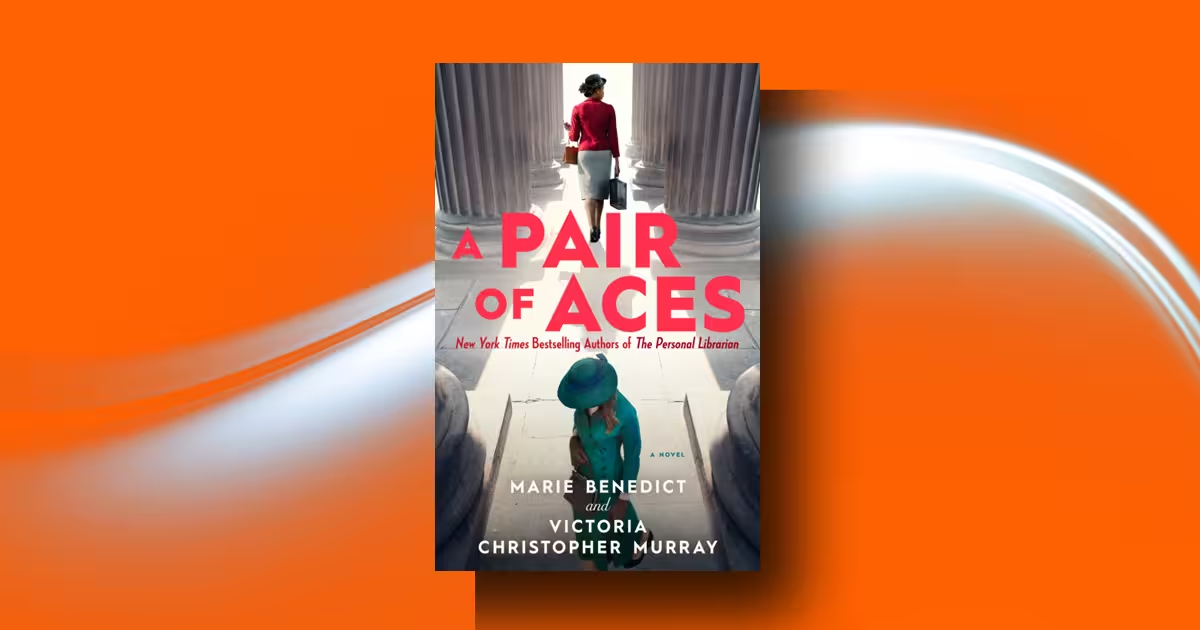
What happens when two women—one a respected prosecutor, the other a notorious madam—find themselves trapped on the same side of the law, both desperate to topple the same ruthless mobster? In A Pair of Aces, their unlikely alliance becomes the secret engine of one of the most dramatic trials of the 1930s.
In A Pair of Aces, a Jewish immigrant madam and a Black female assistant DA forge a secret alliance to take down Lucky Luciano’s prostitution ring, proving that power is multiplied when women from different worlds stand together for a common goal.
A Pair of Aces is great read fans of gripping historical fiction, readers who loved The Personal Librarian, anyone fascinated by true crime and 1930s New York, and those who enjoy stories about fierce, unconventional women who break the rules to achieve justice.
However, A Pair of Aces is not for readers looking for a traditional romance plot, those uncomfortable with frank discussions of prostitution and mob violence, or anyone who prefers straightforward heroes—the women in this story are complex, flawed, and operate in moral gray zones.
Table of Contents
1. Introduction
Title and Author Information: A Pair of Aces is a 2026 historical fiction novel co-authored by Marie Benedict and Victoria Christopher Murray, published by Berkley (an imprint of Penguin Random House). The authors previously collaborated on the million-copy bestsellers The Personal Librarian and The First Ladies. The book has been selected as a Reese’s Book Club pick.
2. Background
Set during the depths of the Great Depression in 1935–1936, A Pair of Aces plunges readers into a New York City terrorized by gangland violence. The novel opens with the murder of Vincent “Mad Dog” Coll, a brutal hit that signals the shifting power dynamics within the underworld.
At the center of this chaos is newly appointed Special Prosecutor Thomas Dewey, who has assembled a twenty-person team to dismantle organized crime. Among his handpicked prosecutors is Eunice Hunton Carter—Manhattan’s first Black female assistant district attorney.
Against this backdrop, the authors introduce Polly Adler, the most infamous madam of the Jazz Age, a Russian Jewish immigrant whose exclusive brothel has become a haven for celebrities and gangsters alike.
As Dewey’s investigation heats up, these two women from opposite sides of the law find themselves drawn into a dangerous, secret collaboration that will alter the course of American crime history.
3. A Pair of Aces Summary
Part One: An Unwelcome Introduction
The novel opens on April 3, 1935, as Polly Adler steps into a suite at the Algonquin Hotel with four of her girls. Her host, theater owner Archie Elwyn, has arranged a private party. Almost immediately, Polly senses something is wrong.
The so-called “Mr. Brown” she is introduced to is no theater impresario but rather the notorious gangster Dutch Schultz. When Polly retreats to the butler’s pantry, she discovers a hidden arsenal of tommy guns, and moments later she overhears Schultz ordering a hit on his rival, “Mad Dog” Coll. “In the fifteen years I’ve been running my business,” Polly reflects, “I’ve done everything I can to avoid connections with the upper levels of the Mob”.
Yet she now finds herself trapped.
Meanwhile, Eunice Carter hurries through the labyrinth of hallways in the special prosecutor’s office on April 4, 1935. She is the lone woman and the sole Black attorney among Dewey’s twenty prosecutors.
When Dewey announces that Coll has been murdered, Eunice is determined to use the chaos to build her own investigation. Rather than focusing on gambling or extortion like her male colleagues, she has been assigned to field complaints from ordinary New Yorkers. But she has quietly begun to notice a troubling pattern emerging from the complaints—a pattern of brothels multiplying unchecked across the city, protected by corrupt lawyers and bail bondsmen.
Eunice visits Polly in her jail cell at the 30th Precinct Station House.
The tension between them crackles.
Polly, recognizing a colored female assistant district attorney for the first time, refuses to speak. But Eunice refuses to leave. “Assistant District Attorney Carter,” Polly says, enunciating every syllable, “I don’t know a thing about running a ‘house of prostitution.’ My arrest is a big mistake.” And then she adds, almost as an afterthought, “But I will tell you something for nothing.
No girl wakes up in the morning wishing to spend her life as a whore”.
Part Two: The Strain of a Double Life
Back home in Sugar Hill, Eunice struggles to balance her dangerous work with her failing marriage. Her husband, Lisle, a successful Harlem dentist, has grown resentful of her late hours and high-profile role. “You’re gunning for the most dangerous men in this city,” he warns her. “Can’t you see you’re not safe because of that? No one is.”.
They argue repeatedly, and Lisle eventually storms out, slamming the door behind him.
Polly, in the meantime, discovers the true cost of her freedom.
After her arrest, she had made a deal with Dutch Schultz to reduce her jail time. Now Dutch and his crew treat her brothel as their personal headquarters. “I wasn’t given a choice but to invite the Devil to my doorstep,” she laments.
Dutch’s lieutenant, Lulu, and other thugs destroy her bar, drink for free, and intimidate her guests. Worse, Polly learns that a shadowy organization called “the Combination” is consolidating control over every brothel in the city.
By the fall of 1935, Lucky Luciano has orchestrated Dutch Schultz’s assassination. Polly realizes with horror that Luciano intends to extend the Combination to her own house.
When she refuses to comply, one of his thugs punches her in the face, sending her to the floor. “All the rage simmering beneath my surface—rage over my loss of power, rage over my inability to protect my girls, rage over being forced into this life because my family sent me to this country at twelve when I was innocent and vulnerable—bursts forth,” Polly narrates.
Part Three: The Unthinkable Alliance
Eunice continues to investigate, now convinced that a prostitution racket linked to the Mob could be the key to bringing down Luciano. Dewey dismisses her theory at first. “I will not be going after Schultz for prostitution,” he declares.
Undeterred, Eunice requests permission for a wiretap. As she listens to hours of recorded conversations between corrupt attorneys and bondsmen, she uncovers names like Abe Karp, Jesse Jacobs, and Pete Harris—names that form a chain of evidence leading ever upward.
Meanwhile, Polly’s desperation reaches a breaking point after Luciano drags one of her favorite girls, Virginia, out of the house, never to be seen again.
She searches for Virginia in vain, visiting flophouses and street corners. Finally, she swallows her pride and sends a telegram to Assistant District Attorney Carter: “I need to speak with you about an important matter.” The two women meet in secret at a Chock full o’Nuts near Penn Station.
Polly supplies Eunice with a list of bookers and fixers connected to the Combination. In exchange, Polly asks for only one thing: advance warning so she and her girls can escape when the raids begin.
Part Four: The Trap Springs
On the night of February 1, 1936, Eunice orchestrates the largest vice raid in New York City’s history. Police storm forty-one brothels simultaneously, arresting over one hundred women. The raids are front-page news. “Largest Vice Raid Ever,” the headlines scream. “Bosses Nabbed in New York Raids.”
Polly, tipped off in advance, slips out of her house with the Lion and her girls just in time.
But Eunice soon discovers that securing evidence is far easier than securing testimony. The arrested girls and madams refuse to talk. They have been threatened with death. “Do you have any idea what will happen to me if I say anything?” one of the girls asks Eunice, then slowly lifts her finger to her throat and drags it across her skin.
Weeks pass. Eunice grows frustrated—until Polly sends her another message, this time containing a crucial piece of intelligence about Red Sadie, the notorious madam.
Eunice confronts Red Sadie in her jail cell. “You’re facing fifteen years,” she tells her. Sadie’s bravado crumbles. She whispers the name that Eunice has been waiting to hear: “The Boss is Lucky Luciano.”
Armed with that confession, Eunice returns to Dewey. He finally agrees to indict Luciano for running a prostitution racket.
Part Five: The Trial and the Verdict
The trial becomes a media sensation. But the prosecution’s case rests largely on the testimony of prostitutes and madams, whose credibility is relentlessly attacked by Luciano’s defense team. Eunice knows she needs a credible, impartial witness to corroborate the women’s stories.
Polly comes to the rescue once more. She approaches the manager of the Waldorf-Astoria, Mr. Woelfle, and persuades him to allow his staff to testify. Marjorie Brown, a young chambermaid, takes the stand and identifies Luciano’s co-defendants with unshakable certainty. She describes seeing women drugged and beaten in Luciano’s apartment.
When Luciano himself testifies, he denies knowing any of the other defendants. Dewey confronts him with telephone records proving he called Nancy Presser and Mildred Balitzer. The jury deliberates for only a few hours before returning a guilty verdict on all sixty-one counts.
The Aftermath
In the days following the verdict, Polly learns that Virginia, the missing girl, has survived and now works as a sales clerk at Saks Fifth Avenue. She buys two tubes of lipstick, one for herself and one for Eunice. “We make quite a pair,” she tells Eunice over the phone. “A pair of aces, that’s what we are.”
The two women, who can never be friends, acknowledge the deep respect forged in their shared struggle. Eunice returns to her husband, who has finally come to understand and appreciate her work. Polly faces the challenge of rebuilding her life, determined one day to tell her story on her own terms.
4. A Pair of Aces Analysis
4.1 Characters
Eunice Hunton Carter: Eunice emerges as the intellectual engine of the book. She is methodical, patient, and relentless.
The authors show her grappling with the dual burdens of being the only woman—and the only Black person—on the prosecution team. “You know, I’ve often thought that your life story would make a terrific book,” a friend tells her, and indeed Eunice’s life is a study in quiet heroism. Her defining moment comes when she bribes a police officer to release Virginia secretly, risking her own case to save a terrified girl.
This act reveals her humanity beneath the starched collar.
Polly Adler: Polly is the book’s great tragic figure. The authors refuse to romanticize her profession but also refuse to condemn her outright. She is fiercely protective of her girls, creating a safe haven in a brutal industry.
Her backstory—a twelve-year-old immigrant sent alone to America, raped by a factory foreman, thrown out by her cousin when she became pregnant—explains how she was forced into vice. Her decision to betray Luciano is not born of altruism alone but of desperation: “I will never allow my girls to be treated in the dismissive, subhuman manner I endured,” she declares.
Lucky Luciano: The authors depict Luciano as a cold, calculating strategist. Unlike the volatile Dutch Schultz, Lucky uses charm and intelligence to consolidate power. When he slaps Polly, the violence is chilling because of its casualness.
His trial testimony, in which he denies knowing any of his co-defendants despite overwhelming evidence, is masterfully written as a study in arrogant sociopathy.
The Lion: Polly’s devoted housekeeper is a quiet powerhouse. She sees everything and says little, but her loyalty is absolute. When Polly is kidnapped by Luciano’s thugs, the Lion is the one who keeps the household together. Their relationship—“she gave me the unconditional love that my father never did”—is one of the most moving in the book.
4.2 A Pair of Aces Themes and Symbolism
The Cost of Ambition: Both Eunice and Polly pay a steep price for their success. Eunice’s marriage nearly collapses; she misses her son’s childhood and is excluded from the trial team because of her race. Polly is disowned by her parents when they discover her true profession. The authors refuse to pretend that ambition comes without sacrifice.
The Power of Unlikely Alliances: The central theme is that women from vastly different backgrounds can achieve the impossible when they set aside judgment and work together. Eunice and Polly never become friends. They mistrust each other. Yet they recognize that neither can succeed without the other. “The prosecutor and the madam—strange and secret bedfellows, indeed!” Eunice reflects.
The Machinery of Exploitation: The book exposes how the Mob turned prostitution into a ruthless business. The Combination—a network of bookers, lawyers, bondsmen, and corrupt cops—treated women as disposable assets. “Those girls are working harder than factory hands,” one of the bookers jokes on a wiretap.
The authors force readers to confront the human cost of vice.
Identity and Reinvention: Polly’s struggle to escape her past is heartbreaking. She tries to start a legitimate business after her jail term, only to be rejected because of her criminal record. Dutch Schultz’s words haunt her: “Once you’re tagged a criminal, you’re tagged for life. There’s no getting out.”
Yet she ultimately finds a different form of reinvention, becoming a writer who can tell her story on her own terms.
Race and Class: A powerful scene late in the book has Eunice and Polly arguing about who has had it harder. Eunice points out that Polly, as a white woman, can pass as “respectable” if she chooses. Polly fires back that Eunice had a family who supported her education. Neither is wrong. The authors refuse to rank suffering, instead showing how systems of oppression intersect in complex ways.
5. Evaluation
“A Pair of Aces” is a gripping, impeccably researched historical thriller that restores two forgotten women to their rightful place in the history books. Benedict and Murray have crafted a narrative that is part courtroom drama, part character study, and entirely unputdownable.
5.1 Strengths
The pacing is masterful. The authors alternate between Eunice’s and Polly’s points of view, creating a tension that builds steadily toward the climactic trial.
The dialogue crackles with authenticity, from the streets of Harlem to the King Tut bar. The authors’ decision to show the women’s home lives—Eunice’s crumbling marriage, Polly’s fractured relationship with her parents—adds emotional depth that elevates the book above standard historical fiction.
The research is meticulous. The authors name-drop real historical figures (Walter Winchell, Dorothy Parker, Robert Benchley) without overdoing it. The trial transcripts feel authentic, and the depiction of Lucky Luciano’s operation aligns with historical accounts.
5.2 Weaknesses
At times, the secondary characters feel underdeveloped. Polly’s other girls, with the exception of Virginia and Mabel, blend together.
The pacing in the middle section drags slightly as Eunice listens to wiretap after wiretap without significant plot advancement. Additionally, some readers may find the moral ambiguity uncomfortable—Polly is a sympathetic figure, but she is also a woman who profits from the exploitation of other women, and the book never fully resolves that tension.
5.3 Impact
The novel packs an emotional punch. Polly’s reunion with her mother—and subsequent rejection—is devastating. Eunice’s quiet triumph at being acknowledged by Duke Ellington in front of her husband is unexpectedly moving.
The final scene, with Polly buying lipstick for Eunice, is a small but perfect gesture that encapsulates their relationship: not friendship, but solidarity.
5.4 Comparison with Similar Works
Fans of Erik Larson’s The Devil in the White City will appreciate the meticulous historical detail. Readers who enjoyed The Personal Librarian (by the same authors) will recognize the dual-protagonist structure and the exploration of race and class.
The book also calls to mind The Gown by Jennifer Robson, which focuses on female friendship and hidden historical contributions.
6. Personal insight with contemporary educational relevance
What makes A Pair of Aces more than just entertainment is its timely exploration of how women from different backgrounds can work together for justice. In an era of deep political divisions, the novel offers a roadmap for coalition-building.
Five lessons from the book that resonate today:
1. Credibility is often unfairly tied to identity. Eunice’s witnesses are dismissed as “prostitutes and pimps,” yet their testimony is truthful. The novel asks readers to question who we deem trustworthy and why.
2. Systemic change requires unconventional alliances. Eunice could not have built her case without Polly’s inside knowledge, and Polly could not have protected her girls without Eunice’s legal muscle. Neither could act alone.
3. The personal is political. Eunice’s marriage suffers because she chooses public service. Polly is disowned because she chooses survival. The novel refuses to pretend that women can “have it all” without sacrifice.
4. Silence is complicity. The hotel staff who witness Luciano’s crimes initially say nothing. It takes Marjorie Brown’s courage to break the silence. Her testimony turns the tide of the trial.
5. Redemption is possible, but it is never easy. Polly cannot erase her past. She cannot undo the harm she has caused. But she can choose to act differently in the present. That choice defines her.
These lessons are particularly relevant as we witness ongoing debates about criminal justice reform, sex work, and the role of whistleblowers in exposing corruption.
7. A Pair of Aces Quotes
“No girl wakes up in the morning wishing to spend her life as a whore.”
“Once you’re tagged a criminal, you’re tagged for life. There’s no getting out.”
“I will never allow my girls to be treated in the dismissive, subhuman manner I endured.”
“The prosecutor and the madam—strange and secret bedfellows, indeed!”
“A pair of aces, that’s what we are, Mrs. Carter.”
8. Conclusion
A Pair of Aces is a triumph of historical fiction. Benedict and Murray have resurrected two extraordinary women whose names have been relegated to footnotes and given them the starring roles they deserve.
The novel is at once a gripping thriller, a nuanced character study, and a poignant meditation on justice, sacrifice, and the power of women to change the world from the shadows. Highly recommended for book clubs, history buffs, and anyone who loves a story about defying the odds.







