
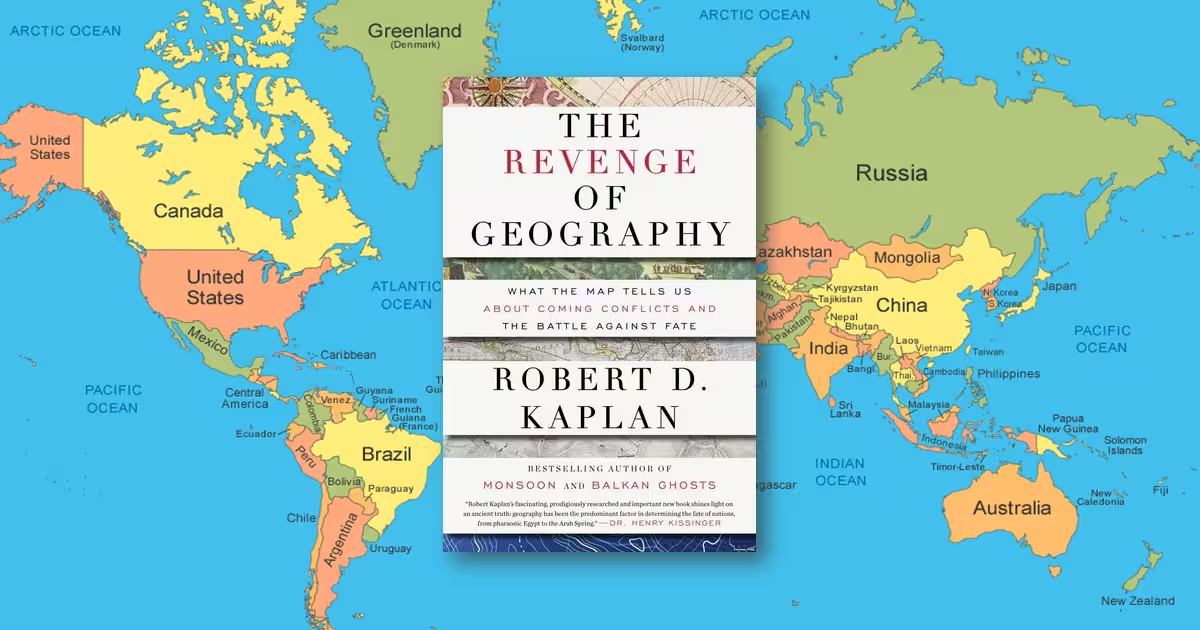
Does it ever strike you that the world’s most violent and contested places — the Iran-Iraq border, the South China Sea, the Russia-Ukraine frontier, the Af-Pak tribal belt — are exactly where ancient geography would have predicted trouble? Are borders drawn on paper simply no match for the mountains and deserts that existed ten thousand years before the cartographer arrived? That is the animating question behind Robert D. Kaplan’s The Revenge of Geography, and it is the kind of question that rewires your brain for how you will read any headline for the rest of your life.
Best For
- Readers curious about why the world is the way it is, not just what happened
- Foreign policy enthusiasts, IR students, and strategic thinkers
- Anyone who found Kissinger’s World Order compelling but wanted more terrain and fewer cocktail parties
- Journalists and analysts trying to understand Russia, China, Iran, or India
- History lovers who care about the deep, geological time of civilizations
Not For
- Readers looking for optimistic or agenda-driven policy prescriptions
- Those who want a narrative thriller with characters and plot
- Readers uncomfortable with what can sound like fatalism or determinism
- Anyone who expects every claim to be data-rich and statistically proven
- Casual readers wanting a light, fast read — this book demands attention
Table of Contents
Introduction
Title: The Revenge of Geography: What the Map Tells Us About Coming Conflicts and the Battle Against Fate
Author: Robert D. Kaplan
Publisher: Random House
First Published: 2012 (Afterword added 2013)
Pages: 376 (with notes)
The Revenge of Geography: What the Map Tells Us About Coming Conflicts and the Battle Against Fate was written by Robert D. Kaplan and published by Random House in 2012, with an afterword added in 2013. Kaplan is a senior fellow at the Center for a New American Security, a longtime Atlantic correspondent, a senior advisor at Eurasia Group, and a member of the U.S. Navy’s Executive Panel.
Foreign Policy magazine twice named him one of the world’s Top 100 Global Thinkers. Before he was any of those things, he spent thirty years crossing borders on foot — from Iraqi Kurdistan to the Berlin Wall, from the Khyber Pass to the Jordan River — and this book is, among other things, a reckoning with what those crossings taught him.
The Revenge of Geography is about political geography — specifically, the forgotten discipline that studies how rivers, mountains, deserts, coastlines, and climate shape the behaviour of states and the fate of civilizations.
Kaplan’s central argument is disarmingly simple: we forgot about geography after the Cold War ended, imagined a borderless, flat world, invaded Mesopotamia without reading the relief map, and paid dearly for it.
The Revenge of Geography is what happens when physical reality reasserts itself against ideological ambition.
This is not a book that argues geography determines everything. It argues that geography is the first thing you must understand before you can understand anything else about a country’s foreign policy, military behaviour, or political culture — and that we almost never start there. Moreover, this is a deeply personal book.
Kaplan begins with himself, at frontiers, and returns to the human moral dilemma throughout: how much room, really, does geography leave for human agency?
“Geography, from a Greek word that means essentially a ‘description of the earth,’ has often been associated with fatalism and therefore stigmatized: for to think geographically is to limit human choice, it is said.
But in engaging with such tools as relief maps and population studies I merely want to add another layer of complexity to conventional foreign policy analyses, and thus find a deeper and more powerful way to look at the world.”
— Robert D. Kaplan, The Revenge of Geography (Preface)
That framing alone tells you what kind of thinker Kaplan is. He is not an ideologue and not a determinist. He is, above all, a witness who has spent three decades watching the map vindicate itself, and he wants the rest of us to catch up.
Background
The Revenge of Geography‘s first chapter, “From Bosnia to Baghdad,” is one of the most honest pieces of geopolitical self-examination I have read by an American journalist.
Kaplan confesses openly that he supported the 2003 Iraq War, partly because he had been impressed by the relatively painless American military interventions in Bosnia and Kosovo during the 1990s.
He had, he admits, mistaken air power for omnipotence and mistaken the Balkans — the western, most developed edge of the former Ottoman Empire, adjacent to Central Europe — for Mesopotamia, its most chaotic eastern reaches.
The lesson the map would have taught him, and that he missed, is that intervening in the former Yugoslavia is geographically and historically very different from intervening in Iraq, a land with no natural borders, composed of Kurds and Sunni and Shia Arabs seething with ethnic and sectarian consciousness, where every dictator going back to 1958 had to be more repressive than the previous one simply to hold the state together.
This intellectual honesty is one of the book’s great virtues. Kaplan is not trying to score political points. He is trying to understand how an entire generation of American policymakers — neoconservatives and liberal internationalists alike — convinced themselves that geography had been defeated by air power and moral clarity, and what exactly went wrong when that assumption collided with the terrain of Fallujah.
The Post Cold War world, he argues, moved through two intellectual cycles.
The first, from 1989 to roughly 2003, was the cycle of idealism: the fall of the Berlin Wall appeared to prove that geography and culture were mere obstacles to be overcome by will, democracy, and American military power.
The Munich analogy dominated policy thinking — evil must be stopped wherever it rises, and stopping it is always possible if you commit. The second cycle, which the Iraq War inaugurated, was the cycle of realism, the Vietnam analogy: the recognition that terrain, history, and ethnic and sectarian consciousness impose genuine limits on what foreign military intervention can achieve.
Kaplan’s book is written as a corrective that tries to make that second cycle intellectually rigorous, rather than just emotionally reactive.
“The debacle of the early years in Iraq has reinforced the realist dictum, disparaged by idealists in the 1990s, that the legacies of geography, history, and culture really do set limits on what can be accomplished in any given place.”
— Kaplan, Ch. II
Realism, as Kaplan traces it through Hans Morgenthau’s foundational 1948 work Politics Among Nations, is itself deeply spatial. Morgenthau writes that “on the relatively stable foundation of geography the pyramid of national power arises.”
For realists, the map is not decoration; it is the preface to understanding any state’s behaviour.
A state’s position on the map is the first thing that defines it, more than its governing philosophy even. Kaplan builds on this to argue that we need to recover a sensibility about geography that the jet age and the information age have caused us to lose.
The Revenge of Geography Summary
The Revenge of Geography is organised in three parts. Part I, titled “Visionaries,” excavates the intellectual tradition of geopolitical thinking — the scholars who mapped the connection between landscape and power. Part II, “The Early-Twenty-First-Century Map,” applies those theories region by region across Eurasia.
Part III, “America’s Destiny,” turns the lens on the United States itself, with a particularly unsettling chapter on Mexico. Together, they form a single sustained argument: that geography is not fate, but it is the most durable constraint on fate.
Part I — The Visionaries: Building the Intellectual Architecture
Kaplan begins not with politicians but with scholars, specifically three University of Chicago professors who he believes give us the intellectual tools to read the map honestly: Hans Morgenthau (political realism), William H. McNeill (world history as civilizational interaction), and Marshall Hodgson (the geography of Islam).
He then introduces the canonical geopolitical thinkers of the twentieth century — Halford Mackinder, Nicholas Spykman, Alfred Thayer Mahan — before tracing how their ideas were distorted by Nazi Geopolitik and subsequently discredited in ways that prevented their legitimate insights from being heard.
Herodotus and the geography of antiquity.
Before any of the moderns, Kaplan reaches back to Herodotus, who he regards as the archetype of the geographical sensibility he wants to recover. Herodotus, born a Persian subject in Halicarnassus around 484 BC, maintains in his Histories the balance between geography and human agency that Kaplan spends the entire book searching for.
The mountains of Kurdistan, the flatlands of Mesopotamia, the protective deserts of Egypt — these are not background decoration in Herodotus. They are characters with agency, and politicians who ignore them come to grief.
McNeill and the rise of the West. William McNeill’s 1963 masterwork The Rise of the West runs over eight hundred pages and covers the entire sweep of human civilisational development, from the Fertile Crescent to the closing of the global map in the Age of Discovery.
For McNeill, history is not a story of separate civilisations pursuing separate destinies (against Spengler and Toynbee) but a story of civilisations in constant interaction, shaped by the landscapes from which they arise.
The great migrations across Eurasia, the spread of plague, the diffusion of technology — all are intelligible only by reference to the terrain on which they occurred.
Europe developed as it did, McNeill argues, partly because of its intricate array of mountains, peninsulas, and navigable rivers, which produced distinct language groups and competitive states capable of seizing advantage from one another.
Its 23,000-mile coastline — equal to the circumference of the earth — gave it a higher ratio of coast to landmass than any other continent, enabling the maritime dynamism that produced the Age of Discovery.
Hodgson and the geography of Islam. Marshall Hodgson’s three-volume The Venture of Islam (published posthumously in 1974) is, Kaplan argues, one of the most important and most neglected works of twentieth-century scholarship.
Hodgson shows how Islam emerged not as a desert creed but as a merchants’ creed, from the pulsing cosmopolitan centre of Mecca, located at the intersection of the Red Sea trade routes between Yemen and Syria, and the east-west routes connecting Africa, Arabia, and Mesopotamia.
The aridity of the Greater Middle East forced concentrated wealth into oases and trading cities, making commercial ethics — “just dealing” — paramount, and creating the social conditions from which a faith emphasising moral integrity could spread with extraordinary speed. Hodgson’s broader point is that the rigid Cold War categories of “the Middle East” versus “South Asia” versus “Central Asia” are geographical distortions.
The Oikoumene — the temperate zone stretching from North Africa to the margins of western China — is a single organic geography, and the modern states carved out of it by colonialism have more continuity with their ancient predecessors than most people acknowledge.
Mackinder and the Heartland.
Sir Halford Mackinder, the father of modern geopolitics, published “The Geographical Pivot of History” in the April 1904 issue of The Geographical Journal. His thesis is that Central Asia — the vast interior landmass inaccessible to sea power — is the pivot around which world empires rotate. His famous dictum, refined over subsequent decades, runs:
“Who rules East Europe commands the Heartland: Who rules the Heartland commands the World-Island: Who rules the World-Island commands the World.”
— Halford J. Mackinder, Democratic Ideals and Reality (1919)
The World-Island is Eurasia plus Africa — the super-continent that contains 75 percent of the human population and 60 percent of global GDP. Mackinder’s insight was that the Columbian epoch (the Age of Discovery, roughly 1500–1900) saw European sea powers project force around the rimlands of Eurasia, but that this era was ending.
Henceforth, geography would be a closed system: “every explosion of social forces, instead of being dissipated in a surrounding circuit of unknown space and barbaric chaos, will henceforth be sharply re-echoed from the far side of the globe.”
The two world wars were, in Mackinder’s frame, struggles for domination of the Heartland: Germany trying to seize it in two directions, Russia consolidating it through the Soviet Union. Cold War containment strategy was, at root, about preventing any single power from commanding the Heartland.
And America’s post-2001 projection of force into Afghanistan and Iraq — two Heartland or near-Heartland states — re-enacted the same geopolitical drama, though few American policymakers were reading Mackinder at the time.
Kaplan is careful to defend Mackinder against the charge of determinism, noting that Mackinder himself insisted that geography could be overcome — but only if you took it seriously first.
He also traces the tragic misappropriation of Mackinder by Karl Haushofer, the Nazi geopolitician who twisted the Heartland thesis into a justification for Lebensraum and German expansion eastward.
This Nazi distortion, Kaplan argues, gave geography and geopolitics a toxicity in postwar Western academia that they never deserved, and that directly contributed to the ignorance of geography which led to the Iraq disaster.
Spykman and the Rimland. Nicholas Spykman, a Dutch-American strategist who died in 1943, inverted Mackinder. Where Mackinder said the Heartland controls the World-Island, Spykman argued that the Rimland — the great arc of coastal territory running from Western Europe through the Middle East and South Asia to East Asia — is the real prize.
He who controls the Rimland controls the Heartland; he who controls the Heartland controls the destiny of the world. This subtle shift in emphasis has enormous practical consequences: it is the Rimland that the United States has spent the post-WWII era trying to prevent any hostile power from dominating, through its network of bases, alliances, and naval deployments in the Mediterranean, the Persian Gulf, and the Western Pacific. Spykman wrote in 1942 that “geography does not argue.
It simply is.” His point that “ministers come and go, even dictators die, but mountain ranges stand unperturbed” is a phrase that should be carved above every foreign ministry entrance in the world.
Mahan and sea power.
Alfred Thayer Mahan, the late-nineteenth-century American naval strategist, rounds out Kaplan’s gallery of visionaries. Mahan’s insight was that sea power — the ability to control the lines of maritime communication — is the fundamental variable in great power competition.
Land powers, lacking ocean access, are insecure and expand compulsively to find it. Russia’s entire modern history, in this reading, is the story of a land power trying to acquire warm-water ports.
Mahan identified the “debatable and debated ground” of the Middle East as the zone where sea power and land power perpetually contest for dominance. His Indian Ocean observations were so prescient that they shape American naval strategy today.
Part II — The Map: Region by Region
The second part of The Revenge of Geography applies this theoretical architecture to the actual world of the twenty-first century, region by region.
This is where the book becomes a tour de force of synthesis, moving from Europe to Russia to China to India to Iran to the former Ottoman lands in a single sustained argument.
Europe. Europe, Kaplan reminds us, is the “westerly excrescence” of Asia. Its 23,000-mile coastline and multiplicity of mountain ranges, peninsulas, and river systems produced distinct nation-states but also constant conflict.
The Revenge of Geography traces how the economic divisions visible in the eurozone crisis of 2010–2012 (Germany versus Greece, north versus south) actually reproduce ancient geographical and historical fissures: the border between Carolingian Catholic Europe and Byzantine-Ottoman Orthodox Europe, the divide between the rich loess soils of northern Europe and the poorer, more precarious Mediterranean soils that Fernand Braudel identified as the historical basis of more rigid, oligarchic social orders.
The European Union is, in Kaplan’s telling, a heroic attempt to overcome these geographical divides, but it cannot simply paper over them with a single currency.
Germany, reunited and central, emerges as the key question mark. Will it drift toward Russia and the Eurasian Heartland, or anchor itself firmly in maritime Western Europe? The answer, Kaplan argues, will determine whether Mackinder’s nightmare — a single power controlling the Heartland — comes to pass.
Russia. Russia is, in Kaplan’s account, geography’s most insecure prisoner. A land power extending 170 degrees of longitude with no significant natural barriers anywhere on its vast flatlands, Russia has been invaded repeatedly — by Lithuanians, Poles, Swedes, Frenchmen, and Germans — and the memory of the Mongol yoke (1237–1480) is the deepest psychological scar in Russian civilisational consciousness. Insecurity is the quintessential Russian national emotion.
Russia’s compulsive need to expand — into Eastern Europe, the Caucasus, Central Asia, and Siberia — is not mere imperialism. It is the behaviour of a state that has learned from centuries of experience that land is the only barrier it possesses, and that enough land is never enough.
Russia supplies roughly 25 percent of Europe’s natural gas and nearly 100 percent of Finland’s and the Baltic states’ gas. That energy dependency is not an accident; it is the modern form of Mackinder’s Heartland thesis operating in real time.
China. China is the book’s most dazzling regional chapter. Kaplan argues that China’s long-term strategic objective is to convert the Western Pacific from an American lake into a Chinese lake — not because of ideology, but because of geography.
China’s coastline faces the Western Pacific the way America’s coastline faces the Atlantic. A China that cannot project power across that ocean is, like Russia, a land power hemmed in and vulnerable.
The string of islands running from the Japanese archipelago south through Taiwan to the Philippines constitutes, in strategic terms, a first island chain that currently prevents Chinese naval expansion. For China to be a genuine great power, it must break through or dominate this chain.
Meanwhile, China is building ports and infrastructure throughout the Indian Ocean littoral — in Burma, Bangladesh, Sri Lanka, and Pakistan — in what has been called a “string of pearls” strategy, aimed at securing its sea lines of communication to the energy resources of the Middle East.
India. India is, in Kaplan’s framework, the ultimate pivot state. Its geography is simultaneously magnificent and treacherous: bounded by the Arabian Sea, the Bay of Bengal, the Burmese jungles, and the Himalayas, it looks like a closed subcontinent.
But its northwestern frontier — where the Afghan plateau descends gradually to the Indus plain — is where every major invasion in history entered India, from the Aryans and the Greeks to the Mongols and the Mughals. Pakistan, in this reading, is the modern embodiment of every Muslim invasion that swept down from the northwest.
The two countries are locked in a geographically determined embrace from which neither can fully escape.
Moreover, India’s lack of a single demographic and political core comparable to China’s Wei River valley meant that political unity in the subcontinent always required extraordinary effort — and still does.
Kaplan quotes Mackinder, who said in a lecture that “in the British Empire there is but one land frontier on which warlike preparation must ever be ready. It is the Northwest Frontier of India.” That frontier has a different name today, but it has not moved.
Iran.
The Iranian pivot is perhaps Kaplan’s most original contribution toThe Revenge of Geography. Iran is the place where Mackinder’s Heartland and Spykman’s Rimland physically meet. The Iranian plateau — rising from the Persian Gulf in the south to the mountains of the Caucasus in the northwest — is the geographic nexus through which historical empires have always had to pass.
The border between Persia and Mesopotamia shifted for centuries, with the Euphrates River itself serving at times as the frontier. Iran’s influence over Iraq since the 2003 American invasion is not a matter of Iranian scheming — it is geography expressing itself.
The Iranian plateau is intrinsically related to the politics and culture of Mesopotamia. Moreover, Iran’s ambition to project influence from Gaza to Afghanistan is not ideology alone; it is an ancient heartland power seeking the warm-water access and rimland reach that its geography almost but not quite provides.
A democratic Iran, Kaplan argues, might use this same geographic imperative more benignly, but the imperative itself will not disappear with regime change.
The former Ottoman lands.
The chapter on the former Ottoman Empire is where the book is most directly relevant to the news of any given day. Syria, Iraq, Lebanon, Jordan, Israel-Palestine — these states were drawn on paper by exhausted European diplomats after World War I, with only partial reference to the demographic, geographical, and sectarian realities on the ground.
Syria’s present borders exclude Lebanon, which is historically part of greater Syria and without which Syria has no full Mediterranean access. Iraq’s borders enclose a geographic nonsense: Kurds in defensible mountains to the north, Sunnis on the flat central plain, Shia in the demographically rich south, with no natural frontier anywhere.
Every Iraqi dictator going back to 1958 had to be more repressive than the previous one simply because geography gave him no organic basis for state cohesion. The Alawite regime in Syria, likewise, needed extraordinary brutality to hold together a state whose truncated borders harbour irreconcilable sectarian geography.
Kaplan predicted in 2012 that the next generation of Middle Eastern rulers would not have the luxury to rule as autocratically as their predecessors, even as democratic experiments in the region would prove that elections are easily accomplished and stable liberal orders are processes that take generations.
He was right. The Arab Spring vindicated him almost immediately.
Part III — America’s Destiny: Braudel, Mexico, and Grand Strategy
The book’s final section pivots from Eurasia to North America, anchored by a brilliant chapter on Fernand Braudel, the French historian who introduced the concept of the longue durée — the slow geological time of geography and environment that underlies the faster rhythms of politics and the fastest rhythm of daily events.
Braudel allows Kaplan to ask the large question: are the wars in Iraq and Afghanistan mere flecks of surf on the ocean’s surface, or are they symptoms of something deeper and more structural?
The most provocative argument in the final section concerns Mexico.
At a 2009 Washington conference, Boston University professor Andrew Bacevich asked whether, while the United States was deeply focused on Afghanistan and the Greater Middle East, a massive state failure was developing right on America’s southern border. Kaplan finds this observation not merely interesting but structurally correct.
The income gap between the United States and Mexico is the largest between any two contiguous countries in the world. Mexico’s population of 111 million, plus Central America’s 40 million, amounts to half the population of the United States.
The median age in Mexico is 25, compared to nearly 37 in the United States. Kaplan is not alarmist about this — he does not share Huntington’s conclusion that cultural nationalism can hold the line.
He argues instead that the organic geographical, demographic, and economic connection between Mexico and America is already too deep to be reversed, and that American grand strategy should orient itself north-south rather than clinging to its traditional east-west, sea-to-shining-sea mythology.
A stable and prosperous Mexico working in concert with the United States would be a geopolitical combination more powerful than anything achievable through Middle Eastern intervention.
“Fixing Mexico is more important than fixing Afghanistan.”
— Andrew Bacevich, paraphrased by Kaplan, Ch. XV
The Revenge of Geography ends with a summons to be simultaneously a balancing power in Eurasia and a unifying power in North America — to do both, which Kaplan argues is easier than doing just one.
The closing image is Coronado’s 1540 journey north from central Mexico through Arizona, New Mexico, Texas, and Kansas — a south-to-north axis that predates Lewis and Clark’s east-to-west one, and that, Kaplan implies, will define America’s future more than its continental mythology acknowledges.
The Revenge of Geography Analysis
The Revenge of Geography is a remarkable, unsettling, and genuinely important book.
It is not great in the way that a flawlessly constructed literary argument is great — it is great the way a long, deeply experienced journey is great: it has the texture of decades on the ground, the intellectual humility of a man who was wrong about Iraq and spent years trying to understand why, and the breadth of someone who has read everything from Herodotus to Braudel and can hold it all together in a single argument.
Kaplan’s core thesis holds up with extraordinary force fourteen years after publication.
Russia’s 2022 invasion of Ukraine, which Kaplan’s framework all but predicted (a land power without natural frontiers, traumatised by historical invasion, will keep expanding or be conquered), China’s naval buildup in the South China Sea and its string-of-pearls infrastructure in the Indian Ocean, Iran’s de facto control of a land corridor from Tehran to Beirut via Iraq and Syria, India’s paralysis over Afghanistan and Pakistan — all of these are exactly the conflicts his geographical analysis forecast.
A reader in 2026 who picks up The Revenge of Geography will feel, disturbingly, that Kaplan is describing the present rather than the future.
There is something almost Shakespearean about the book’s central irony: that geography informs, never fully determines, and yet human beings consistently refuse to be informed by it. Kaplan quotes Spykman — “ministers come and go, even dictators die, but mountain ranges stand unperturbed” — and the phrase echoes through every subsequent chapter like a Shakespearean refrain.
The tragedy is not that geography is fate. The tragedy is that we keep behaving as if it isn’t.
The chapter on Iran is, to my mind, the book’s most original intellectual contribution.
The insight that Iran is the geographic pivot where Heartland and Rimland meet — that Iranian influence over Iraq is not ideology but geology — explains more about the post-2003 Middle East than a dozen books of political analysis.
Similarly, the India chapter, with its account of the subcontinent’s historically permeable northwest frontier as the matrix through which every historical threat has entered, provides the essential context for understanding why Indian policymakers treat Afghanistan as their near-abroad and Pakistan as an existential problem, not merely a difficult neighbour.
The Revenge of Geography reads best as a corrective and a call to intellectual sobriety. It does not tell you that democracy is impossible in the Middle East or that autocracy is inevitable in Russia.
It tells you that before you make any assumptions about what is possible, you had better know what the map looks like and what it has historically meant. That is, in the end, a moderate and humble position — and one that our political class, always in search of the transformative gesture and the redemptive narrative, consistently fails to adopt.
Strengths and Weaknesses
Strenghts of The Revenge of Geography
✅ Intellectual breadth is genuinely extraordinary: from Herodotus to Braudel, McNeill to Spykman, the synthesis is dazzling and coherent
✅ Kaplan’s firsthand reporting from over thirty countries gives the theoretical framework visceral credibility — he has crossed most of the borders he writes about
✅ The self-critical preface and Iraq confession give the book an intellectual honesty that is rare in geopolitical writing
✅ The “probabilistic determinism” position — geography informs but does not determine — is philosophically careful and avoids the crude fatalism critics often project onto it
✅ The regional chapters (Iran, India, China) are original and have held up with striking accuracy in the decade since publication
✅ The Mackinder chapter rescues a genuinely important thinker from the taint of Nazi misappropriation with real nuance
✅ The final Mexico chapter reorients American grand strategy in a way that is both provocative and geographically rigorous
Weaknesses and Criticism of The Revenge of Geography
❌ The Revenge of Geography is deeply Eurasian in focus; Africa, Latin America (beyond Mexico), and Southeast Asia are underexplored
❌ The treatment of climate change is almost absent — a significant omission for a book about how physical environment shapes politics
❌ Kaplan’s writing style can become dense in the theoretical sections; Part I, while intellectually rich, is slower going than Parts II and III
❌ The book occasionally slips into describing tendencies as near-inevitabilities, even with its disclaimers about probabilistic determinism
❌ His treatment of democracy is cautious to the point of pessimism — he sometimes gives the impression that authoritarian stability is the best realistic outcome for certain regions, which critics find dangerously comfortable
❌ The treatment of Israel-Palestine, while accurate in its demographic projections, is presented with a detachment that some readers find insufficient given the scale of human suffering
Books like The Revenge of Geography
For readers who find Kaplan’s framework compelling, several companion works deepen different aspects of his argument. In fact, Probinism has already reviewed Henry Kissinger’s World Order — arguably the closest companion to this book in scope and ambition — which you can read here.
| Book | Author | Similarity | Key Difference |
|---|---|---|---|
| World Order | Henry Kissinger (2014) | Grand strategic view; realist framework; similar regional scope covering Europe, Middle East, China | Kissinger focuses on diplomatic history and balance-of-power politics; Kaplan on physical geography as the underlying constraint. Kissinger is more optimistic about statecraft’s room to manoeuvre. |
| Prisoners of Geography | Tim Marshall (2015) | Direct application of geographical analysis to current geopolitics; shares Kaplan’s thesis almost entirely; easier and faster to read | Marshall is more accessible and journalistic; Kaplan is deeper and more intellectually complex. Marshall is the entry point; Kaplan is the graduate course. |
| The Clash of Civilizations | Samuel Huntington (1996) | Argues that cultural/civilisational identity is a more durable variable than ideology in international relations; deeply influential on Kaplan | Huntington organises the world by cultural blocs; Kaplan by terrain. Kaplan is less categorical and more sceptical of the “civilisational” frame, noting that McNeill’s inter-civilisational interactions complicate it. |
| Guns, Germs, and Steel | Jared Diamond (1997) | Both argue for the primacy of physical environment in shaping historical outcomes; both explicitly resist racial or cultural determinism | Diamond looks at the deep past (why did some continents develop agriculture first?); Kaplan looks at the geopolitical present and near future. Diamond is more scientific; Kaplan more humanistic and journalistic. |
| The Tragedy of Great Power Politics | John J. Mearsheimer (2001) | Structural realism; argues that geography and power distribution drive state behaviour more than intentions or leaders | Mearsheimer is more formal and theoretical (offensive realism as a complete theory); Kaplan is more historically grounded and willing to engage with the texture of individual civilisations. |
FAQs
Q: What is the main argument of The Revenge of Geography?
A: Kaplan’s central argument is that physical geography — mountains, rivers, deserts, coastlines, climate — shapes the foreign policy and military behaviour of states more durably than ideology, leadership, or political systems.
After the Cold War, the United States and much of the Western policy establishment convinced themselves that geography had been conquered by air power, communications technology, and democratic idealism.
The disasters in Iraq and Afghanistan proved otherwise. The Revenge of Geography is a sustained argument for recovering a geographical sensibility in foreign policy thinking.
Q: Is The Revenge of Geography a determinist book? Does Kaplan believe geography controls everything?
A: No, and Kaplan is emphatic about this. He explicitly invokes Raymond Aron’s concept of “probabilistic determinism” and Isaiah Berlin’s warning against the immorality of surrendering individual agency to vast impersonal forces.
Geography informs — it sets contours, raises costs, shapes historical tendencies — but it does not determine. Human agency always operates within these contours, and the book’s final summons is to understand geography precisely so that you can overcome it more effectively.
The map is “the beginning, not an end to interpreting the past and present.”
Q: What is the Heartland theory and why does Kaplan consider it important?
A: The Heartland theory was developed by British geographer Halford Mackinder in his 1904 article “The Geographical Pivot of History.” Mackinder argued that the vast interior of Eurasia — inaccessible to sea power but traversable by land — is the strategic pivot of world politics.
Any power that controls this Heartland (essentially Central Asia, Russia, and much of Eastern Europe) dominates the World-Island (Eurasia plus Africa), and through it, the world. Kaplan argues that this theory, though developed over a century ago, maps almost uncannily onto the dynamics of both World Wars, the Cold War, and contemporary Russian and Chinese strategic behaviour.
He defends it against misappropriation by Nazi Geopolitik while showing it remains a useful analytical lens.
Q: What does Kaplan say about Russia?
A: Kaplan portrays Russia as geography’s most insecure prisoner. With no meaningful natural barriers anywhere on its vast flat expanse, Russia has been invaded repeatedly throughout its history and the psychological legacy — the Mongol yoke, Napoleon, Hitler — has produced a national character shaped by paranoia and compulsive expansion.
Russia’s need for buffer zones in Eastern Europe, warm-water ports, and access to the Caucasus is not mere imperialism; it is the logical response of a land power that history has shown can be overrun from almost any direction. His 2012 analysis reads, in 2026, as almost perfectly predictive of Russian behaviour in Ukraine.
Q: What does Kaplan say about China?
A: China, in Kaplan’s analysis, is a rising maritime power whose first strategic priority is to convert the Western Pacific from an American lake into a Chinese one — not from ideology but from geography.
The Western Pacific is to China what the Atlantic is to the United States: the strategic moat behind which a great power can operate from relative security.
China’s naval expansion, its port-building around the Indian Ocean, and its resource investments in Central Asia are all intelligible as the behaviour of a Rimland power seeking the maritime access and overland reach that its geography almost but not quite provides.
Q: Is The Revenge of Geography still relevant in 2026?
A: More than ever. The book was published in 2012, and almost every major geopolitical development since then — Russia’s Ukraine interventions, China’s South China Sea assertiveness and Belt and Road Initiative, Iran’s corridor of influence from Tehran to Beirut, India’s strategic paralysis over Pakistan and Afghanistan, the collapse of artificial states across the former Ottoman world — was predicted or at least logically anticipated by Kaplan’s geographical framework.
The book’s afterword, written in 2013, already identified the South China Sea disputes and the crisis of the EU as geography reasserting itself. In 2026, it reads less like a prediction and more like a dispatch from an unchangeable future.
Conclusion:
Should you read Revenge of Geography?
Yes — but with the right expectations.
This is not a beach read.
It is a book that asks you to think historically, geographically, and uncomfortably about the limits of human ambition. It is, at times, slow going in its theoretical sections, and it can seem to lean into pessimism more heavily than its probabilistic-determinist disclaimer warrants. But the intellectual payoff is enormous.
After reading it, you will never look at a news map the same way. You will ask, automatically, what the terrain looks like, what the natural borders are, what historical empires occupied this space, and what the migration routes are. You will be, in short, a better reader of the world.
A major trait of the best nonfiction is that it gives you a new lens that you cannot put down after you close the book. The Revenge of Geography does this with unusual power. It is the kind of book that sits in your mind and becomes more useful with every headline you read.
Kaplan writes at the close of his preface that his goal is “to have an appreciation of the map so that, counterintuitively, we need not always be bounded by it.” That is, ultimately, the right note.
Geography is not an argument for despair. It is an argument for honesty — the prior condition for any wisdom in foreign policy or, for that matter, in life.







