
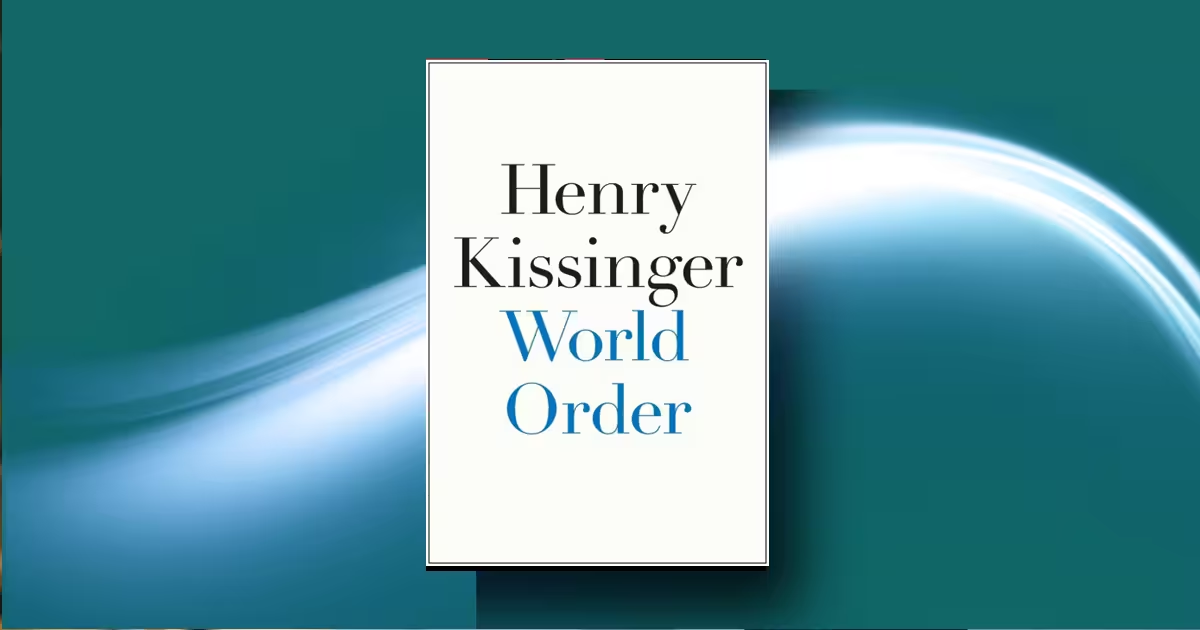
Did you know that the international “rules” everyone keeps talking about were designed by a handful of exhausted Europeans in two small German towns nearly four centuries ago—without a single Asian, African, or Middle Eastern voice in the room? That staggering realization lies at the heart of Henry Kissinger’s World Order, a sweeping 400-page masterwork that examines how different civilizations have conceived of global order and why the modern world is dangerously fragmented despite unprecedented interdependence.
World Order is best for geopolitics enthusiasts, international relations students, policymakers, historians, and anyone who has ever wondered why the United Nations seems paralyzed on major crises or why China, Russia, and America talk past each other on fundamental issues.
Not for readers seeking a quick, light read (this is dense, academic-level analysis), those with no background in European history, or anyone looking for simple solutions to complex global problems.
Table of Contents
World Order Information
Title: World Order: Reflections on the Character of Nations and the Course of History
Author: Henry Kissinger (former U.S. Secretary of State and National Security Advisor)
Publication Date: 2014
Publisher: Penguin Press
Pages: Approximately 420 pages (including notes and index)
Genre: Non-fiction, Geopolitics, International Relations, Political History
Author’s Credentials: Kissinger served as National Security Advisor (1969–1975) and Secretary of State (1973–1977) under Presidents Richard Nixon and Gerald Ford.
He received the Nobel Peace Prize in 1973 for negotiating the Vietnam War cease-fire. Before his government service, he was a Harvard professor specializing in diplomatic history and international relations. His previous books include Diplomacy (1994) and On China (2011).
Central Thesis: According to Kissinger’s own words in the introduction, no truly global world order has ever existed. The “rules-based system” frequently invoked today was devised in Western Europe at the Peace of Westphalia in 1648, without the involvement or awareness of most other civilizations.
A sustainable world order requires a delicate balance between legitimacy (commonly accepted rules that define permissible action) and power (a balance of forces that enforces restraint when rules break down). Order without freedom eventually creates its own counterpoise, yet freedom cannot be secured without a framework of order to keep the peace.
Kissinger writes:
“Our age is insistently, at times almost desperately, in pursuit of a concept of world order. Chaos threatens side by side with unprecedented interdependence: in the spread of weapons of mass destruction, the disintegration of states, the impact of environmental depredations, the persistence of genocidal practices, and the spread of new technologies threatening to drive conflict beyond human control or comprehension.”
World Order is one of the 15 books on the geopolitics.
Background Context
Initially, it may seem that Kissinger—a controversial figure associated with Realpolitik, the bombing of Cambodia, and Cold War power politics—might produce a cynical manual for manipulation. Yet World Order is surprisingly philosophical.
Kissinger wrote this book at age 91, drawing on six decades of observing and shaping international affairs. The work emerged from his growing concern that the post-Cold War optimism of the 1990s had given way to a fragmented, multipolar world where different civilizations operate on fundamentally incompatible assumptions about legitimacy, sovereignty, and justice.
According to BBC analysis of Kissinger’s later writings, he became increasingly worried that Western leaders had forgotten the hard-won lessons of the Congress of Vienna (1814–1815) and the Peace of Westphalia (1648)—namely, that stable order requires consensus among major powers about basic rules of conduct.
The Arab Spring (beginning 2010), the rise of China, Iran’s nuclear program, and the emergence of ISIS all prompted Kissinger to articulate a comprehensive vision of what world order means and why it matters.
As noted earlier, the book draws extensively from Kissinger’s personal experiences: his 1971 secret trip to Beijing to reopen relations with China, his negotiations with Soviet leaders during the Cold War, and his shuttle diplomacy in the Middle East following the 1973 Yom Kippur War. This firsthand knowledge gives the book an authority that purely academic works lack.
World Order Summary: Key Arguments and Themes
The Westphalian System: Origin of Modern Order
A comprehensive view of the issue cannot be formed without understanding the Peace of Westphalia (1648), which Kissinger identifies as the foundational moment of modern international order.
According to the book, the Thirty Years’ War (1618–1648) devastated Central Europe, killing nearly a quarter of its population through combat, disease, or starvation.
The exhausted participants met in the German cities of Münster and Osnabrück—235 official envoys taking residence in rooms “that stank of sausage and fish oil”—and designed a system based on practical accommodation rather than moral insight.
“The Westphalian peace reflected a practical accommodation to reality, not a unique moral insight. It relied on a system of independent states refraining from interference in each other’s domestic affairs and checking each other’s ambitions through a general equilibrium of power.”
The genius of this system, Kissinger argues, was procedural rather than substantive. It established that:
- The state (not empire, dynasty, or religious confession) is the building block of order
- Each state has sovereign power over its territory
- No state should interfere in another’s domestic affairs
- The balance of power would prevent any single state from dominating others
This system spread globally because European nations carried its blueprint with them during colonial expansion. When colonized peoples demanded independence, they did so using Westphalian concepts: national sovereignty, non-interference, and statehood.
The European Balance-of-Power System
Kissinger dedicates significant attention to the Congress of Vienna (1814–1815), which he considers the closest Europe has come to universal governance since Charlemagne’s empire collapsed. The statesmen who assembled there—Metternich of Austria, Talleyrand of France (remarkably representing the defeated nation), Czar Alexander of Russia—faced the wreckage of the Napoleonic Wars.
The key innovation of Vienna: They created a “concert of powers” through periodic diplomatic conferences, functioning as a precursor to the UN Security Council.
This system handled the Belgian revolution of 1830 (creating the novel concept of a “neutral” state), the Greek war of independence (1821–1832), and other crises without major-power war.
Nevertheless, the balance-of-power system had inherent dilemmas. Kissinger quotes Lord Palmerston’s famous statement: “We have no eternal allies, and we have no perpetual enemies. Our interests are eternal and perpetual, and those interests it is our duty to follow.”
The system collapsed in 1914 when political leaders lost control over military planning. Mobilization schedules—not diplomatic calculations—dictated events. According to Kissinger, none of the leaders who drifted into war in August 1914 would have done so had they foreseen the world of 1918, where twenty-five million died and the Russian, Austrian, and Ottoman Empires perished entirely.
As Kissinger goes:
“Reflecting on what might have occurred in alternative historical scenarios is usually a futile exercise. But the war that overturned Western civilization had no inevitable necessity. It arose from a series of miscalculations made by serious leaders who did not understand the consequences of their planning, and a final maelstrom triggered by a terrorist attack occurring in a year generally believed to be a tranquil period.”
Islam and the Middle East: A World in Disorder
This chapter may be the book’s most urgent and unsettling. Kissinger traces the Islamic concept of world order to the seventh century, when Islam launched itself across three continents in an unprecedented wave of religious exaltation and imperial expansion.
“The dar al-Islam, in theory, was in a state of war with the dar al-harb, because the ultimate objective of Islam was the whole world. If the dar al-harb were reduced by Islam, the public order of Pax Islamica would supersede all others.”
Kissinger distinguishes between traditional Islamic empires (which eventually entered the Westphalian system as declining powers) and modern Islamism—the ideology seeking to enforce Muslim scripture as the central arbiter of personal, political, and international life. He profiles two influential thinkers:
Hassan al-Banna (founder of the Muslim Brotherhood, 1928) wrote in 1947 that the West “is now bankrupt and in decline. Their congresses are failures, their treaties are broken, and their covenants torn to pieces.”
Sayyid Qutb (executed in 1966) wrote Milestones while imprisoned, declaring war on the existing world order. Qutb argued that all modern governments are “unIslamic and illegal” and that an ideologically pure vanguard must overthrow them.
“This body of thought represents an almost total inversion of Westphalian world order. In the purist version of Islamism, the state cannot be the point of departure for an international system because states are secular, hence illegitimate.”
Kissinger notes that the Arab Spring (beginning December 2010) initially raised hopes for liberal democracy but was soon “shouldered aside, disrupted, or crushed.” In Egypt, the Muslim Brotherhood’s Mohammed Morsi was elected in 2012, but his government concentrated on institutionalizing authority through intimidation of women, minorities, and dissidents—leading to a military coup welcomed even by secular democrats.
Iran: The Intersection of Two World Orders
Iran presents a unique paradox: a nation with perhaps the most coherent sense of national identity in the Middle East, governed by a clerical regime that has declared war on the Westphalian system.
“Iran’s clerical regime thus placed itself at the intersection of two world orders, arrogating the formal protections of the Westphalian system even while repeatedly proclaiming that it did not believe in it, would not be bound by it, and intended ultimately to replace it.”
Kissinger traces Iran’s statecraft tradition to the Persian Empire and the Arthashastra-like sophistication of its diplomatic methods. The 1979 Khomeini revolution transformed Iran from a US ally (under the Shah) to a revolutionary Islamist state. The Iranian constitution proclaims the goal of unifying all Muslims as a national obligation.
On nuclear proliferation, Kissinger writes that Iran has shown exceptional skill in negotiations: when the P5+1 formed in 2006, Iran had 130 centrifuges; by 2013, it had deployed approximately 19,000. Each Western concession was met with further Iranian demands.
“Iran needs to make a choice. It must decide whether it is a country or a cause.”
The Multiplicity of Asia
Unlike Europe, Asia never developed a common concept of order. China operated a hierarchical tribute system where the Emperor held sway over “All Under Heaven.” Japan existed at the fringe of this system, periodically insisting on its equality. India drew on Hindu cosmology where world order was governed by immutable cycles of millions of years.
“With the exception of Japan, Asia was a victim of the international order imposed by colonialism, not an actor in it.”
Kissinger provides a fascinating account of Japan’s 1853 encounter with Commodore Matthew Perry’s “black ships.” Unlike China, which reaffirmed its traditional stance, Japan set out to master Western concepts and technology for the purpose of eventually expelling foreign domination.
The Meiji Emperor’s 1868 Charter Oath promised: “Knowledge shall be sought throughout the world so as to strengthen the foundation of imperial rule.”
India’s strategic tradition, embodied in Kautilya’s Arthashastra (4th century BC), anticipated Machiavelli by nearly two millennia. According to Max Weber (as cited by Kissinger), the Arthashastra represented “truly radical ‘Machiavellianism’ … compared to it, Machiavelli’s The Prince is harmless.”
China and World Order: The Central Challenge
China’s traditional concept of world order was the furthest from Westphalian ideas. Its Emperor was not a sovereign among equals but the linchpin between human and divine, ruling “All Under Heaven.” Foreign policy was the province of the Ministry of Rituals.
“The goal of the tribute system was to foster deference, not to extract economic benefit or to dominate foreign societies militarily.”
The Western encounter with China was traumatic.
When the first British envoy, George Macartney, arrived in the late 18th century, his ship was festooned with a banner identifying him as “The English ambassador bringing tribute to the Emperor of China.” The Emperor famously replied that Britain had no goods China desired: “Strange and costly objects do not interest me… As your Ambassador can see for himself, we possess all things.”
Kissinger argues that contemporary China combines three legacies: the imperial “All Under Heaven” tradition, Maoist revolutionary ideology, and pragmatic Dengist reforms. Chinese leaders accept Westphalian rules they had no part in making—but expect to revise them.
“A Harvard study has shown that in fifteen cases in history where a rising and an established power interacted, ten ended in war.”
The United States: Ambivalent Superpower
America’s concept of order differs fundamentally from Europe’s. Where Europeans saw balance-of-power as a mechanism to restrain conflict, Americans believed that peace was the natural human condition, disturbed only by other countries’ unreasonableness.
Kissinger contrasts two American presidents who embodied competing visions:
Theodore Roosevelt (1901–1909) understood power politics and balance-of-power. He mediated the Russo-Japanese War (1904–1905), sent the Great White Fleet around the world, and proclaimed the Roosevelt Corollary to the Monroe Doctrine, asserting America’s right to intervene in Latin American domestic affairs to prevent European intervention.
“Liberal societies, Roosevelt believed, tended to underestimate the elements of antagonism and strife in international affairs… ‘the countries which are most humanitarian… tend to grow weaker compared with the other countries which possess a less altruistic civilization.'”
Woodrow Wilson (1913–1921) denounced balance-of-power as immoral and proposed collective security through the League of Nations. Wilson believed that democratic publics would always choose peace if given full information.
“The procedural aspect of the balance of power, its neutrality as to the moral merit of contending parties, was therefore immoral as well as dangerous.”
Kissinger notes that Wilson’s “self-determination” principle, ironically, enhanced Germany’s geopolitical prospects by breaking Austria-Hungary into small, weak states containing large German minorities clamoring for reunion with their native land.
Franklin Roosevelt attempted a synthesis, believing that personal relationships with Stalin could overcome ideological differences.
As Kissinger notes, Roosevelt told a skeptical advisor: “I just have a hunch that Stalin is not that kind of man… I think if I give him everything that I possibly can and ask nothing from him in return, noblesse oblige, he won’t try to annex anything.”
Technology, Equilibrium, and Human Consciousness
The concluding substantive chapter addresses cyber technology and its implications for international order. Kissinger acknowledges his limited technical expertise but focuses on implications.
“The new technology of the Internet opens up entirely new vistas. Cyberspace challenges all historical experience. It is ubiquitous but not threatening in itself; its menace depends on its use.”
The Commander of U.S. Cyber Command has predicted that “the next war will begin in cyberspace.” Yet no international framework exists for cyber conflict. A laptop can produce global consequences; a solitary actor with enough computing power can disable critical infrastructure from near-complete anonymity.
Kissinger worries that the Internet’s emphasis on information over knowledge and wisdom may inhibit the development of leaders capable of lonely, difficult decisions. He quotes T.S. Eliot:
“Where is the Life we have lost in living? / Where is the wisdom we have lost in knowledge? / Where is the knowledge we have lost in information?”
World Order Analysis
What makes World Order groundbreaking is not its individual insights—many historians have written about Westphalia or the Congress of Vienna—but its synthetic scope.
Kissinger attempts nothing less than a unified field theory of international relations, explaining why different civilizations see the same events so differently and why the post-Cold War hope of a universal rules-based order was always illusory.
The book’s methodology is fundamentally historical and philosophical rather than social-scientific. Kissinger does not offer statistical models or testable hypotheses. Instead, he presents history as a series of lessons that statesmen ignore at their peril.
What works brilliantly: The chapters on Islam and Iran are exceptional. Kissinger’s deep knowledge of Middle East diplomacy (from the 1973 war through the 2013 interim nuclear agreement) gives him authority few scholars possess.
His analysis of why the Arab Spring failed to produce democracy—because the existing political forces embedded in military and religion were stronger and better organized than middle-class protesters—has proven prescient given subsequent events in Egypt, Libya, and Syria.
What may trouble readers: Kissinger’s Eurocentrism is explicit but unapologetic. He argues that Westphalian principles are the “sole generally recognized basis of what exists of a world order” (Page 13), and other civilizations must adapt to them rather than the reverse.
This will strike many readers as, at minimum, insufficiently attentive to the legitimacy of non-Western concepts of order.
Also, the book largely ignores economic factors. There is minimal discussion of globalization, trade, financial systems, or inequality as drivers of international order. Similarly, climate change—arguably the most pressing global challenge requiring international cooperation—receives only a single passing mention.
Strengths and Weaknesses
Strengths:
Unmatched historical sweep – Few living writers could synthesize four centuries of diplomatic history across Europe, the Middle East, and Asia with Kissinger’s authority.
Firsthand knowledge – The chapters on US-China relations, Middle East diplomacy, and Cold War strategy draw on Kissinger’s personal experience as a participant, not just an observer.
Conceptual clarity – The distinction between legitimacy (shared rules) and power (balance of forces) provides an elegant framework for analyzing any international order.
Uncomfortable honesty about Islamism – Unlike many Western writers who downplay jihadist ideology as a distortion of “true Islam,” Kissinger takes radical Islamists at their word and analyzes their worldview seriously.
Weaknesses:
Dismissive of non-Western legitimacy – The claim that Westphalian principles are universally recognized ignores the deep resistance to these principles in much of the Global South, where they are associated with colonialism.
Limited attention to economic globalization – The book notes that economic and political organizations are at variance with each other but offers little analysis of how trade, finance, or multinational corporations affect international order.
Underdeveloped recommendations – The conclusion asks what the US should seek to prevent, achieve, or avoid but provides few concrete policy proposals.
Occasional nostalgia for aristocratic diplomacy – Kissinger seems to romanticize the 18th-century system where aristocrats speaking French and sharing common values managed international relations, implicitly doubting whether democratic publics can sustain complex foreign policies.
Comparison with Similar Works
| Work | Focus | Key Difference |
|---|---|---|
| The Clash of Civilizations by Samuel Huntington (1996) | Civilizational identities as primary drivers of conflict | Huntington sees civilizational conflict as inevitable; Kissinger believes diplomacy can manage differences |
| Diplomacy by Henry Kissinger (1994) | History of European and American statecraft | World Order is more global and philosophical; Diplomacy focuses more narrowly on US-European relations |
| The End of History by Francis Fukuyama (1992) | Liberal democracy as endpoint of human governance | Fukuyama was optimistic about universal convergence; Kissinger is skeptical |
| The Anarchy by William Dalrymple (2019) | East India Company’s conquest of India | Dalrymple focuses on one colonial case; Kissinger synthesizes multiple civilizations |
Unlike Fukuyama’s triumphalism or Huntington’s determinism, Kissinger occupies a middle ground: he believes order is possible but only through conscious, skilled diplomacy that respects both power and legitimacy.
Conclusion: Who Should Read This Book?
World Order is essential reading for anyone who wants to understand why the international system seems so fragile in the 2020s.
Whether you agree with Kissinger’s conclusions or not, the framework he provides—distinguishing between power and legitimacy, understanding different civilizations’ concepts of order, recognizing the fragility of the Westphalian system—is indispensable for serious engagement with world affairs.
The book will most benefit:
- Students of international relations seeking a historical-philosophical foundation
- Policymakers and diplomats needing to understand non-Western perspectives
- Journalists and commentators covering global conflicts
- General readers with patience for dense, rewarding prose
This is not a beach read. Kissinger’s sentences are complex, his historical references demand attention, and the book assumes basic familiarity with European history. But for those willing to invest the effort, World Order offers a master class in strategic thinking from one of the most consequential foreign policy minds of the 20th century.
As Kissinger writes in his concluding passage: “History’s meaning is a matter to be discovered, not declared.
It is a question we must attempt to answer as best we can in recognition that it will remain open to debate; that each generation will be judged by whether the greatest, most consequential issues of the human condition have been faced.”







