
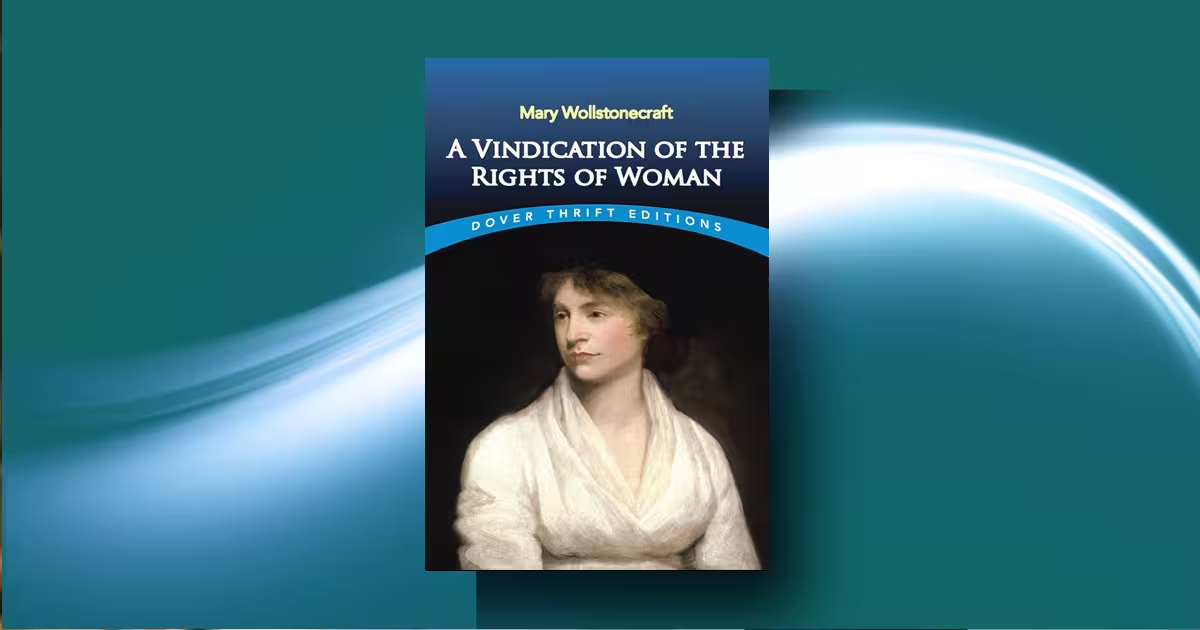
Mary Wollstonecraft’s education reform was not a footnote to her feminism — it was her feminism. In A Vindication of the Rights of Woman (1792), Mary Wollstonecraft argued that every injustice suffered by women — economic dependence, political invisibility, moral infantilisation — traced back to a single, correctable source: an education system designed to keep them ornamental and ignorant.
Her remedy was precise, radical, and institutional: government-funded day schools, a shared curriculum for both sexes, uniform dress to dissolve class hierarchy, and reason as the only legitimate authority in the classroom. She was not writing philosophy for its own sake. She was drafting a blueprint.
Few texts in the Western canon have aged as audaciously as Mary Wollstonecraft’s A Vindication of the Rights of Woman (1792).
While much scholarly attention fixes on its proto-feminist argument for political rights, the text’s most operationally radical section may be the chapter “On National Education” — a meticulous pedagogical manifesto that sketches, with remarkable specificity, a publicly funded, coeducational school system designed to dissolve the twin tyrannies of sex and class.
More than two centuries before the phrase “Wollstonecraft education reform” would appear in a search bar, she was already building the architecture of educational utopia, brick by logical brick, against the fashionable scaffolding of Rousseauian sentiment.
Table of Contents
Coeducation and Equal Curriculum: Wollstonecraft’s Call for Boys and Girls Learning Together
The centrepiece of Wollstonecraft’s pedagogical vision is the national day school — a government-established institution where, in her own words, “boys and girls, the rich and the poor, should meet together.”
This is not a casual aside. It is the structural load-bearing wall of her entire social argument. For Wollstonecraft, the separation of male and female education was not merely an inconvenience; it was the engine of female subjugation.
Girls schooled apart from boys, she argued, were schooled into weakness, trained for ornament rather than reason, and graduated into a life of “slavish dependence” that the education itself had manufactured.
Her Wollstonecraft coeducation proposal was both moral and practical. She envisioned day schools for children from age five upward in which a shared curriculum would include reading, writing, arithmetic, natural history, botany, mechanics, basic astronomy, history, politics — and crucially, the elements of religion taught not by rote ceremony but through “conversations in the Socratic form.”
Physical exercise in the open air was non-negotiable, as she insisted that “these relaxations might all be rendered a part of elementary education.”
The body and the mind were to be cultivated together, not sequestered into gendered spheres of needlework and wrestling.
The Wollstonecraft curriculum for women was, in essence, the same curriculum she proposed for men — with the calculated radicalism of that equivalence being the point. She acknowledged a degree of differentiation after age nine, when children could be separated into vocational streams: boys toward trades and languages, girls toward practical domestic arts in the afternoons.
Yet even then, she insists, “the two sexes being still together in the morning.” The shared mornings are not a compromise; they are the heart of the reform. They are the hours in which equal citizens are made.
Her argument against the existing boarding school was equally forceful. “At school,” she wrote, “boys become gluttons and slovens,” while girls, equally damaged though differently, are “cowed” and “more restrained” into a wearisome conformity of manners without substance. She had “heard sensible women speak with disgust of the wearisome confinement which they endured at school.”
The boarding school, for both sexes, was a finishing school for vice — producing selfish men and cunning women in almost equal measure. The national day school, by contrast, would keep children within family affection in the evenings while immersing them in civic equality by day.
From Rousseau to Rights of Woman: Contrast with Contemporaries
No understanding of Wollstonecraft equality education is complete without reckoning with Jean-Jacques Rousseau, her most formidable intellectual adversary and, paradoxically, one of her most important inspirations.
In Émile (1762), Rousseau had constructed the most influential educational philosophy of the 18th century — and built into its foundations a deliberate, theorised subjugation of women. His Sophie, the ideal female companion for his ideal male pupil Émile, was educated not to think but to please; not to reason but to charm; not to govern herself but to submit gracefully to governance by man.
Wollstonecraft did not merely disagree — she methodically dismantled. She quoted Rousseau at length and “interspersed comments and reflections,” conducting, in effect, a forensic cross-examination of his premises. His core argument — that “men and women are not, nor ought to be, constituted alike in temperament and character” and therefore “should not be educated in the same manner” — she attacked not at the level of sentiment but of logic.
If women appear weaker and more irrational, she argued, it is precisely because they have been educated to be so. The cause precedes the conclusion; the conclusion is then used to justify the cause. It is circular reasoning dressed in the language of nature.
“Who ever drew a more exalted female character than Rousseau?” she asked, with lethal irony — noting that the same man who could imaginatively conceive of woman’s potential immediately bent that potential toward the service of a man’s comfort. His “paradise,” she declared, “would soon be destroyed” if it depended on keeping women in strategic ignorance.
She was equally cutting about other contemporaries: Dr. Fordyce, whose Sermons to Young Women spun out, she said, “Rousseau’s sentiments” in “declamatory periods”; and Dr. Gregory, whose A Father’s Legacy to His Daughters counselled women to conceal their intelligence to better attract husbands — advice Wollstonecraft found morally abhorrent.
Against this field of polished condescension, Wollstonecraft drew on Locke’s empiricism and the radical civic philosophy emerging from the French Revolution to insist that reason was not a male endowment but a human faculty, equally distributed and equally suppressible by bad education.
The 18th-century school reform she envisioned was, in this sense, epistemological before it was institutional: it required first accepting that women were rational beings, and then building schools that treated them as such.
Uniforms and Class: The Rationale for Dress as a Tool of Equality
Among the most overlooked and prescient elements of the Mary Wollstonecraft school uniforms argument is her explicit insistence that in the national day school, children “should be dressed alike, and all obliged to submit to the same discipline, or leave the school.”
This sentence, tucked into the “On National Education” chapter with the precision of a policy memo, is not decorative. It is one of the most direct statements in 18th-century public schooling literature of the idea that clothing is a class weapon, and that stripping it of its social coding is prerequisite to genuine educational equality.
Wollstonecraft understood, with a sociologist’s clarity, that the visible markers of wealth and rank — in dress, in manner, in the cost of a coat — were not incidental to the classroom experience but constitutive of it.
Children from wealthy families who “lived at great expense” arrived at school not merely with better shoes but with a social grammar that expressed contempt for those below them and flattery for those above.
The Rights of Woman schooling utopia she imagined was one where that grammar had been neutralised at the gate. Uniform dress was the architectural decision that made the rest of the egalitarian project coherent.
This connects directly to her broader critique of class as a moral pathology.
The “desire of living in the same style as the rank just above” — that relentless upward mimicry she observed throughout English society — was, she argued, both a symptom and a cause of moral corruption. It produced vanity, envy, the “fondness for dress” she described as a mark not of femininity but of enforced idleness.
Women who had nothing to think about, and no public sphere in which to act, were left with appearance as their only available currency of power.
The school uniform was thus not merely a levelling device; it was a liberation device — freeing children, particularly girls, from the exhausting performance of class through clothing.
Crucially, she paired the dress requirement with an equally radical insistence on shared discipline: “all obliged to submit to the same discipline, or leave the school.” There were to be no exemptions for rank, no softened rules for the children of gentlemen.
The 18th century public schooling Wollstonecraft envisioned operated on a single standard of conduct, applied without deference to birth or fortune. In an era when even radical thinkers routinely assumed that a gentleman’s son required different handling from a tradesman’s, this was a remarkable and deliberately egalitarian stance.
Modern Comparisons: The School Uniform Debate Today
Wollstonecraft’s uniform argument resonates with remarkable persistence in contemporary educational policy debates.
The question of whether school uniforms reduce class-based inequality — or merely displace it — remains live and contested. Proponents of uniform policies in both the United Kingdom and the United States frequently echo, consciously or not, her precise logic: that visible markers of wealth create hierarchies that undermine the civic and educational purpose of the school.
The argument that a child from a low-income family should not arrive in a classroom defined by her worn-out trainers versus a wealthier classmate’s designer shoes is, structurally, Wollstonecraft’s argument in modern dress.
Critics, however, raise concerns she did not fully anticipate: that uniform policies can become financially burdensome on the poorest families if not subsidised; that they can suppress individual identity in ways that harm development; and that they do not, in practice, eliminate the status competition she diagnosed — children simply redirect it toward watches, phones, or subtle variations in how the uniform is worn.
This suggests that her insight was correct but incomplete. Uniform dress addresses the symptom of class performance; it does not resolve the underlying inequalities that generate that performance.
A genuinely egalitarian school, as she herself implied, requires state funding, accessible geography (hence her preference for day schools over fee-paying boarding schools), and a curriculum that treats all students as future citizens rather than sorting them early into their class destinies.
What is striking is that this debate — still unresolved in the 21st century — was so clearly framed by one woman writing in 1792, before compulsory state education existed anywhere in the world.
Legacy Today: Her Core Claim That Ignorance Is Not Bliss for Women
Wollstonecraft’s most philosophically urgent claim — that keeping women in ignorance did not make them innocent, gentle, or happy, but made them slaves — has been vindicated by two centuries of educational expansion with a thoroughness she might have found both gratifying and sobering.
She wrote that women “kept in ignorance become in the same proportion the slaves of pleasure as they are the slaves of man,” and that “women must be allowed to found their virtue on knowledge, which is scarcely possible unless they be educated by the same pursuits as men.”
The global record of female education since the 19th century confirms the structural logic of this claim at every level.
Where women have gained access to education equivalent to men’s — in literacy, numeracy, secondary schooling, and higher education — the results align precisely with her predictions. Economic independence increases.
Marriage ceases to be the only viable survival strategy. Political participation rises. Children’s health outcomes improve (a point she herself raised, noting that “children are absolutely murdered by the ignorance of women” who lack basic medical education).
The connection between female education and civilisational flourishing is now one of the most robust findings in development economics — which is, in essence, an empirical elaboration of Wollstonecraft’s argument.
Yet her vision remains incompletely realised. Global gender gaps in education persist, particularly at the secondary and tertiary levels in lower-income countries. Even in societies with formal equality of access, curriculum design, teacher expectations, and the social grammar of the classroom continue to channel girls and boys toward different knowledge in ways she would recognise and critique.
The Wollstonecraft curriculum women argument — that women deserve not a modified, feminised education but the full range of intellectual life — is still a contested proposition in many contexts, and an unrealised one in many more.
The Wollstonecraft equality education vision was not, it bears emphasising, one of women becoming more like men.
She was not arguing for assimilation into an unchanged male standard. She was arguing that both sexes, educated together in reason and virtue, would improve — that men degraded by unchecked libertinism and women degraded by enforced ignorance would both become more fully human through shared, rational education.
“Society can only be happy and free in proportion as it is virtuous,” she wrote, and virtue required the full enfranchisement of both sexes in the life of the mind.
Books Like A Vindication of the Rights of Woman
For readers drawn to Wollstonecraft’s educational and philosophical project, several texts form an essential constellation:
Jean-Jacques Rousseau, Émile, or On Education (1762) — The primary target of Wollstonecraft’s critique; essential reading for understanding what she was arguing against and how far she departed from the dominant educational philosophy of her age.
John Locke, Some Thoughts Concerning Education (1693) — A foundational influence on Wollstonecraft’s empiricist approach to child development and the role of reason in education.
Catharine Macaulay, Letters on Education (1790) — Published just two years before Rights of Woman, Macaulay’s text makes many parallel arguments about female rationality and the damage of gendered education; Wollstonecraft admired it greatly.
John Stuart Mill, The Subjection of Women (1869) — The next great liberal philosophical argument for female equality, extending Wollstonecraft’s claims into the domain of law and civil rights.
Virginia Woolf, A Room of One’s Own (1929) — Woolf’s essay extends the material conditions of Wollstonecraft’s educational argument, asking what women might have written and thought if they had been given the same intellectual resources as men.
bell hooks, Teaching to Transgress (1994) — A modern reworking of the idea that education is either an instrument of liberation or of domination, deeply consonant with Wollstonecraft’s foundational insight.
Conclusion
Mary Wollstonecraft did not write a polite suggestion. She wrote a blueprint. The “On National Education” chapter of A Vindication of the Rights of Woman is, depending on how one reads it, either the most practical section of a philosophical treatise or the most philosophical section of a policy document. It is both.
It describes day schools that exist nowhere, funded by a government that had never considered such a thing, teaching a curriculum denied to half the population, with children dressed to prevent the visibility of the class hierarchy that organised their entire world outside the school gates.
That so many elements of this blueprint have since been implemented — compulsory public education, coeducation, school uniform policies, government-funded curricula — without those implementations fully delivering the equality she envisioned is itself an argument for the depth of her analysis.
She understood that the school was not merely a building where information was transferred but an institution that reproduced the society that built it. Reforming it, truly reforming it, required reforming the assumptions about human nature — and particularly female human nature — that gave the old system its legitimacy.
Ignorance, she insisted, was never bliss. It was a cage. And she drew the blueprints for the door.







