
Last updated on June 17th, 2026 at 02:08 pm
Can a minimum-wage job actually sustain a life in America? That’s the deceptively simple question that drove Barbara Ehrenreich to abandon her comfortable existence and plunge into the world of low-wage work. The answer she found is as devastating as it is eye-opening. As she writes in her groundbreaking book Nickel and Dimed, her goal was “just to see whether I could match income to expenses, as the truly poor attempt to do every day”.
Nickel and Dimed is best for anyone who has ever wondered what it’s really like to live on minimum wage—especially those who have never worked a service job. It’s essential reading for policymakers, social workers, students of sociology and economics, and anyone who believes in the “American Dream” of hard work leading to prosperity.
If you’ve ever felt a twinge of guilt leaving a small tip or wondered about the lives of the people who clean your hotel room or stock your supermarket shelves, this book is for you.
Not for readers looking for a light, escapist read. This is a confronting, anger-inducing, and deeply unsettling book.
Those who prefer their social commentary with a heavy dose of statistical analysis and detached academic tone might find Ehrenreich’s personal, often furious, narrative style off-putting. As one reviewer noted, it’s a book that “might be enlightening if you have never worked for minimum wage or cleaned toilets for a living”.
Table of Contents
1. Introduction
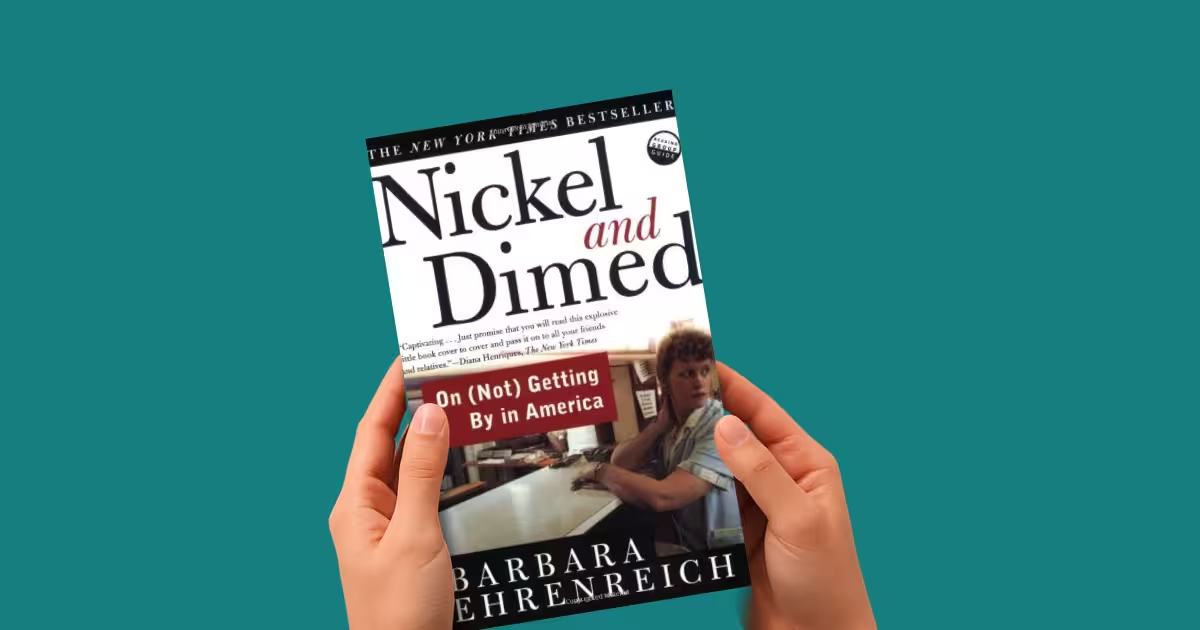
Nickel and Dimed: On (Not) Getting By in America is a landmark work of immersion journalism by the acclaimed author, social critic, and activist Barbara Ehrenreich. First published in 2001 by Metropolitan Books, the book quickly became a New York Times bestseller, spending two years on the list.
Its impact has been so profound that it was ranked 13th on The Guardian‘s list of the 100 best books of the 21st century in 2019 and was named one of the 57th of the 100 Best Books of the 21st Century by the New York Times in 2024. With nearly a million copies in print, it has cemented its place as a modern classic.
Nickel and Dimed is a piece of immersive, first-person reportage. In the late 1990s, following the passage of the 1996 Welfare Reform Act, which pushed roughly four million women into the labor market, Ehrenreich decided to see if she could survive on the wages available to unskilled workers.
She adopted a simple but powerful methodology: she would leave her life behind, take the highest-paying job she was offered, secure the cheapest possible accommodation, and attempt to make ends meet. She worked as a waitress in Key West, Florida; a hotel housekeeper and nursing home dietary aide in Portland, Maine; and a Wal-Mart sales associate in Minneapolis, Minnesota.
The central message of Nickel and Dimed is a direct challenge to the American mythos of self-sufficiency. Ehrenreich argues that a minimum-wage job is often not enough to support a single person, let alone a family. She systematically dismantles the idea that hard work alone is the ticket out of poverty.
Instead, she reveals a system where wages are stagnant, housing costs are exorbitant, and the working poor are trapped in a cycle of emergency, forced to make impossible choices between food, shelter, and healthcare.
2. Background
It’s crucial to understand the historical context in which Ehrenreich conducted her experiment. She began her journey in 1998, during a time of “unprecedented prosperity” in America.
The economy was booming, unemployment was low, and the prevailing political rhetoric suggested that anyone willing to work could share in the nation’s wealth. The 1996 Welfare Reform Act was predicated on the belief that work, any work, was the solution to poverty.
However, as Ehrenreich quickly discovered, prosperity did not trickle down to the lowest rungs of the labor market. Wages for entry-level workers remained flat. Furthermore, as she points out, the very strength of the economy created a cruel irony. She quotes Secretary of HUD Andrew Cuomo, who noted that “the stronger the economy, the stronger the upward pressure on rents”.
The rich were outbidding the poor for housing, shrinking the already limited stock of affordable options. This was the backdrop—a booming economy that was invisibly crushing its most essential workers.
3. Nickel and Dimed Summary
Ehrenreich’s journey is structured as a three-part odyssey, each location presenting its own unique challenges. However, a common thread runs through all of them: the brutal, unrelenting math of survival.
Serving in Florida: The Waitress’s Dilemma
In Key West, Ehrenreich begins her journey as a waitress at “Hearthside,” earning $2.43 an hour plus tips. She quickly learns the exhausting physical toll of the job and the constant scrutiny of management. The dream of a simple, honest living is shattered by the reality of the numbers.
After two weeks, she assesses her situation and realizes she will be more than $100 short of her rent at the end of the month. She takes a second job at “Jerry’s,” a high-volume restaurant, pushing herself to the brink of exhaustion.
She notes that she is “averaging only about $7.50 an hour” between wages and tips. This is where she first articulates a key finding: “In poverty, as in certain propositions in physics, starting conditions are everything”. Without the capital for a deposit, you’re forced into more expensive weekly rentals, creating a poverty trap.
Scrubbing in Maine: The Invisible Maids
Moving to Portland, Maine, Ehrenreich takes on two jobs: as a dietary aide in a nursing home for $7 an hour and as a maid for “The Maids” cleaning service for $6.65 an hour.
This section is a visceral exploration of physical labor and social invisibility. She describes the corporate cleaning system, which emphasizes “cosmetic touches” over actual sanitation, and the demeaning nature of the work, including cleaning toilets and scrubbing floors on her hands and knees. She learns that the company charges customers $25 per person-hour while paying its maids only $6.65.
This is a profound illustration of how corporate structures extract surplus value from labor.
The physical toll is immense.
She observes that “ours is a world of pain—managed by Excedrin and Advil”. She also witnesses the precariousness of her coworkers’ lives, many of whom live in cars, vans, or crowded motel rooms. One coworker, Holly, works through a pregnancy, nausea, and even a sprained ankle because she cannot afford to miss a day.
This section highlights the invisibility of the poor; as one maid, Marge, puts it, “We’re nothing to these people. We’re just maids”.
Selling in Minnesota: The Wal-Mart Experiment
In Minneapolis, Ehrenreich attempts to find work in retail, aiming for a job that might be less physically demanding. She lands a job at Wal-Mart for $7 an hour. However, she immediately runs into the city’s severe housing crisis, with a vacancy rate of less than 1 percent. She ends up living in a series of overpriced, squalid motels, spending $245 a week on a room, which is more than her after-tax weekly pay.
This section is a deep dive into the culture of corporate America. She describes the grueling “orientation,” the endless “zoning” and “returns” in the ladies’ wear department, and the paternalistic management style that insists on calling employees “associates.”
She also explores the psychological toll of the work, where the constant repetition and lack of purpose can lead to a kind of “tunnel vision”. She observes that “what you don’t necessarily realize when you start selling your time by the hour is that what you’re actually selling is your life”.
The overarching lesson from all three locations is that one job is never enough. Ehrenreich concludes that “almost everyone is embedded in extended families or families artificially extended with housemates” just to survive. The working poor are not a separate, lazy underclass; they are the people who make middle-class life possible.
4. Nickel and Dimed Analysis
This book is a masterclass in investigative journalism. Ehrenreich doesn’t just tell you that low-wage workers are struggling; she makes you feel the exhaustion, the indignity, and the constant fear of a financial catastrophe.
Evaluation
Ehrenreich’s argument is powerfully supported by her personal experience. She provides concrete, shocking examples of the math of poverty. For instance, she points out that according to the National Coalition for the Homeless, in 1998, it took an average nationwide hourly wage of $8.89 to afford a one-bedroom apartment. This was during a time when the minimum wage was $5.15 an hour.
The gap between wages and the cost of living was a chasm.
She effectively uses her own middle-class background as a foil. She acknowledges her privileges—being white, educated, and without children—and emphasizes that her experience represents a “best-case scenario”. If she, with all her advantages, could barely survive, what hope is there for those without them? This self-awareness strengthens her credibility and makes her argument more damning.
The book also fulfills its purpose by contributing meaningfully to the national conversation on poverty and welfare. It reframes the issue from one of “dependency” to one of exploitation. By showing how much of the “prosperity” is built on the backs of underpaid workers, she shifts the blame from the individual to the system.
5. Strengths and Weaknesses
My Pleasant Experience: What I Found Compelling
Raw, Unflinching Honesty: Ehrenreich doesn’t spare herself. She admits to her failures, her moments of anger, and her own prejudices, such as her initial contempt for a coworker who was simply trying to do her job. This makes her a relatable and trustworthy narrator.
The Human Element: The book is at its best when it focuses on the people.
The stories of Gail, Holly, Melissa, and others are heartbreaking and unforgettable. They are not statistics; they are individuals struggling with illness, injury, and the constant threat of homelessness. As one review put it, the book is “unforgettable—heart-wrenching, infuriating, funny, smart, and empowering”.
Exposing the Hidden Costs of Being Poor: Ehrenreich brilliantly reveals the “poverty tax”—how being poor is more expensive. You can’t afford the deposit for an apartment, so you pay more per week for a motel. You don’t have a kitchen, so you can’t cook and must rely on expensive, unhealthy fast food. You can’t afford preventive healthcare, so you end up in the emergency room.
My Unpleasant Experience: Points of Criticism
The “Stunt” Journalism Critique: Some critics argue that the premise is flawed from the start. A well-funded, educated woman who knows she can return to her comfortable life at any moment cannot truly replicate the experience of a person trapped in poverty. The psychological stress of knowing there is a safety net is a fundamental difference.
A Pre-Determined Agenda? Others have accused Ehrenreich of going into the project with a pre-formed conclusion. They argue that she cherry-picked examples to support her thesis that the system is rigged against the poor. For instance, she never attempts to find the cheapest possible housing (like a room in a shared house) and instead opts for more expensive motels and trailer parks.
Lack of Diversity: While Ehrenreich acknowledges her own privilege, some critics argue that the book’s focus on a white, English-speaking woman ignores the additional layers of discrimination faced by people of color and immigrants. She herself notes that she chose Maine for its “whiteness” to avoid the complications of race, which some see as a cop-out.
6. Thematic Highlights: Key Takeaways and Quotes
On the “Poverty Tax”: “There are no secret economies that nourish the poor; on the contrary, there are a host of special costs. If you can’t put up the two months’ rent you need to secure an apartment, you end up paying through the nose for a room by the week”.
On the Invisibility of the Poor: “Maids, as an occupational group, are not visible, and when we are seen we are often sorry for it”.
On the Nature of Service Work: “It is our job as servers to assemble the salads and desserts, pour the dressings, and squirt the whipped cream. We also control the number of butter pats our customers get and the amount of sour cream on their baked potatoes. So if you wonder why Americans are so obese, consider the fact that waitresses both express their humanity and earn their tips through the covert distribution of fats”.
On the Reality of the “Working Poor”: “The ‘working poor,’ as they are approvingly termed, are in fact the major philanthropists of our society. They neglect their own children so that the children of others will be cared for; they live in substandard housing so that other homes will be shiny and perfect; they endure privation so that inflation will be low and stock prices high”.
On the Psychological Toll: “Any dictatorship takes a psychological toll on its subjects. If you are treated as an untrustworthy person—a potential slacker, drug addict, or thief—you may begin to feel less trustworthy yourself. If you are constantly reminded of your lowly position in the social hierarchy, whether by individual managers or by a plethora of impersonal rules, you begin to accept that unfortunate status”.
7. Comparison with Similar Works
Nickel and Dimed is often compared to other works of investigative journalism that explore the dark underbelly of American capitalism.
Fast Food Nation by Eric Schlosser: This is perhaps the most common pairing. While Schlosser’s book is a broader exposé of the fast-food industry—its history, its politics, and its impact on public health—it shares Nickel and Dimed’s focus on the exploitation of low-wage labor. Together, they are often described as “bookends” on the state of the American worker.
Evicted: Poverty and Profit in the American City by Matthew Desmond: This Pulitzer Prize-winning book is a more recent and systematic exploration of the housing crisis that Ehrenreich documented. Desmond focuses on the lives of eight families in Milwaukee as they struggle to keep a roof over their heads, providing a powerful, data-rich complement to Ehrenreich’s personal narrative.
Maid: Hard Work, Low Pay, and a Mother’s Will to Survive by Stephanie Land: This memoir, which was adapted into a popular Netflix series, is a first-hand account of a single mother struggling to survive as a housecleaner. It shares Nickel and Dimed’s themes of invisibility and physical labor, but Land’s story is not an experiment; it is her real life.
8. Conclusion: A Call to See the Invisible
Nickel and Dimed is not just a book; it is an indictment. It is a scathing, deeply personal, and utterly convincing argument that the American Dream is a myth for millions of its citizens. Barbara Ehrenreich’s courageous experiment forces us to confront the uncomfortable truth about our own comfort: it is built on the backs of people who are systematically underpaid and undervalued.
Recommendation:
This book is essential reading for anyone living in America. It is for the college student, the CEO, the politician, and the retiree. It is for anyone who has ever shopped at a big-box store, eaten at a restaurant, or stayed in a hotel.
It is a powerful antidote to the complacency of prosperity and a much-needed reminder that the fight for a living wage is a fight for human dignity. Reading it will change the way you see the world.
Nickel and Dimed is a book that will “make you see the world in a new way”. More than two decades after its publication, its message has only become more urgent







