
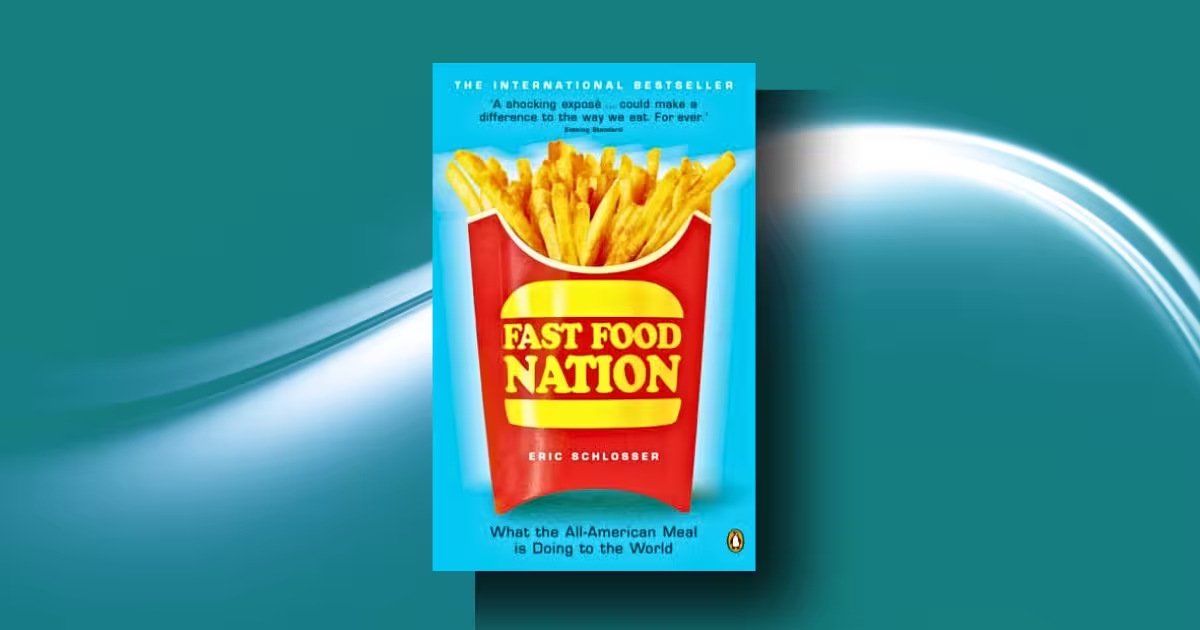
Why does a cheap burger often cost society far more than the price printed on the menu? Eric Schlosser’s Fast Food Nation answers that question with startling clarity, revealing how an industry built on convenience transformed not only what we eat but also how we work, farm, consume, and live. Few books have changed the way I look at a meal more profoundly than this one.
Best For / Not For
Fast Food Nation is best for
- Readers interested in food politics
- Consumers curious about what is really inside fast food
- Students of economics, sociology, public health, and business
- Readers of investigative journalism
- Anyone interested in corporate power and globalization
- Fans of books like The Omnivore’s Dilemma and The Jungle
Notfor
- Readers looking for a cookbook or nutrition guide
- People seeking a neutral corporate history
- Those wanting quick self-help lessons
- Readers uncomfortable with discussions of labor exploitation, food contamination, and corporate influence
Table of Contents
Introduction
Fast Food Nation: The Dark Side of the All-American Meal is a groundbreaking work of investigative nonfiction written by Eric Schlosser and first published in 2001 by Houghton Mifflin.
More than two decades after publication, the book remains one of the most influential critiques of the modern food industry ever written.
Schlosser is an American journalist known for combining deep investigative reporting with accessible storytelling. Before writing Fast Food Nation, he contributed extensively to magazines such as The Atlantic and Rolling Stone. His research-driven approach helped bring public attention to issues hidden behind the fast-food counter.
Context of Fast Food Nation
At first glance, this appears to be a book about hamburgers, french fries, and restaurant chains.
In reality, it is a study of modern America itself.
Schlosser uses the fast-food industry as a lens through which to examine:
- Corporate power
- Labor practices
- Agricultural industrialization
- Food safety
- Consumer culture
- Advertising to children
- Environmental impact
- Globalization
As Schlosser explains, fast food became far more than a method of selling meals. It evolved into a model for organizing entire industries and reshaping everyday life.
Purpose of Fast Food Nation
The central message of the book is simple but powerful:
Fast food did not merely change America’s diet; it transformed American society, economics, labor systems, culture, and politics.
Schlosser argues that the true costs of fast food are often hidden.
Consumers see low prices.
They do not see:
- Injured slaughterhouse workers
- Exploited teenage employees
- Concentrated corporate power
- Environmental damage
- Foodborne illnesses
- Aggressive marketing toward children
As Schlosser writes near the conclusion of the introduction:
“The real price never appears on the menu.”
That single idea serves as the foundation for the entire book.
Background
To understand Fast Food Nation, it helps to remember the historical moment in which it was written.
The book emerged during a period when:
- McDonald’s had become one of the world’s most recognizable brands
- Obesity rates were rising rapidly
- Globalization was accelerating
- Corporate consolidation was reshaping agriculture
According to Schlosser, Americans spent roughly $6 billion on fast food in 1970, but by 2000 that figure exceeded $110 billion.
That extraordinary growth forms the backdrop of the book.
The rise of fast food mirrors:
- The growth of suburban America
- The expansion of highways
- Increased workforce participation by women
- The demand for convenience
- The dominance of large corporations
In other words, fast food did not emerge in isolation.
It grew because broader economic and cultural forces made it possible.
Fast Food Nation Summary
What I Learned From This Book
The greatest strength of Fast Food Nation is that it transforms an ordinary hamburger into a window through which readers can observe an entire economic system.
The book is divided into two major sections:
Part I: The American Way
This section explains how the fast-food industry was born.
Part II: Meat and Potatoes
This section investigates the consequences of that industry’s growth.
Together they form one of the most comprehensive examinations of modern food production ever written.
Chapter 1: The Founding Fathers
Schlosser begins by exploring the origins of the fast-food industry.
The chapter focuses heavily on Carl Karcher, founder of Carl’s Jr., whose story resembles the classic American Dream.
Beginning with a hot dog cart purchased for approximately $326, Karcher built a restaurant empire.
Yet Schlosser does not merely celebrate entrepreneurship.
Instead, he demonstrates how:
- Automobile culture
- Highway construction
- Suburban expansion
- Government infrastructure spending
created ideal conditions for fast-food growth.
A major trait of the chapter is its insistence that fast food did not emerge naturally.
It emerged because America built a society designed around automobiles.
Consequently, drive-ins, franchises, and eventually chains became inevitable outcomes of those decisions.
Chapter 2: Your Trusted Friends
This chapter investigates McDonald’s and its remarkable ability to shape consumer behavior.
Schlosser describes:
- Hamburger University
- Corporate branding
- Franchise culture
- Marketing psychology
One of the most striking observations concerns children.
A survey cited in the book found that 96% of American schoolchildren recognized Ronald McDonald, second only to Santa Claus.
This statistic shocked me.
It demonstrates how effectively corporations can enter childhood consciousness.
The chapter argues that modern advertising no longer merely sells products.
It creates lifelong consumers.
Chapter 3: Behind the Counter
Here, Schlosser examines the labor force powering fast food.
Initially, it may seem that fast-food jobs simply provide opportunities for young workers.
However, the chapter reveals a different reality.
Fast-food restaurants rely heavily upon:
- Teenagers
- Low wages
- High turnover
- Minimal training
The industry’s business model depends upon labor being inexpensive and easily replaceable.
As a result, workers gain little long-term economic security.
This leads to one of the book’s recurring themes:
Efficiency often benefits corporations far more than employees.
Chapter 4: Success
This chapter explores Ray Kroc’s transformation of McDonald’s into a global empire.
Kroc did not invent the hamburger. He did not invent franchising. He perfected standardization.
The genius of McDonald’s was consistency. Whether a customer visited California or New York, the experience remained nearly identical.
Accordingly, the company became a symbol of modern corporate expansion.
Yet Schlosser suggests that such uniformity also erodes regional diversity and local business culture.
Key Insight From the First Half of the Book
If the first four chapters teach one lesson, it is this:
Fast food is not primarily about food.
It is about systems.
The industry represents:
- Standardization
- Automation
- Franchising
- Marketing
- Scale
In other words, the hamburger is merely the visible product of a much larger machine.
Memorable Quotations
One of the most important passages appears in the introduction:
“You are what you eat.”
Another foundational observation:
“The real price never appears on the menu.”
And perhaps the book’s most significant warning:
“Fast food has infiltrated every nook and cranny of American society.”
These statements encapsulate Schlosser’s entire argument.
Chapter 5: Why the Fries Taste Good
If the first half of Fast Food Nation explores the rise of the industry, Chapter 5 begins exposing the hidden mechanisms that keep consumers returning.
Before reading this book, I assumed french fries tasted good because potatoes naturally taste good.
Schlosser reveals a much more complicated reality.
Historically, McDonald’s fries were cooked in a mixture containing beef tallow, which created a distinctive flavor profile. When public pressure about saturated fats increased in the late twentieth century, companies switched to vegetable oils. Yet consumers still expected the same taste.
The solution was industrial food science.
Schlosser explains that much of the flavor associated with modern fast food is created in specialized flavor laboratories rather than restaurant kitchens. He notes that the aroma and taste of many processed foods are manufactured through sophisticated chemical engineering.
This chapter fundamentally changed how I think about food.
Traditionally, flavor came from ingredients.
Today, flavor often comes from technology.
That distinction matters.
The implication is not simply that food is processed; it is that food has increasingly become an engineered product designed to maximize consumer satisfaction and repeat purchases.
Chapter 6: On the Range
The focus shifts to cattle ranching and industrial agriculture.
Initially, it may seem that hamburgers originate from traditional ranches populated by independent cowboys.
Schlosser demonstrates that reality differs dramatically.
Large corporations increasingly dominate beef production.
Small family ranchers struggle to compete against vertically integrated systems that control:
- Feedlots
- Processing
- Distribution
- Pricing
As noted earlier, one of the book’s recurring concerns is concentration of power.
This chapter shows how economic consolidation transformed American agriculture. Independent producers gradually became dependent on a handful of giant corporations.
Consequently, market competition weakened while corporate influence expanded.
Chapter 7: Cogs in the Great Machine
This chapter examines slaughterhouses and meat-processing plants.
It is among the most disturbing sections of the book. Historically, meatpacking jobs were stable, skilled, and relatively well-paid. However, Schlosser argues that industry restructuring dramatically altered working conditions.
To increase productivity, companies accelerated production lines.
Workers performed repetitive tasks at extraordinary speeds.
The result was predictable:
- More injuries
- Higher turnover
- Increased physical strain
Schlosser portrays workers as “cogs” within an industrial machine.
The title itself captures the central message.
Human beings became interchangeable components in a system designed primarily for efficiency. This chapter strongly echoes themes from Upton Sinclair’s The Jungle, although Schlosser updates those concerns for the twenty-first century.
Chapter 8: The Most Dangerous Job
This chapter intensifies the examination of slaughterhouse labor.
According to Schlosser’s reporting, meatpacking became one of America’s most dangerous occupations.
Workers frequently faced:
- Knife injuries
- Repetitive stress disorders
- Amputations
- Chemical exposure
- Psychological trauma
Surprisingly, many injuries went unreported. Workers often feared losing employment if they complained.
This chapter is difficult to read because it forces readers to confront the hidden labor behind inexpensive food. A major trait of Schlosser’s writing is his refusal to allow consumers to remain detached from production systems.
He consistently asks: What human costs make these low prices possible?
Chapter 9: What’s in the Meat
This may be the most famous chapter in the entire book.
Here Schlosser investigates food safety and bacterial contamination.
Particular attention is given to:
- E. coli O157:H7
- Ground beef processing
- Regulatory failures
- Corporate lobbying
The chapter explains why ground beef can become especially vulnerable to contamination.
Because meat from numerous animals is mixed together during processing, contamination from a single source can affect enormous quantities of product.
The book details outbreaks that sickened and sometimes killed consumers.
Importantly, Schlosser argues that many food safety problems stem not from individual mistakes but from systemic incentives prioritizing production speed and profit.
Consequently, foodborne illness becomes not merely a biological problem but also an economic and political one.
This chapter remains highly relevant because food recalls continue to occur worldwide.
Chapter 10: Global Realization
The final chapter expands the discussion beyond the United States.
Fast food evolved into one of America’s most influential exports.
Alongside:
- Hollywood films
- Blue jeans
- Pop music
fast food became a symbol of globalization.
Schlosser argues that the fast-food model spread not only restaurants but also:
- Labor practices
- Marketing strategies
- Agricultural methods
- Consumer values
In other words, globalization exported an entire system.
This chapter raises a question that remains important today:
When fast food expands internationally, what cultural traditions are gained—and what traditions disappear?
The answer is not simple.
Fast food provides affordability, consistency, and convenience.
Yet it can also undermine local food cultures and small businesses.
Thematic Analysis
Theme 1: The Hidden Cost of Convenience
Perhaps the most important lesson of Fast Food Nation is that convenience is never free.
Consumers save time.
However, somebody else often absorbs the cost:
- Workers
- Farmers
- Communities
- Taxpayers
- Future generations
This idea appears repeatedly throughout the book.
Theme 2: Standardization and Uniformity
McDonald’s succeeded because it delivered predictable experiences.
Yet Schlosser questions whether a society organized around uniformity sacrifices diversity and individuality.
In contrast to local restaurants, chains prioritize consistency above all else.
Consequently, regional differences gradually disappear.
Theme 3: Corporate Power
Throughout the book, Schlosser documents the growing influence of large corporations over:
- Food production
- Labor policy
- Marketing
- Government regulation
The result is a system in which economic power becomes increasingly concentrated.
Theme 4: Children as Consumers
One of the book’s most powerful arguments concerns marketing to children.
Fast-food companies understood something important:
Capture customers early, and loyalty may last decades.
Accordingly, advertising campaigns targeted young audiences through:
- Toys
- Mascots
- Schools
- Television
The ethical implications remain controversial today.
Fast Food Nation Analysis and Opinion
Few books have altered my perception of everyday life as thoroughly as Fast Food Nation.
This is not merely a book about hamburgers.
It is a book about modern capitalism.
It is a book about labor.
It is a book about agriculture.
It is a book about consumer culture.
Most importantly, it is a book about consequences.
Schlosser accomplishes something remarkable.
He takes an ordinary meal and reveals the enormous economic network hidden beneath it.
The book succeeds because it avoids simplistic moralizing.
Although clearly critical, Schlosser recognizes why fast food became successful:
- It is convenient.
- It is inexpensive.
- It tastes good.
- It fits modern lifestyles.
Yet he also demonstrates that these benefits often obscure significant social costs.
Like the best investigative journalism from The New Yorker, The New York Times, or The Guardian, the book combines meticulous reporting with compelling storytelling.
In my view, Fast Food Nation remains one of the most important nonfiction books published in the last quarter-century.
Fast Food Nation Evaluation
Does Schlosser Support His Arguments?
Yes.
The book relies heavily on:
- Interviews
- Historical records
- Industry documents
- Government reports
- Academic research
The evidence is extensive and carefully assembled.
Throughout the narrative, Schlosser connects individual stories to broader structural patterns.
As a result, the argument feels persuasive rather than ideological.
Does the Book Fulfill Its Purpose?
Absolutely.
The stated purpose is to expose what lies behind the fast-food industry.
By the final page, readers understand:
- How fast food emerged
- Why it succeeded
- How it changed labor
- How it changed agriculture
- How it changed public health
- How it influenced globalization
The book fulfills that mission exceptionally well.
Strengths and Weaknesses
Strengths
Investigative Depth
Schlosser’s research is extraordinarily detailed.
Accessibility
Complex economic and political issues remain understandable.
Human Stories
Workers, ranchers, managers, and consumers all receive attention.
Historical Context
The book explains not only what happened but why it happened.
Lasting Relevance
Many concerns raised in 2001 remain significant today.
Weaknesses
Occasionally One-Sided
Some defenders of the fast-food industry may argue that benefits receive less attention than criticisms.
U.S.-Centric Perspective
Although globalization is discussed, the primary focus remains America.
Limited Nutritional Discussion
Readers expecting a health-focused book may find the emphasis broader than anticipated.
Nevertheless, these criticisms do little to diminish the book’s overall impact.
Comparison With Similar Books
1. The Jungle by Upton Sinclair
Like The Jungle, Fast Food Nation exposes hidden realities within the food industry.
However, Schlosser focuses on modern industrial systems rather than early twentieth-century meatpacking.
2. The Omnivore’s Dilemma
The Omnivore’s Dilemma explores where food comes from and how food choices shape society.
Pollan is more philosophical. Schlosser is more investigative.
3. Salt Sugar Fat
Salt Sugar Fat focuses on how food companies engineer products for maximum consumption.
Together, the books provide a comprehensive understanding of modern processed food.
4. Nickel and Dimed
Nickel and Dimed examines low-wage labor from the worker’s perspective.
Readers interested in the employment issues discussed in Fast Food Nation will find strong thematic overlap.
Conclusion
More than twenty years after publication, Fast Food Nation remains essential reading.
Eric Schlosser demonstrates that fast food is not simply a meal. It is a system that touches nearly every aspect of modern life.
The book’s greatest achievement is making the invisible visible. After reading it, a burger no longer appears to be just a burger. It becomes a product of history, economics, politics, labor, technology, marketing, and globalization.
For that reason, I strongly recommend Fast Food Nation to anyone interested in understanding how modern society works.
Whether you are a student, researcher, journalist, policymaker, or ordinary consumer, this book provides insights that remain remarkably relevant today.







