

You can get a chatbot to write your emails, a fitness app to track your sleep, and a therapist to help you set boundaries. What you cannot get from any of them is an honest answer to why you are here, what time actually is, or what happens to your sense of self when everything is taken away. For those questions, the modern world mostly just changes the subject.
These are 6 books that give you answers the modern world cannot — not because the modern world is stupid, but because it is too busy and too commercial to sit with questions that have no clean resolution. Each book below goes to a place the productivity discourse cannot follow.
Table of Contents
Why the Modern World Avoids the Big Questions
We are not short on information. We are short on the kind of knowledge that does not scale. The modern world is extraordinarily good at optimizing things. It is less good at asking whether those things are worth optimizing in the first place.
There is a category of question that slips through every modern framework: Why does suffering exist, and what should we do with it? What is time, underneath the clock face? Do other living beings have an interior life the way we do? What has philosophy actually delivered after 2,500 years? What does it mean to keep working at something when death is close?
These are not self-help questions. They do not have action steps. But they are the questions that actually define a life. The 6 books that give you answers the modern world cannot are not arranged by difficulty or prestige.
They are arranged by the specific kind of silence each one breaks. If you have been looking for books that give you answers the modern world cannot produce through its usual channels — the algorithm, the trend cycle, the inbox — this list is a different kind of resource entirely.
1. Sparks of Truth: The Remarkable Allegories of the Old Testament by Mario Ramirez
The question it answers: What if the Bible’s oldest stories were never meant to be read as history — and what do they tell us about ourselves when read as psychology?
Mario Ramirez takes an approach to the Old Testament that most readers will not have encountered in a church, a classroom, or a commentary. Rather than reading biblical narratives for their doctrinal content or historical accuracy, he reads them as allegories — symbolic maps of the mental and emotional life that every human being carries.
What the book actually says:
The organizing principle of Sparks of Truth is Jungian. Drawing on Carl Jung’s concept of archetypes — the inherited psychological patterns that Jung believed shape human experience across all cultures and eras — Ramirez examines the characters, conflicts, and stories of the Old Testament as expressions of universal inner dynamics.
The figures in these ancient narratives are not simply ancestors or moral examples. They are, in Ramirez’s reading, projections of tendencies that live inside each of us: the shadow, the hero, the self, the trickster, the scapegoat.

This is not a new idea in academic circles. Jungian analysis of religious texts has a long tradition, from Edward Edinger’s The Bible and the Psyche to Joseph Campbell’s work on mythological archetypes in sacred literature. What Ramirez offers is a more direct and accessible entry point — a reading that does not require a background in psychology or theology to follow.
The premise carries real weight. The Old Testament was produced over centuries by people who had no framework for psychology as a discipline but were nonetheless recording something about how human beings behave under pressure, in community, in betrayal, in grief, and in moments of extraordinary decision.
Reading these texts allegorically — as Ramirez does, asking what each character represents as a psychological state rather than a historical person — produces a different kind of encounter with material that many readers think they already understand.
The result is a mode of reading that is, as Ramirez describes it, grounded in allegorical, symbolic, and spiritual analysis rather than literal or doctrinal interpretation.
Adam and Eve become an account of consciousness and its complications. Abraham’s willingness to sacrifice Isaac reads differently when Isaac is understood as something precious inside the self rather than an actual child. Jacob wrestling with the angel is not a supernatural episode but an encounter with the part of us that resists what we need to become.
Why the modern world cannot answer this: The modern world has largely separated religion from psychology and psychology from ancient wisdom. It treats scripture as either literal truth or outdated myth, with not much room between those positions.
Ramirez works in the space between — treating the Old Testament as a document that knows something about the human interior, and offering a reading practice that might make very old stories suddenly feel personal.
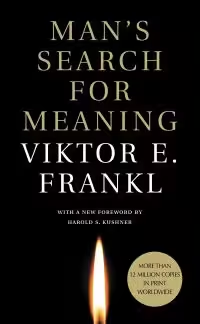
2. Man’s Search for Meaning by Viktor Frankl (1946)
The question it answers: Why does suffering have to mean anything? And what happens to a person when it does not?
Viktor Frankl was an Austrian psychiatrist and neurologist who survived four Nazi concentration camps, including Auschwitz and Dachau. His family did not survive. His nearly complete manuscript was confiscated when he arrived at the camps. He rewrote it from memory on stolen strips of paper during his imprisonment.
Man’s Search for Meaning was composed in nine days after liberation and has since sold over 16 million copies and been translated into more than 50 languages.
What the book actually says:
Frankl observed that among the prisoners, survival was not simply a matter of physical strength or luck. Those who retained a sense of purpose — something still to do, someone still to love, something still to understand — held on longer.
Those who lost that anchor collapsed faster. From this, he developed logotherapy, the “Third Viennese School of Psychotherapy” after Freud and Adler, built on a single premise: the primary human drive is not pleasure (Freud’s argument) or power (Adler’s), but meaning.
The book identifies three ways a person can find meaning: through work — doing something that matters; through love — caring for another person; and through suffering — choosing how to respond to pain that cannot be avoided.
That last point is the uncomfortable one. Frankl does not say suffering is good. He says it can be given a direction. In his framework, even in the worst circumstances, a person retains one freedom that cannot be stripped away: the freedom to choose their attitude toward what is happening to them.
The second half of the book, “Logotherapy in a Nutshell,” introduces the concept of the existential vacuum — a widespread feeling of emptiness and purposelessness that Frankl observed in post-war society and that arguably describes modern life more accurately than it did his.
He wrote about “Sunday neurosis,” the depression that hits when the week stops and there is nothing meaningful to fill the space.
Why the modern world cannot answer this: The modern world responds to meaninglessness with distraction. It offers content, productivity, social media, and consumption. Frankl offers something else entirely: the argument that meaning is not found but created, and that the act of creating it — even under extremity — is what makes a human being.
This is not a comfortable book. It is an honest one.
3. The Truth About Everything: An Irreverent History of Philosophy by Matthew Stewart (1997)
The question it answers: Has philosophy actually gotten us anywhere? And is it a discipline for professionals, or for everyone?
Matthew Stewart holds a doctorate in philosophy from Oxford. His argument, made at book length with parables, imaginary dialogues, and hand-drawn illustrations, is that the professional philosophy industry has taken something that belongs to everyone and locked it inside a system of credentials, jargon, and institutional gatekeeping.
What the book actually says:
Stewart’s central claim is that philosophy has always been after the same thing — the truth about everything — and that this ambition, however noble, is impossible to achieve. What this means is that the history of Western philosophy is largely a history of failure, but an instructive and human one. The misconceptions, the false starts, and the blind alleys are not accidents. They are what philosophy is.
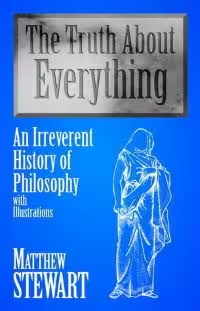
He takes the reader through every major name — Plato, Descartes, Spinoza, Kant, Hegel, Nietzsche, Heidegger, Sartre, Wittgenstein, Foucault, Derrida — and in each case, with genuine wit and occasional acid, shows where the grand system-building went wrong. Sartre, he argues, mostly dressed up familiar ideas in elaborate new clothes.
Nietzsche was more of an Enlightenment thinker than the irrationalist he is usually painted as. Spinoza, often seen as a prophet of rational modernity, was actually reaching back toward the Stoics.
His two core theses: first, rational consciousness is not the exclusive property of the Western tradition; second, philosophy is not a professional discipline with special access to truth. It is a general human disposition — the love of knowledge — that anyone can practice and that nobody can own.
The book ends with a proposal: philosophy as a way of life rather than an academic specialty. Not something you go to university for, but something you do every time you slow down and think carefully about what you actually believe and why.
Why the modern world cannot answer this: The modern world produces philosophical content — podcasts, newsletters, threads. What it almost never does is turn the question on itself. Stewart does. He asks not just what philosophy has found, but what it is for. That is a harder question than it looks.
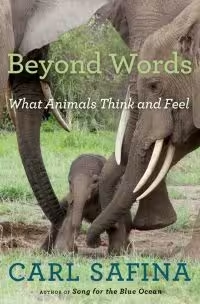
4. Beyond Words: What Animals Think and Feel by Carl Safina (2015)
The question it answers: Are we the only ones in here? Do other animals have an interior life?
Carl Safina is a MacArthur Fellow, a professor of nature and humanity at Stony Brook University, and an ecologist whose work has won Guggenheim, Pew, and Orion literary awards. Beyond Words is built from decades of field observations and draws on current neuroscience to ask one of the oldest and most contested questions in natural history: what, if anything, is happening inside the minds of other animals?
What the book actually says:
Safina takes the reader to three locations. First, Amboseli National Park in Kenya, where he observes elephant families navigating the pressure of poaching and drought. Second, Yellowstone National Park, where he watches wolf packs manage loss, hierarchy, and social rupture.
Third, the waters of the Pacific Northwest, where killer whale communities live in structures of apparent stability and deep social bonding.
What he finds, consistently, is that the categories we have used to separate human experience from animal experience — grief, joy, jealousy, empathy, love — keep showing up in the animals he is watching. Elephants mourn their dead. Wolves form attachments that change their behavior for months after a loss.
Killer whale families maintain what appear to be lifelong bonds and individual identities in ways that are difficult to explain without some version of what we would call consciousness.
The book also traces the scientific resistance to these conclusions. For decades, behaviorists warned that attributing emotions to animals was anthropomorphism — a projection, not a finding.
Safina argues, carefully and with evidence, that the opposite error — denying the possibility of animal inner life simply to protect human uniqueness — was the more dangerous mistake. Jane Goodall was told at Cambridge that she should not have named the chimpanzees she studied, that she could not speak of their personalities or feelings. The science has since moved significantly in her direction.
Why the modern world cannot answer this: The modern world is largely anthropocentric by design. Its economies, its legal systems, and its dominant ethics are built around the assumption that human experience is categorically different from everything else. Beyond Words does not politely argue against this.
It shows, with specific animals and specific behavior, that the boundary we drew was never as clear as we needed it to be.
This is one of the 6 books that give you answers the modern world cannot, precisely because the modern world has a financial and structural interest in the wrong answer.
5. The Order of Time by Carlo Rovelli (2018)
The question it answers: What is time, actually? Not as a metaphor — as a physical thing.
Carlo Rovelli is an Italian theoretical physicist and one of the founders of loop quantum gravity theory. He currently directs the quantum gravity research group at the Centre de physique théorique in Marseille. Foreign Policy named him one of the world’s 100 most influential global thinkers. He is also, in a tradition that includes Feynman and Hawking, a genuinely good writer.
What the book actually says:
The book is short, but it takes something you have felt every second of your life — the passage of time — and methodically dismantles every assumption you have about it.
Here is what physics has established. Time does not pass at the same speed everywhere; it runs faster at higher altitudes and slower near gravitational mass. Einstein showed this, and it has since been confirmed with clocks placed at different elevations. So the idea of a single, universal “now” that everyone on Earth shares — the common-sense view — is already wrong.
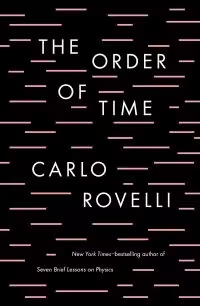
It goes further. In the equations of fundamental physics, particularly in quantum gravity, time does not appear as an independent variable at all. The universe, at its deepest level, is better understood as a collection of events and their relationships with each other than as objects moving through time.
Rovelli argues that what we experience as the flow of time — the difference between past and future — comes from entropy, the thermodynamic tendency of things to move from order to disorder. The direction of time, in other words, may be a consequence of the second law of thermodynamics rather than a fundamental feature of the universe.
The final section is the most affecting. Rovelli turns from physics to philosophy and asks why we experience time the way we do. His answer is that time — the sense of duration, of memory, of anticipation — is something that emerges in a being like us, with our particular position in the universe, our particular scale, and our particular neurology.
Time is real, but it is not what we think it is.
Why the modern world cannot answer this: The modern world runs on clock time. Every app, every schedule, every productivity system treats time as a fixed, uniform medium. Rovelli shows that this is a useful fiction, and that reality is stranger and more interesting than the calendar on your phone.
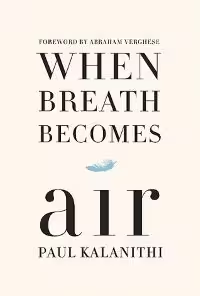
6. When Breath Becomes Air by Paul Kalanithi (2016, posthumous)
The question it answers: What makes a life worth living when there is very little of it left?
Paul Kalanithi was a neurosurgeon in his final year of residency at Stanford when he was diagnosed with stage IV metastatic lung cancer at age 36. He died in March 2015, before he could finish the book.
His wife Lucy, also a physician, completed the epilogue and brought it to publication. When Breath Becomes Air spent 68 weeks on the New York Times bestseller list and was a finalist for the Pulitzer Prize.
It has been translated into more than 40 languages.
What the book actually says:
Kalanithi came to neurosurgery from literature.
He held undergraduate and graduate degrees in English from Stanford and had studied at Cambridge before attending Yale Medical School. His driving question, from early in his education, was the relationship between the brain and human identity — what it means that the physical organ is also the site of personhood, memory, and meaning.
The first half of the book follows him through residency: the technical demands of neurosurgery, the weight of decisions made at the level of one or two millimeters, the specific way a surgeon learns to hold other people’s mortality before he is forced to hold his own.
The second half is the inversion. The man who spent years helping patients face death is now the patient. The questions he asked on behalf of others are now his own.
What does he do with the time he has? How does he continue to find identity in a body that is failing? Does he keep working? Does he write? Does he start a family knowing he will not see it grow?
His answers are not triumphant in the way that illness narratives sometimes demand.
They are honest. He keeps working as a surgeon for longer than seems medically advisable, because it is what gives him a sense of self. He writes this book, knowing he may not finish it. He and Lucy decide to have a child — their daughter Cady is born nine months before he dies.
The book is, at its core, about the difference between knowing that you will die and actually living inside that knowledge. It covers what remains of purpose, love, and identity when the future can no longer be taken for granted.
Why the modern world cannot answer this: The modern world treats death as a failure — a medical problem that better technology might eventually solve, or at minimum something to manage and defer. Kalanithi treats it as the condition under which everything that matters must be done. That is a different orientation entirely, and almost every page of the book reflects it.
Among the 6 books that give you answers the modern world cannot, this is the one most likely to change what you do tomorrow.
A Final Note on What These Books Share
None of these five books has a summary that fits on a slide deck. None of them can be distilled into a morning routine. What they share is the willingness to stay inside a hard question long enough for it to actually do something.
Frankl asks what you do with suffering. Stewart asks what philosophy is actually for. Safina asks what kind of being you share the planet with. Rovelli asks what the medium of your entire life actually is. Kalanithi asks what the point of any of it is when the end is close.
If you have tried to find answers to these questions through self-help, therapy, or the internet and come away feeling like something is still missing — that is because these questions require a different kind of attention. Reading about them in a rushed paragraph does not work. That is precisely why books that give you answers the modern world cannot exist in a different category from content, however good the content might be.
The modern world is not good at these questions. It is not designed to be. That is not a failing — it is just a constraint. For the questions that fall outside its design, these are the books to reach for.







