
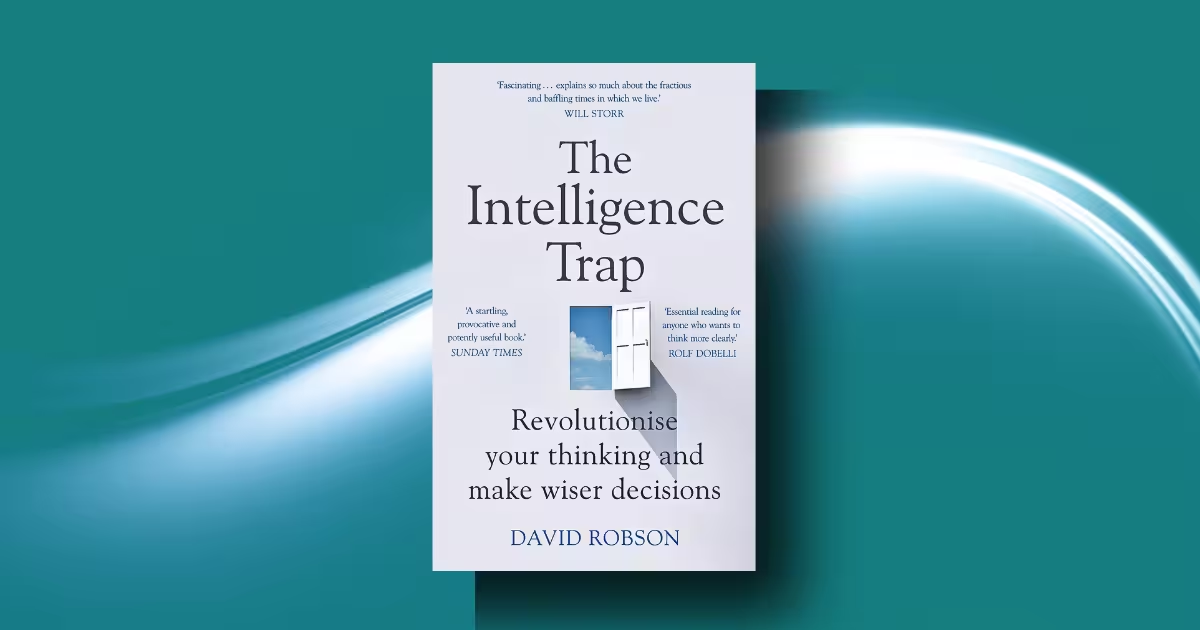
Ever wonder why your sharpest colleague makes the most baffling decisions, or why highly educated people sometimes believe the most outrageous things? David Robson’s The Intelligence Trap doesn’t just answer these questions—it dismantles everything you thought you knew about intelligence and reveals why being smart might actually make you more vulnerable to foolish thinking.
This isn’t another self-help book promising to make you a genius; it’s a scientifically grounded investigation into the dark side of high IQ, and it might just change how you think about thinking itself.
The Intelligence Trap by David Robson challenges the fundamental assumption that high intelligence and education automatically lead to better decision-making. Through compelling case studies—from Nobel Prize winners believing in aliens to FBI experts making catastrophic fingerprint errors—Robson demonstrates that smart people are often more susceptible to certain cognitive biases.
The Intelligence Trap offers a practical toolkit based on “evidence-based wisdom” to help anyone, regardless of IQ, think more rationally and avoid the pitfalls that trap even the brightest minds.
The Intelligence Trap is best for / not for
Best for:
- Professionals in high-stakes fields (medicine, law, finance, engineering) who want to understand why expertise can sometimes backfire
- Students and educators seeking to understand the limitations of traditional intelligence measures
- Anyone who’s ever wondered why smart people believe conspiracy theories or make obviously poor decisions
- Leaders and managers looking to build wiser, more effective teams
- Curious minds who want to understand the science behind thinking and decision-making
Not for:
- Readers looking for a quick-fix “become smarter overnight” guide
- Those who prefer purely anecdotal self-help without scientific backing
- Anyone uncomfortable having their assumptions about intelligence challenged
- Readers seeking spiritual or philosophical wisdom rather than evidence-based practical advice
Table of Contents
Introduction
Book Title: The Intelligence Trap: Why Smart People Make Stupid Mistakes
Author: David Robson
Publication Date: 2019
Publisher: W. W. Norton & Company
Pages: 313
Context
David Robson is an award-winning science journalist who specializes in psychology and neuroscience. He has written for prestigious publications including BBC Future, The Atlantic, The Guardian, and New Scientist.
His background in translating complex scientific research into accessible, engaging prose makes him uniquely qualified to tackle the intricate subject of intelligence and decision-making.
As a journalist who has spent years covering the latest psychological research, Robson brings both depth and accessibility to this exploration of why intelligent people sometimes make terrible decisions.
Purpose
The book’s central thesis is both provocative and unsettling: intelligence and education do not protect us from cognitive errors—in fact, they can make us more vulnerable to certain kinds of foolish thinking.
Robson argues that we’ve been measuring the wrong things when we assess mental ability.
While IQ tests capture important skills like abstract reasoning and factual recall, they completely miss the cognitive qualities that actually matter for wise decision-making: intellectual humility, curiosity, open-minded thinking, and emotional awareness.
Background
The story of The Intelligence Trap begins with a paradox that has puzzled philosophers and psychologists for centuries. In 399 BC, Socrates was declared the wisest man in Athens—not because he knew everything, but because he recognized the limits of his own knowledge.
Fast forward to the 20th century, and psychologist Lewis Terman was measuring intelligence through increasingly narrow tests of abstract reasoning, believing that IQ would predict success in everything from career to morality.
Robson traces how this narrow definition of intelligence became deeply embedded in our education systems and professional world.
The SAT, GRE, Wonderlic test—all are direct descendants of Terman’s work, and all capture essentially the same limited set of skills. Yet as the book reveals, these measures fail to predict the qualities that actually matter for good judgment: the ability to question assumptions, consider alternative perspectives, learn from mistakes, and regulate emotions.
The book also addresses the “Flynn Effect”—the mysterious rise in IQ scores over the 20th century—which shows that intelligence can be culturally shaped.
If IQ were truly a measure of innate brainpower, it shouldn’t be rising so dramatically across generations. This suggests that we’ve simply gotten better at the specific skills IQ tests measure, without necessarily becoming wiser or better decision-makers.
The Intelligence Trap Summary
Part 1: The Downsides of Intelligence
Robson opens with the story of Lewis Terman’s famous “Termites”—gifted children with IQs over 140 who were tracked throughout their lives. Terman believed these children would become the leaders of society, advancing science, art, and government.
The results were… underwhelming. While many achieved professional success, few became the towering figures Terman had predicted. Some of the brightest—including a girl with an IQ of 192—ended up living unremarkable lives.
The book then explores three major ways intelligence can backfire:
1. Dysrationalia
Keith Stanovich, a Canadian psychologist, coined this term to describe the mismatch between intelligence and rationality. You can have a high IQ and still make irrational decisions. In fact, Stanovich found that people with higher SAT scores actually had a larger “bias blind spot”—they were less able to recognize the flaws in their own logic.
The book provides a powerful example: consider the question “Jack is looking at Anne but Anne is looking at George. Jack is married but George is not. Is a married person looking at an unmarried person?” The correct answer is “yes”—but most people, including many Ivy League students, say “cannot be determined”.
2. Motivated Reasoning
This is perhaps the most dangerous form of the intelligence trap. Smart people don’t apply their intelligence fairly—they use it “opportunistically” to defend their existing beliefs and identity.
Dan Kahan’s research at Yale Law School demonstrated this powerfully. When presented with data about gun control, more numerate participants were more likely to interpret the data correctly—but only if it supported their political views. If the data contradicted their beliefs, their intelligence actually made them worse at reading it correctly.
This explains why intelligent people can believe in astrology, reject climate science, or fall for obvious scams. Their intelligence doesn’t help them think more clearly—it helps them build more elaborate justifications for their existing beliefs.
3. The Curse of Expertise
Robson examines the case of Brandon Mayfield, an Oregon lawyer falsely accused of the 2004 Madrid bombings based on a fingerprint match. The FBI’s top experts declared it a “100% positive match.” They were spectacularly wrong. The problem wasn’t incompetence—it was the very nature of expertise itself.
Expertise works by creating mental shortcuts called “schemas”—patterns that allow experts to process information quickly and automatically. This is usually efficient, but it also makes experts:
- Less flexible and less able to adapt to new situations
- More likely to miss details that don’t fit their expectations
- More susceptible to bias and emotional influence
- Less likely to question their own judgment
“The more expert you are, the more vulnerable you are in many ways,” explains cognitive neuroscientist Itiel Dror.
Part 2: Escaping the Intelligence Trap
Having diagnosed the problem, Robson offers practical solutions based on “evidence-based wisdom”—a new scientific discipline that identifies the thinking skills and dispositions that actually lead to good judgment.
1. Intellectual Humility and Open-Minded Thinking
Benjamin Franklin serves as a model of wise reasoning. At the Constitutional Convention, he urged delegates to “doubt a little of his own infallibility”. He developed a method called “moral algebra”—a systematic way of weighing pros and cons over several days to avoid impulsive decisions.
Research shows that simply taking time to “consider the opposite” can reduce a range of reasoning errors, including anchoring, overconfidence, and the myside bias.
2. Self-Distancing and Solomon’s Paradox
Igor Grossmann at the University of Waterloo discovered that people reason more wisely about other people’s problems than their own—a phenomenon he named after King Solomon, who gave wise advice to others but made terrible personal decisions.
The solution is “self-distancing”—imagining you’re watching yourself from a distance, or advising a friend in your situation. This simple technique reduces “hot” emotional processing and helps people think more clearly.
3. Emotional Awareness
Antonio Damasio’s work on the “somatic marker hypothesis” shows that emotions aren’t the enemy of good thinking—they’re essential for it. People with damage to the emotional centers of their brains make terrible decisions, despite having normal IQs.
The key is “emotion differentiation”—the ability to precisely label your feelings. People with richer emotional vocabularies make better investment decisions, are less susceptible to cognitive biases, and regulate their emotions more effectively.
4. Cognitive Reflection and Bullshit Detection
The Cognitive Reflection Test measures your ability to override intuitive but wrong answers. People who score higher are less likely to believe conspiracy theories, fall for fake news, or accept pseudo-profound nonsense.
Robson also explores how misinformation works through “truthiness”—the feeling that something is true because it’s familiar or easy to process. Simply repeating a false claim makes it feel more true, which is why debunking myths often backfires.
Part 3: The Art of Successful Learning
Robson challenges common assumptions about learning. Richard Feynman, one of the greatest physicists of the 20th century, had an IQ of just 125—well below the “genius” level. What set him apart was his insatiable curiosity and growth mindset.
The book identifies three key principles of deep learning:
1. Curiosity
Curiosity activates the brain’s dopamine system, making learning more effective and memorable. Crucially, curiosity also protects against motivated reasoning—curious people are more willing to seek out information that challenges their beliefs.
2. Growth Mindset
Carol Dweck’s research shows that people who believe intelligence can be developed learn more effectively than those who believe it’s fixed. A growth mindset also promotes intellectual humility and openness to new ideas.
3. Desirable Difficulties
Counterintuitively, learning is most effective when it’s harder, not easier. Techniques like spacing out study sessions, interleaving different topics, and productive failure (trying to solve problems before you know how) produce better long-term retention.
Part 4: The Folly and Wisdom of the Crowd
The final section examines how groups of intelligent people can make collectively stupid decisions.
Collective Intelligence
Anita Williams Woolley’s research shows that a team’s collective intelligence is only weakly related to members’ individual IQs. Much more important is social sensitivity—the ability to read others’ emotions and perspectives. Teams with more women tend to have higher collective intelligence because women, on average, score higher on social sensitivity.
The Too-Much-Talent Effect
Adam Galinsky found that teams benefit from having star players—but only up to a point. Once a team’s “star” percentage exceeds about 60%, performance actually declines.
This explains why the England football team, packed with players from elite clubs, lost to Iceland in Euro 2016. The stars’ egos and status conflicts undermined teamwork.
Functional Stupidity
Mats Alvesson and André Spicer coined this term to describe how organizations can actively discourage thinking. When employees are punished for questioning decisions or bringing bad news, the organization becomes collectively dumber.
Mindful Organizations
High-reliability organizations like nuclear power plants and aircraft carriers have developed strategies to avoid catastrophic errors. These include:
- Preoccupation with failure (assuming every day could be a bad day)
- Reluctance to simplify interpretations
- Sensitivity to operations
- Commitment to resilience
- Deference to expertise
The Intelligence Trap Analysis
The Intelligence Trap is a genuinely eye-opening work that deserves a place alongside classics like Daniel Kahneman’s Thinking, Fast and Slow as essential reading for anyone who wants to understand how the human mind works—and fails to work.
What makes this book so compelling is the way Robson weaves together scientific research with vivid, often shocking case studies. The story of Kary Mullis—a Nobel Prize-winning chemist who believed in aliens and AIDS denialism—is both jaw-dropping and instructive.
Similarly, the tale of Arthur Conan Doyle, creator of the supremely logical Sherlock Holmes, falling for the Cottingley Fairies hoax, illustrates how even the most brilliant minds can be fooled.
Robson’s greatest achievement is making complex psychological research accessible without dumbing it down. He explains concepts like “dysrationalia,” “motivated reasoning,” and the “somatic marker hypothesis” with clarity and concrete examples. The book doesn’t just tell you that smart people make mistakes—it shows you exactly how and why.
The book has a few minor weaknesses. Some readers might find the sheer volume of psychological studies overwhelming. At times, the book feels like a whirlwind tour of cognitive science research, with so many studies and researchers mentioned that it’s hard to keep track. Additionally, while the practical advice in Part 2 is solid, it’s not always as actionable as one might hope. “Be more intellectually humble” is easier said than done.
However, these are minor quibbles. The Intelligence Trap succeeds brilliantly in its central mission: changing how we think about intelligence and wisdom. It’s humbling to realize that our educational system has been measuring the wrong things, and that being smart doesn’t protect us from being foolish.
But it’s also empowering to know that wisdom can be cultivated—that we can learn to think better.
Strengths and Weaknesses
Strengths
Compelling Case Studies – From Nobel Prize winners to FBI experts, Robson’s examples are unforgettable and drive home the book’s points powerfully.
Solid Scientific Foundation – Every claim is backed by rigorous research, with extensive notes and references.
Practical Toolkit – The book doesn’t just diagnose the problem; it offers concrete strategies for improvement.
Accessible Writing – Robson translates complex psychology into clear, engaging prose.
Timely Relevance – In an age of fake news, political polarization, and information overload, the book’s insights are urgently needed.
Weaknesses
Overwhelming Detail – The sheer number of studies and researchers mentioned can be difficult to process.
Limited Actionability – Some advice (“cultivate intellectual humility”) is easier said than done without more structured guidance.
Repetition – Certain concepts (like motivated reasoning) are revisited multiple times, which can feel repetitive.
Comparison with Similar Works
The Intelligence Trap vs. Thinking, Fast and Slow (Daniel Kahneman)
Kahneman’s classic focuses on the cognitive biases that affect all human thinking. Robson’s book is more specific: it examines why smart people are particularly vulnerable to certain biases. While Kahneman diagnosed the problem, Robson offers a more focused prescription.
The Intelligence Trap vs. Superforecasting (Philip Tetlock)
Tetlock’s book shows how some people make remarkably accurate predictions through open-minded thinking and intellectual humility. Robson covers similar territory but with a broader focus on decision-making in general, not just prediction.
The Intelligence Trap vs. Mindset (Carol Dweck)
Dweck’s work on growth vs. fixed mindset is a key part of Robson’s argument, but Robson places it in a broader context of wisdom and decision-making.
Conclusion
The Intelligence Trap is essential reading for anyone who wants to think better—especially those who think they already do. By exposing the hidden vulnerabilities of high intelligence, David Robson has written a book that’s both humbling and empowering.
It humbles us by showing that our intellectual achievements don’t protect us from foolishness. But it empowers us by demonstrating that wisdom can be learned and cultivated.
The book’s lessons are urgently relevant. In a world of polarized politics, sophisticated misinformation, and complex global challenges, we need more than raw intelligence—we need intellectual humility, curiosity, emotional awareness, and the ability to question our own assumptions.
“The greatest minds are capable of the greatest vices as well as the greatest virtues,” Robson reminds us, quoting Descartes. This book shows us how to ensure our intelligence serves virtue rather than vice.







