
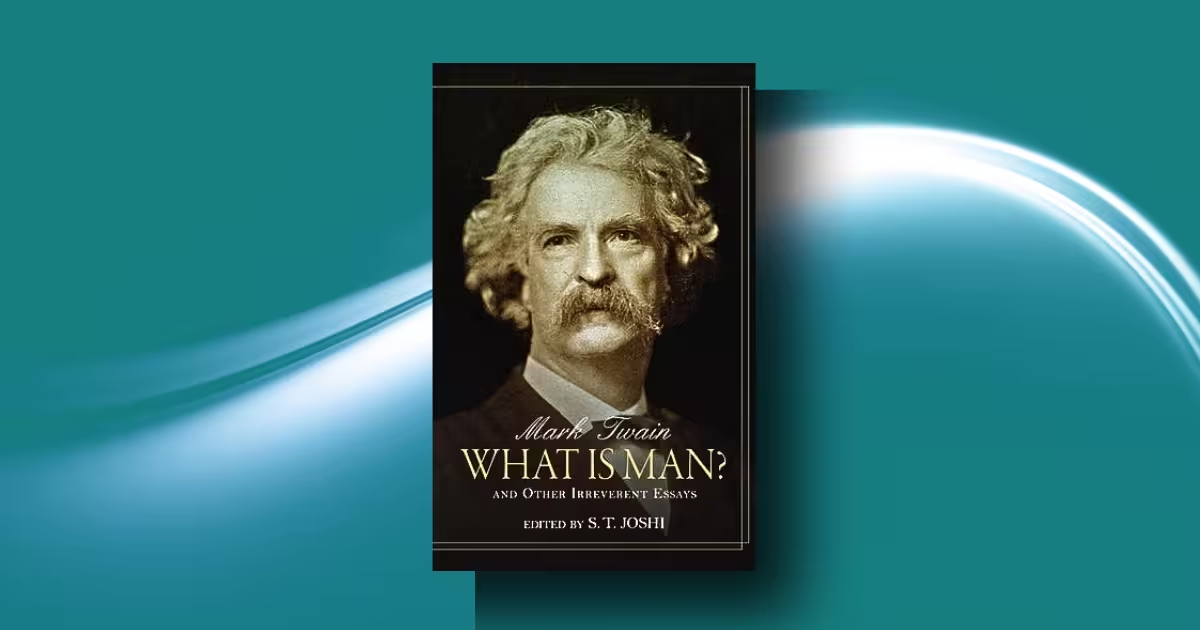
Ever catch yourself wondering why you really did that “selfless” thing? What if every act of kindness, every sacrifice, every so-called noble deed was actually driven by a single, selfish impulse? What Is Man? by Mark Twain doesn’t just ask these questions—it shatters your assumptions and forces you to see yourself as a machine, nothing more.
What Is Man? (1906) is Mark Twain’s philosophical dialogue that argues human beings are nothing but machines—automatic, deterministic, and incapable of originating a single thought. Through a Socratic debate between an Old Man and a Young Man, Twain systematically dismantles free will, personal merit, and altruism.
The central thesis: every human action, no matter how noble, is ultimately driven by the sole impulse to secure one’s own spiritual comfort and self-approval. It’s a brutal, unflinching, and surprisingly liberating read that forces you to rethink everything you believe about morality, choice, and human dignity.
What Is Man? is best for:
- Readers who enjoy philosophy but hate academic jargon.
- Fans of Twain who want to see his dark, cynical side.
- Anyone questioning the nature of free will, morality, or altruism.
- People who appreciate Socratic dialogues and thought experiments.
- Those seeking a short, dense, and intellectually provocative read.
Not For:
- Readers who prefer light, uplifting, or hopeful literature.
- Those who hold strong religious or spiritual beliefs about human dignity and free will (this book will offend you).
- Anyone looking for a traditional narrative or storytelling—this is pure philosophy.
- Readers who dislike repetitive arguments or dense dialogue.
Table of Contents
1. Introduction: What Is Man?
What Is Man? is a philosophical essay by the legendary American author Mark Twain (born Samuel Langhorne Clemens), published in 1906. The book is often subtitled And Other Essays, as this edition includes additional works like “The Death of Jean,” “The Turning-Point of My Life,” “Is Shakespeare Dead?” and more. T
he title itself is a direct reference to Psalm 8:4, which asks, “what is man, that you are mindful of him…”—a question Twain answers with devastating cynicism.
Context: What Is Man? Is About…
What Is Man? is not a novel, nor a memoir, nor a collection of humorous sketches—though Twain’s wit is ever-present. It’s a philosophical dialogue in the tradition of Plato, where an Old Man (the cynic) and a Young Man (the idealist) engage in a rigorous debate about human nature.
The Old Man asserts that the human being is merely a machine, and nothing more. He argues that we are driven by a single, unalterable impulse: the necessity of securing our own spiritual comfort and self-approval.
The Young Man resists, questions, and gradually—perhaps reluctantly—begins to see the truth in the Old Man’s “infamous doctrine.”
Purpose: The Central Thesis
What Is Man?‘s central argument is radical and uncompromising:
- Man is a machine. He originates nothing; all his thoughts, impulses, and actions come from outside influences.
- There is no free will. The mind works automatically, independent of the man’s control.
- There is no altruism. Every act, no matter how self-sacrificing, is performed primarily to content the actor’s own spirit.
- Personal merit does not exist. A man deserves no credit for his virtues, nor blame for his vices, because he did not create them—they are products of his heredity, training, and environment.
Twain held these views for decades before publishing. He first presented the core ideas as “What is Happiness?” to the Monday Evening Club in Hartford on February 19, 1883.
The response was chilly, and Twain wryly noted: “They said I was trying to strip man of his dignity, and I said I shouldn’t succeed, for it would not be possible to strip him of a quality which he did not possess”. He composed the first draft in 1898 while living in Vienna, but sat on it for years, finally publishing it anonymously in a limited edition of 250 copies.
It received so little attention that Twain later claimed to regret its publication. Only after his death in 1910 did the New-York Tribune reveal him as the author.
2. Background: The Making of a Cynical Gospel
To understand What Is Man?, you have to understand the man who wrote it. By the time Twain composed this dialogue, he had lived through severe financial troubles (his publishing company went bankrupt, leaving him with massive debts) and personal tragedies (the deaths of his beloved wife Livy and three of his four children, including his daughter Susy and, later, Jean).
He had also been deeply influenced by the scientific realism of Darwin and Huxley, and the deterministic philosophies that were gaining traction in the late 19th century.
Twain was not merely being provocative; he was genuinely grappling with the problem of suffering and injustice. If man is a free agent with a soul, why does God allow such senseless pain?
If there is no free will, then suffering becomes an impersonal, mechanical process—unjust, perhaps, but not a personal affront from a cruel deity.
Determinism, for Twain, offered a kind of grim comfort: it explained the unexplainable and removed the burden of moral outrage.
As scholar Linda Wagner-Martin notes, the ideas in What Is Man? form “a thread that runs through even the lightest of Mark Twain’s fiction, the calmest of his memoirs; and as the questioning hook that may provide a rationale for his becoming a writer in the first place”.
This wasn’t a passing fancy; it was the philosophical bedrock of his later years.
3. What Is Man? Summary
What Is Man? is structured as a series of conversations between the Old Man (O.M.) and the Young Man (Y.M.). Here’s a breakdown of the key arguments, with direct citations from the text.
I. Man the Machine
The Old Man begins by drawing an analogy between a man and a steam-engine. Just as an engine is made from materials found in nature and shaped by external forces, so too is man shaped by his heredity, training, and environment. The Old Man asserts:
“Man the machine—man the impersonal engine. Whatsoever a man is, is due to his make, and to the influences brought to bear upon it by his heredities, his habitat, his associations. He is moved, directed, COMMANDED, by exterior influences—solely. He originates nothing, not even a thought.”
The Young Man objects, insisting that he can form his own opinions. The Old Man retorts that even the Young Man’s opinion that this is “foolishness” came from outside influences—books, conversations, ancestral streams of thought. He drives the point home:
“A man’s brain is so constructed that it can originate nothing whatsoever. It can only use material obtained outside. It is merely a machine; and it works automatically, not by will-power.”
II. The Sole Impulse: Self-Approval
This is the heart of Twain’s “gospel.” The Old Man declares that there is only one impulse that ever moves a person to do anything:
“The impulse to content his own spirit—the necessity of contenting his own spirit and winning its approval.”
The Young Man is incredulous. What about self-sacrifice? What about the soldier who gives his life for his country? What about the mother who starves herself to feed her child? The Old Man systematically dismantles each example.
Take the case of a man who gives his last quarter to a starving old woman on a cold night. The Young Man sees this as pure altruism. The Old Man dissects it:
“In the first place he couldn’t bear the pain which the old suffering face gave him. So he was thinking of his pain—this good man. He must buy a salve for it… He bought himself free of a sharp pain in his heart, he bought himself free of the tortures of a waiting conscience, he bought a whole night’s sleep—all for twenty-five cents!”
As for the mother’s love, the Old Man is equally ruthless:
“The mother will go naked to clothe her child; she will starve that it may have food; suffer torture to save it from pain; die that it may live. She takes a living pleasure in making these sacrifices. She does it for that reward—that self-approval, that contentment, that peace, that comfort.”
The Young Man calls this “an infernal philosophy.” The Old Man replies, calmly: “It isn’t a philosophy, it is a fact”
III. The Role of Training and Temperament
If man is a machine, then training is everything. The Old Man explains that we are all born with a certain temperament—a disposition we cannot change—and that our environment and associations train us up or down. He uses a powerful metaphor: a man’s mind is like an ingot of gold. Exposed to “clean steam” (good influences), it remains pure; exposed to “vaporized quicksilver” (bad influences), it corrodes and crumbles.
He also introduces the concept of the Interior Master—the conscience, which is not a moral guide but a tyrant that demands to be satisfied:
“That mysterious autocrat, lodged in a man, which compels the man to content its desires. It may be called the Master Passion—the hunger for Self-Approval.”
The Young Man asks if this Master can be trained to prefer good over evil. The Old Man says yes, but only because good actions will content the Master better than evil ones. The Master cares nothing for the man’s actual welfare; it only cares about its own contentment.
IV. The Ant and the Rat: Man’s Intellectual Inferiority
In one of the most provocative sections, the Old Man argues that there is no intellectual frontier separating man from the lower animals. He points to the ant, which builds elaborate houses, practices agriculture, keeps slaves, and even holds consultations to solve problems.
He cites Sir John Lubbock’s experiments showing that ants can recognize individual members of their hive of 500,000 after a year’s absence.
The Old Man concludes:
“Man has a finer and more capable machine in him than those others, but it is the same machine and works in the same way.”
But when it comes to morality, man is actually inferior. The Old Man declares:
“The fact that man knows right from wrong proves his intellectual superiority to the other creatures; but the fact that he can do wrong proves his moral inferiority to any creature that cannot.”
V. Free Will: An Illusion
The Young Man asks about free will. The Old Man dismisses it entirely:
“There is no such thing… Free Will has always existed in words, but it stops there, I think—stops short of fact.”
He distinguishes between Free Choice (the mind’s ability to determine which action is right) and Free Will (the power to act on that choice). The mind can point out the right path, but the man’s temperament and training—his “machine”—will determine which path he actually takes.
A born coward may know it is right to fight, but he cannot; a brave man may know it is wrong to fight, but he cannot help himself.
VI. The Death of Jean and Other Essays
The edition also includes several other essays that provide a window into Twain’s personal life and broader interests. “The Death of Jean” is a heartbreaking account of the sudden death of his youngest daughter, Jean Clemens, on Christmas Eve 1909. Twain writes with raw, unadorned grief:
“How poor I am, who was once so rich!… Jean lies yonder, I sit here; we are strangers under our own roof; we kissed hands good-by at this door last night—and it was forever, we never suspecting it.”
“The Turning-Point of My Life” is a fascinating reflection on how circumstance and temperament, not personal will, shaped his career. He traces his literary success back to a single, seemingly trivial event: catching measles at age twelve. He argues that every so-called “turning point” is merely the last link in a long chain of predetermined events.
“Is Shakespeare Dead?” is a lengthy, playful, and surprisingly convincing argument that William Shakespeare of Stratford could not have written the plays attributed to him.
Twain marshals evidence from legal experts to show that the author of the plays had a deep, professional knowledge of the law—knowledge that the illiterate Stratford actor could not have possessed. He concludes that Francis Bacon is a far more likely candidate.
“English as She Is Taught” is a hilarious collection of howlers from American public schools, showcasing Twain’s enduring love of linguistic absurdity.
4. What Is Man? Analysis
Does Twain effectively support his arguments? Yes and no.
On one hand, the dialogue is a masterpiece of rhetorical persuasion. The Old Man is relentless, logical, and backed by a mountain of evidence drawn from everyday experience. He anticipates every objection the Young Man (and the reader) can muster and demolishes them with cold, surgical precision. The analogy of the steam-engine, the ingot of gold, and the ant are all powerful and memorable.
On the other hand, Twain’s determinism is philosophically problematic. As one critic notes, “this concept of a self-training machine may be untenable as a philosophical doctrine”.
If man is a machine with no free will, then the Old Man’s arguments are themselves merely the product of outside influences—and so is the Young Man’s eventual acceptance of them.
There is no room for genuine rational persuasion, only mechanical reaction. As another scholar points out, the book “expounds determinism precisely as it demonstrates that only a ‘petrified’ thinker could hold determinist views”.
In other words, if determinism is true, then no one can be convinced of it; they can only be conditioned into it. This is a fatal flaw.
Furthermore, Twain’s psychological egoism—the claim that all actions are selfish—is empirically unprovable. While he makes a strong case that many “altruistic” acts have hidden selfish motives, he cannot prove that all do. The mother who sacrifices her life for her child may be seeking self-approval, but is that really the only possible explanation?
Twain’s refusal to entertain any alternative makes his argument feel dogmatic, not scientific.
Nevertheless, What Is Man? does fulfill its stated purpose. It is a genuine, earnest, and rigorous exploration of human nature from a deterministic perspective. It forces the reader to confront uncomfortable questions about morality, free will, and personal responsibility. Even if you reject its conclusions, you cannot dismiss its arguments lightly.
What I Learned from What Is Man?
Reading What Is Man? is like having a brilliant, cynical, and slightly cruel uncle sit you down and systematically destroy every comforting illusion you have about yourself. It’s uncomfortable, infuriating, and yet strangely liberating.
Here’s what I took away:
1. Humility. If personal merit is an illusion, then I have no right to feel superior to anyone else. My virtues are accidents of birth and environment; my vices are the same. This doesn’t excuse bad behavior, but it does make judgment feel a lot less satisfying.
2. Honesty. Twain forces me to examine my own motives. Why did I really donate to that charity? Why did I help that stranger? Was it for them, or was it to feel good about myself? The answer is almost always a mix, but Twain’s insistence on the selfish core is a useful corrective to self-deception.
3. Compassion. If people are machines, then punishing them for their “sins” is like punishing a broken clock for being slow. It makes no sense. This doesn’t mean we shouldn’t have laws or consequences, but it does mean we should approach wrongdoing with less moral outrage and more practical problem-solving.
4. The Power of Training. If environment and association shape us, then we have a responsibility to create good environments—for ourselves and for others.
Twain’s “Admonition” is surprisingly practical: “Diligently train your ideals upward and still upward toward a summit where you will find your chiefest pleasure in conduct which, while contenting you, will be sure to confer benefits upon your neighbor and the community”.
5. Strengths and Weaknesses
Strengths
✅ Clarity and Wit. Twain’s prose is a joy to read. He takes dense philosophical concepts and makes them accessible, even entertaining. His use of dialogue, analogy, and humor keeps the reader engaged.
✅ Intellectual Rigor. The Old Man’s arguments are carefully constructed and logically consistent. Twain anticipates and addresses most major objections.
✅ Historical Significance. The book is a valuable document of late-19th-century philosophical thought, showing how Darwinism and determinism influenced even the most beloved of American writers.
✅ Personal Honesty. The inclusion of deeply personal essays like “The Death of Jean” shows Twain’s willingness to apply his philosophy to his own life, with all its pain and loss.
Weaknesses
❌ Dogmatism. The Old Man never wavers, never concedes a point, never entertains the possibility that he might be wrong. This makes the dialogue feel more like a sermon than a genuine debate.
❌ Philosophical Flaws. As noted, the determinism is self-refuting. If all thoughts come from outside, then the Old Man’s arguments are not true in any meaningful sense; they are merely inevitable.
❌ Repetitiveness. The dialogue goes on for longer than necessary. The Young Man makes the same objections multiple times, and the Old Man gives essentially the same answers.
❌ Pessimism. What Is Man? offers little hope or consolation. It strips away human dignity without offering anything in its place—except, perhaps, the grim comfort of determinism.
6. Comparison with Similar Works
What Is Man? belongs to a long tradition of philosophical dialogues and deterministic thought.
Plato’s Dialogues. The Socratic format is a clear influence. However, unlike Plato, who uses dialogue to arrive at transcendent truths, Twain uses it to demolish all transcendence.
Thomas Hobbes’s Leviathan. Hobbes also argued that humans are machines driven by self-interest. But Hobbes believed in a social contract; Twain offers no such solution.
B.F. Skinner’s Beyond Freedom and Dignity. Skinner’s radical behaviorism is a 20th-century echo of Twain’s determinism. Both argue that free will is an illusion and that environment shapes behavior. However, Skinner is more optimistic about our ability to engineer better environments.
Arthur Schopenhauer’s Essays. Schopenhauer’s pessimism and his denial of free will are strikingly similar to Twain’s. But Schopenhauer offers a path of aesthetic and ascetic escape; Twain offers nothing but acceptance.
Isaac Asimov’s … That Thou Art Mindful of Him. Asimov’s science fiction story directly references Twain’s work, with two robots debating the same questions of determinism and human nature. It’s a fitting tribute to Twain’s lasting influence.
7. Conclusion: Should You Read This Book?
What Is Man? is not a book for everyone. It’s dark, cynical, and uncompromising. It will challenge your most cherished beliefs about free will, morality, and human dignity. It will make you uncomfortable.
But that’s precisely why you should read it.
In an age of self-help platitudes and empty positivity, Twain’s brutal honesty is a breath of fresh air. He doesn’t tell you what you want to hear; he tells you what he believes to be true, regardless of how painful it is.
And in doing so, he offers a strange kind of liberation. If we are machines, then we are not responsible for our failures—but we are also not entitled to pride in our successes.
We can stop judging ourselves and others and start focusing on what really matters: creating environments that train us upward, toward ideals that benefit everyone.
As Twain himself wrote in his “Admonition”:
“Diligently train your ideals upward and still upward toward a summit where you will find your chiefest pleasure in conduct which, while contenting you, will be sure to confer benefits upon your neighbor and the community.”
That’s not a bad gospel, even if it comes from a self-proclaimed machine.
Who Should Read It?
- Students of philosophy, literature, or American history.
- Fans of Mark Twain who want to see his darker side.
- Anyone struggling with questions of free will, morality, or the meaning of life.
- Readers who appreciate dense, thought-provoking, and intellectually challenging works.
Rating: 4/5 Stars. It’s not perfect, but it’s unforgettable.







