
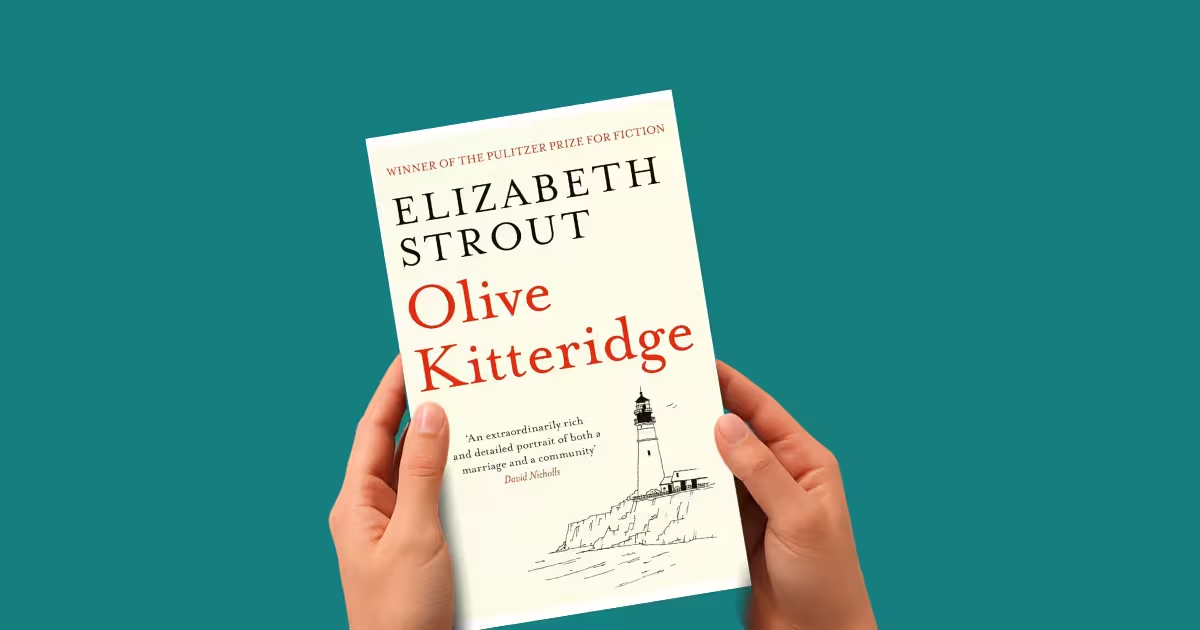
Why do the most ordinary, quiet lives often hide the most devastating, earth-shattering secrets? If you are looking for a story that strips away the polite veneer of small-town living, you have found it. Elizabeth Strout tells it through Olive Kitteridge.
Elizabeth Strout’s Pulitzer-winning novel Olive Kitteridge brilliantly exposes the thorny, messy, and deeply interconnected lives of the residents in a coastal Maine town, anchored by the brutally honest and polarizing figure of Olive Kitteridge.
Olive Kitteridge is best for readers who appreciate character-driven literary fiction, slow-burn psychological tension, realistic depictions of marriage, and unvarnished truths about aging.
Not for the readers seeking fast-paced plots, tidy and happy endings, or highly sympathetic, warm-and-fuzzy protagonists.
Table of Contents
1. Introduction
Olive Kitteridge by Elizabeth Strout is a masterclass in literary realism. Published by Random House in 2008, this collection of thirteen interconnected short stories functions as a novel. The book went on to win the 2009 Pulitzer Prize for Fiction.
It captures the essence of human fragility, told through the lens of a fierce, unfiltered, and deeply complex retired mathematics teacher in the coastal town of Crosby, Maine.
2. Background
Set against the backdrop of late 20th-century New England, the novel captures a transitional period in American life. The town of Crosby serves as a microcosm of working-class and middle-class struggles.
The historical context reflects a time when stoicism was highly valued, mental health was rarely discussed openly, and the expectations of marriage were rigid. Strout uses this environment to paint a bleak but incredibly authentic picture of a community where everyone knows your name, but very few know your true pain.
3. Olive Kitteridge Summary
The Quiet Desperation of the Pharmacy
The narrative opens not with Olive, but with her husband, Henry Kitteridge. Henry is a steadfast, mild-mannered pharmacist who finds peace in the predictable routines of his work.
His pharmacy is his sanctuary from his home life, where Olive’s dark moods and volatile temper create a suffocating atmosphere. Olive is described as having a darkness that stands beside her like an acquaintance that will not go away.
Henry hires a young, plain, and eager twenty-two-year-old assistant named Denise Thibodeau. Denise is married to a robust local plumber, also named Henry. Henry Kitteridge develops a deep, unconsummated, and almost fatherly affection for Denise. He watches her efficiently run the registers and marvels at her simple dreams of making a home.
When Henry Thibodeau is tragically killed in a hunting accident by his best friend Tony Kuzio, Denise is left utterly shattered and helpless. Henry Kitteridge steps in to manage her life, teaching her to drive and setting up her bank accounts.
His quiet devotion to her becomes an emotional lifeline for him, an escape from Olive’s sharp criticisms. Eventually, Denise marries Jerry McCarthy, the pharmacy’s delivery boy, and moves away. Henry is left to face his aging marriage with Olive, grappling with his own unspoken regrets and the realization that he cannot save anyone.
The Incoming Tide and Hidden Trauma
The story shifts to Kevin Coulson, a former student of Olive’s who has returned to Crosby as an adult. Kevin is a medical student in New York training in psychiatry, heavily burdened by the trauma of his mother’s gruesome suicide.
His mother suffered from undiagnosed bipolar disorder, a detail that deeply haunts Kevin. He drives to the local marina and parks his car, heavily implying that he plans to end his own life with the rifle he has concealed in the back seat.
While sitting in the car, Kevin is unexpectedly interrupted by Olive Kitteridge, who invites herself into his vehicle. Olive is loud, intrusive, and bluntly observant. She recognizes Kevin and remembers his mother fondly.
During their uncomfortable conversation, Olive reveals her own family trauma, noting that her father also committed suicide. This stark, shared admission of pain creates a bizarre but profound connection between them. As they speak, a young woman named Patty Howe, who works at the marina and has suffered multiple miscarriages, slips off the rocky cliff and falls into the turbulent ocean.
Kevin’s survival instinct overrides his suicidal ideation, and he rushes to save Patty. Olive’s sheer, abrasive presence inadvertently stops Kevin from killing himself.
The Expanding Web of Crosby
The subsequent chapters delve into the lives of other Crosby residents, always circling back to Olive. We see Olive’s relationship with her son, Christopher, which is fraught with resentment and misunderstanding.
Christopher is deeply affected by his mother’s overbearing nature and his father’s passive enabling. He eventually marries a controlling woman, moves to California, and becomes a podiatrist, distancing himself from his parents.
Olive feels abandoned and misunderstood, completely unable to see how her own harshness drove him away.
Henry eventually suffers a massive stroke, leaving him incapacitated and unable to speak in a nursing home. Olive visits him faithfully, showing a softer, grieving side of her personality. The town moves on, and Olive is forced to confront her isolation. She begins to realize the immense damage she has caused those she loves through her bluntness and lack of emotional filter.
The Ending Explained
In the final arc of the book, Henry passes away, leaving Olive a widow. She is completely alone, struggling with the quiet emptiness of her house. She unexpectedly forms a connection with Jack Kennison, a wealthy, arrogant Republican widower whom she previously despised. Jack is also estranged from his child and understands the deep loneliness of old age.
The book ends with Olive and Jack in bed together. Olive rests her hand on his chest, feeling the steady beat of his heart. She reflects on the fact that the world is a beautiful place, despite the immense pain, and acknowledges that she does not want to leave it yet.
The ending is not a neat resolution of her past mistakes, but rather a quiet, profound acceptance of her own flaws and a desperate clinging to human connection in the twilight of her life.
4. Olive Kitteridge Analysis
4.1. Characters
Olive Kitteridge: Olive is abrasive, judgmental, and completely lacking in tact. Yet, she is fiercely perceptive and surprisingly empathetic toward those suffering from deep, unspoken traumas (like Kevin Coulson). Her complexity lies in her inability to show love in traditional ways. She is a woman who loves deeply but communicates terribly, alienating her own son while accidentally saving a suicidal man.
Henry Kitteridge: Henry represents the tragic danger of extreme passivity. He is kind, patient, and desperate for everyone to be happy. His emotional affair with Denise Thibodeau highlights his deep dissatisfaction with Olive, yet he remains loyal. His inability to confront Olive directly damages his relationship with his son and ultimately traps him in a quiet life of quiet desperation.
Christopher Kitteridge: Christopher is the victim of his parents’ dysfunctional dynamic. He absorbs Olive’s aggression and Henry’s passivity. His eventual escape to California and his choice of a domineering wife show that he is doomed to repeat the patterns he grew up with.
4.2. Themes and Symbolism
The Burden of Mental Illness: The text constantly deals with depression, suicide, and undiagnosed conditions. Olive’s father, Kevin’s mother, and arguably Olive herself all suffer from severe depressive traits. The town ignores these issues, forcing characters to suffer in absolute silence.
The Facade of Normalcy: Crosby is a town where everyone knows each other, but the surface-level politeness masks intense suffering. The pharmacy serves as a symbol for this: a place where people come for medicine to fix their physical ailments, while their emotional wounds remain completely untreated.
Water and Tides: The ocean is a constant, brooding presence. In “Incoming Tide,” the rough water physically threatens Patty Howe but also symbolically represents the chaotic, uncontrollable nature of life and depression that threatens to pull the characters under.
5. Olive Kitteridge Evaluation
Olive Kitteridge is a piercingly accurate, unsentimental triumph of modern American fiction. Strout refuses to make her protagonist likable, yet she demands our total understanding.
Strengths: The absolute strongest point is Strout’s character work. The dialogue is painfully real, and the narrative structure of interconnected stories builds a massive, suffocating world out of a tiny town.
Weaknesses: Some readers may find the pacing slow or the tone overwhelmingly bleak. A few of the peripheral stories feel slightly disconnected from the core emotional arc of Olive’s family.
Impact: The book forces you to look at the difficult, aging people in your own life and wonder what hidden tragedies made them so hard. It is a brilliant study in empathy.
Comparison: The novel compares favorably to Sherwood Anderson’s Winesburg, Ohio for its small-town structure, and to Alice Munro’s short stories for its precise, sharp observations of domestic tragedy.
Adaptation: The novel was adapted into a highly acclaimed HBO miniseries in 2014 starring Frances McDormand. Directed by Lisa Cholodenko, the adaptation was praised heavily for McDormand’s tour de force performance, earning a 94% approval rating on Rotten Tomatoes. Critics noted that the miniseries allowed ample time to do justice to the novel, perfectly capturing the bleak yet uplifting tone.
6. Personal Insight & Contemporary Educational Relevance
Reading this book reveals five major lessons deeply relevant to our modern understanding of mental health and relationships:
1. Mental Health Needs Open Dialogue: In the book, Kevin Coulson notes the brain chemistry of the bipolar mind. Today, we know that hiding family mental health histories only isolates the suffering. (Check NAMI for modern resources).
2. Passivity is Not Kindness: Henry’s refusal to fight back against Olive is framed as goodness, but it actively harms their son. True healthy relationships require healthy conflict.
3. Aging is an Invisible Crisis: Olive’s later years highlight how society completely abandons the elderly. As global populations age, addressing elder loneliness is critical.
4. Trauma Binds Strangers: The connection between Olive and Kevin shows that shared pain often creates more authentic bonds than shared joy.
5. Perfection is a Myth: The Thibodeaus appear perfect until tragedy strikes. Social media today creates similar illusions; Strout reminds us that every household has its hidden miseries.
7. Olive Kitteridge Quotes
- “It was Henry’s nature to listen, and many times during the week he would say, ‘Gosh, I’m awful sorry to hear that,’ or ‘Say, isn’t that something?’”
- “America’s a big cheese gone rotten.”
- “She had a darkness that seemed to stand beside her like an acquaintance that would not go away.”
- “Traits don’t change, states of mind do.”
- “Only that the goddamn teacher is a moron, which Jim understands instinctively,” Olive said.
8. Conclusion
My overall impression of Olive Kitteridge is one of awe. It is a difficult, bruising read, but an entirely necessary one. I highly recommend this book for fans of character studies and psychological realism.
It is completely worth reading because it teaches us how to forgive the unforgiving people in our lives.







