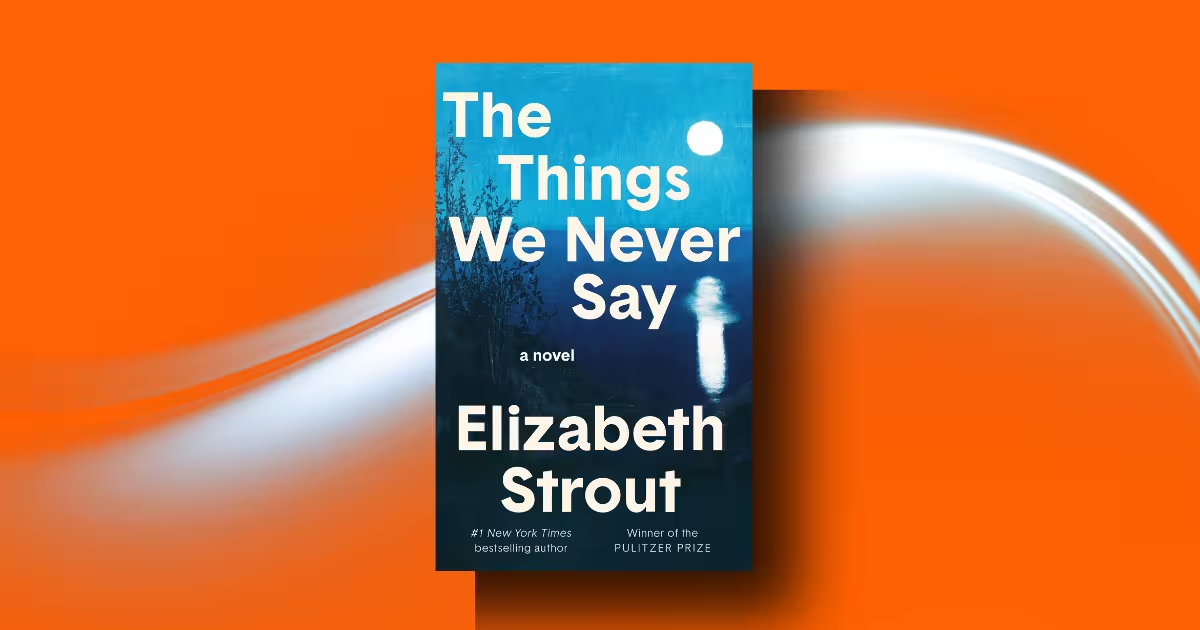

Do you ever sit beside someone you love and suddenly wonder why the most important truths between you remain unsaid? That is why The Things We Never Say stayed with me: it turns ordinary loneliness into something frightening, tender, and deeply recognizable.
Elizabeth Strout’s The Things We Never Say is a quiet, devastating novel about a beloved teacher who discovers that love can be real even when family history, marriage, politics, and memory are built on silence.
The Things We Never Say is for readers of literary fiction, Elizabeth Strout fans, book clubs, teachers, parents, readers interested in loneliness, marriage, aging, mental health, and American political anxiety.
Not for readers who need a fast thriller plot, clean moral judgment, romantic escapism, or characters who explain every feeling directly.
Table of Contents
1. Introduction
The Things We Never Say is a 2026 novel by Pulitzer Prize-winning American writer Elizabeth Strout, published by Random House in the United States on May 5, 2026.
Strout is best known for Olive Kitteridge, My Name Is Lucy Barton, Oh William!, Lucy by the Sea, Olive, Again, and Tell Me Everything. Penguin Random House identifies her as a #1 New York Times bestselling author and notes that Olive Kitteridge won the Pulitzer Prize.
In this new novel, Strout leaves the familiar Lucy Barton/Olive Kitteridge universe and introduces Artie Dam, a 57-year-old history teacher on the Massachusetts coast.
Publicly, Artie is cheerful, kind, funny, and beloved. Privately, he is collapsing. The publisher describes the book as “a poignant meditation on loneliness, friendship, parenthood, and the importance of truth in a capsizing world.”
As a reader, I felt this was not simply a novel about a family secret. It is about the terrible fact that people can live beside one another for decades and still remain mysterious.
2. Background and Historical Context
The novel is set in coastal Massachusetts around the 2024 U.S. election and its aftermath.
That political backdrop matters because Artie teaches history; he cannot separate private fear from public history.
He watches his students grow more anxious after the pandemic, notices moral cruelty among teenagers, and worries about fascism, war, and democratic decline. In the uploaded text, Artie notices that “the pandemic had been hard” on students, that they were more anxious and less able to talk than before.
The Guardian’s review also highlights the novel’s contemporary pressure points: post-pandemic students, the 2024 election, class difference, trauma, Rob’s accident, and Artie’s dread about the future.
Historically, the novel also keeps returning to the Civil War because Artie teaches it through letters from Massachusetts soldiers and nurses.
That classroom method becomes more than a teaching technique. It is Strout’s ethical model for the whole novel: if you want to understand people, read what they wrote when they were frightened, ashamed, in love, or close to death.
3. The Things We Never Say Summary
Artie Dam looks, from the outside, like a man who has made it.
He lives in a large inherited house by the ocean with his wife Evie.
He teaches eleventh-grade history, jokes with students, sails on weekends, and is liked by almost everyone. But the novel immediately shows us that public warmth and private despair can exist in the same person.
At the beginning, Artie’s closest emotional ease seems to come not from Evie but from Flossie MacDonald, a loud, needy, grieving friend who has moved to Ohio after her husband Reginald’s death.
Artie is not in love with Flossie, but he can be himself with her. That difference matters. Evie finds Flossie “too much,” but Artie loves the way Flossie lets feeling spill out. Their meals at Spud’s Bar and Grille become little rituals of emotional honesty.
At school, Artie is at his best.
He is a teacher who sees students carefully. When Danny Marino mocks Rhonda Lazarre, an awkward and vulnerable girl, Artie explodes with moral anger and tells the class that no one is superior to anyone else.
That moment later changes both Danny and Rhonda. Rhonda will remember him with lifelong love; Danny will one day understand that Artie changed his life.
But beneath this decency, Artie is thinking about suicide.
The text is explicit: for more than two months he has been considering how to kill himself without his wife, son, or students knowing. Drowning seems most plausible because he sails. Strout’s terrible skill is that she makes this despair both shocking and ordinary. Artie still jokes, teaches, chats, and goes to parties. Yet inside, he feels “lonely enough to die.”
The family’s earlier trauma centers on Rob, Artie and Evie’s only son.
Ten years before the present action, Rob was driving with his girlfriend Heather Morrison when the car crashed and Heather died. Rob survived, but the accident changed the family. Rob became withdrawn, Evie became more controlled and professionalized her grief by training as a family therapist, and Artie watched his son drift away.
Then comes the first major turning point: Artie almost drowns.
He slips while trying to get from the dinghy into his sailboat; his rubber boots fill with water, the current carries him away, and he is saved by Kenneth Moynihan and Ken’s son. The accident is not deliberate, but it violently interrupts Artie’s suicidal imagination. Afterward, the novel says: “A page had been turned.” Artie, having almost died, no longer wants to.
In the hospital, Rob asks the question Artie fears: did he fall into the water on purpose? Rob calls Artie his “Explorer,” meaning the one who goes ahead and proves survival is possible. If Artie kills himself, Rob says, it will mean Rob can do it too.
This is one of The Things We Never Say’s most emotionally direct scenes. Artie promises he will never do that.
After the near-drowning, Artie begins to live again, but the world does not become simple. He meets Ken, his rescuer, for dinners at Spud’s.
Ken becomes a new friend, a male friend who can receive Artie’s talk without dismissing it. This friendship becomes essential because Artie soon learns the real secret.
Rob eventually tells Artie: “You’re not my father.” Reginald MacDonald, Flossie’s late husband, had written Rob a deathbed letter claiming to be his biological father. According to the letter, Evie had difficulty conceiving, Reginald “accommodated” her, and Rob was conceived. Reginald even leaves DNA evidence so Rob can verify the claim. Rob does, and the test confirms it.
Artie’s response is morally beautiful.
He is devastated, but his first instinct is to protect Rob.
He tells him that if it is true, it makes no difference to him. And in a later scene, he tells Rob that when Rob was a baby, Artie thought he could not possibly love him more, and then discovered that he did. Fatherhood, the novel insists, is not reducible to biology.
The secret changes everything and nothing. Artie and Rob know. Francesca, Rob’s wife, knows. Evie does not know that they know. Artie chooses not to confront Evie immediately.
Instead, he and Rob live with the knowledge. Artie begins lying by omission, but he also begins to see how much of life is made of omission. He realizes that he and Evie have lived with “this huge thing silently between them,” except that he had not known it was there.
Meanwhile, Rob leaves Rachel, the woman he briefly thought he loved, after discovering her instability and theft.
He returns emotionally to Francesca, who becomes one of the novel’s loveliest surprises. Artie’s relationship with Francesca deepens through music, Thanksgiving, and shared knowledge. She tells him that when she plays, she is “looking for God.”
Artie also helps Rob face the old Heather tragedy. Rob considers writing to Heather’s parents; Ken, who knows them, tells Artie they would welcome a properly worded letter.
Artie texts Rob to write it, and Rob replies with gratitude. This is not a neat redemption, but it is a movement toward responsibility.
The ending widens beyond Artie’s immediate crisis. Rob and Francesca reunite, later move to Brussels after Rob’s government contract is canceled, and Artie loses the hoped-for future of sailing with his son. Hoover Lakeland, the principal, later dies by suicide after political and legal pressure. Artie’s mental health declines; he is hospitalized for depression. The state of the country, separation from Rob, Francesca’s miscarriage, school pressures, and accumulated grief all weigh on him.
Yet Strout does not end with melodrama. Artie eventually dies in his sleep of a heart attack several years later, during a heat wave and power outage.
After his death, Evie finds the old student notes in his mother’s jewelry box and realizes more fully what he meant to people. She also finds Reginald’s letter and finally learns that Artie knew.
When she calls Rob, he does not take her side, and Evie is devastated. For the rest of her life, she speaks of Artie as a saint, perhaps because she finally understands too late the scale of his kindness.
The final feeling is not triumph. It is recognition. The people in this novel hurt one another, save one another, miss one another, misunderstand one another, and sometimes love one another better after the chance to say the truth has passed.
4. The Things We Never Say Analysis
4.1 The Things We Never Say Characters
Artie Dam
Artie is the moral center of the novel, but Strout wisely refuses to make him heroic in a simple way. He is funny, kind, class-conscious, wounded, passive, ashamed, curious, and sometimes evasive. His great gift is attention.
He sees Rhonda’s humiliation, Danny’s pain, Rob’s shame, Flossie’s loneliness, Ken’s decency, and Francesca’s strangeness. Yet he cannot fully see Evie, and he cannot fully see himself until near death turns him around.
Evie Dam
Evie is not a villain. She is more frightening than that: she is ordinary, competent, and emotionally withholding.
She has carried the secret of Rob’s conception for decades. She loves Artie, but she often does not listen to him. Her final devastation after finding Reginald’s letter is painful because she realizes that Artie had known and had still continued to live beside her.
Rob Dam
Rob’s life is shaped by two fatherhood crises: the guilt over Heather’s death and the revelation that Artie is not his biological father.
His desperate line about Artie being his “Explorer” is the emotional key to their relationship. Rob does not need Artie to be his genetic father; he needs him to remain alive, steady, and ahead of him.
Francesca
At first Artie finds Francesca odd and unknowable. Later, she becomes one of the book’s most quietly luminous figures.
Her music, her honesty, and her tenderness toward Rob allow Artie to see a different kind of intelligence: not social smoothness, but inward seriousness.
Flossie MacDonald
Flossie is comic, wounded, lonely, and messy. Her grief for Reginald is real even though he was cruel. Her affair with Ed Merrill echoes Evie’s hidden sexual history, making her another person judged by a secret.
At the New Year’s dinner, Artie realizes their old friendship cannot fully return.
Ken Moynihan
Ken saves Artie physically, then emotionally. The complication is that Ken’s politics differ from Artie’s, and Artie must reckon with the fact that a person can be decent and still, in his view, support something dangerous. That tension gives the novel moral realism.
Rhonda Lazarre and Danny Marino
Rhonda and Danny show Artie’s long influence as a teacher. Rhonda receives his kindness almost sacramentally. Danny first feels humiliated, but later understands.
Their later photograph with Artie becomes proof, after his death, that his private life was not the only measure of his existence.
4.2 The Things We Never Say Themes and Symbolism
Loneliness
The novel opens with a Jung epigraph about loneliness as the inability to communicate what matters most. That idea becomes the whole structure of The Things We Never Say. Artie is surrounded by people and still isolated. Flossie is near her daughter and still lonely. Evie is married and still unknowable. Rob has a father and then loses, regains, and redefines him.
The things people do not say
The title is not abstract. Evie does not say who fathered Rob. Reginald waits until death to say it.
Artie does not tell Evie that he knows. Rob does not tell his mother. Flossie does not tell Artie about her affair until late. The novel’s repeated wound is not only betrayal; it is deferred speech.
The sea and drowning
The sea is both beauty and death. Artie loves sailing, yet drowning is the method he imagines for suicide. When he actually falls into the water, the sea becomes a brutal teacher. It shows him that not wanting to live is not the same as wanting to die.
Teaching and history
Artie teaches history because he believes the past matters. But the novel asks whether knowing history helps us live better. Artie sees fascism and public cruelty more clearly than many around him, but that knowledge also burdens him.
Music
Music belongs to Francesca and, unexpectedly, Artie. When Francesca turns Artie’s simple piano melody into something grand, the scene becomes symbolic: one person’s small, private feeling can become larger when another person receives it.
Letters
Letters carry truth across distances. Civil War letters teach Artie’s students. Reginald’s letter detonates Rob’s life. Rob’s possible letter to Heather’s parents becomes a gesture toward moral repair. In this novel, writing is dangerous because it preserves what speech avoids.
5. Evaluation
For me, The Things We Never Say is a poignant, mature, and quietly devastating novel. It does not shout; it sits beside you until you realize your own life is full of sentences you have postponed saying.
Strengths
The greatest strength is character complexity. Strout understands how one person can be good, weak, loving, evasive, comic, selfish, and generous in the same day. Artie is unforgettable because he is not dramatic. He is merely human in a way that hurts.
The second strength is emotional pacing. The novel begins with ordinary details—white socks, schoolrooms, boats, dinner parties—and slowly reveals that every detail has pressure underneath.
Weaknesses
Some readers may feel the political material is too direct.
Others may find the late leaps into future events—Artie’s death, Hoover’s suicide, Rob’s move to Brussels—slightly abrupt. Strout’s method is elliptical; she trusts implication more than plot mechanics. That is beautiful, but it may frustrate readers who prefer a tighter conventional arc.
Impact
The book affected me most in its idea that kindness does not always look like rescue. Sometimes kindness is not telling. Sometimes it is telling. Sometimes it is simply staying alive for someone who sees you as their Explorer.
Comparison with similar works
This novel belongs beside Strout’s Olive Kitteridge, especially in its compassion for difficult, aging, lonely people. Olive Kitteridge is officially described as a Pulitzer Prize winner and HBO miniseries, and it similarly explores ordinary lives with emotional ruthlessness.
It also sits naturally beside Anne Tyler’s Breathing Lessons, which Probinism has already discussed as a study of ordinary marriage, unspoken tension, memory, and endurance.
Buckeye review is another useful internal comparison, especially because it also focuses on small-town America, family secrets, war-shadowed history, and ordinary people carrying hidden grief.
6. Personal Insight with Contemporary Educational Relevance
The most important contemporary theme in The Things We Never Say is loneliness—not romantic loneliness, but the loneliness of being emotionally unknown. That is why Artie’s story feels so current.
The World Health Organization says loneliness and social isolation are now recognized as a public-health issue, with around one in six people worldwide experiencing loneliness.
Gallup reported in 2024 that 23% of people worldwide said they felt lonely “a lot of the day yesterday.”
This gives the novel strong educational relevance. In classrooms, it can be paired with discussions of post-pandemic student anxiety, mental health stigma, political polarization, and the social cost of silence. Artie’s students are not side characters only; they show how adults shape young people by noticing them. Rhonda becomes a future helper because Artie treats her as visible. Danny changes because Artie refuses casual cruelty.
For me, the lesson is simple but not easy: we do not know people as well as we think we do. A teacher, parent, spouse, or friend may be performing normal life while quietly drowning.
Therefore, the book asks us to practice a more active form of attention—not invasive curiosity, but humane noticing.
7. The Things We Never Say Quotes
- “I wonder why people never say anything real.”
This is the clearest statement of the novel’s title-theme: social politeness as emotional evasion. - “No one is superior to anyone in this world.”
Artie says this after Danny mocks Rhonda. It shows his moral instinct as a teacher. - “I am lonely enough to die.”
A devastating inward sentence that reveals how far Artie’s despair has gone. - “You’re not my father.”
Rob’s revelation detonates the central family secret. - “I am your biological father.”
Reginald’s letter turns biology into a weapon of ego, inheritance, and delayed truth. - “You’re my Explorer.”
Rob’s metaphor reframes Artie’s life: Artie’s survival gives Rob permission to survive. - “A sweet girl, just looking for sweetness.”
Artie’s memory of Maria becomes one of the tenderest summaries of deprivation in the novel. - “I’m looking for God when I play.”
Francesca’s line turns music into spiritual searching.
8. Conclusion
The Things We Never Say is one of Elizabeth Strout’s most piercing studies of loneliness, family secrecy, and moral tenderness.
It is about a man who almost disappears from life, then learns that survival is not a private act. Other people are attached to us in ways we may not understand.
I would recommend it to fans of Elizabeth Strout, Anne Tyler, Marilynne Robinson, Richard Russo, and readers who like literary fiction about ordinary lives under extraordinary emotional pressure.
It is especially suitable for book clubs because almost every major question is arguable: Should Artie have told Evie? Was Reginald cruel or merely honest? Is biological fatherhood morally important here? Can a marriage survive a truth never spoken?
For me, the novel matters because it says something deeply unfashionable: decency still counts. Even when truth comes late. Even when love is imperfect. Even when the world feels capsized.